
You already know your website converts fewer visitors than it should.
What you do not know is whether the agency you are about to pay to fix that will run a genuine testing programme, or just rearrange a few buttons and send you a nice report.
That distinction is the whole game with conversion rate optimisation.
Spend enough time researching the subject and you will find plenty of agencies claiming to do it, and far fewer who can show you a real testing roadmap backed by actual visitor data.
This guide is written from the other side of the table.
We run CRO alongside paid ads, SEO and web design for UK businesses, so we have sat through the same pitches you are about to hear.
We know exactly which questions separate a genuine specialist from someone who has added "CRO" to their service list this year.
We have already covered what CRO actually costs in the UK, so this piece focuses on the harder question that comes after pricing: who should you actually hire, and how do you spot the real thing versus a sales pitch.
"CRO" gets used loosely enough that two agencies quoting for the same job can mean completely different things by it. Before you compare prices or pitches, you need a shared definition of what you are actually buying.
A genuine CRO engagement combines four distinct disciplines, and a provider missing more than one of them is not really offering CRO, whatever the proposal says.
A proper audit blends a heuristic review of your key pages against established usability principles with an analytics deep-dive into where visitors actually drop off, often backed by a short round of user testing or session recordings.
The output should be a prioritised list of test hypotheses ranked by likely impact and ease of implementation, not a generic checklist that would apply to any website on earth.
This is the part most people picture: running two or more versions of a page against each other and measuring which one wins.
Done properly, it needs enough traffic to reach statistical significance and a success metric agreed before the test starts, not after.
Heatmaps, scroll maps and session recordings show you what visitors actually do, rather than what your analytics dashboard implies they do. A broken filter or a confusing form field buried below the fold is a common, unglamorous finding that moves real numbers.
Layout and button colour get most of the attention, but messaging usually moves the needle further. A CRO team with no strong copywriter attached, or no close access to one, is missing one of the highest-leverage levers available to them.
If a proposal only covers design tweaks with no mention of testing discipline, hypothesis tracking or copy, you are looking at a web design retainer wearing a CRO label.
For a wider view of where general site-build pricing fits around this, our How to Choose a Web Design Agency in the UK guide covers the adjacent decision of who builds and maintains the site itself.
A genuine CRO agency runs structured, hypothesis-led testing backed by real behavioural data. If a provider cannot show you a testing roadmap and a copywriting angle alongside the design tweaks, they are not actually doing CRO.
We have broken this down in full in what CRO actually costs in the UK, but the short version matters here too, because price is the first filter most business owners apply, and it is easy to misread.
Cross-referencing current UK agency pricing and freelance day rates gives a reasonably consistent picture, even though no two providers structure their tiers identically.
| Engagement type | Typical UK cost | What it usually includes |
|---|---|---|
| One-off audit (small site) | £500 – £2,000 | Heuristic review, analytics audit, prioritised recommendations, no testing |
| One-off audit (complex/high-traffic site) | £2,000 – £15,000 | Full audit plus UX research, stakeholder workshops, testing roadmap |
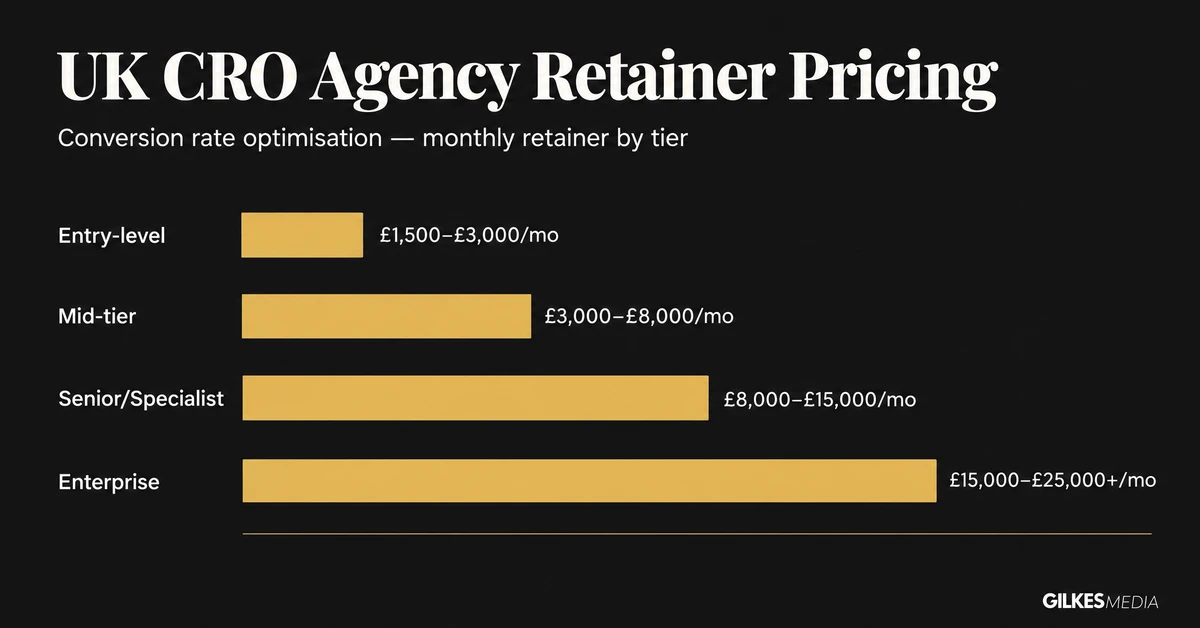
| Entry-level retainer | £1,500 – £3,000/month | 1–2 tests a month, basic reporting |
| Mid-tier retainer | £3,000 – £8,000/month | 4–8 tests a month, UX research, dedicated strategist |
| Senior/specialist retainer | £8,000 – £15,000/month | Full testing programme, personalisation, senior-led |
| Enterprise/multi-channel | £15,000 – £25,000+/month | Dedicated team, multi-channel testing, cross-functional work |
| Freelance/hourly | £50 – £200/hour | Ad hoc project or advisory work, London rates toward the top |
A separate, US-focused pricing guide from ClicksGeek (published April 2026) puts entry-level agency retainers at $2,000 to $5,000 a month, mid-tier at $5,000 to $15,000, and enterprise work above $15,000, with audits running $5,000 to $25,000.
Those dollar figures track closely with the UK sterling bands above once converted, which is a useful sanity check: if a quote you receive sits wildly outside either range, ask why before you sign anything.
One practical point worth asking about directly: whether the quote includes copywriting and design time for building test variants, or only the strategy and analysis. A programme that only plans tests without building them is half a service at full price.
Take two UK businesses on the same £4,000-a-month mid-tier retainer. One gets 150,000 monthly visitors to its checkout flow; the other gets 12,000 visitors to a single B2B contact form.
The first can realistically run six to eight tests a month and reach significance within days.
The second might need three to four weeks per test just to gather enough data, so the same monthly fee buys roughly a third of the testing volume.
This is why two agencies can quote wildly different prices for what sounds like the same scope: one may be pricing for your actual traffic reality, and the other may not have asked about it at all.
Before comparing agencies against each other, it is worth comparing the agency option against hiring someone in-house, because the real cost gap is often smaller than people assume once you add everything up.
Data from itjobswatch.co.uk, covering the six months to 5 October 2026, puts the median UK salary for a Conversion Rate Optimisation role at £42,500 a year (£41,250 outside London), with the middle half of earners sitting between £34,438 and £52,500.
That same data set recorded 163 live CRO vacancies nationally and 111 permanent job ads mentioning conversion rate optimisation over the preceding six months.
That is a genuinely thin specialist hiring market in the UK, not a role you fill quickly.
Take the £42,500 median salary. Under the 2026/27 rules, employer National Insurance runs at 15% above the £5,000 secondary threshold, adding roughly £5,625 a year on top of salary alone.
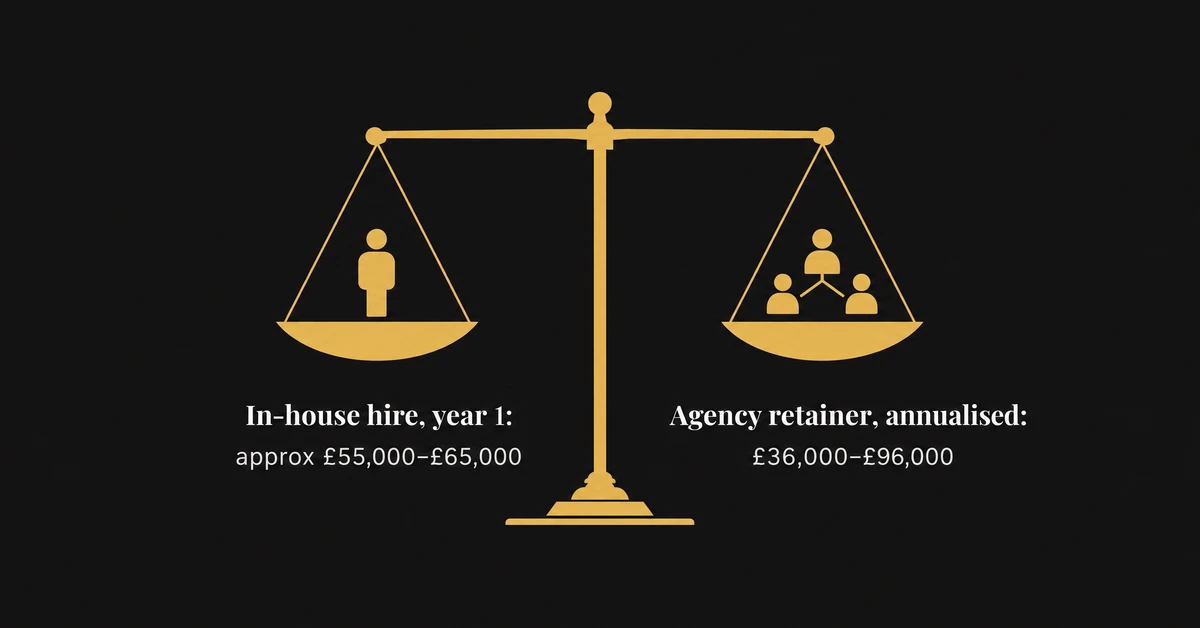
Add a testing platform licence, a heatmap/session recording tool, and the time cost of someone learning your specific site and audience from scratch, and a realistic fully-loaded first-year cost for one in-house CRO hire lands somewhere around £55,000 to £65,000.
Compare that against a mid-tier agency retainer of £3,000 to £8,000 a month (£36,000 to £96,000 a year), and the two options overlap more than either side of the debate usually admits.
A mid-tier CRO retainer and a single in-house hire cost roughly the same once National Insurance, tooling and ramp-up time are counted properly. The deciding factor is whether you need one specialist's time or a full multi-disciplinary team.
Accessibility rarely comes up in a CRO pitch, which is a missed opportunity, because an inaccessible site is quietly losing conversions from a meaningful share of your visitors before any test even begins.
The Click-Away Pound Survey, run by Freeney Williams with the Business Disability Forum, found UK businesses were losing £17.1 billion a year in online sales because disabled customers abandoned sites they found difficult to use.
The same research found 69% of disabled consumers click away from a difficult site rather than persevere, and only 8% ever tell the site owner why they left.
This survey dates to 2019 and no successor study has been run in any market since, so treat the exact figure as dated, though the underlying pattern is unlikely to have reversed.
A CRO partner who never raises accessibility, screen reader compatibility, colour contrast or keyboard navigation is leaving a real, measurable source of lost conversions completely unexamined. Ask whether accessibility auditing is part of their standard process, not an optional extra.
Once you have a shortlist and a rough budget, the actual vetting conversation is where most of the real signal lives. Group your questions into three areas: track record, process, and commercial terms.
These questions matter more than the pitch deck.
A provider who answers them specifically, with real numbers and real names, is a different proposition from one who talks in generalities about "data-driven growth".
For context on what good testing discipline should surface on your own site, see our guide to practical ways to improve your website conversion rate.
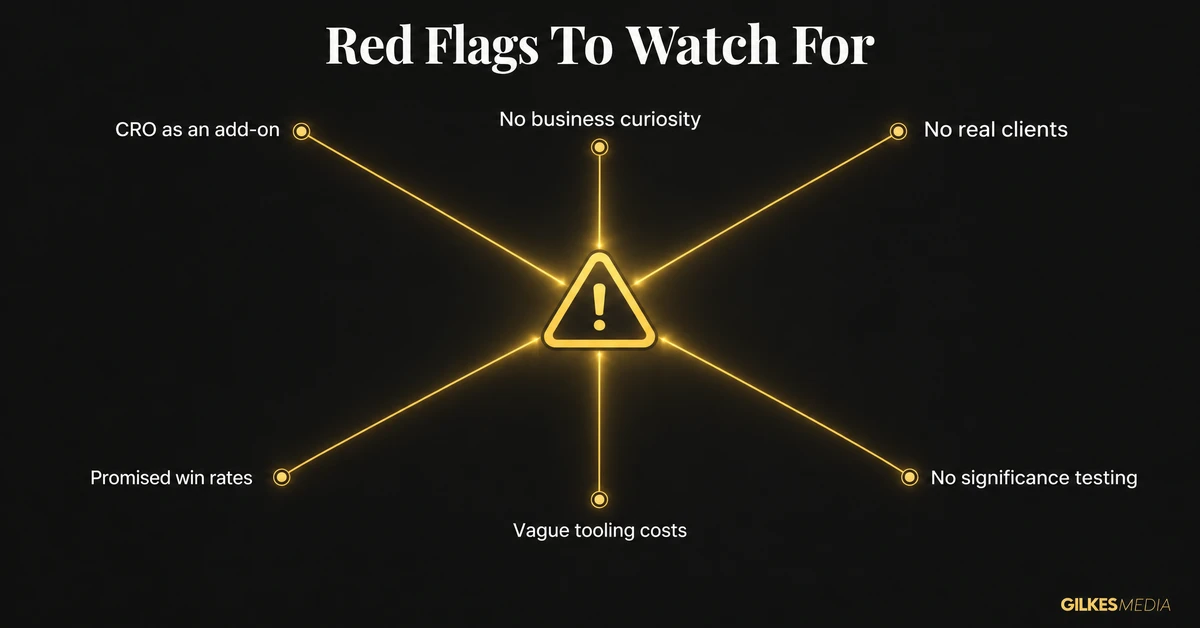
A handful of patterns show up again and again in CRO engagements that go badly. None of these are automatically disqualifying on their own, but two or more together are a strong signal to keep looking.
CRO treated as a bolt-on service, vague answers about statistical significance, and an inability to name a real client are the three most common red flags in a weak CRO pitch. Any two together are reason enough to keep looking.
Beyond the red flags on the agency side, a few mistakes on the buyer's side show up repeatedly and are worth guarding against before you even start talking to agencies.
Running a formal A/B testing programme on a page that gets 500 visitors a month is a waste of a retainer.
Below a certain traffic threshold, a heuristic audit and direct user research deliver far more value than formal split testing ever could.
Given the realistic 12% to 33% win rates covered earlier, a single losing test proves almost nothing, and a single winning test proves even less. Judge the relationship on a rolling pattern, not any one result.
Businesses that go straight to an agency pitch without first understanding their own current conversion rate, by channel and by page, cannot properly judge whether a proposed price or testing plan is proportionate to their situation.
CRO pricing varies more than most marketing services because scope definitions vary so widely. Get at least two or three comparable quotes against the same brief before deciding a number feels high or low.
This is the section most agencies skip in their own marketing, because the honest numbers are less exciting than the case studies. You deserve to know them before you sign a contract.
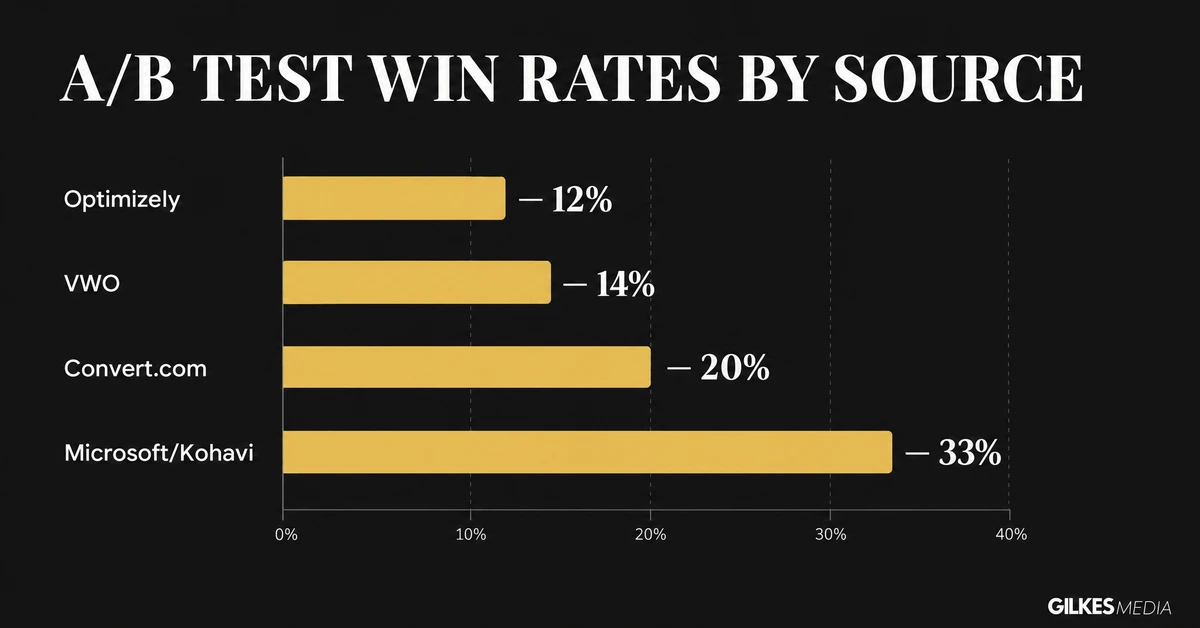
Independent, vendor-reported win rates for A/B tests vary by methodology, but they cluster in a consistent place: nowhere near the "most tests win" impression a lot of marketing copy creates.
Those figures measure slightly different things and are not directly comparable, but the pattern is consistent: a realistic testing programme wins somewhere between one test in ten and one test in three, not every time.
On impact, Optimizely's data shows an average 0.4% revenue lift per winning experiment. Compounded across a realistic annual testing cadence, that is a genuinely useful, unglamorous number, not the dramatic case-study headline you will see in sales decks.
A separate, much larger potential exists in specific high-friction areas.
The Baymard Institute's 2025 research on checkout design found up to 35.26% of revenue could theoretically be recovered through expert-identified checkout fixes.
That figure is a modelled potential from expert scoring, not an observed test result.
None of this means CRO does not work.
It means a good agency sets expectations around a steady compounding programme rather than one big win, and talks you through what a good conversion rate actually looks like for your specific business before promising anything.
Heatmap and session recording tools capture real visitor behaviour, which puts them squarely inside UK data protection law, not just a nice-to-have compliance checkbox.
The ICO published finalised guidance on "storage and access technologies" on 29 April 2026, replacing its older cookies guidance. It covers cookies, tracking pixels, device fingerprinting, web storage, scripts and tags, since PECR Regulation 6 is technology-neutral rather than cookie-specific.
The Data (Use and Access) Act added five new categories of storage or access technology that can be used without consent. The most relevant one for CRO work is the analytics exception, and it comes with real conditions attached.
Heatmap and session recording tools are not explicitly addressed in the guidance, but by its own logic they only qualify for the exception if they meet every one of those conditions.
In practice, most commercial heatmap tools need genuine consent, not a quiet assumption of it.
The stakes are not small.
Fines under PECR Regulation 6, now sitting alongside the Data (Use and Access) Act framework, can reach £17.5 million or 4% of global turnover.
A CRO partner who treats this as an afterthought is a direct business risk, not just a compliance nitpick.
Ask any shortlisted agency directly how they configure consent for tracking tools on client sites, and whether they can point to a live client implementation that handles it properly. A vague or irritated answer here tells you a lot.
A CRO agency that cannot explain how it handles UK cookie consent for heatmap and session recording tools under the ICO's 2026 guidance is exposing your business to real regulatory risk, not just running a sloppy process.
Agree your measurement framework before the first test goes live, not after three months when you are trying to work out whether the retainer is worth renewing.
Start from a realistic baseline for your own industry and channel mix, not a generic target pulled from somewhere else.
Our guide to what a good conversion rate actually looks like breaks this down by channel.
As a rough anchor across UK businesses, paid search typically converts at 3% to 10%+, organic search at 1% to 4%, email at 5% to 15%+, and paid social at 0.5% to 2%.
A good agency will also push permanent wins live quickly rather than leaving them running indefinitely as "tests", and will connect findings back to your wider site, including anything surfaced in a landing page design best practices review.
Judge a CRO partnership on a rolling 6 to 12 month view of tests shipped, win rate and revenue impact, not on any single test's result. One losing month proves nothing either way.
If CRO sits alongside a wider website rebuild or redesign, it is worth reading How to Choose a Web Design Agency in the UK alongside this guide, since the two decisions often overlap more than business owners expect.
If your site already covers the basics but testing has never been properly structured, the CRO tools actually worth paying for is worth a look first, since some lower-cost platforms may cover more than you think.
We run CRO as part of our wider website design and CRO work for UK businesses, built on the same testing discipline and UK-specific compliance approach covered in this guide.
If you want a second opinion on a quote you've received, or want to talk through where your site is likely leaking conversions, book a free discovery call and we will give you a straight answer either way.
Most UK CRO agencies charge £1,500 to £25,000+ a month depending on team seniority and testing volume, with one-off audits running £500 to £15,000 and freelance day rates of £50 to £200 an hour. A full breakdown is in our CRO Cost UK guide.
A web design agency builds or redesigns your site. A genuine CRO agency runs ongoing, hypothesis-led testing on an existing site using real visitor data, usually including A/B testing, UX research and copy testing rather than a one-off build.
A proper audit typically takes two to four weeks for a small site and six to eight weeks for a complex one. Meaningful testing results usually take a minimum of three to six months, since individual tests need enough traffic to reach statistical significance.
Published rates vary by methodology but cluster between roughly 12% and 33%, depending on how strictly "win" is defined and how experienced the team running the tests is. Anyone promising most or all of your tests will win is overselling.
It depends on volume and scope. A fully-loaded in-house hire in the UK typically costs £55,000 to £65,000 in year one, which overlaps with a mid-tier agency retainer. In-house suits businesses with enough traffic to keep one specialist genuinely busy; agencies suit those needing a wider mix of skills.
In most cases, yes. Under the ICO's 2026 guidance on storage and access technologies, these tools generally need genuine consent unless they meet narrow conditions limited to first-party, aggregate, non-identifying analytics with no secondary use.
Ask about their specific CRO track record (not just general marketing experience), how they define statistical significance, whether software licences are included in the price, who builds test variants, and how they handle UK cookie consent for tracking tools.
Treating CRO as an add-on to another service, proposing tests before understanding your business, being unable to name a real client, promising high win rates, and giving vague answers about statistical significance or tooling costs.
