
If you have been running Google Ads or Meta Ads for a while, YouTube is usually the next question. It reaches more UK adults than almost any other platform, and the ad formats look cheap on paper.
The real question is what it costs once you factor in the budget you actually need, the time it takes to manage properly, and whether it fits your sales cycle at all.
This guide sets out exactly what UK businesses are paying for YouTube ads in 2026: cost per view, cost per thousand impressions, cost per click, realistic minimum budgets, and what it costs to have someone manage it for you.
We have pulled together the most current UK-specific figures we could verify, flagged anywhere a number is global rather than UK, and worked through a few examples so the numbers mean something rather than sitting on a page as abstract ranges.
By the end you should know roughly what to budget, which ad formats suit your goal, and whether YouTube advertising is worth adding to your mix this year or something to revisit later.
YouTube ads run through the same auction system as the rest of Google Ads. You are not paying a fixed rate card; you are bidding against other advertisers for the same audience.
The price moves with demand, competition and how relevant your ad is judged to be.
What changes between formats is how you get charged. Some formats bill you per view, some per thousand impressions, and some per click.
Picking the wrong charging model for your goal is one of the fastest ways to waste a YouTube budget, so it is worth understanding each one before you look at the numbers.
These are the ads that play before, during or after another video, with a "Skip Ad" button appearing after five seconds.
You are charged on a cost-per-view (CPV) basis: Google only bills you if someone watches 30 seconds, watches the whole ad if it is shorter than 30 seconds, or interacts with it (clicking through, for example).
This is the most commonly used YouTube ad format for UK small and mid-sized businesses, because you only pay for genuine attention rather than every impression. It suits awareness and consideration campaigns well.
Fixed-length ads, usually 15 to 20 seconds, that the viewer cannot skip. These are billed on a cost-per-thousand-impressions (CPM) basis, so you pay for the guaranteed view regardless of how engaged the viewer is.
They cost more per impression than skippable formats, which makes sense: you are buying certainty of a full view, not just the chance of one. This format works best for short, high-impact brand messages rather than anything that needs explaining.
Six-second, non-skippable ads, also billed on CPM. Bumpers are built for frequency and reach rather than storytelling: a short, memorable message shown to a lot of people, often alongside a longer campaign rather than on its own.
They tend to be the cheapest format per impression, which makes them a reasonable way to build frequency against an audience you are already targeting with other formats.
These appear in YouTube search results, on the YouTube homepage, and alongside related videos, styled like a video thumbnail with a headline. You are charged on a cost-per-click (CPC) basis when someone clicks through to watch.
Because the viewer is choosing to click rather than having the ad interrupt them, in-feed ads tend to attract a more intent-driven audience. They suit businesses that already have strong, clickable thumbnails and titles.
Shown between Shorts in the vertical, swipeable feed, these are billed on an impression basis similar to bumper and non-skippable ads.
Shorts inventory is newer and the competitive landscape is still settling, so UK-specific benchmark data is thinner here than for the established formats.
If your audience skews younger or you already have short-form creative from TikTok or Instagram Reels, Shorts ads are worth testing, but budget for more experimentation and less certainty than the longer-established formats.
Every YouTube ad format charges differently: skippable in-stream pays per genuine view, non-skippable and bumper pay per guaranteed impression, and in-feed pays per click. Picking the right one for your goal matters more than the headline price.
Published UK-specific YouTube ad cost data is harder to find than for Google Search or Meta, because fewer UK agencies report their own aggregate numbers publicly.
The clearest UK figures we found come from aggregated UK advertiser account data published by digital marketing agency Cloudswitched in May 2026.
We have used this as the primary UK benchmark below, cross-checked against global cost ranges from other sources where UK data was not available.
Cloudswitched's UK data puts the average cost per view for skippable in-stream ads at around £0.04, with a typical range of £0.02 to £0.08 depending on targeting and competition.
That is broadly consistent with global CPV ranges reported elsewhere, which sit between roughly $0.01 and $0.20 depending on how competitive the audience is.
| Ad format | Charging model | Typical UK cost | Best used for |
|---|---|---|---|
| Skippable in-stream | Cost per view (CPV) | £0.02–£0.08 (avg. ~£0.04) | Awareness and consideration |
| Non-skippable in-stream (15–20s) | Cost per 1,000 impressions (CPM) | £6–£15 | Guaranteed full-view brand messages |
| Bumper (6s) | Cost per 1,000 impressions (CPM) | £4–£10 | Frequency and reach |
| In-feed / Discovery | Cost per click (CPC) | £0.10–£0.30 | Intent-driven, clickable content |
| YouTube Shorts | Cost per 1,000 impressions (CPM) | ~£2.40–£6.40 (global estimate) | Short-form reach, younger audiences |
| Google Search ads (for comparison) | Cost per click (CPC) | £1–£8+ | Bottom-of-funnel, high purchase intent |
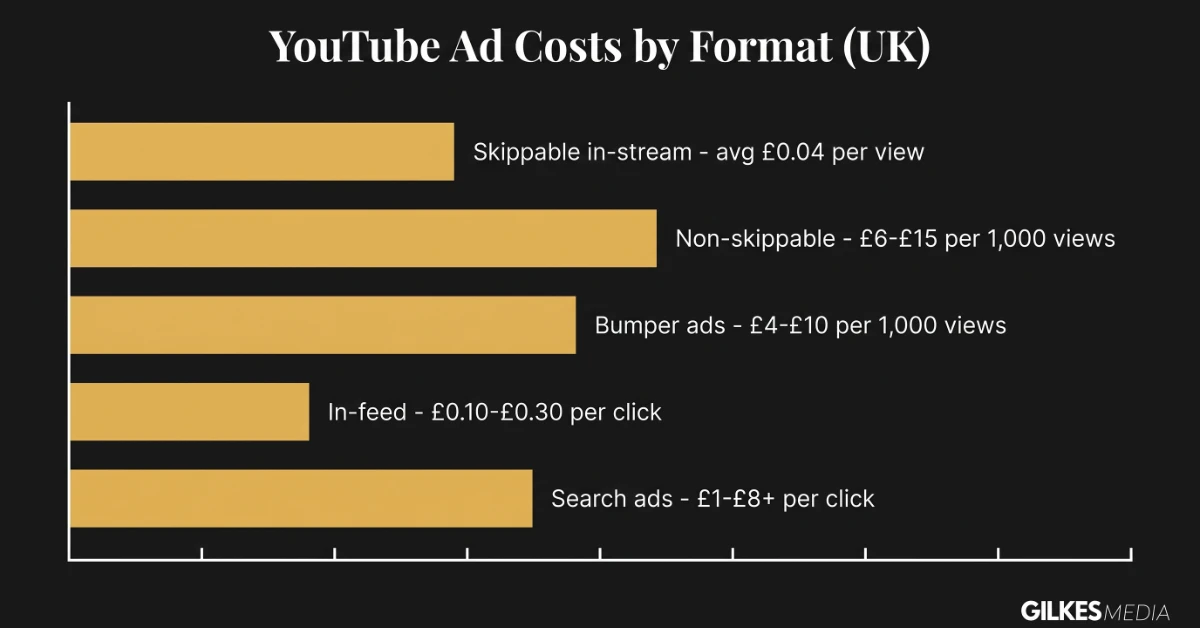
The comparison with Search is worth sitting with for a moment. If you are used to paying several pounds per click on Google Search, a £0.04 cost per genuine YouTube view looks almost too good to be true.
It is not a fair like-for-like comparison, though: a Search click comes from someone actively looking for what you sell, while a YouTube view comes from someone who was watching something else and did not skip your ad.
A worked example makes this concrete. At a £3 average Search CPC, a £3,000 monthly budget buys around 1,000 clicks from people actively searching.
At a £0.04 average YouTube CPV, the same £3,000 buys roughly 75,000 views. You are reaching far more people for the same spend, but a far smaller share of them are ready to buy right now.
A typical UK YouTube campaign averages around £0.04 per genuine view, against £1 to £8 or more per click on Google Search. You reach far more people for the same spend, but fewer of them are ready to buy today.
The ranges above move a lot in practice, and six factors explain most of the difference between a cheap campaign and an expensive one.
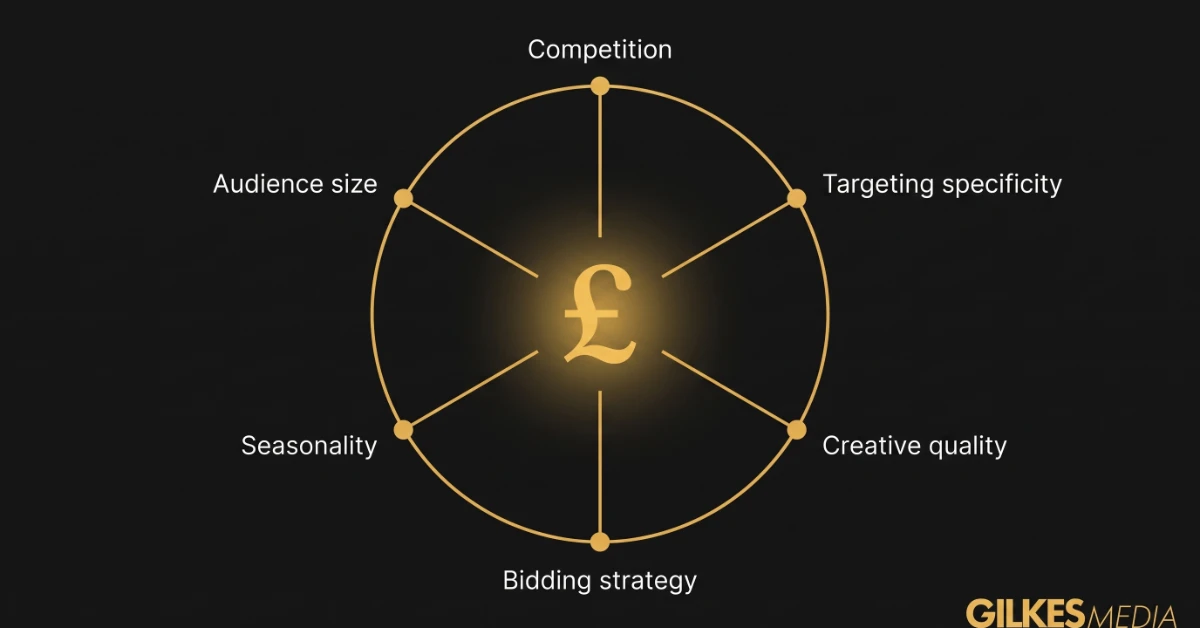
None of these factors are unique to YouTube. They are the same auction dynamics that drive Google Search and Meta Ads costs.
What is different is how much weight creative quality carries on YouTube specifically, because your charge depends directly on whether people choose to keep watching.
Six things move YouTube ad costs: audience competition, targeting specificity, creative quality, bidding strategy, seasonality and audience size. Strong creative is the one lever you fully control, and it is often the cheapest way to bring your average cost down.
We have already written a direct comparison of Google Ads, Meta, LinkedIn and TikTok for UK businesses deciding where to put their budget first. YouTube sits alongside that decision rather than replacing it, because it does a different job in the funnel.
Search captures demand that already exists: someone typing a query is close to a decision. YouTube creates demand by putting your business in front of people who were not looking for you yet.
Most UK businesses get more from Search first and add YouTube once Search is performing well, rather than the other way round.
Meta and TikTok ads run on broadly similar impression-and-engagement economics to YouTube, and our own Meta Ads Cost UK and TikTok Ads Cost UK articles cover their specific ranges.
The honest answer on which is cheapest changes month to month as competition shifts between platforms.
The bigger difference is audience and format fit: YouTube suits longer-form storytelling and product demonstration in a way a six-second TikTok clip does not.
LinkedIn is far more expensive per click or impression than YouTube, reflecting how narrow and valuable its B2B audience is.
YouTube can still work for B2B brand awareness at a fraction of the cost, but it will not match LinkedIn for reaching a specific job title at a specific company.
In practice, most of the UK businesses we work with treat YouTube as a reach-and-frequency layer that sits underneath a more targeted platform, rather than a replacement for it.
Google does not enforce a published minimum spend for YouTube campaigns, but a budget that is too small will not generate enough data for the auction to learn who to show your ad to.
You will end up paying over the odds for the little data you do get.
A realistic starting point for a UK business testing YouTube ads for the first time is £500 to £1,000 a month, run for at least four to six weeks before judging results.
That is broadly consistent with the test-budget guidance UK agencies give their own clients, and it mirrors the minimum spend thresholds we recommend for Google Search campaigns in our Google Ads Cost UK guide.
If you plan to use Google's automated Smart Bidding strategies rather than manual CPV bidding, you need enough volume for the algorithm to learn from: roughly 30 or more conversions a month is the usual rule of thumb.
In a typical UK lead-generation account that works out to somewhere around £4,000 a month of spend, depending on your conversion rate and average cost per action.
Treat the first month as a learning budget rather than a results budget. The businesses that give up on YouTube after two weeks are usually judging a campaign that never had enough data to optimise properly.
Say you run £1,000 a month at the UK average CPV of £0.04. That buys roughly 25,000 views. If 2% of viewers click through to your site, you get around 500 visits.
At a typical landing page conversion rate of 3% to 5% for a cold, top-of-funnel audience, that works out to 15 to 25 leads a month, putting your cost per lead somewhere between £40 and £67.
That is not a cheap lead by search standards, but it is a reasonable price for reaching people who were not actively looking for you yet.
The number improves as your creative and targeting improve, and gets worse if you launch with a weak hook or audience that is too broad.
The ad spend is only part of the cost. Someone also has to build the campaign, write and brief the creative, monitor it, and adjust it as the data comes in.
That work costs money whether you do it yourself, hire someone, or pay an agency.
Running YouTube ads yourself costs nothing beyond your ad spend and your own time, and the Google Ads interface is accessible enough for a motivated business owner to learn the basics.
The risk is less about the platform being hard to use and more about wasted spend while you learn what good targeting and creative actually look like.
A UK PPC or paid media manager carries a median salary of around £45,000 a year outside London, based on itjobswatch.co.uk's live UK salary data for the six months to October 2026, with a typical range of roughly £40,300 to £47,000.
Add the 2026/27 employer National Insurance rate of 15% on earnings above the £5,000 secondary threshold. The fully loaded cost of one in-house hire comes to roughly £51,000 a year.
That is around £4,250 a month, before you have spent a single pound on media.
That fixed cost only makes sense once your total paid media spend across all platforms is large enough to justify a dedicated person.
For most UK SMEs that means YouTube is one part of a wider in-house paid media role rather than a standalone hire.
YouTube campaigns run through the same Google Ads account structure as Search campaigns, so UK agency pricing for YouTube management tends to follow the same bands we cover in our guide to choosing a PPC agency.
Flat monthly retainers run from roughly £300 up to £10,000 or more depending on agency size and scope, with a UK average retainer around £1,040 a month. A percentage-of-spend model is typically 10% to 20% instead.
Expect a one-off setup fee of £500 to £2,500 for a brand-new YouTube campaign build, which some agencies waive on a longer contract.
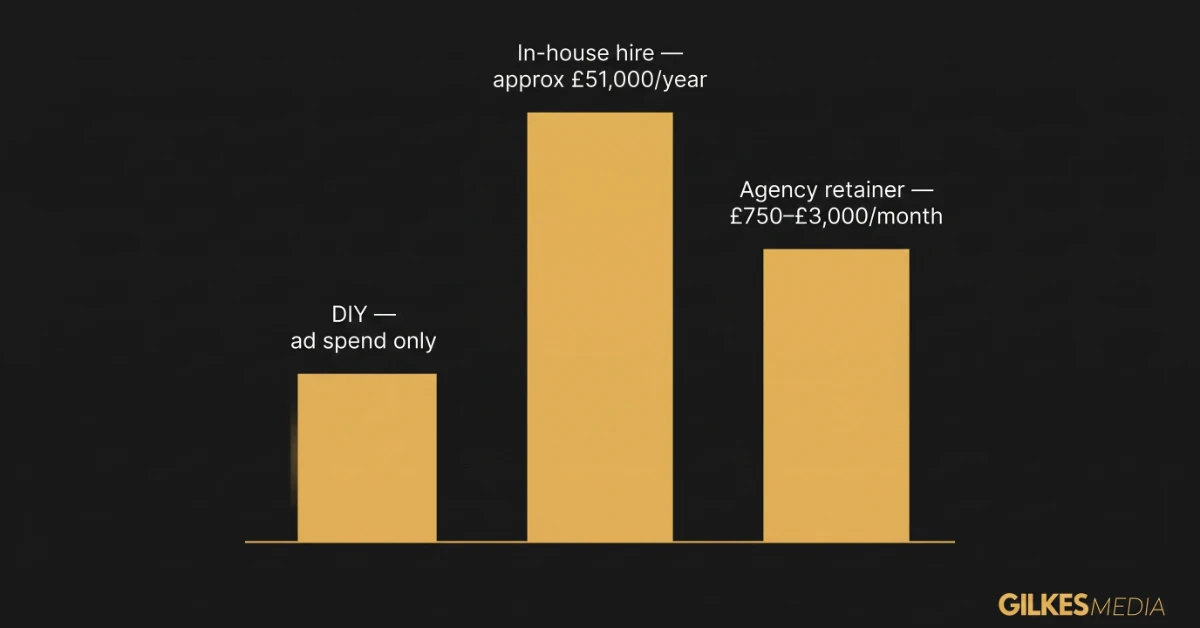
For most UK small businesses testing YouTube for the first time, a flat retainer at the lower end of that range is the most sensible way to get a fair test without committing to a full-time hire.
That retainer should cover campaign build, creative briefing and weekly optimisation as a minimum.
An in-house paid media hire costs roughly £51,000 a year fully loaded before any ad spend. A YouTube-focused agency retainer typically starts far lower, which is why most UK SMEs testing the platform for the first time go to an agency before they go to a hire.
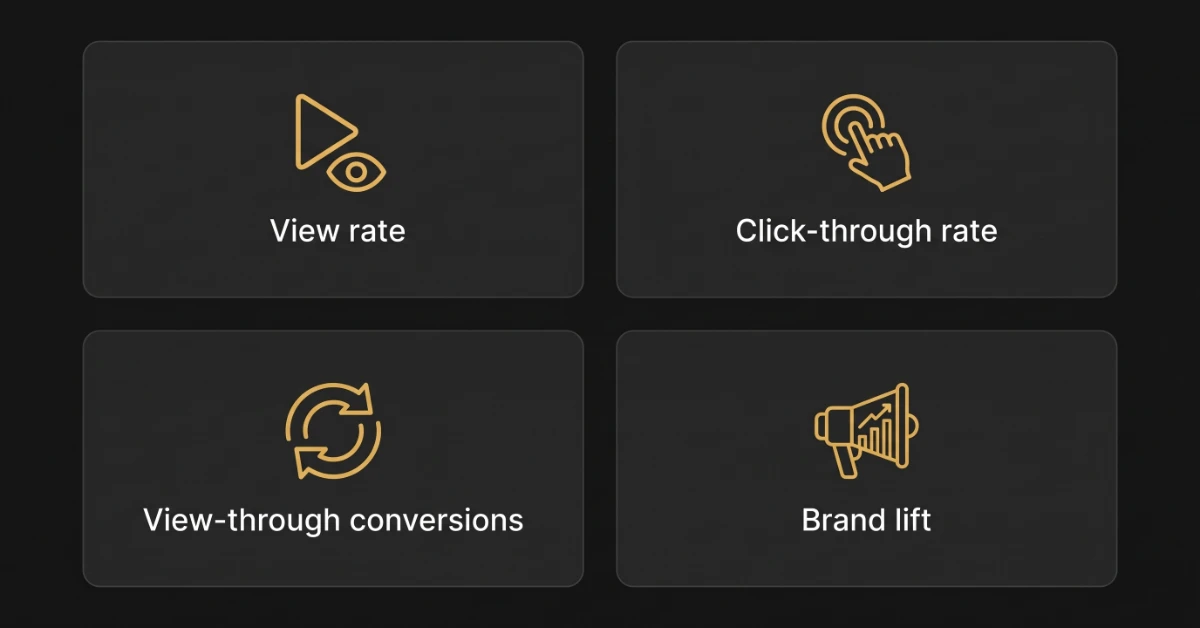
Ad spend and leads are not the only numbers worth watching. YouTube's own metrics tell you whether your creative and targeting are working before conversion data has had time to build up.
That matters when you are deciding whether to keep a campaign running past the first few weeks.
View rate is the percentage of people who watched your ad all the way through rather than skipping it. A strong skippable in-stream ad typically holds a view rate of 15% to 30%, depending on the audience and category.
If yours sits well below that, your hook needs work before you spend more on targeting fixes.
For in-feed and Discovery ads, click-through rate is your primary efficiency signal, since you are only charged when someone clicks. A thumbnail and headline that do not earn clicks will sit unseen in the auction regardless of how well-targeted the audience is.
Google Ads reports view-through conversions separately from click-through conversions, which matters because YouTube's job is often to influence a later purchase rather than close one directly.
Google's own research shows people exposed to a YouTube ad are around twice as likely to convert on a subsequent search. Judging YouTube purely on its own last-click conversions understates what it is actually doing for your pipeline.
For larger budgets, Google offers brand lift studies that survey a sample of viewers who saw your ad against a control group who did not, measuring shifts in awareness, consideration or purchase intent directly.
These are usually only available once your campaign is spending enough to generate a statistically meaningful sample, so they suit an established campaign rather than an initial test.
View rate and view-through conversions matter as much as last-click conversions, because YouTube's real job is often influencing a later search or purchase rather than closing one on the spot.
We see the same handful of mistakes repeatedly when UK businesses try YouTube ads without proper guidance, and each one inflates the effective cost per result without the business necessarily realising why.
YouTube ads work well for businesses that need to build awareness or explain something that takes more than a few seconds: considered purchases, services with a longer sales cycle, or products that benefit from being seen in use.
It is less well suited to businesses chasing an immediate transaction with a short consideration window, where Search or Meta's direct-response formats usually outperform it pound for pound.
Scale matters too. Ofcom's Media Nations 2025 report found UK adults spend an average of 39 minutes a day watching YouTube, with 16 of those minutes on a TV set rather than a phone or laptop.
That makes YouTube the second most-watched service in the UK, behind the BBC and ahead of ITV. Over-55s now account for 42% of that TV-set viewing, up from 33% the year before.
That tells you the platform's reach has genuinely broadened beyond a younger demographic, which is a reason to take YouTube seriously, not a reason to assume it will work for every business.
If your product or service needs demonstrating, benefits from storytelling, or sells to a broad consumer audience, it is worth testing properly.
If you sell a narrow B2B service to a handful of named accounts, your budget is usually better spent on LinkedIn or targeted Search.
YouTube reaches more UK adults, for longer, than almost any other platform, including a fast-growing over-55 audience now watching on TV sets. That makes it worth testing for most businesses, but it still suits awareness and consideration goals far better than an immediate sale.
If you decide to go ahead, the biggest single lever on your cost per result is creative, not targeting or bidding strategy.
A YouTube ad that earns its first five seconds costs less per view than one that gets skipped, because the auction itself rewards ads people choose to keep watching.
Start with a realistic test budget, track conversions properly from day one, and give the campaign enough time to learn before judging it.
Most of the expensive mistakes above come from skipping one of those three basics under pressure to show results quickly.
If you would rather have someone who already knows the current UK benchmarks handle the setup and targeting, that is exactly the kind of work our paid ads management team does.
We manage campaigns for clients across Google, Meta, LinkedIn and TikTok as well as YouTube.
You can get in touch via our contact page for a free, no-obligation discovery call to talk through whether YouTube fits your budget and your goals this year.
Skippable in-stream ads, the most common format, average around £0.04 per view in the UK, with a typical range of £0.02 to £0.08. Non-skippable and bumper ads are billed per 1,000 impressions, typically £4 to £15.
In-feed ads cost £0.10 to £0.30 per click.
A realistic starting test budget is £500 to £1,000 a month, run for at least four to six weeks.
If you plan to use Google's automated Smart Bidding strategies, you typically need enough volume for around 30 conversions a month, which for most UK accounts means closer to £4,000 a month.
Cost-per-view bidding on skippable in-stream ads is the most forgiving starting point, because you only pay for genuine attention rather than every impression. CPM bidding on bumper or non-skippable formats suits campaigns focused on guaranteed reach and frequency rather than engagement.
Because YouTube campaigns run through the same Google Ads account as Search, UK agency pricing tends to follow similar bands: flat retainers from around £300 to £10,000 or more a month, or a percentage-of-spend model between 10% and 20%.
Expect a one-off setup fee of £500 to £2,500 for a new campaign build.
Per view, yes: YouTube's roughly £0.04 average cost per view is far lower than Search's £1 to £8-plus cost per click.
The comparison is not quite fair, though, because a Search click comes from someone already looking for what you sell, while a YouTube view comes from someone who was watching something else.
Yes. Google Ads lets you restrict YouTube campaigns by country, region, city or even a radius around a specific location, the same geographic targeting available on Google Search and Display campaigns.
Give a new campaign at least four to six weeks before judging results. The auction needs time and data to learn who to show your ad to.
Campaigns judged after a few days rarely reflect the cost per result they would settle at with proper time to optimise.
It depends on your sales cycle and product. YouTube suits businesses with something worth demonstrating or explaining, or a longer consideration window, better than it suits an immediate, low-consideration sale, where Search or Meta's direct-response formats usually perform better pound for pound.
