Three quotes for the same brief can land anywhere between £1,500 and £30,000. That gap isn't one supplier padding their price and another cutting corners. It usually means the businesses asking for quotes haven't worked out what they actually need first. As a result, they end up comparing three completely different products that happen to share the word "video".
Gilkes Media isn't a video production company. We're a marketing consultancy that sits next to a lot of businesses while they make exactly this decision. We then have to make the resulting video actually work inside a wider campaign - on a landing page, in a paid ad, in an email sequence.
We've seen good briefs land with the wrong supplier and go to waste. We've also seen modest budgets turn into videos that outperformed ones costing five times as much. This guide is what we tell clients before they sign anything.
It covers the three real routes to getting a video made: in-house, freelancer, and agency. It also covers what separates a production company worth paying for from one that isn't, plus realistic UK pricing for 2026. Finally, it sets out the red flags that should end a conversation early, and a step-by-step way to vet anyone you're considering. If you want the cost breakdown in more depth, read this guide first. Once you have, we've covered that separately in our UK video production pricing guide.
A brief tells a production company what you want. It doesn't tell them how to get a nervous founder to talk naturally on camera, or how to structure a 90-second product video so the first three seconds earn the next twelve. What it also can't tell them is when a script needs junking, because it reads well but nobody would ever say it out loud.
That judgement is the actual product you're buying, and it's almost impossible to assess from a deck of previous work alone.
Wyzowl's 2026 video marketing survey found that 91% of businesses now use video as a marketing tool, and 93% consider it an important part of their strategy. As a result, the competitive bar for "good enough" video has moved a long way in a few years.
A generic talking-head clip with stock music doesn't just fail to stand out. It actively signals that a business didn't take the format seriously, and that's worse than not having a video at all.
The cost of getting the partner wrong isn't just the invoice. It's the weeks lost waiting for a first cut that misses the brief. It's also the internal time spent explaining the business to someone who never quite understood it.
Worse still is the video that ends up quietly retired because nobody wants to put it in front of a client. Money is the easiest cost to see and usually the smallest one.
We've seen it play out both ways with the same budget. One UK manufacturing client paid a mid-range agency fee for a product launch film and got a genuinely usable asset. That's because the team asked hard questions about the audience before writing a single word of script.
Another business worked with a cheaper freelancer who skipped that stage entirely. They ended up with a technically well-shot video that nobody on the sales team wanted to send to a prospect, because it explained the product to the wrong person. The spend was roughly the same, but the outcome was completely different - and the difference wasn't the camera.
The brief is what you want. The partner's judgement is what actually gets made - and that's the part no showreel fully proves before you've paid for it.
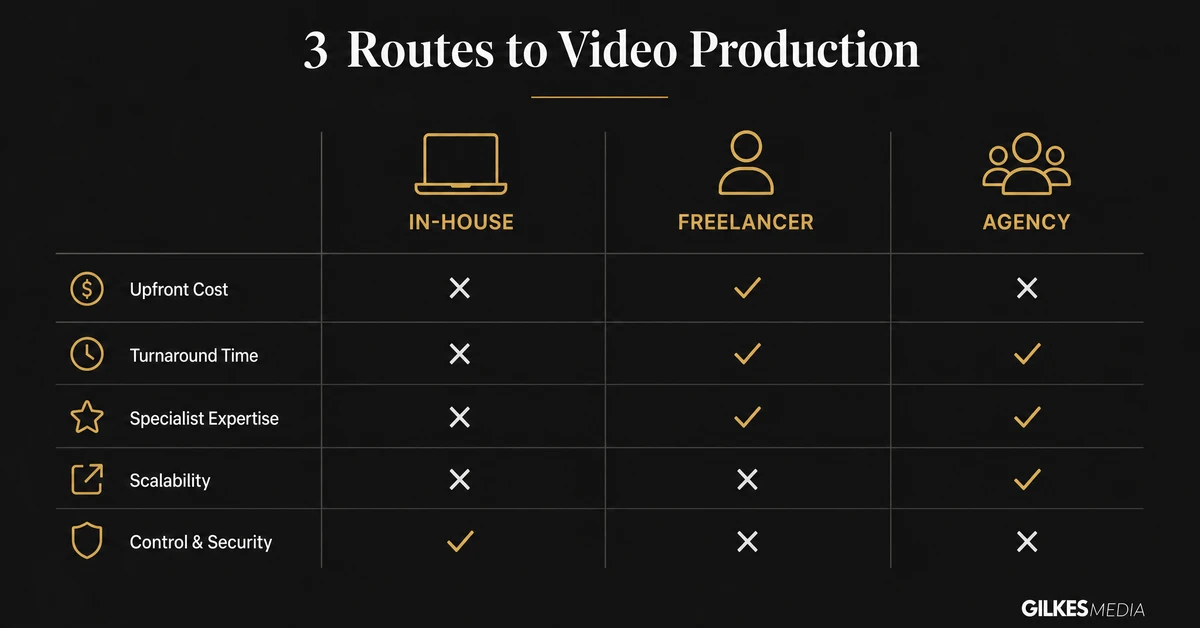
There are three routes to a finished video. The right one depends on frequency, complexity, and how much you already have in-house, not on budget alone. Getting this choice wrong is the single most common reason a video project underdelivers.
Building video capability internally makes sense when you need a steady stream of content: weekly social clips, regular product updates, founder-led thought leadership. It also makes sense when someone on the team already has a genuine eye for it. Wyzowl's 2026 data shows 59% of businesses now produce at least some video in-house. That tells you it's a mainstream option, not a fallback for businesses that can't afford better.
The catch is that equipment, software, and time all cost real money, even when nobody's invoicing you for them. The learning curve on lighting, sound and editing is also steeper than it looks from the outside. A founder shooting on a phone in a spare room can work brilliantly for authentic, low-fi content. It rarely works for anything that needs to look like a considered investment.
A single experienced freelancer, or a small collective who work together regularly, is usually the sharpest option for a well-defined single project. Examples include one strong brand video, a set of testimonial clips, or a product launch piece. You get direct access to the person actually doing the work, plus day rates well below agency overheads. If you pick well, you also get genuine craft.
The risk sits in capacity and range. One person can't be simultaneously excellent at directing, shooting, sound, motion graphics and colour grading. That's why most freelancers specialise and sub-contract the rest, which means you're still managing a small team. You just don't get the project management that would normally come with it.
A production agency earns its premium by owning the whole process: strategy, scripting, a full crew, and post-production. Crucially, someone is accountable for the final result, rather than just their own piece of it. That's worth paying for on anything with real complexity: multiple locations, a tight external deadline, or several stakeholders who all need to sign off. It's also worth it for a video that has to work across several different channels at once.
The trade-off is cost and, sometimes, distance from the actual craftspeople. You're often briefing an account manager rather than the director or editor. A good agency closes that gap by keeping you close to the creative team throughout. A poor one, though, turns every note into a game of telephone.
| Route | Best for | Typical UK cost | Main risk |
|---|---|---|---|
| In-house | Frequent, ongoing content with an in-house eye for it | Equipment + time, no day rate | Looks amateur if rushed or under-skilled |
| Freelancer / small collective | One well-defined project, tighter budgets | £500-£1,500/day for the lead | Limited capacity, you manage the gaps |
| Agency | Complex, multi-stakeholder or multi-channel projects | £2,000-£30,000+ per project | Higher cost, risk of account-manager distance |
None of these routes is inherently better. A £30,000 agency campaign is the wrong answer for a single internal training video. Equally, a founder's iPhone is the wrong answer for a product launch aimed at enterprise buyers. The job is matching the route to what the video actually has to do.
"We need a video" isn't a brief. It's five or six genuinely different projects wearing the same word. Each type below carries its own realistic cost band, crew requirement and turnaround. Knowing which one you're actually asking for changes who you should hire, before you've even started comparing quotes.
A single customer talking through their experience, filmed on location or in a simple studio set-up, is one of the most cost-effective formats available. It's also often one of the highest-converting: 83% of consumers say they've purchased after watching a brand video, according to Animoto's data. A skilled freelancer with a single camera operator can usually deliver this well for £500-£2,000. Turnaround is typically one to two weeks once filming is done.
These need a clear script, usually some screen capture or product footage, and often light motion graphics to walk through a feature or process. Expect a mid-tier crew and a heavier post-production stage. Most projects land in the £3,000-£8,000 range, with a three to four week turnaround. That's because the script has to be right before anyone films anything.
A considered piece designed to carry your brand story is where pre-production discipline earns its keep. Think of the kind of film that sits on a homepage or opens a pitch. Real examples in this category run around £9,500. Expect a full mid-tier crew, professional talent in many cases, and a four to six week process from first conversation to delivery.
Built for platforms where 65% of viewers won't make it past the first minute, this format prizes a strong opening few seconds over production polish. It can be shot quickly, often in-house or with a single freelancer, and costs can stay low. However, the scripting and editing discipline needed to earn attention in a crowded feed is its own specialist skill. It isn't a lesser version of longer-form work.
This is the most complex and expensive category. It involves several shoot days, possibly multiple locations, a full crew, and heavy post-production. Real examples run to £27,500 or more, and this is squarely agency territory. The coordination alone - call sheets, travel, multiple stakeholders reviewing cuts - needs project management that most freelancers aren't set up to provide.
Anyone can own a camera that shoots in 4K. The difference between a production company worth your budget and one that isn't shows up long before anyone presses record. It shows up again, too, after the crew has gone home.
UK pricing data puts pre-production at roughly 15-25% of a typical project's total budget. That proportion is a good sign, not a waste. A company that wants to jump straight to a shoot date without a proper script, shot list, and shared understanding of the goal is optimising for their calendar. It isn't optimising for your result.
Ask to see a shot list or storyboard from a past project before you commit - a company with real process will have one to show you.
Most buyers watch a showreel for whether it looks polished, which is the least useful question to ask of it. Better questions: does anything on it sound like a real person rather than a read script? Is there variety in pacing and structure, or does every video follow an identical template regardless of the brand?
And can they tell you, unprompted, what each clip was actually trying to achieve for that client. A company that only remembers how a video looked, not what it was for, probably approached your project the same way.
What crew size and equipment you actually need scales with ambition, not with how impressive the quote sounds. A single skilled camera operator at £500-£1,500 a day can produce something excellent for a simple set-up. By contrast, a full broadcast crew at £3,000-£8,000+ a day only earns its cost on complex, multi-camera, multi-location work. Good production companies size the crew to the brief. Less scrupulous ones size it to your budget instead.
For anything graphics-heavy - motion graphics, data visualisation, animated explainer sequences - post-production can eat 40-50% of the entire budget. It's also the stage clients most often underestimate when comparing quotes. A quote that looks cheap, because it's compressed the edit into a couple of days, usually shows in the final cut. The signs are clumsy pacing, unfixed audio issues, and graphics that feel bolted on rather than designed in.
A rushed pre-production stage and a rushed post-production stage produce the same symptom on screen: a video that technically exists but doesn't quite work. The reasons, though, are very different.
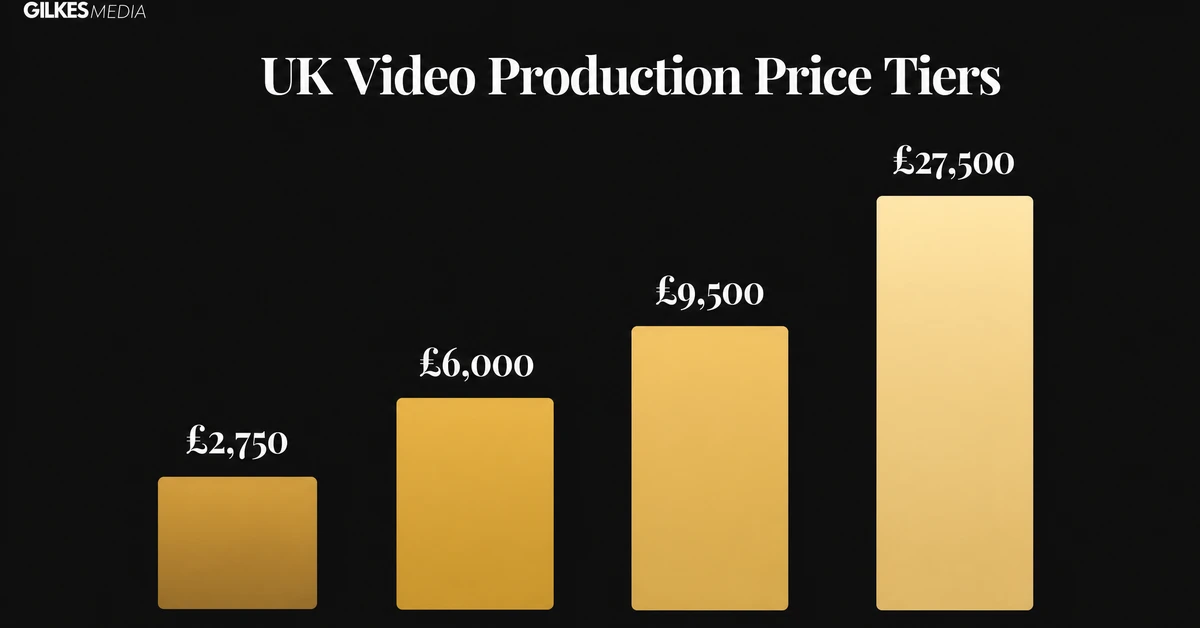
Wide price ranges aren't evasiveness - they reflect genuinely different products. A standard 2-3 minute online corporate video typically runs £2,000-£6,000 in the UK. Inside that band, a straightforward internal training video tends to land around £2,750. A proper brand narrative film, with a bigger creative lift, sits closer to £9,500. A full product launch video, with multiple locations and heavier post-production, can reach £27,500 or more.
Several factors reliably push a quote up or down, and it's worth knowing them before you're sat across from a salesperson:
The other pattern worth knowing: 63% of video producers reported using AI tools somewhere in their creation or editing workflow, in Wyzowl's 2026 survey. That's not a red flag by itself. AI-assisted rough cuts, transcription, and some motion graphics work are now genuinely mainstream. Even so, it's worth asking directly where AI is used in your project, and where a human is still making the creative calls. This matters particularly on anything customer-facing, where accuracy counts.
Here's the ordered version of how to actually budget a project, rather than guess at a number and hope:
Most bad hires were avoidable in hindsight. These are the signals that should make you pause, or walk away, before any money changes hands.

A video that isn't built for where it's going to live is a video that underperforms, regardless of production quality. Vidyard's analysis of over 943,000 videos found that 65% of viewers finish anything under a minute, while only 20% finish videos running over twenty minutes. That means a five-minute brand film, cut down for a six-second pre-roll ad, is usually the wrong asset in the wrong place. It isn't a cost-saving shortcut.
Distribution matters as much as production. Wistia's data shows company websites remain the top distribution channel at 67%, followed by email at 49%, LinkedIn at 43%, and YouTube at 40%. A video with no plan for where it will actually be watched, in other words, is only half a strategy.
We've written separately about getting video content itself found in search, in our guide to video SEO. We've also written about why video specifically outperforms text for B2B audiences, in our B2B video marketing piece.
83% of businesses in Wyzowl's 2026 survey reported that video directly increased sales, and 82% said it delivered good return on investment. HubSpot's 2026 data adds useful nuance: 49% of marketers credit short-form video specifically with delivering their best ROI, against 29% for long-form. That's a real argument for a shorter, sharper hero video over one long film trying to do everything at once, if budget forces a choice between the two.
The best production company in the country can't rescue a video that was never built for the channel it ends up living on. Decide where it's going before you decide who makes it.
Once you've got two or three companies or freelancers you're seriously considering, run each of them through the same process rather than judging on gut feel alone.
If a company won't happily walk through all six of these before you've signed anything, that reluctance is itself useful information.
Vetting works both ways. A production company can only protect your budget and your timeline if you turn up prepared. The businesses who get the best results are usually the ones who've done a bit of homework before the first call. They don't expect the supplier to extract a brief from scratch.
"Professional but approachable" means something different to every person who reads it. Two or three existing videos you like - even from completely different industries - give a production company far more to work with. Add a note on what specifically works about each one, and you'll get much further than a mood board of adjectives.
Three stakeholders sending three separate rounds of conflicting notes on the same cut is the single most common cause of a project running over both budget and schedule. Agree internally who has final sign-off before the first cut arrives, not after everyone's seen it.
If the video needs a founder, a customer, or specific staff members on camera, confirm their actual availability before a shoot date is booked. A rescheduled shoot day rarely just moves. It usually costs money, since crew and studio time are booked and paid for, whether or not filming happens.
Build in time for at least one full revision round beyond the production company's quoted turnaround, particularly if the video is tied to an external launch date. A quote of "three weeks" from a supplier who's never seen your internal approval process is an estimate of their work. It isn't a guarantee of yours.
A standard 2-3 minute online corporate video typically costs £2,000-£6,000 in the UK, with a straightforward internal or training video often landing around £2,750. Location, crew size, and how graphics-heavy the post-production is are the main things that move a project up or down within that range.
For one well-defined project - a single brand video or a set of testimonial clips - an experienced freelancer or small collective is usually the sharper choice on cost and directness. For anything with multiple stakeholders, several locations, or a tight external deadline, an agency's project management earns its higher price.
A proper quote should break out pre-production (script, shot list, planning), the production day itself (crew, equipment, studio if needed), and post-production (editing, graphics, sound, colour grading) as separate line items, plus a clear statement of how many revision rounds are included and what happens after that.
This should be spelt out in the contract before you sign, not assumed. Get written confirmation that you own the finished deliverables outright, and check separately whether raw, unedited footage is included or held back - and for how long any music or talent usage rights actually last.
63% of video producers already use AI tools somewhere in their workflow, usually for rough cuts, transcription or some motion graphics - not as a full replacement for a human creative team. For anything customer-facing where tone, accuracy and brand fit matter, a production company using AI to speed up parts of the process is a reasonable middle ground; fully AI-generated video is still a much rougher, less reliable substitute for a properly briefed shoot.
A simple testimonial or social clip can be turned around in one to two weeks. An explainer or product demo typically needs three to four weeks once the script is signed off. A full brand narrative film or multi-location project usually runs four to six weeks or more, mostly because pre-production planning and stakeholder approval take longer than the shoot itself.
Sometimes, but rarely without editing. A five-minute brand film and a six-second pre-roll ad need different pacing, aspect ratios and opening hooks, and Vidyard's viewing data shows why - most viewers won't get past the first minute of anything, so a long-form video simply trimmed down usually opens too slowly. Ask your production company to scope cut-downs for your actual distribution channels as part of the original brief, rather than as an afterthought once the hero video is finished.
Every point in this guide assumes you already know what the video needs to achieve, and where it's going to live. That's the strategy work that has to happen before any production company gets a call. We help clients with exactly that, directly, through our own video production service, alongside the wider paid ads, SEO and web work that a good video should plug into, rather than sit apart from.
If you're weighing up a video project, you might want a second opinion. That could be on the brief, the budget, or which of the three routes above actually fits what you're trying to do. If so, get in touch for a free consultation. We're not a production company chasing the job. We're the ones who'll tell you honestly, if you don't need one yet.
That's the same reason we treat this decision as part of a wider marketing conversation, rather than a standalone purchase. A video made in isolation, without reference to your website, your paid campaigns or your existing content, tends to sit unused a few months after delivery. That's because nobody built a plan for where it would actually live.
If you're also weighing up who should handle the broader strategy around it, take a look at our guide to choosing the right marketing consultant. It covers many of the same vetting principles as this one. Our piece on choosing a web design agency is worth reading too. That's especially true if the video's first job is to sit on a homepage that hasn't been built yet.
