
If you run Google Ads for a UK business, there is a good chance a chunk of your budget already sits inside a Performance Max campaign. You may have put it there deliberately, or Google may have moved it there for you.
Performance Max now carries a large and growing share of UK ad spend. It is also one of the least understood campaign types most businesses run.
That lack of understanding costs money. Performance Max hands almost all control to Google's own automation, which is exactly what makes it powerful when it is set up properly, and exactly what makes it dangerous when nobody is watching it.
This guide covers what Performance Max actually is, what it costs a UK business to run in 2026, and the real risks worth knowing before you switch your budget over. It also covers how to tell whether yours is working or quietly draining money.
Performance Max is a single campaign type that runs your ads across every major Google property at once. One campaign, one budget, one set of goals, and Google's own machine learning decides where your money goes.
Instead of building separate campaigns for Search, Shopping, Display, YouTube, Discover, Gmail and Maps, you give Google a goal, a budget, and a set of creative assets. That goal might be sales, leads, or a specific conversion action you choose.
The system then decides, in real time, which channel, which audience and which placement gives you the best shot at that goal. You set the destination and hand over the steering wheel.
You feed the campaign "asset groups": headlines, descriptions, images, videos and logos, organised around a theme such as a product line or service. Google's AI then assembles these into ads on the fly.
It matches your assets to whichever placement and audience it predicts will convert. You can add "audience signals", such as existing customer lists, website visitors or interests, to give the system a head start.
From 2025 onwards, you can also add negative keywords and some demographic controls. Beyond that, the day-to-day bidding and placement decisions remain entirely automated.
Performance Max was not an optional add-on. Google announced in January 2022 that every Smart Shopping and Local campaign would be automatically transitioned into Performance Max.
That migration was completed by the end of September 2022, whether individual advertisers had asked for it or not. This is why so many UK businesses found themselves running Performance Max without ever actively choosing it.
If your account has been live for more than a few years, this is probably how you ended up with one. Nobody sat down and chose it; it simply arrived.
Performance Max bundles Search, Shopping, Display, YouTube, Discover, Gmail and Maps into one AI-run campaign, and for many accounts it arrived automatically in 2022 rather than by choice.
Performance Max is not a "set it and forget it" product, despite how it is sometimes sold. It needs a genuine supply of creative assets: several headline variations, a handful of descriptions, and a range of images in different aspect ratios.
It also benefits from at least one video. Google will build a basic one for you if you do not supply your own, but the result is rarely as good as something made for your business.
For e-commerce businesses, it also needs a properly structured product feed through Google Merchant Center. Pricing, stock status and categorisation all need to be accurate, since Shopping inventory is pulled directly from that feed.
A messy feed produces a messy campaign, no matter how good the automation is underneath it. Conversion tracking also has to be accurate before you switch any meaningful budget over.
Performance Max's bidding decisions are only as good as the conversion data it learns from. An account with broken or inflated tracking will teach the algorithm to chase the wrong signal.
It will do this faster than a Search campaign would, simply because it has more channels across which to spend. A tracking mistake that might cost you a few hundred pounds in Search can cost several times that here.
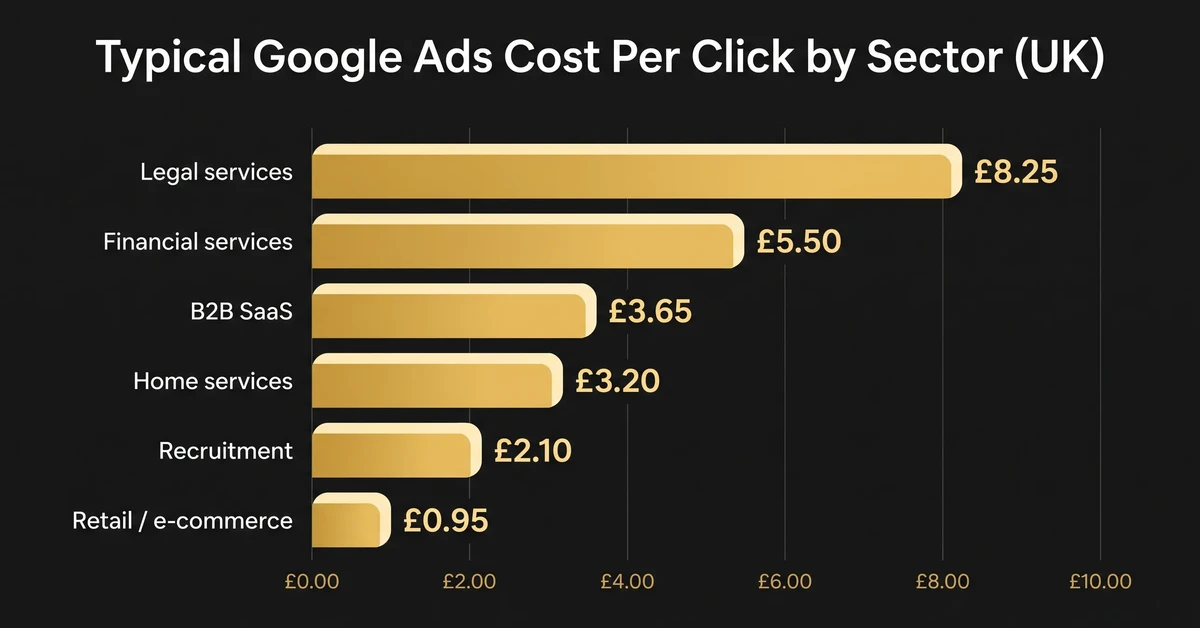
Performance Max does not have its own separate pricing. You are bidding in the same auctions as every other Google Ads campaign type.
Your cost per click still depends almost entirely on your industry and how competitive your keywords are. The table below is our own already-published UK cost-per-click data by sector, which Performance Max draws from in the same way a Search campaign would.
| Sector | Typical CPC | Range |
|---|---|---|
| Legal services | £8.25 | £4.50 - £15.00+ |
| Financial services | £5.50 | £3.00 - £10.00 |
| B2B SaaS | £3.65 | £2.00 - £6.00 |
| Home services | £3.20 | £1.50 - £5.50 |
| Recruitment | £2.10 | £1.00 - £4.00 |
| Retail / e-commerce | £0.95 | £0.40 - £2.00 |
Most UK small businesses land somewhere between £1.50 and £2.50 a click once you average across a full account. That is exactly as they would with a standard Google Ads account, because Performance Max sits inside the same budget rather than beside it.
Performance Max needs enough conversion volume to let its bidding algorithm learn. A very small budget tends to struggle more here than it would with a tightly targeted Search campaign.
On top of ad spend, most UK businesses pay someone to manage the account. Our own research into UK PPC agency pricing found freelancers charging £300 to £2,500 a month and small agencies £500 to £1,500.
Mid-market agencies tend to charge £1,500 to £5,000, and specialist agencies £4,000 to £10,000 or more. Some charge 10 to 20 percent of spend instead of a flat fee.
Picture a UK boiler installation company setting aside £2,500 a month to test Performance Max, after years of relying only on word of mouth. Home services typically sees a blended cost per click around £3.20.
At £2,500 a month, that buys roughly 780 clicks before any other factor is considered. What happens to those clicks next depends almost entirely on how the campaign is set up.
Say the business applies a negative keyword list excluding its own brand name and obvious irrelevant searches, such as job vacancies, DIY guides and unrelated boiler brands. It also uploads its existing customer list as an audience signal.
A realistic conversion rate for this sector sits somewhere between 3 and 8 percent, depending on landing page quality. That works out to somewhere between 23 and 62 leads a month before sales follow-up.
That is a cost per lead of roughly £40 to £110. Skip the negative keyword list and audience signal, and a meaningful share of that spend goes to existing customers and curious browsers the business never needed to pay for.
The business also needs patience in the first few weeks. Performance Max goes through a learning phase while the algorithm gathers enough data to bid efficiently, and judging results in the first fortnight almost always looks worse than the campaign settles to by month two.
Performance Max shares the same auction and the same cost per click as every other Google Ads campaign. There is no separate "Performance Max price", only the same cost-per-click reality with less visibility into where the money actually went.
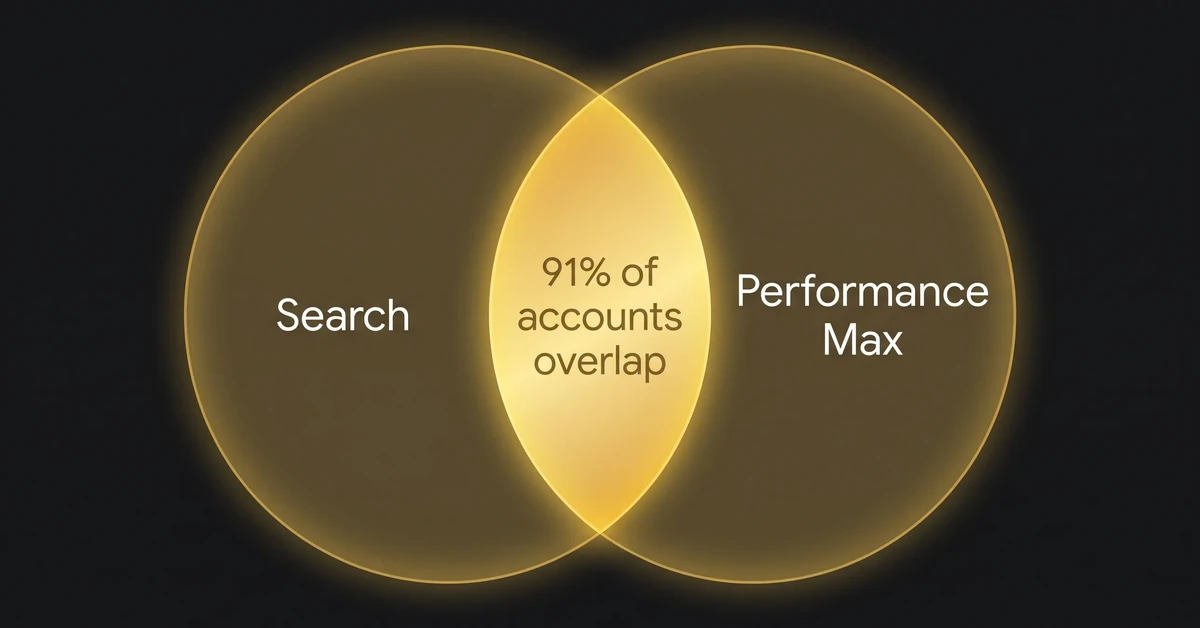
The most common complaint about Performance Max is not that it performs badly. It is that nobody can see exactly what it is doing, and that it quietly competes with campaigns you already run.
"Cannibalisation" means Performance Max picks up a conversion that would have happened anyway, often from someone searching your own brand name, and claims the credit for it.
You end up paying a Performance Max click price for a visitor who would have found you for free, or at a far lower cost, through a dedicated brand Search campaign instead.
PPC optimisation platform Optmyzr studied this directly across 503 managed accounts running both Search and Performance Max, in February 2025. It found that 91.45 percent of accounts had at least one keyword overlap between the two.
Specifically, a Search keyword's exact text also appeared as a search term triggering Performance Max in the vast majority of accounts studied. The two campaign types were, in other words, routinely fighting for the same traffic.
When Optmyzr compared performance on that overlapping traffic, Search won on click-through rate in 28.37 percent of comparisons against Performance Max's 15.98 percent, with the rest showing no meaningful difference.
On conversion rate, Search won in 18.91 percent of comparisons against Performance Max's 6.17 percent. A second part of the same study looked at 424,820 individual search terms across 511 accounts.
It found a similar pattern. Most of the time, neither campaign type has a meaningful edge, but when there is a clear winner, it is Search more often than not.
The honest conclusion is not that Performance Max is broken. It is that running it without a dedicated Search campaign watching your brand terms leaves money on the table.
If a tenth of your Performance Max spend is quietly going to people who typed your own brand name, that is pure waste. The same traffic is available through a basic brand Search campaign.
A brand Search campaign costs a fraction of the per-click price, with no need to compete against the rest of the internet for that same visitor.
This is a close cousin of the problem covered in our guide to click fraud in Google Ads. The clicks are real and the traffic is genuine, but the budget is still being spent on something that never needed paid advertising to convert.
An independent 503-account study found Performance Max and Search overlapping on brand and near-brand terms in the vast majority of accounts, with Search usually the stronger performer when a real difference showed up.
A lot of the frustration around Performance Max traces back to one simple fact. For its first three years, advertisers had almost no way to tell it what not to show ads for.
There was no self-service negative keyword tool at all. The only documented route was contacting your Google account manager and asking them to apply exclusions on your behalf.
That is simply not realistic for most small and mid-sized UK advertisers, who rarely have a dedicated rep to call. Most just lived with whatever the algorithm decided.
Google has gradually responded to years of advertiser pressure. The pace of change through 2025 is worth knowing, because advice about Performance Max from even a year or two ago can already be out of date.
These are genuine improvements. They make Performance Max a more manageable campaign type than it was at launch.
They do not, however, change the fundamental trade-off. You are still handing most day-to-day decisions to an algorithm, and someone still needs to check what it is actually doing with your money.
The same August 2025 update also gave advertisers visibility into "Final URL Expansion". This feature lets Google send traffic to a different page on your website than the one you specified, if its model thinks another page will convert better.
You can now see which pages it generated and switch the feature off. For most of 2022 to 2025, this ran with no reporting at all.
This matters for brand consistency as much as performance. A UK professional services firm with carefully worded legal or compliance language on its core pages may not want Google quietly routing paid traffic around it.
For three years, the only way to stop Performance Max showing ads for an unwanted search term was to ask your Google account manager. Self-service negative keywords, and a cap raised from 100 to 10,000, only arrived through 2025.
None of this means Performance Max is a bad campaign type. It genuinely works well in the right conditions, and plenty of UK businesses run it profitably alongside, not instead of, other campaigns.
It tends to suit e-commerce businesses with a product feed and enough order volume to generate real conversion data quickly. It also works well for businesses with a wide product or service range.
Those businesses want Google's algorithm to find pockets of demand they would never think to target manually themselves. That is a genuine strength of letting a machine search broadly.
If you already have a clean customer list, decent creative assets, and someone checking in on the account regularly, Performance Max has a genuinely good chance of adding incremental sales.
If your business relies on a small number of high-value leads rather than volume, the lack of transparency is a bigger problem than the potential upside. The same applies to a long, considered sales cycle, such as legal, B2B software or professional services.
One lost enquiry can matter far more here than in a high-volume retail business, which is exactly where losing visibility into individual search terms hurts the most.
You need to know exactly which search terms and placements are working, and Performance Max makes that hard by design. In that situation, a dedicated Search campaign usually earns its keep faster.
If you are choosing between platforms entirely, our comparison of Google Ads, Meta, LinkedIn and TikTok is a better starting point. The platform choice usually matters more than the campaign type within it.
E-commerce businesses get the clearest benefit from Performance Max. Shopping inventory, a product feed and purchase conversion data give the algorithm exactly the signal it is built to optimise against.
Sales either happen or they do not, and the feedback loop is fast. Lead generation businesses have a harder time, because a "lead" is a much weaker signal than a completed sale.
A form fill from a tyre-kicker and a form fill from a ready-to-buy customer look identical to Google by default. Feeding offline conversion data back in, showing which leads actually turned into revenue, is how the algorithm learns to chase quality rather than volume.

Because Performance Max reports in aggregate rather than keyword by keyword, waste can sit there for months without anyone noticing. These are the signs worth checking for in your own account this week.
If more than one or two of these apply to your account, the campaign is very likely costing you more than it needs to. That holds even if the headline return on ad spend number still looks acceptable.
This is not a problem unique to Performance Max. WordStream's Google Ads Performance Grader, which analysed 251,236 account assessments, has repeatedly found that most accounts waste a meaningful share of their monthly budget on avoidable issues, across every campaign type it checked.
Performance Max simply makes that waste harder to spot, because it does not hand you a keyword-by-keyword report the way Search does. The underlying habit of letting an account run unchecked for months is the same mistake either way.
Performance Max reports in aggregate, not keyword by keyword, so waste from missing negative keywords, empty audience signals, or a single catch-all asset group can run for months before anyone notices.
The fixes are straightforward once you know to look for them. Apply a negative keyword list covering your brand name and obvious irrelevant terms.
Split asset groups by product or service theme rather than running one catch-all group, and upload a genuine customer list as an audience signal rather than leaving it blank.
Set the new customer acquisition goal if winning new business matters more than repeat purchases. Check the Insights tab weekly rather than letting the campaign run on autopilot for months.
None of this is complicated, but it does need someone to actually do it on a schedule. Automation still needs a human checking its homework, the same way a junior team member would.
The single biggest structural mistake we see in UK accounts is one asset group covering an entire business. Picture a plumbing company running boiler installs, bathroom fitting and emergency callouts through one generic asset group.
That gives Google no way to tell which service a given ad is actually for. Splitting into separate asset groups by service or product line, each with its own headlines, images and landing page, fixes this.
The algorithm can then learn what converts for each service individually, rather than averaging everything together. It also makes the Insights tab genuinely useful, instead of a blur of unrelated traffic.
If you have the time to check your account weekly, and you are comfortable reading Google's reporting, there is no reason you cannot manage a straightforward Performance Max campaign yourself.
That is particularly true at the lower end of the spend bands above. Once your budget climbs past a few thousand pounds a month, the case for bringing in outside help gets stronger.
Time is the real cost most business owners underestimate here. Reviewing Insights weekly, refreshing audience signals and keeping asset groups tidy takes a genuine hour or two a week, every week, not a one-off afternoon of setup.
That is doubly true if you are running Performance Max alongside Search, Shopping and other campaigns at the same time. Our guide on how to choose a PPC agency in the UK covers the questions worth asking before you hand the account over.
If you already have a Performance Max campaign running, and you are not sure whether it is one of the good ones or one quietly wasting budget, the fastest way to find out is a proper account audit.
Guessing from the headline return on ad spend number alone will not tell you. A good audit checks exactly the things covered in this guide: brand term overlap, audience signal use, and asset group structure.
It also checks whether the new customer acquisition goal is set up correctly. Our guide to what a proper Google Ads audit checks and costs walks through what that should look like in the UK.
And if your real concern is simply whether your cost per lead is reasonable for your industry, our guide to cost per lead in the UK gives you the benchmarks to check that on its own terms.
If you would rather have someone look at your account directly than work through a checklist alone, Gilkes Media runs paid ads management for UK businesses, including Performance Max accounts that need untangling.
You can get in touch for a free discovery call if you would like a second opinion on yours. There is no obligation, and no sales pressure attached to simply asking a question.
It can be, but it depends on your budget and sales cycle. Performance Max tends to work best once you have enough conversion volume for the algorithm to learn from and a product or service that suits automated targeting, such as e-commerce with a product feed. Low-volume, high-value, considered-purchase businesses often get more reliable results from a well-structured Search campaign instead.
No. Performance Max bids in the same auctions as every other campaign type, so your cost per click is driven by your industry and competition, not by the campaign type itself. The real cost risk is wasted spend from poor setup, such as missing negative keywords, not a higher price per click.
Yes, unless you apply a negative keyword list excluding your brand terms. An independent study of 503 accounts found the vast majority had overlap between Search and Performance Max on exact-matching search terms, which is a common source of wasted spend if nobody checks for it.
Yes, as of 2025. For its first three years, Performance Max had no self-service negative keyword tool at all, and advertisers had to request exclusions through a Google account manager. Google raised the per-campaign cap from 100 to 10,000 in March 2025 and expanded campaign-level negative keyword lists further that August.
Alongside, in almost every case. Running a dedicated brand Search campaign at the same time protects your lowest-cost, highest-intent traffic from being picked up and reported as a Performance Max win, and gives you keyword-level visibility that Performance Max does not provide on its own.
Check for the common red flags: no negative keyword list, no audience signals uploaded, a single asset group covering everything, nobody reviewing the Insights tab, and falling return on ad spend with no investigation. If two or more apply, the account is very likely underperforming its potential.
Most established UK businesses see consistent performance somewhere between £1,500 and £5,000 a month. Below roughly £600 to £1,500 a month, the campaign often lacks enough conversion volume for Google's bidding algorithm to optimise reliably.
A straightforward account at a modest budget can be managed in-house if someone checks it weekly and understands the reporting. Once spend grows or you are running several campaign types together, bringing in a PPC specialist who manages these accounts daily tends to pay for itself in avoided waste alone.
