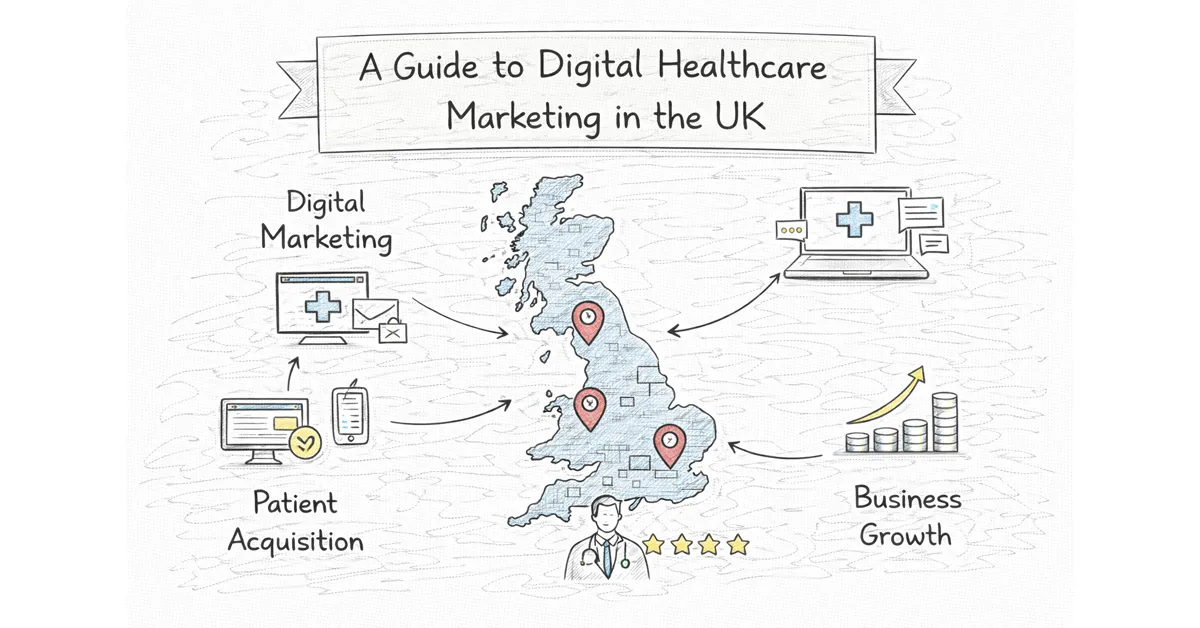
Digital healthcare marketing is the use of online channels to connect with, educate, and attract patients. It is no longer an optional extra. For UK clinics, med-tech innovators, and private practices that want to grow sustainably, it is now a core business function.
Digital marketing in healthcare has evolved beyond a basic website and occasional social media updates. Today, it is the primary engine that drives patient acquisition, builds critical trust, and delivers measurable commercial results. For founders and practice managers, it is a strategic investment in the long-term health of the organisation.
Patient behaviour has changed. People now act like consumers, researching conditions, comparing providers, and reading reviews online long before they pick up the phone. Your digital presence is often their first interaction with your practice. A professional and genuinely helpful online footprint is non-negotiable for making that first impression count.
This diagram shows how a modern healthcare marketing strategy works.
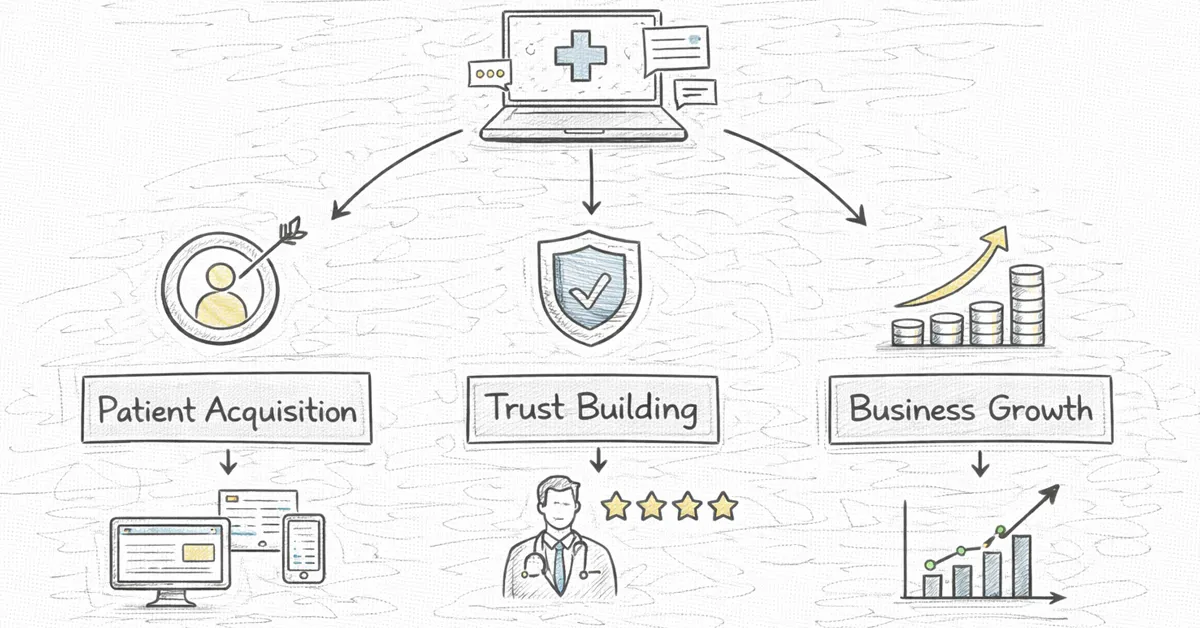
As you can see, the aim is not just to run a few ads. It is to build a system where patient acquisition, trust-building, and business growth reinforce one another.
The UK healthcare market is highly competitive. Standing out requires a deliberate strategy to be both visible and credible where potential patients are actively looking for solutions.
This is not just about being present; it is about performance. Every digital activity should be tied to a specific business goal.
A core part of this is understanding the mechanics of growth. Learning how to increase patient volume through proven marketing strategies is fundamental for any ambitious practice.
The entire sector is moving online. The UK digital health market was valued at around £10.1 billion in 2024 and is projected to reach nearly £29.7 billion by 2033. That is a compound annual growth rate of over 12%.
This is not just a trend; it is a fundamental change in how healthcare is delivered and chosen.
For founders and practice managers, the question is no longer if you should invest in digital marketing. The question is how you can do it effectively to capture this demand and secure a competitive advantage.
As the hands-on consultant at Gilkes Media, I build practical, results-driven strategies. We focus on what moves the needle: generating high-quality leads, increasing patient bookings, and delivering a clear return on your investment.
Search Engine Optimisation (SEO) is the most powerful and sustainable way to build a consistent pipeline of new patients. It comes down to understanding what your potential patients are worried about and being the first, most authoritative answer they find on Google.
This is not about tricking algorithms. It is about building genuine trust by answering questions. When someone searches for symptoms, treatment options, or local specialists, your practice must be visible. Get this right, and you will create an asset that generates enquiries on its own, reducing your reliance on paid advertising.
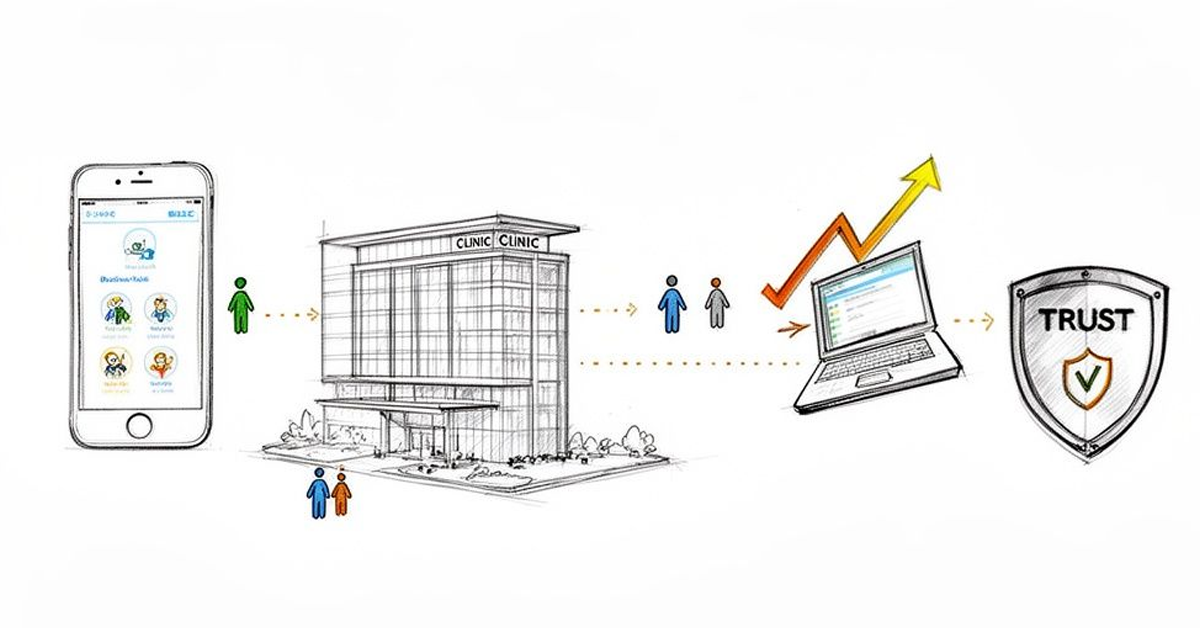
For most clinics and private practices, the patient journey starts locally. A staggering 46% of all Google searches are for local information, and a search like 'private GP near me' signals immediate intent. Winning in local SEO means becoming the obvious choice for patients in your area.
Your Google Business Profile (GBP) is your most important local SEO tool. It is your digital front door. A fully optimised profile is non-negotiable.
Make sure it includes:
Responding professionally to all reviews, good and bad, shows you are an engaged, patient-focused practice.
The heart of modern healthcare SEO is creating high-quality, helpful content. Your website should be a trusted resource that directly addresses the concerns and questions of your target patients.
Think about the questions your clinicians answer daily. Those are your content topics. Create dedicated pages or in-depth articles that cover:
By creating content that helps and educates, you build a relationship with potential patients before they visit your clinic. This is the foundation of effective digital healthcare marketing.
Structuring your site logically around these patient needs is a key part of our process at Gilkes Media. If you are managing this in-house, our guide on on-page SEO best practices will give you a solid framework.
In healthcare, Google's standards are high. It uses a framework known as E-A-T, Expertise, Authoritativeness, and Trustworthiness, to judge your content. This has practical implications for your website.
By building your digital presence around the needs of patients, you create a powerful system. This patient-centric approach to SEO improves rankings and builds a foundation of trust that attracts and converts qualified enquiries, driving sustainable growth.
SEO builds a long-term asset, but sometimes you need results now. This is where paid advertising acts as a lever for immediate and predictable growth.
When done right, paid ads place your services in front of motivated patients at the exact moment they are searching for a solution. Treat it as a direct investment in patient acquisition. Every pound spent needs to be accountable, tracked, and tied to a result, whether a booked consultation or a treatment enquiry.
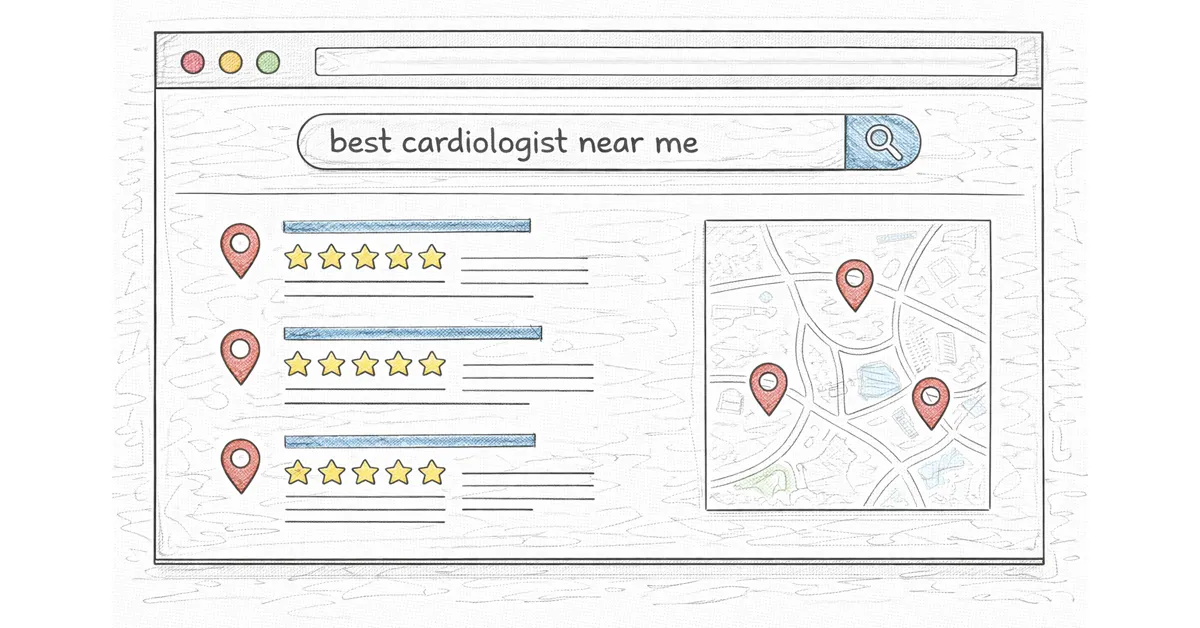
For capturing immediate demand, Google Ads is essential. The platform lets you bid on specific search terms, ensuring your clinic appears at the top of the results. The secret to a profitable campaign is being seen by the right people.
This means focusing on high-intent keywords, the phrases that signal someone is ready to take action.
A search for ‘sore back’ is informational. A search for ‘private spine consultant London’ is transactional. That user is actively looking to book an appointment.
Your budget should be focused on these long-tail, high-intent keywords. For example:
By targeting these precise phrases, you filter out casual browsers and attract individuals serious about becoming patients. This is the most important factor in maximising your return.
The UK private healthcare market is fiercely competitive, which drives up advertising costs. Without a disciplined, data-driven approach, it is easy to waste thousands of pounds.
A recent study of the eight largest UK private healthcare companies found that average monthly budget wastage reached £6,599 in the first quarter of 2024. With the average cost-per-click (CPC) at a steep £18, the penalty for inefficient campaign management is enormous.
This data proves that success in paid advertising is not about having the biggest budget. It is about having the smartest strategy. Every click must be scrutinised, and every campaign continually optimised to drive down the cost per acquisition.
As a hands-on paid ads specialist, this is my focus. We build campaigns from the ground up to eliminate waste, ensuring every pound of your ad spend works to grow your practice.
While Google Ads captures people already searching for you, social media advertising on platforms like Facebook and Instagram plays a different role. It allows you to build awareness and connect with potential patients before they start searching.
Here, the strategy shifts from intent to interest. You can target users based on demographics, online behaviours, and interests relevant to specific health conditions.
For instance, a cosmetic clinic could target users interested in luxury skincare brands. A physiotherapy practice might target members of local running clubs. The goal is to introduce your practice as a helpful resource, building trust over time.
This approach is effective for elective treatments and wellness services where the patient journey is longer. For a deeper dive into structuring these campaigns, check out our guide on PPC management for small businesses.
A balanced digital healthcare marketing strategy combines the long-term foundation of SEO with the immediate impact of paid advertising. By using both Google and social channels intelligently, you build a solid system that captures existing demand and creates new opportunities.
While foundational channels like SEO and paid search are essential, real advantage comes from owning the next wave of patient demand. The UK healthcare market is shifting towards digitally-native services. Focusing your marketing here is how you secure future growth.
This means looking past the traditional clinic model to the rise of E-Health, telemedicine, and online consultation platforms. These represent a fundamental change in how people access care. Your marketing must meet them there.
The data shows where the money is going. E-Health is the fastest-growing part of the UK's digital health market. Industry analysis projects that E-Health will grow at a compound annual rate of 28.11% between 2024 and 2032. You can explore the trends in the full market research from DataBridge.
This is a strategic directive. It shows that more patients are actively looking for and paying for healthcare delivered online.
For ambitious practices and med-tech startups, this is the new frontier. Your ability to build marketing funnels that attract and convert patients in these digital-first environments will decide your market share over the next decade.
Marketing a telemedicine service is different from promoting a physical clinic. The patient journey is faster, and the competition is global. A winning funnel must be efficient and built for digital conversion.
Here are the core stages:
Patients who use digital health platforms are tech-savvy and value convenience. They are comfortable managing their lives through a smartphone. Your marketing messages must reflect this.
| Priority | Strategic Marketing Tactic |
|---|---|
| Speed & Convenience | Promote same-day appointments and skipping waiting rooms. |
| Accessibility | Highlight 24/7 access to medical advice. |
| Transparency | Display clear, fixed pricing for services up front. |
| Control & Privacy | Focus on discreet, secure consultations from home. |
As the consultant at Gilkes Media, my specialism is mapping these user journeys and building performance-driven campaigns for these new patient behaviours. We build marketing systems that align with the commercial realities of the digital health revolution.
In healthcare, trust is your most valuable commercial asset. Any tactic that undermines patient trust or enters regulatory grey areas can damage your brand.
Building your growth strategy on a compliant foundation is non-negotiable. Every Google Ad, social media post, and privacy policy must be crafted to build confidence. This is about protecting your patients, your reputation, and your ability to operate.
Several bodies govern how healthcare services can be marketed in the UK. Ignoring their rules can lead to significant penalties. A working knowledge of these bodies is essential.
Here is a simplified overview of the main players.
| Regulatory Body | Area of Focus | Key Marketing Implication |
|---|---|---|
| ICO | Data Protection (GDPR) | You must have explicit consent to collect and use patient data for marketing. Your privacy policy must be clear and easy to find. |
| ASA | Advertising Claims | All marketing claims must be truthful, not misleading, and backed by solid evidence, especially for treatment effectiveness. |
| MHRA | Medical Devices & Medicines | You are forbidden from promoting prescription-only medicines (POMs) to the public. Marketing for medical devices must be accurate. |
These rules exist to protect vulnerable people, ensuring patients can make informed decisions based on accurate, ethical, and responsible information.
Your marketing must be effective, but it must be ethical first. Compliance is not a barrier to growth; it is the prerequisite for sustainable growth in the healthcare sector.
This table provides a quick reference for the main compliance areas you will need to consider. Use it as a starting point for your internal review process.
| Compliance Area | Key Consideration | Governing Body/Rule |
|---|---|---|
| Treatment Claims | Can you provide solid evidence for all clinical claims? | GMC & ASA |
| Patient Data | Have you obtained explicit consent for marketing communications? | ICO (GDPR) |
| Testimonials | Is the testimonial genuine and verifiable? Is consent documented? | ASA & GMC |
| Pricing | Is all pricing information clear, transparent, and unambiguous? | ASA & CMA |
This checklist is not exhaustive, but it covers the main items that regulators focus on.
Ultimately, ethical health care marketing comes down to clarity and honesty. It is about making promises you can keep, backing up every claim with evidence, and always putting the patient’s welfare and privacy first. This approach is not just about avoiding risks; it is the only sustainable way to build a respected and commercially successful practice.
Building trust goes beyond following rules. It involves demonstrating your commitment to patient welfare at every digital touchpoint.
Here are four actionable steps to ensure your digital marketing is both compliant and confidence-building:
As a consultant, I see this as a core part of strategy. At Gilkes Media, we ensure the strategies we build are rooted in ethical practices that strengthen your brand.
Effective digital healthcare marketing is about driving outcomes. A successful campaign is measured not in clicks, but in its impact on your bottom line. You must connect every pound you spend to a measurable business result.
This means focusing on the Key Performance Indicators (KPIs) that matter to a founder or CEO. It is about building a data-driven picture of what is working and how to use your budget for maximum growth.

To measure success, you need to track the right things. In healthcare, three metrics are most important for judging the commercial health of your marketing.
By tracking these KPIs, you stop treating marketing as a cost centre and start running it as a predictable engine for revenue growth.
Setting a marketing budget should be a strategic decision, grounded in your growth targets. An effective way to do this is to work backwards from your revenue goals.
Instead of asking, "What's our marketing budget?" ask, "How many new patients do we need, and what are we willing to invest to acquire each one?" This re-frames the conversation around investment and return.
Here is a simplified model to guide your thinking:
| Budget Element | Description | Example Calculation |
|---|---|---|
| Revenue Target | The additional revenue you aim to generate. | Target: £100,000 |
| Patient Value | The average revenue from a new patient. | Value: £500 |
| Patients Needed | New patients required to hit the target. | 100,000 ÷ 500 = 200 |
| Target CPA | The maximum spend to acquire a patient. | Example: £150 |
Based on this, your total marketing budget would be £30,000 (200 patients x £150 CPA). This data-led approach gives you a realistic figure and ensures your spending is tied to commercial objectives.
You can then allocate that budget strategically. A portion should go to long-term activities like SEO. The rest can be used on growth accelerators like paid ads. For a more detailed breakdown, learn how to measure marketing ROI in our guide.
As a hands-on consultant at Gilkes Media, I help founders build these frameworks. We create clear, accountable strategies that ensure every marketing pound contributes to your commercial success.
Every regulated or trust-led sector faces its own version of these challenges. Our guides to marketing construction companies and digital marketing for financial services show how the same principles apply in practice elsewhere.
Here are straight answers to common questions from founders and practice managers.
There is no magic number, but a sensible starting point for a growth-focused practice is between 7% and 12% of your total revenue. The key is to see this as a calculated investment in patient acquisition, not a cost.
A newer practice might lean towards the higher end to build initial momentum. An established clinic could allocate a smaller percentage to maintain its position.
Ultimately, your budget should be tied to your patient acquisition goals. Start there, and the right number will become clearer.
For immediate results, Google Ads almost always delivers the highest initial ROI. You are reaching potential patients at the exact moment they are actively searching for your services.
The best long-term ROI often comes from SEO. It takes more time, but a strong organic presence becomes a powerful asset. It generates a consistent flow of enquiries without you paying for every click. An effective strategy uses both.
Patience is key with SEO. You should see early signs of progress, like improved keyword rankings and more website traffic, within the first three to six months.
However, achieving a significant, consistent flow of patient leads from organic search typically takes six to twelve months of dedicated effort. Think of SEO as a long-term investment in a sustainable asset for your practice. It is about building foundational strength.
Absolutely. The key is not the size of your team; it is the quality of your strategy and execution. Many successful clinics partner with a hands-on consultant rather than hiring a large in-house team.
This approach gives you direct access to senior-level expertise without the overheads. A good consultant can build your strategy, manage critical channels like paid ads, and create a clear reporting framework focused on commercial outcomes. It is a lean and highly effective model for growth.
Ready to build a practical, results-driven marketing strategy that delivers a clear return on investment? Gilkes Media works directly with founders and leadership teams to create and execute focused plans that generate more leads, increase patient bookings, and drive sustainable growth.
Book a free, no-obligation consultation with me to discuss your goals at https://gilkesmedia.co.uk.
