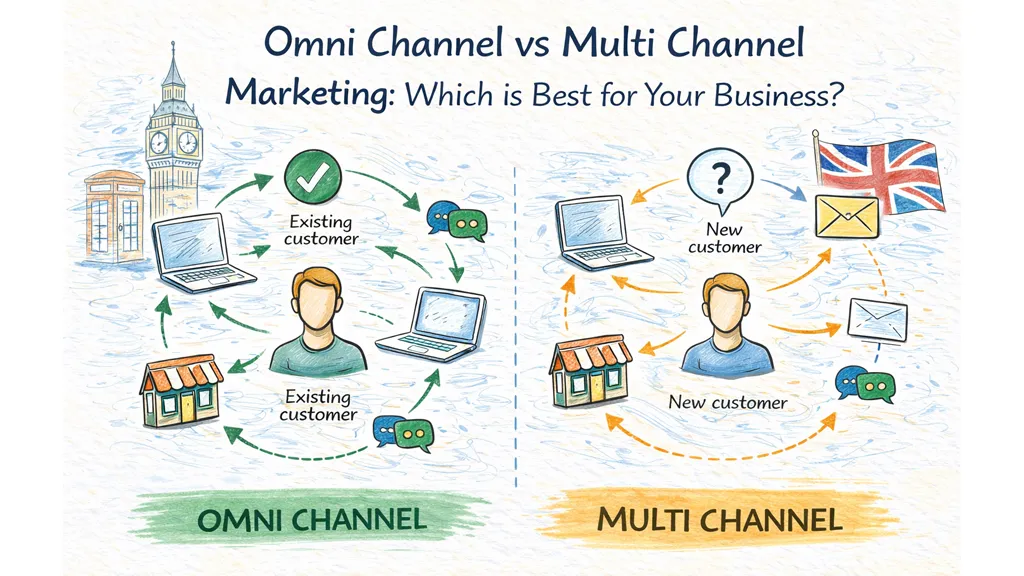
It’s easy to get lost in the jargon, but the difference between omni-channel and multi-channel marketing is simple and commercially vital. One is about presence; the other is about connection. Getting this right decides whether your channels work in silos or as a single, powerful growth engine.
For any UK business leader, understanding this distinction is critical. Most businesses are already doing multi-channel marketing. It’s about casting a wide net, pushing your brand message out across different, unconnected platforms like paid search, social media, and email.
This approach is product-centric. Each channel works independently, often with its own strategy and goals. It is a pragmatic way to build broad awareness and can be quick to get started. The problem? It creates a choppy and disconnected customer experience. A customer might see one offer in a LinkedIn ad but get a completely different message in an email, creating friction that kills conversions.
Omni-channel marketing, on the other hand, puts the customer at the absolute centre. It weaves your channels together so they act as one, sharing data to create a single, smooth conversation with each individual. Think of it as the difference between shouting a message from several street corners (multi-channel) and having one intelligent conversation that follows a customer from their phone to their laptop and into your physical store (omni-channel).
It is more complex, yes. It requires investment in the right tech, usually built around a central CRM. But the commercial impact is where it really counts.
Multi-channel is about reach. Omni-channel is engineered for retention, loyalty, and lifetime value. The numbers do not lie: businesses with strong omni-channel strategies retain an average of 89% of their customers, compared to just 33% for companies with weak, disconnected multi-channel efforts.
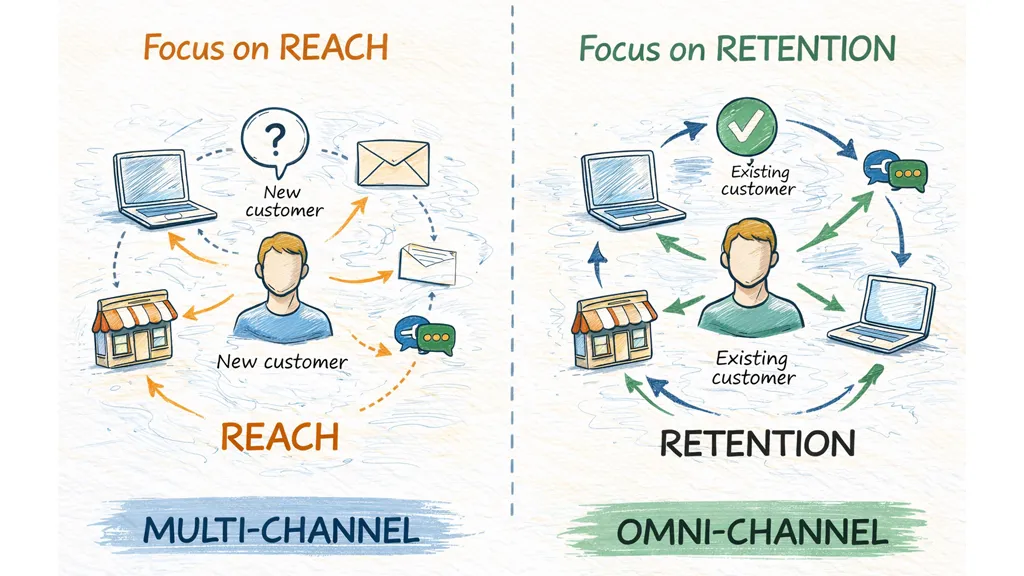
To make the choice clearer, this table breaks down the core differences between the two approaches. Use it to see which strategy aligns with your business goals right now and where you need to be heading long-term.
| Aspect | Multi-Channel Marketing | Omni-Channel Marketing |
|---|---|---|
| Core Philosophy | Product-centric. The brand communicates at the customer on various channels. | Customer-centric. The channels work together to create a smooth experience for the customer. |
| Customer Experience | Fragmented and inconsistent. Each channel operates independently. | Unified and smooth. The customer journey is continuous across all touchpoints. |
| Data & Technology | Siloed. Data is not shared between channels, leading to a disconnected view of the customer. | Integrated. A central system (like a CRM) creates a single, unified customer profile. |
| Primary Business Goal | Maximise reach and brand awareness across as many platforms as possible. | Increase customer retention, loyalty, and lifetime value (£) through a superior experience. |
In short, multi-channel puts your brand at the centre of the strategy. Omni-channel puts your customer there. While one is about volume, the other is about value and in today's market, value always wins.
Let's cut through the jargon. The choice between omni-channel and multi-channel marketing is not just about definitions; it’s about your entire strategic intent. Are you just trying to be everywhere your customers might be, or are you trying to be with your customer every step of their journey?
The answer dictates your approach to data, tech, and team structure, and it directly impacts your return on investment.
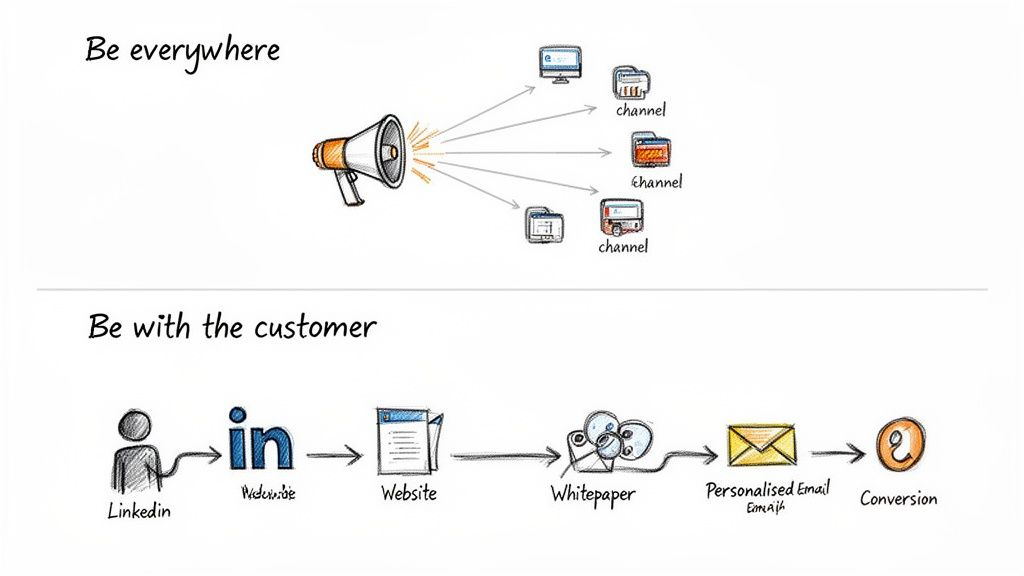
A multi-channel strategy is all about maximising your brand’s presence. The goal is to cast a wide net and reach potential customers on the platforms they use, like paid search, social media, and email. While it’s a solid way to build top-of-funnel awareness, it has a critical weakness: the channels do not talk to each other.
This creates a disjointed, and often frustrating, customer experience. A prospect might see one message in a Google Ad but get a completely different, unrelated offer in an email. The brand is present, but the conversation is broken, leaving potential revenue on the table.
An omni-channel strategy flips this entire model on its head. Instead of focusing on the channel, it puts the customer at the absolute centre. The goal is to create one single, continuous conversation that follows the customer across every touchpoint, whether it's online or offline. Each interaction informs the next, building a smooth and intelligent path to conversion.
The core strategic difference is this: Multi-channel marketing is about the brand broadcasting a message at the customer across many channels. Omni-channel marketing is about creating a persistent, valuable dialogue with the customer that flows smoothly between all channels.
Imagine a UK-based professional services firm trying to generate high-quality leads. Here’s how the two strategies would play out in the real world:
Multi-Channel Approach: The firm runs a generic brand awareness campaign on LinkedIn, separate PPC ads on Google targeting broad keywords, and sends out a standard monthly newsletter. A prospect might see all three, but each interaction is totally isolated. The LinkedIn ad has no idea they clicked the Google ad, and the newsletter has no context of their previous engagement. It is just noise.
Omni-Channel Approach: A potential client sees a highly targeted LinkedIn ad for a specific service. They click through, visit the website, and download a related whitepaper. That action immediately segments them in the CRM. A few days later, they get a personalised follow-up email that directly references the whitepaper they downloaded, inviting them to a relevant webinar. This is a single, logical journey.
The omni-channel example does not just feel more personal, it is vastly more effective. By connecting the dots, you guide prospects through the buying process with far less friction. To see how this connects to the broader buyer’s journey, you can explore our detailed guide on full-funnel marketing strategy.
Ultimately, this unified approach is what turns initial interest into qualified leads and closed business. Deciding between omni-channel vs multi-channel is a fundamental business decision, not just a marketing one.
While the strategic differences are clear, any decision to invest in an omni-channel approach has to stack up commercially. Moving beyond theory, the data paints a very clear picture, directly linking a unified customer journey to better financial results. For UK SMEs where every marketing pound is scrutinised, this is not just a preference, it is a competitive necessity.
The numbers speak for themselves. Brands with strong omni-channel strategies see 9.5% year-on-year revenue growth, a figure that completely overshadows the 3.4% achieved by those using weaker or purely multi-channel setups.
This growth is not just about finding new customers. It is driven by loyalty. Research from Aberdeen Group shows that businesses executing a proper omni-channel strategy retain an average of 89% of their customers. For those with disconnected, multi-channel efforts? That number plummets to just 33%.
In the UK market, where retail and e-commerce are so vital, these figures carry serious weight.
The fundamental problem with a multi-channel approach is fragmentation. Being present on social media, email, and search is great for awareness, but it almost always leads to siloed data, overlapping audiences, and messy attribution. It becomes incredibly difficult to know the true cost of acquiring a customer and nearly impossible to accurately measure their lifetime value.
An omni-channel model fixes this by connecting the dots. It uses shared customer data to build personalised, logical journeys. A LinkedIn ad can be smoothly followed up with a retargeting ad on Google or a perfectly timed, contextual email. For leadership teams in sectors like finance, construction, or healthcare, this translates directly to the bottom line:
The ROI is clear. Marketing campaigns that use three or more integrated channels achieve a 287% higher purchase rate than single-channel campaigns. Omni-channel shoppers do not just buy more frequently; they spend more with each purchase.
Having generated over 80,000 leads for our clients, we have seen firsthand that integrating channels is the only real key to driving sustainable growth. As a hands-on consultancy, Gilkes Media specialises in knitting together paid ads, SEO, and web development to create a unified system focused purely on ROI.
The commercial case is undeniable. Ditching the fragmented, channel-first mindset of multi-channel marketing for a customer-centric, omni-channel approach is no longer a "nice-to-have." It is the most reliable path to increasing revenue, boosting retention, and building a resilient, scalable business.
In the omni-channel vs multi-channel debate, the real decider is not how many channels you use. It's the quality of the experience you deliver. This is where the two approaches diverge completely, with a direct impact on customer loyalty, satisfaction, and your bottom line.
A multi-channel journey is almost always fragmented. Your customer sees your brand on different platforms, but critically, your channels do not see the customer moving between them. This operational blindness leads to frustrating and commercially damaging scenarios.
Imagine a customer spends £2,000 with you. A week later, they get an automated email with a "10% off for new customers" offer. It does not just look sloppy; it tells your recent, high-value customer that you have no idea who they are. This is a classic symptom of a siloed, multi-channel setup.
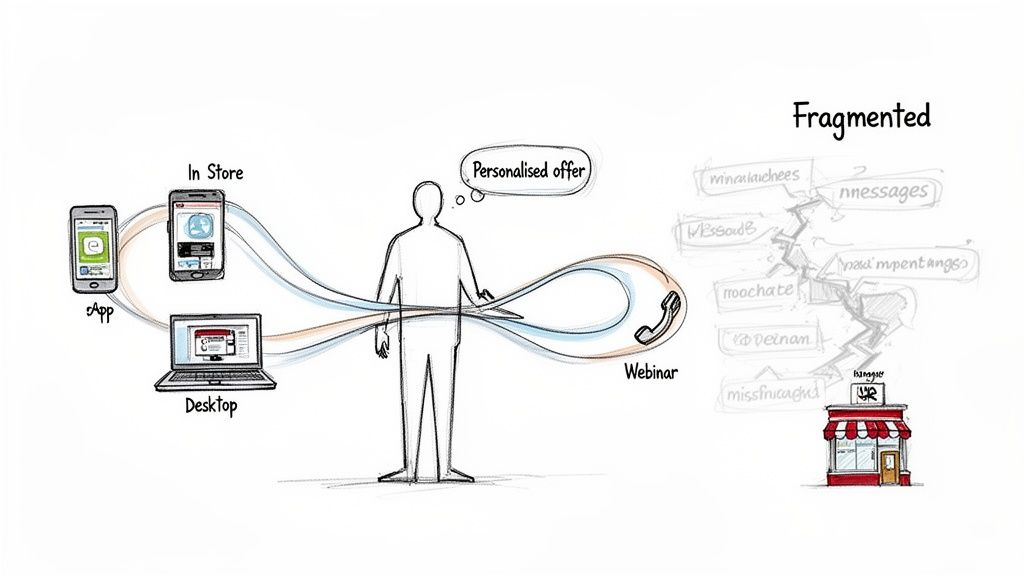
By contrast, an omni-channel experience is smooth, contextual, and intelligent. It recognises each customer as a single individual across every single touchpoint, whether they’re on your mobile app, in a physical store, or browsing on their desktop. The experience is consistent and responsive, often using tools like live chat solutions to provide instant, connected support.
This unified approach turns your marketing from a series of disconnected broadcasts into a single, evolving conversation. Each interaction informs the next, creating a journey that feels personal and makes sense.
The core difference is simple: a multi-channel approach makes the customer do the work of connecting the dots. An omni-channel strategy does the work for them, creating a smooth path from interest to purchase and beyond.
Let's look at a UK professional services firm targeting SME founders. A smart, omni-channel approach to lead generation might look like this:
Each step builds on the last, creating a powerful, frictionless journey that nurtures a high-value lead towards conversion.
This integration is not just a digital "nice-to-have". The UK market shows a strong preference for blended online and offline experiences. A Retail Economics report found a striking 61% of UK consumers still favour in-store shopping, with only 39% preferring to shop mostly online.
This creates a clear imperative for businesses to bridge the gap between their digital marketing and their physical presence. A siloed, multi-channel strategy simply cannot deliver the consistency modern customers expect.
This data reinforces a critical point: whether you're in retail, professional services, or tech, your customers do not live in channel-specific silos. To compete effectively, your marketing cannot afford to either.
Making the switch from multi-channel to a true omni-channel approach is a major strategic move, not just a small tweak to your campaigns. For UK founders and SMEs, the idea can feel overwhelming.
But here’s the good news: you do not need a disruptive, ‘big bang’ overhaul. The best way forward is a pragmatic, step-by-step approach that focuses on progress, not overnight perfection. This is how you get a real, measurable return.
This framework breaks the entire process down into five manageable steps. Think of it as a practical guide, not a theoretical essay. The goal is to build momentum and prove the value at each stage, making it much easier to justify further investment.
The absolute foundation of any omni-channel strategy is a single, unified view of your customer. Without it, your channels will always operate in silos. For most SMEs, this means properly setting up and using a Customer Relationship Management (CRM) system or a Customer Data Platform (CDP).
This central hub needs to pull together data from every single touchpoint:
A centralised data source is completely non-negotiable. It’s the engine that powers a connected customer experience, turning fragmented data points into real intelligence. This is what lets you understand who your customer is, no matter how or where they interact with you.
Once your data is in one place, you can finally start to see how customers actually move through your business. The next step is to map these journeys out, identifying every key touchpoint from the first moment of awareness right through to post-purchase support.
Your main focus should be on finding the moments of friction. Where do customers get stuck? Where are the awkward handovers between channels? For example, does a prospect who downloads a technical whitepaper get hit with an irrelevant, generic email newsletter a week later? Drawing these paths out visually makes it painfully obvious where communication breaks down and where the opportunities are for a smoother, more logical experience.
For an omni-channel strategy to work, your technology has to talk. Your analytics platform, your email marketing software, and your advertising accounts cannot operate in their own little worlds. The aim is to create a smooth flow of information between these systems.
Start with one simple, high-impact integration. For example, make sure that when a lead converts from a Google Ad, that specific conversion data is passed directly into your CRM. That one action could then trigger a highly specific, automated email sequence. Getting this right is a core part of effective marketing automation for small business, turning your separate tools into a single, cohesive system.
Data and technology are only half the battle. A truly successful omni-channel strategy depends on breaking down the internal silos that nearly always exist between marketing, sales, and customer service. These teams need to be working from the same playbook, looking at the same customer data, and chasing the same goals.
If marketing is measured only on lead volume, sales on closed revenue, and service on call resolution times, they will inevitably pull in different directions. Instead, you need to align everyone around a shared commercial objective, like improving customer lifetime value (£). This forces collaboration and makes sure every person in every team understands their role in delivering one, unified customer experience.
Finally, resist the temptation to overhaul everything at once. The most successful transitions I have seen are iterative. You need to begin with a single, high-impact pilot project to prove the concept and generate a clear, undeniable win.
A great place to start is by integrating your paid search campaigns with a specific email nurture sequence. Track a user from a particular ad click, through to a website conversion, and into a targeted email follow-up. Measure the results meticulously. This small-scale success gives you the proof, the learnings, and the momentum you need to roll out your omni-channel efforts across the entire business.
Deciding between multi-channel and omni-channel is not about which one is ‘better’. It’s a strategic choice based entirely on where your business is right now and where you plan to take it.
This checklist cuts through the noise. It’s designed to help you honestly assess your readiness and pick the path that matches your commercial reality.
First, let's talk ambition and scale. Are you an early-stage startup focused on getting your name out there? Or are you a scale-up trying to maximise customer lifetime value (LTV)?
For Early-Stage Businesses: If your main goal is brand awareness and establishing a foothold, a sharp multi-channel strategy is the pragmatic choice. Forget spreading your limited budget too thin. Focus on mastering two or three channels where your audience actually lives.
For Established SMEs and Scale-Ups: If you already have a customer base and want to drive retention, loyalty, and LTV, the case for an omni-channel investment becomes undeniable. Your focus shifts from broad reach to building deep, profitable customer relationships.
Next, look at how your customers buy. Is it an impulse purchase, or a longer, more considered decision?
A customer buying a low-cost item probably does not need a deeply integrated journey. But for high-value B2B services or big-ticket consumer goods, the path to purchase often involves multiple touchpoints over weeks, or even months. If your sales cycle is long and needs careful nurturing, an omni-channel strategy is essential to avoid dropping the baton between emails, ads, and sales calls.
If you’re an early-stage startup, a focused multi-channel strategy is a pragmatic start. If you’re an established SME with customer data, the business case for investing in omni-channel is compelling and directly tied to growth.
The flowchart below breaks down what you need to get right when planning a move toward a more integrated approach.
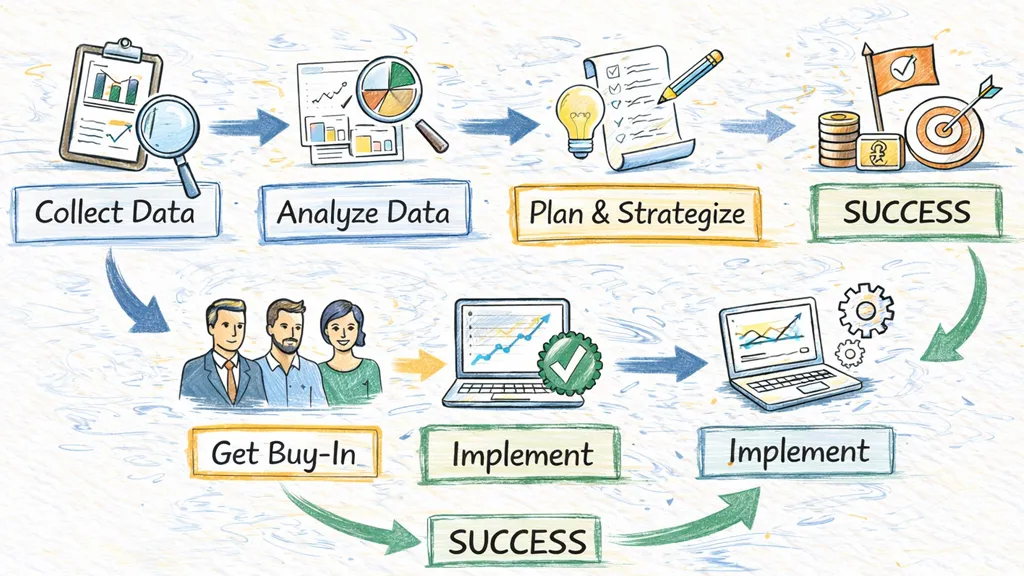
As you can see, a successful transition hinges on getting your data, journey mapping, tech, and team structure properly aligned. It is not a small undertaking.
Finally, you need to be realistic about your internal capabilities. A true omni-channel strategy is built on a foundation of technology and unified data.
Here's a quick readiness check. Be honest.
| Capability | Multi-Channel Ready | Omni-Channel Ready |
|---|---|---|
| Data Maturity | Data is siloed in separate systems (e.g., Mailchimp, Google Analytics) with no integration. | You have a central CRM or CDP giving you a single, unified view of each customer. |
| Tech Stack | Your marketing tools work in isolation. | Your key platforms (ads, email, web) are integrated and share data automatically. |
| Team & Budget | You have a small team or limited budget, making channel-by-channel management more feasible. | You have the team and financial resources to invest in integration, training, and strategic oversight. |
Answering these questions honestly points you to the right strategy for your business today. This is not about chasing buzzwords; it’s about making a sound commercial decision that protects your budget and drives real growth.
As a senior marketing consultant and paid ads specialist, I help founders and leadership teams navigate this exact choice every day. I provide the strategic support and hands-on expertise needed to develop a pragmatic plan and execute a strategy that delivers measurable results, whether that starts with mastering your channels or integrating them for maximum impact.
Getting your channel mix right is only step one. Once that's settled, it's worth having a clear go-to-market strategy template to plan the launch itself, and a wider marketing strategy for startups to guide the decisions that follow.
When it comes to omni-channel vs multi-channel, a few practical questions always come up with the UK business leaders I work with. Here are the straight, commercially-focused answers you need to make the right decision for your business.
Yes, the initial setup for an omni-channel strategy typically costs more. You're looking at an upfront investment in the right technology – usually a proper CRM or a Customer Data Platform (CDP) – to bring all your customer data into one place. There are also costs for integrating your different marketing tools and getting your team up to speed.
But the real question is not about cost; it's about return on investment. A multi-channel approach has a lower barrier to entry, but its disconnected nature almost always leads to wasted ad spend and missed opportunities. An omni-channel strategy, on the other hand, is built from the ground up to increase customer lifetime value. In fact, businesses with a strong omni-channel setup see a 30% higher LTV.
That initial outlay on tech suddenly looks very different when you realise it can deliver a far greater, more predictable return over the long run.
For most early-stage businesses, a smart, focused multi-channel strategy is the right place to start. When you have limited resources, your priority is generating awareness and bringing in those first leads. The best way to do that is to master two or three high-impact channels, like paid search and email, and get the best possible results from your budget.
Omni-channel is the logical next move once you’ve established a solid foundation. You'll know you're ready when you have:
The goal for a startup is not to build a perfect omni-channel system from day one. It's to master your core channels first, collect the data, and then build the integrations for a true omni-channel experience as you scale.
Moving to an omni-channel model is a gradual process, not an overnight flip of a switch. For a typical UK SME, a phased rollout over three to six months is a realistic timeline. The key is to start small with a pilot project focused on a single, high-value customer journey.
A great starting point is integrating your paid ads with your email marketing. For example, you can connect your Google Ads account to your CRM so that a lead from a specific ad campaign is automatically dropped into a tailored email nurture sequence.
Once you prove the ROI on a small scale like this, you build the business case and the internal confidence to roll out wider integrations across the company.
Deciding between these strategies and executing the right one for your stage of growth is a critical leadership decision. At Gilkes Media, we provide the senior, hands-on expertise to help you build a practical marketing plan that delivers measurable results.
Book a free, no-obligation strategy call today to get clarity on your path to growth.
