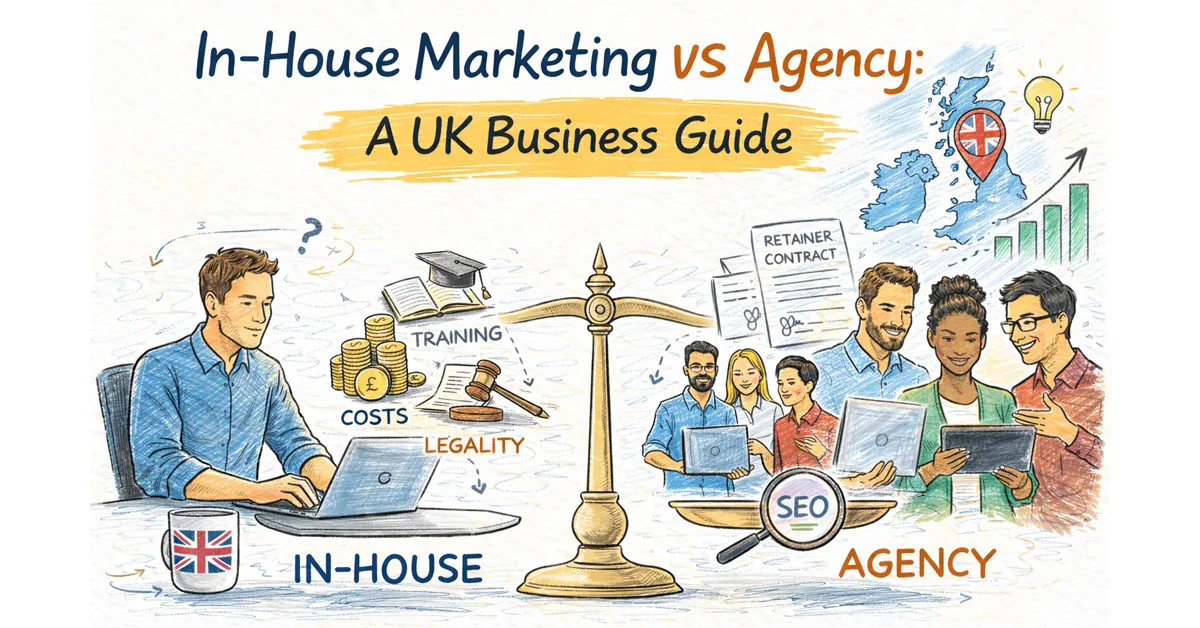
Deciding whether to build your marketing team in-house or partner with an agency is a fundamental strategic decision. The entire "in-house marketing vs agency" debate boils down to a single trade-off: deep internal integration versus broad external expertise.
The path you choose will define your company's speed, capabilities, and ultimately, its growth trajectory.
Choosing your marketing structure is a serious commercial decision. It directly impacts your budget, your ability to react to market shifts, and the specialist skills you can deploy to win new customers. This is not just about hiring staff versus signing a contract; it is about defining the engine that generates demand and revenue for your business.
To make the right call, you must move beyond generic pros and cons lists. You need to look at this through a commercial lens, focusing on tangible outcomes like cost, control, and performance.
To get a quick sense of how these two models differ, let’s look at a high-level overview.
| Factor | In-House Team | Marketing Agency |
|---|---|---|
| Primary Advantage | Deep brand knowledge and cultural alignment. | Immediate access to a team of diverse specialists. |
| Cost Structure | Fixed overheads (salaries, NI, benefits, training). | Predictable monthly retainer or project fees. |
| Skill Access | Limited to the expertise of individuals you hire. | Broad access to SEO, paid ads, and content experts. |
| Accountability | Direct line management and internal KPIs. | Contractual, based on Service Level Agreements. |
This table makes the core trade-offs clear, but the real decision lies in your specific context.
The decision is less about which option is "better" and more about which model is the right strategic fit for your business's current stage, budget, and growth ambitions.
Ultimately, both models can deliver results, but they operate in completely different ways. An in-house marketer becomes part of your company's fabric, living and breathing your brand every day. An agency, on the other hand, provides an external, performance-driven perspective and a wealth of cross-industry experience that is almost impossible to replicate internally.
Getting to grips with these fundamental differences is the first step. If you're leaning towards an agency, our guide on how to choose a digital marketing agency can help you understand what to look for. The following sections will break this down further to help you make an informed choice.
When weighing up an in-house team against a marketing agency, many businesses make a critical mistake: they compare a marketer’s salary directly against an agency’s monthly retainer.
This is a flawed comparison. It dramatically underestimates the real, fully-loaded cost of building and supporting an internal team. To make a sound commercial decision, you must be realistic about the numbers.
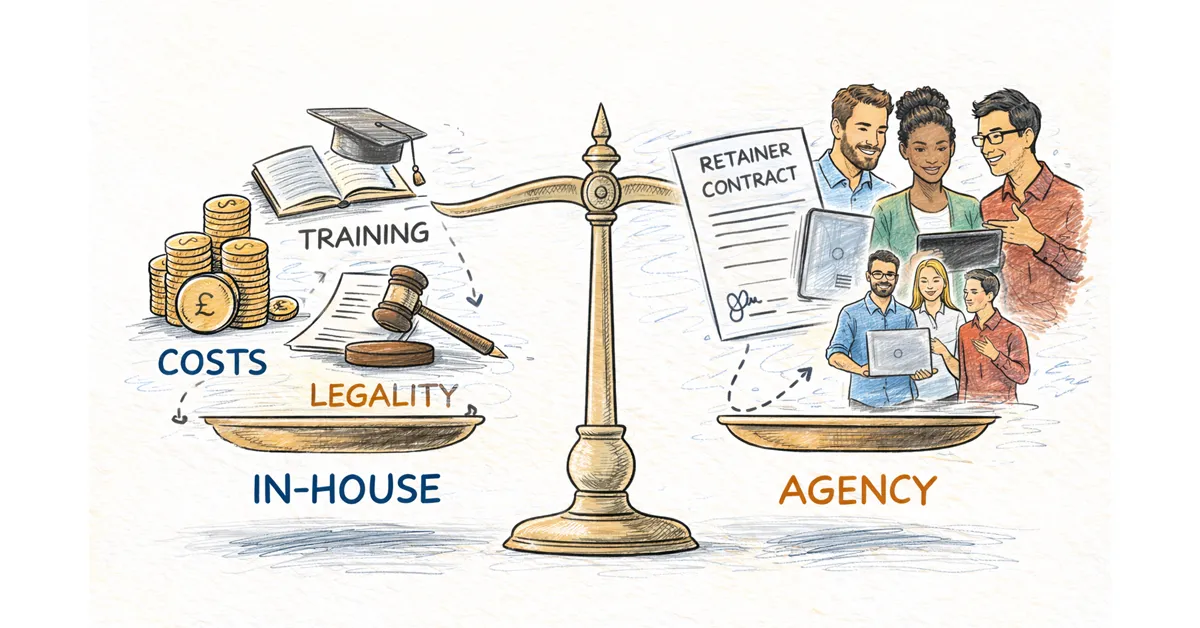
The headline salary is just the starting point. A realistic calculation of your investment must include a long list of hidden and indirect expenses that quickly add up.
Let’s break down the true cost of hiring just one marketing professional in the UK. These are not optional extras; they are standard business expenses you have to cover.
When you factor all this in, the numbers look very different. For example, recent UK data shows that building even a small four-person marketing team can cost between £320,000 and £380,000 annually once you include all overheads.
To put this into perspective, let's compare a small, essential in-house team against a typical specialist agency retainer.
| Cost Item | In-House Team (Annual) | Specialist Agency (Annual) |
|---|---|---|
| Salaries | £180,000 | N/A |
| NI & Pension | £32,400 | N/A |
| Software | £15,000 | Included |
| Training & Benefits | £10,000 | Included |
| Total Investment | £237,400 | £60,000 (@ £5k/month) |
The table makes it painfully clear. The financial outlay is worlds apart. An agency gives you access to a full team of specialists-from paid ads experts to SEO analysts and strategists-for a predictable monthly fee. In many cases, it is a fraction of the cost of hiring one or two people full-time.
For the cost of one senior marketing hire, a business can often engage a specialist agency that provides the expertise of five or six different marketing disciplines. This is a critical point when evaluating the return on your investment.
This financial reality is a key reason many SMEs and growing businesses partner with an agency. It lets them tap into a wide range of high-level skills without the huge financial burden and long-term commitment of building an in-house team. Properly calculating these expenses is the first step in understanding how to measure marketing ROI accurately.
Beyond the balance sheet, the in-house vs. agency debate comes down to capability. Modern marketing is not one job; it is an ecosystem of highly specialised, fast-moving disciplines.
Expecting one or two in-house marketers to master technical SEO, paid search, conversion rate optimisation (CRO), analytics, and content strategy is unrealistic. It sets them up to fail.
This generalist approach, often born out of necessity for smaller businesses, creates huge risks. Your team gets stretched thin, unable to build deep expertise in any single channel. As a result, campaigns underperform, big opportunities are missed, and you are always playing catch-up with platform changes.
The ideal marketer is often described as “T-shaped”: someone with broad knowledge across many areas and deep, hard-won expertise in one or two. But finding, hiring, and keeping these people is incredibly difficult and expensive.
For most businesses, an in-house team ends up being a collection of generalists. This creates several classic problems:
This is a familiar story for many internal teams. UK in-house marketing departments often struggle with resource constraints and skills gaps, especially in fast-paced fields like paid advertising and technical SEO. When a key employee leaves, it creates a knowledge vacuum that is both costly and time-consuming to fill.
This is where an agency model has a clear structural advantage. When you partner with a specialist consultancy or agency, you are not just hiring another company; you are getting immediate access to an entire team of dedicated experts.
An agency provides a ready-made team of T-shaped professionals. You get the paid media specialist, the SEO analyst, the strategist, and the copywriter, all working together, for a single, predictable fee.
This structure immediately de-risks your marketing investment. There is no single point of failure. The agency carries the burden of attracting, training, and retaining top talent, which ensures continuity and up-to-date expertise. Their specialists live and breathe their discipline, working across multiple client accounts, which exposes them to a vast range of problems and solutions.
This cross-industry experience is invaluable. An agency team can take what they learned from a completely different sector and apply it to your business, bringing fresh perspectives and proven tactics that an isolated in-house team would never think of. Understanding the full scope of activities required is crucial.
Ultimately, evaluating your skills gap requires an honest look at not just what you need today, but what you will need in 12 months to hit your growth targets. If your strategy depends on deep expertise across multiple complex channels, an agency partner almost always provides a more solid and scalable solution. Our own work in strategic marketing consultancy is designed to bridge these exact gaps for ambitious businesses.
The desire for more control is one of the biggest reasons businesses bring their marketing in-house. On paper, it makes perfect sense: you get direct oversight, faster decisions, and a team that lives and breathes your company culture.
But the reality is often very different. The control you expect can be surprisingly hard to find once the team is actually in place.
Many new in-house teams, without the formal processes of an agency, quickly become overwhelmed. Workflows turn chaotic and reactive. The team ends up lurching from one urgent task to the next, creating a 'governance gap' where nobody is truly accountable.
This is not just a hunch; it is backed by industry data. The ISBA's 2023 'in-housing' report found that only 53% of brands that moved marketing in-house felt they actually got the control they wanted. Worse, just 60% achieved the cost savings they were banking on.
The report highlighted widespread operational failures, with work going untracked, uncosted, and ungoverned. A telling 42% of brands admitted they still needed both in-house and agency support to function. You can read the full ISBA report findings here.
This confirms a problem I see all the time: in-house teams often lack the operational discipline to manage projects, track time, and prove their value. Without those systems, calculating true ROI is almost impossible.
The belief that having your team in the next room automatically equals better control is a dangerous assumption. Real control comes from solid processes and clear performance metrics, not physical proximity.
An external partner, on the other hand, lives and dies by its ability to demonstrate value. Their entire business is built on clear deliverables, regular reporting, and contractual accountability. They have to prove performance.
This leads us to a more practical and increasingly popular solution that looks beyond the simple ‘in-house vs. agency’ debate. The hybrid model combines the strengths of both into one powerful marketing function.
In this setup, your in-house team is the strategic core. They own the brand voice, know your customers inside out, and make sure marketing is tied directly to business goals. They are the guardians of your long-term vision.
The external partner, a specialist consultant or a lean agency, provides the expert execution and firepower the internal team lacks. They bring deep, channel-specific knowledge in areas like technical SEO, paid advertising, or advanced analytics.
This model genuinely delivers the best of both worlds:
Choosing a hybrid approach is not a compromise; it is a strategic decision. It is an admission that modern marketing is too complex for any one team to master everything. By pairing a focused internal marketer with a hands-on specialist partner like Gilkes Media, you create a marketing engine that is both deeply integrated and incredibly effective.
Theory is great, but business decisions need practical tools. To get past abstract pros and cons and make a definite choice, you need a structured way to assess what really matters to your business. A gut feeling is not a strategy.
This section gives you a simple but powerful scoring framework. It is designed to force you to think critically about your priorities, attach a real number to them, and arrive at a clear, data-informed conclusion. This is not about finding a perfect answer, it is about finding the right answer for where you are right now.
This decision tree offers a quick visual guide for that first step. If total control and deep integration are your non-negotiables, a hybrid model often wins. But if you are chasing specialist skills from day one, an agency is a very strong contender.
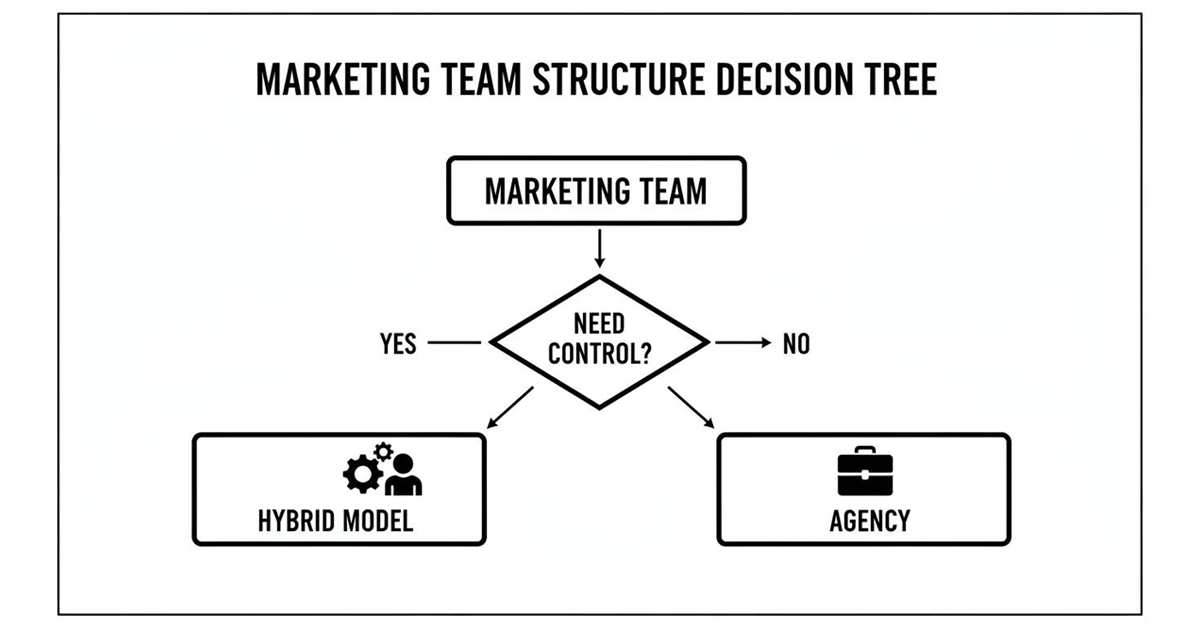
The diagram simplifies the initial choice. By identifying what you cannot compromise on, you can quickly narrow down the best path for your business.
The process is straightforward. First, you will assign a Weighting score from 1 (low importance) to 5 (critical) for each of the four decision factors. This number reflects how crucial that factor is to your immediate business success.
Next, score both the In-House and Agency options from 1 (poor fit) to 5 (excellent fit) against each factor. This is your honest assessment of how well you think each model would deliver in that specific area.
Finally, multiply the Weighting by each score to get a final weighted score. Add up the totals for each column; the model with the higher score is the one that aligns best with your strategic priorities.
Here is a scoring tool to help you evaluate whether an in-house or agency model is the right fit for your business across key strategic dimensions. Use this table to map out your scores. Be realistic about your budget, growth targets, and internal capabilities.
| Decision Factor | Weighting (1-5) | In-House Score (1-5) | Agency Score (1-5) |
|---|---|---|---|
| Cost & Predictability | |||
| Specialist Skill Access | |||
| Speed & Scalability | |||
| Control & Integration | |||
| Total Weighted Score | N/A | (Add Totals Here) | (Add Totals Here) |
Once you have filled it out, the numbers will tell a clear story about which path makes the most commercial sense for you.
To score this accurately, you need to ask the right questions. Think through these prompts as you complete your matrix.
This framework is not an academic exercise. It is a commercial tool designed to bring objectivity to a complex decision. By forcing you to quantify your priorities, it makes the best path forward significantly clearer.
After you have completed the matrix, your final scores will give you a strong indicator. A high score for the agency model suggests your priorities are speed, specialist skills, and predictable costs. A high in-house score points to a preference for deep cultural integration and long-term asset building, even if it comes with a higher initial cost.
You have weighed the costs, capabilities, and control trade-offs. Now it is time to turn that analysis into action.
The decision between building an in-house team or hiring an agency is not set in stone, but the choice you make today will set the pace for your next phase of growth. Whether your scoring framework pointed you towards hiring, outsourcing, or a hybrid approach, the path forward demands a clear, focused plan.
If building your own team aligns with your long-term vision and budget, your most important job is making the right first hire. Get this wrong, and you will be feeling the consequences for years.
Here is your pre-hiring checklist:
If speed, specialist skills, and a predictable monthly cost are what you need right now, your next job is to vet potential partners. Not all agencies are built the same, and you need one whose operating model and expertise actually line up with your commercial goals.
The most important quality in an agency partner is not the size of their office or their client list; it is their ability to demonstrate a clear link between their activity and your business's bottom line.
When you are speaking to potential agencies, cut through the sales pitch and focus on these critical questions:
Choosing between in-house and agency support is a big decision. For many businesses, the answer is not one or the other; it is a hybrid model that blends internal strategic direction with external, specialist execution.
As a senior marketing consultant and paid ads specialist, Gilkes Media provides exactly that: hands-on, strategic support. I work directly with business leaders to plug skills gaps, drive performance, and deliver measurable ROI without the overheads and layers of a traditional agency.
If you’re looking for clarity and a practical plan to grow, I invite you to a free, no-obligation consultation. We can audit your current marketing setup, get clear on your commercial goals, and define the most effective path forward for your business.
When it comes to in-house versus agency, the big strategic questions often give way to smaller, more practical ones. Here, I will give you straight answers to the queries I hear most often from business leaders trying to make this exact decision.
There is no magic revenue number. The real drivers are commercial maturity and budget consistency. As a rule of thumb, you should only consider hiring a full-time marketer when you can confidently commit to their salary, plus all associated overheads (which can easily add 40-50% on top), for at least two years.
For a business turning over less than £1 million, the cost of even one truly experienced marketer is often prohibitive. At this stage, an agency or a specialist consultant almost always delivers a better return, giving you a broad skill set for a predictable monthly fee without the long-term financial handcuff.
Speed is one of the biggest arguments for bringing in an agency. A good one can be onboarded and have initial campaigns live within two to four weeks. That timeline typically includes discovery, strategic planning, and all the technical setup, like getting ad account access and implementing tracking.
Contrast that with hiring. The process of writing a job description, interviewing, and waiting for a new hire to work their notice period and get fully up to speed can take three to six months. If you need to generate leads this quarter, an agency is your fastest route to market.
The core difference is mobilisation. An agency is a ready-made marketing engine you can switch on. An in-house hire is an asset you have to find, build, and integrate over time.
Look past the flashy portfolio and focus on genuine commercial understanding. The best partners do not just talk about clicks and impressions; they start by asking about your profit margins, sales cycle, and customer lifetime value. They want to understand your business, not just your budget.
Key things to demand include:
Ultimately, the best choice in the in house marketing vs agency debate depends entirely on your specific goals, budget, and timeline.
Making the right strategic decision is the first step towards measurable growth. At Gilkes Media, I partner directly with business leaders to provide the hands-on expertise and strategic clarity needed to drive results. If you’re ready for a focused plan, book your free consultation at https://gilkesmedia.co.uk.
