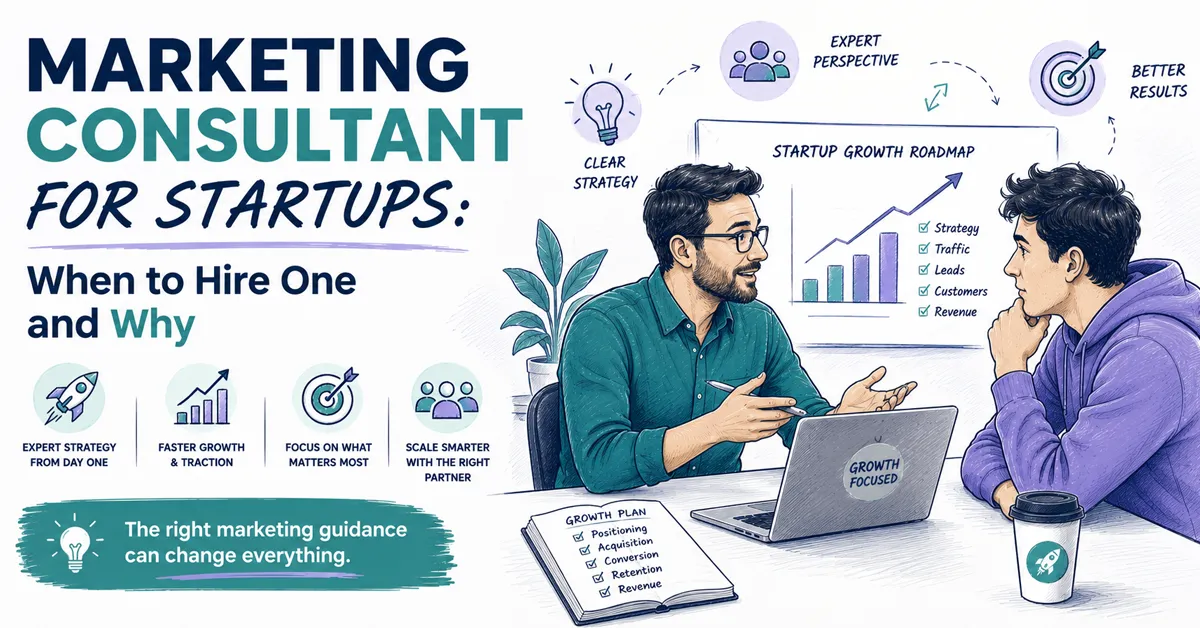
You’ve likely lived some version of this already.
The product is solid. Early users get it. A few customers arrive through referrals, founder-led outreach, or personal networks. Then growth stalls. You try Google Ads for a month, post on LinkedIn when you remember, brief a freelancer, rewrite the homepage twice, and still can’t say with confidence what’s driving leads or sales.
That’s the startup marketing problem in its most common form. Not a lack of effort. A lack of focus, sequencing, and commercial control.
Most founders don’t need more random activity. They need a clear route from offer to audience to conversion. They need someone who can look at the whole picture, challenge weak assumptions, and stop budget leaking into channels that look busy but don’t move revenue. That’s where a marketing consultant for startups becomes useful.
A good consultant doesn’t just “do some marketing”. They help you decide what matters now, what can wait, what should be tested, and what should be cut. They bring structure to acquisition, sharpen the message, and make performance visible in commercial terms.
This matters even more in a UK startup environment where budgets are tighter, compliance matters more, and imported US advice often doesn’t fit the reality on the ground. Founders here don’t need theory dressed up as strategy. They need practical judgement.
One week you’re in product meetings. The next you’re trying to work out why your paid search account is spending money but not producing qualified leads. Then sales asks for better messaging, your developer asks what page should be built next, and an investor wants an update on pipeline.
That’s normal in an early-stage business. It’s also where marketing starts to unravel.
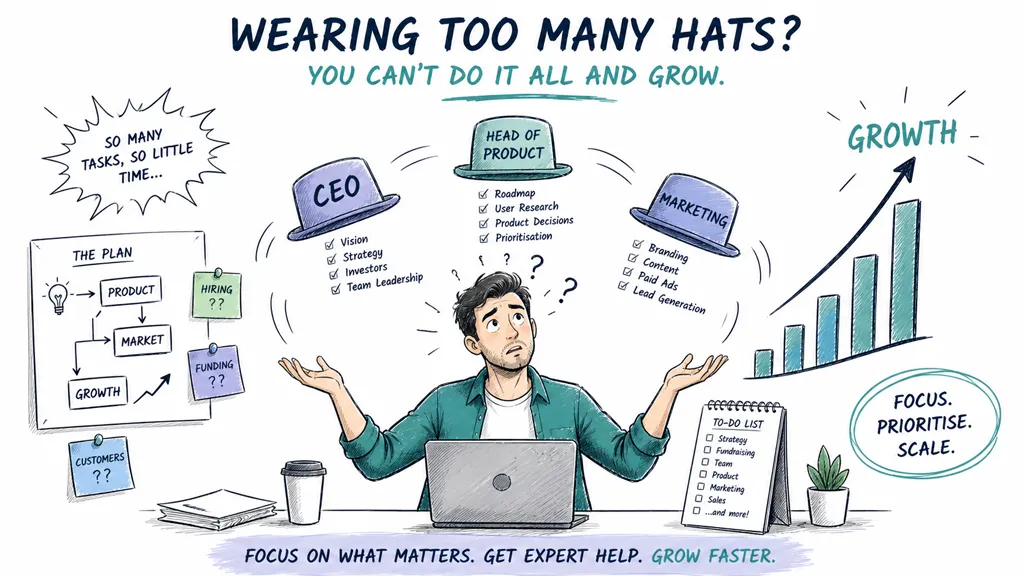
Founders usually start with good instincts. They know the product. They know the problem they solve. What they often don’t have is the time or distance to turn that into a disciplined marketing system.
So the business ends up in a familiar pattern:
The result is frustration. Not because marketing can’t work, but because nobody is steering it properly.
A marketing consultant for startups changes that dynamic. The job isn’t to add noise. It’s to create order. That usually starts with a hard look at the commercial basics: who you’re targeting, what problem you own, which channels match buying intent, and how conversion is being measured.
Founders rarely need more ideas. They need a senior pair of hands to decide which ideas deserve budget and which ones should be ignored.
The difference is important. A consultant should help you make fewer, better decisions. That means clearer positioning, tighter testing, and stronger accountability. It also means protecting the business from common early mistakes, like spending on awareness before the offer converts, or outsourcing execution before strategy is settled.
If your marketing feels expensive, inconsistent, or dependent on founder energy, that’s usually the signal. You don’t need a bigger to-do list. You need a plan that links activity to revenue.
A marketing consultant for startups sits between pure strategy and pure delivery. They aren’t there to fill a junior execution gap, and they aren’t there to produce vague slides that nobody uses. Their value comes from making marketing commercially coherent.
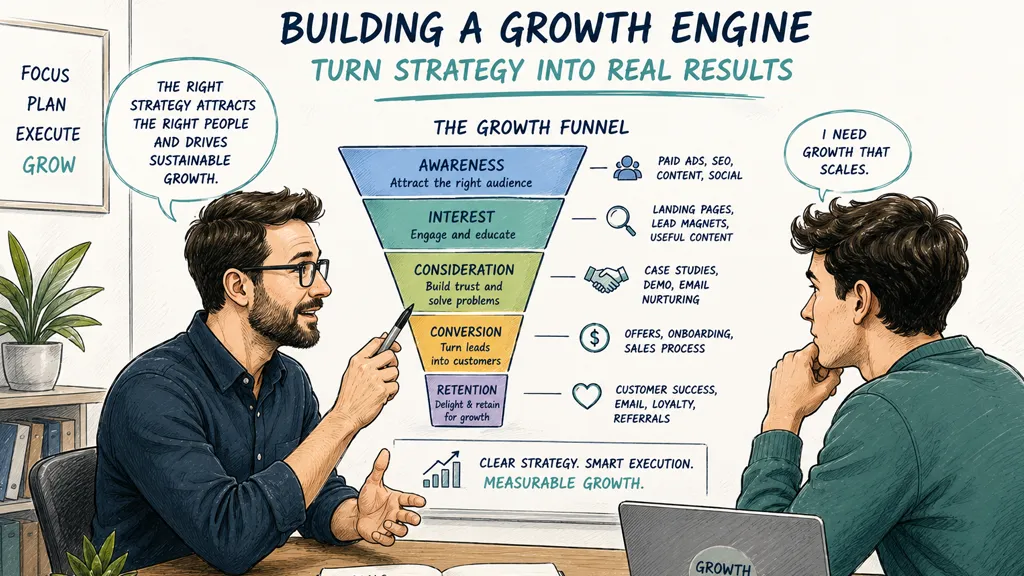
An agency often starts with a channel. Paid search, SEO, social, content. That can work if you already know your positioning, budget, sales process, and growth priorities.
Startups often don’t.
A consultant starts higher up. They ask tougher questions. What’s the actual commercial objective? What has to happen first? Is the bottleneck traffic, conversion, offer clarity, lead quality, or follow-up? That strategic layer matters more than campaign setup.
If you want a deeper explanation of that distinction, this breakdown of a strategic marketing consultancy is useful: https://gilkesmedia.co.uk/marketing-consultancy/what-is-marketing-consultancy/
A freelancer is usually hired to do a task. Write copy. Build landing pages. Run Meta ads. Useful, but narrow.
A full-time marketing lead brings more ownership, but that comes with fixed overhead, onboarding time, and risk if the role isn’t yet fully defined.
A consultant gives you senior judgement without forcing an early-stage business into a structure it may not need yet.
Here’s the practical difference:
| Option | Primary focus | Best use | Main limitation |
|---|---|---|---|
| Freelancer | Task delivery | Short-term execution gaps | Usually limited strategic input |
| Agency | Channel execution | Established businesses with defined goals | Can optimise activity before strategy is settled |
| Full-time hire | Internal ownership | Businesses ready for permanent leadership | Higher fixed commitment |
| Consultant | Strategic direction and oversight | Startups needing clarity, pace, and accountability | Needs founder collaboration to work well |
A strong consultant usually contributes across four areas.
This is the first job. Market focus, offer clarity, audience segmentation, messaging, channel selection, and budget logic all sit here.
Without this, execution becomes expensive guesswork.
Even when they aren’t pushing every button themselves, they should be close enough to spot waste, challenge poor decisions, and improve how campaigns are run.
That means reviewing ad accounts, landing pages, CRM flows, and sales handoff.
A practical example is email. Many startups treat it as an afterthought, even though it often becomes one of the best channels for nurturing leads once paid traffic starts working.
A consultant should translate marketing activity into business outcomes. Not “traffic is up”. Not “engagement looks healthy”.
They should be able to say which channels produce qualified demand, where conversion breaks, and what should change next.
The best consultants leave your business sharper than they found it. They document decisions, improve reporting, raise standards, and help internal teams think more clearly about growth.
Practical rule: If a consultant can’t explain your marketing plan in simple commercial terms, they probably don’t understand it well enough themselves.
You don’t hire a marketing consultant for startups just because marketing feels messy. You hire when the cost of drift becomes higher than the cost of experienced guidance.
That moment usually shows up in a few predictable ways.
Once outside capital is involved, the margin for vague marketing gets smaller. Investors don’t expect perfection, but they do expect decision quality. If spend is increasing, reporting is patchy, and nobody can explain which channels deserve more budget, that’s a risk.
At this stage, founders often need someone who can convert ambition into a realistic acquisition plan.
Plateaus are dangerous because they tempt teams into doing more of everything. More channels, more content, more testing, more spend.
That usually makes the problem worse.
A consultant can separate a traffic issue from a conversion issue, or a messaging issue from a targeting one. That distinction saves time and money.
New product launch. New market. New category entry. Rebrand. Major offer shift.
These aren’t moments for improvised marketing. They need positioning, sequencing, and a clear view of what the market is likely to respond to. A consultant brings that structure before budget is committed.
This is one of the clearest signals. Money is going into paid media, freelancers, content, or tools, but nobody can explain what’s working.
That’s not a scaling issue. It’s a management issue.
According to analysis cited in the Cansulta guide, only 28% of UK startups achieve positive marketing ROI in their first two years, often because of inefficient ad spend, and expert consultants can reduce these failure rates by 35% through data-driven optimisation and strategic oversight.
That doesn’t mean every consultant is worth hiring. It means unmanaged marketing carries real downside.
In the earliest phase, founder-led marketing is often necessary. It helps shape message-market fit and keeps learning close to the customer.
But there’s a point where it becomes a bottleneck.
If every campaign, landing page, message angle, and reporting question still lands on the founder’s desk, growth will stay inconsistent. Senior support becomes less about delegation and more about freeing leadership to focus on product, hiring, and revenue.
Ask yourself four questions:
If the answer to several of those is no, waiting usually costs more than acting.
Hiring too early can waste budget. Hiring too late usually wastes more.
Most founders don’t struggle to find consultants. They struggle to tell the credible ones from the polished ones.
The right choice is rarely the person with the biggest pitch. It’s the one whose thinking matches your stage, your sales reality, and your commercial constraints.
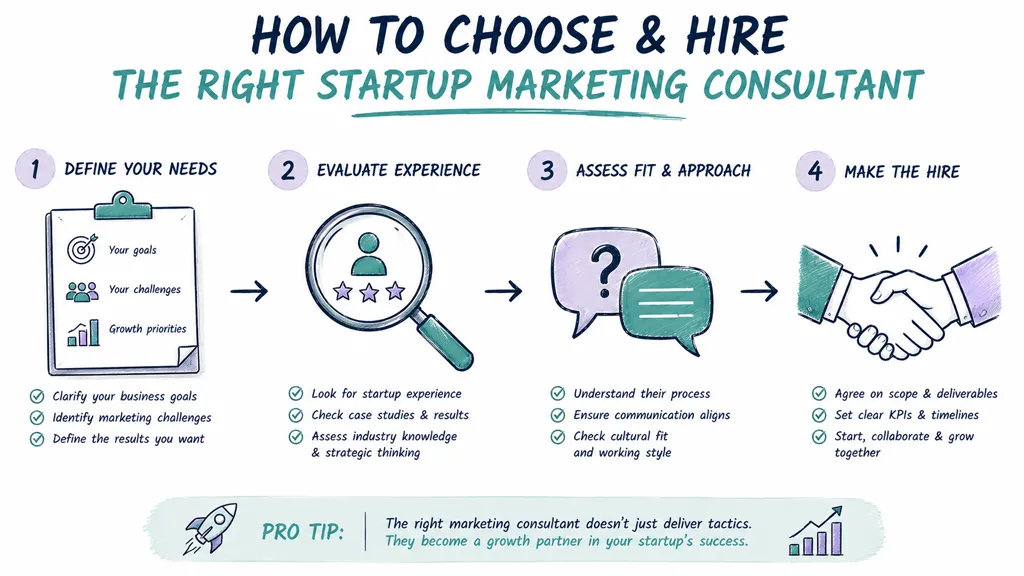
Before you speak to anyone, define what you need.
Not “help with marketing”. That’s too vague. Be specific.
You might need:
A good consultant will usually sharpen the brief, but you still need a starting point.
A consultant who works well with a funded scale-up may be the wrong fit for a pre-seed startup. The reverse is also true.
Early-stage businesses need someone comfortable with ambiguity, limited data, and evolving offers. Later-stage startups usually need stronger operational discipline, clearer reporting, and tighter cross-functional coordination.
Ask direct questions such as:
If answers stay vague, that’s a warning sign.
Startups benefit from broad marketing understanding, but they usually hire because they need depth somewhere critical.
That’s why a T-shaped consultant often works best. Broad enough to connect strategy, channel mix, website, CRM, and conversion. Deep enough to solve a real growth problem.
For many startups, paid media is that deep skill because it creates fast feedback on offer, message, and conversion. For others, it may be lifecycle marketing, SEO-led demand capture, or product marketing.
What matters is whether they can connect channel decisions to business goals.
Don’t ask only for results. Ask how they diagnose problems.
A serious consultant should be able to review your setup and quickly identify likely issues such as:
Listen for commercial reasoning. Strong consultants talk about trade-offs. Weak ones jump straight to tactics.
You’re not hiring someone to agree with your current plan. You’re hiring them to improve it.
The structure matters almost as much as the person.
| Model | Best For | Typical Cost (UK) | Key Benefit |
|---|---|---|---|
| Project-based | Specific launch, audit, or repositioning work | Varies by scope | Clear deliverable and timeline |
| Fractional consultant | Ongoing strategic guidance with regular involvement | £5,000-£15,000/month | Senior expertise without full-time overhead |
| Advisory sessions | Founders needing periodic high-level input | Varies by cadence | Flexible support for decision making |
| Embedded consultant | Close work with internal team and channels | Varies by scope and involvement | Stronger accountability and faster implementation |
The £5,000-£15,000 per month benchmark for fractional UK experts is part of the UK-specific gap highlighted in the background material provided for this article, and it’s one of the few practical pricing ranges founders can use when budgeting.
Case studies help, but they can also mislead. Context matters more than headline wins.
Ask:
That last question is especially useful. Experienced consultants talk comfortably about failed tests, false starts, and pivots. Inexperienced ones often present a suspiciously perfect story.
Many generic guides fall short in this area.
The UK startup environment has its own realities. GDPR affects how teams think about data capture, audience building, and ad targeting. The source material behind this piece notes that 62% of UK founders report compliance as a top barrier in a 2025 Tech Nation survey, which is exactly why imported US playbooks often need adjustment before they’re useful in Britain.
You want someone who understands those operational constraints and can still build practical acquisition systems inside them.
Walk away if you hear any of the following:
Good consultants don’t sell certainty. They sell better judgement, stronger process, and clearer accountability.
Hiring well is only half the job. A strong consultant can still underperform if the startup gives them partial access, inconsistent communication, and unclear authority.
The first few months matter because they set the pace, the standards, and the quality of decisions.
The opening phase should move in sequence.
Discovery comes first. That includes offer, market, current channels, CRM setup, analytics, sales process, and any previous campaign data.
Weak foundations usually present as missing conversion tracking, muddled messaging, poor lead qualification, or channel activity that doesn’t match how buyers purchase.
Strategy turns those findings into action. A good consultant will narrow the focus, prioritise the next tests, define what success looks like, and set reporting expectations.
This is also the point where team roles need to become explicit. Who owns landing pages? Who approves creative? Who handles CRM workflows? Who speaks to sales?
Initial execution starts once the logic is clear. That may mean restructuring ad accounts, rebuilding key pages, tightening forms, refining lead scoring, or cleaning up reporting.
The best early wins are rarely flashy. They tend to come from fixing the obvious leaks first.
Startups often slow down their own consultant by drip-feeding information.
Provide access to:
If access is incomplete, recommendations will be slower and less reliable.
The consultant can only improve what they can see.
You need a simple operating cadence.
That usually means:
Founders sometimes overcomplicate this. You don’t need more meetings. You need cleaner ones.
AI has become part of startup marketing whether teams are ready or not. The issue isn’t whether to use it. It’s where it helps and where it harms.
According to Innovate UK data from March 2026, AI tools can boost lead conversion by 52%, but only 15% of SMEs adopt them due to integration fears, and experienced consultants champion hybrid human-AI strategies that yield up to 2.5x higher ROI than purely automated approaches (https://www.innovateuk.org/).
That fits what many practical operators already see. AI is useful for speed, drafting, summarising, pattern recognition, and workflow support. It is less reliable when left to define positioning, control paid budgets without supervision, or produce persuasive messaging without human judgement.
For startups, the smart model is hybrid. Use AI to reduce manual drag. Keep strategy, offer decisions, budget control, and conversion thinking in human hands.
If improving the point of conversion is a priority, this guide on conversion rates is worth reviewing: https://gilkesmedia.co.uk/marketing-consultancy/how-to-improve-conversion-rates/
Founders get into trouble when marketing is reported in activity metrics instead of business metrics.
Impressions look encouraging. Clicks can look busy. Even lead volume can mislead if sales rejects half of them.
A marketing consultant for startups should build a measurement system that starts with commercial outcomes and works backwards.
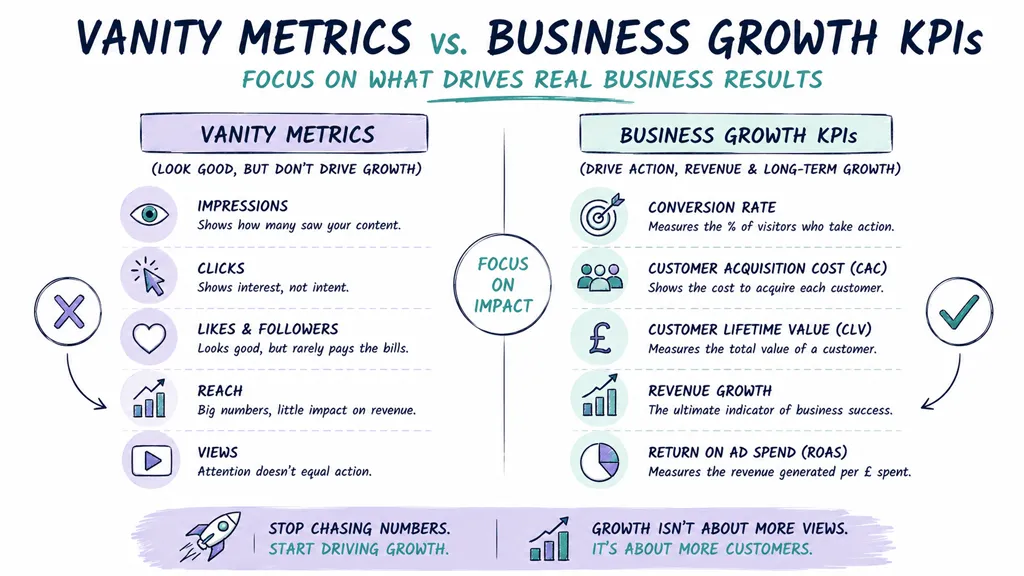
Vanity metrics aren’t useless. They’re just incomplete.
If a report leads with reach, likes, traffic spikes, or click-through rate, ask the obvious next question. Did any of this produce qualified pipeline, revenue, or profitable customer acquisition?
If the answer isn’t clear, the report isn’t doing its job.
A simple hierarchy keeps everyone honest.
These matter most because they reflect commercial health.
These help explain why business-level outcomes are moving.
These are diagnostic metrics, not the final score.
A useful companion read on KPI thinking is this piece on how to measure marketing efforts, particularly if your current reports still lean too heavily on surface-level engagement.
A strong consultant doesn’t dump numbers into a spreadsheet and call it reporting.
They explain what changed, why it changed, whether it’s likely to continue, and what decision should follow. That narrative matters because startups need action, not just data storage.
A dashboard without interpretation leaves founders doing the strategic work they hired someone else to do.
Here’s the kind of situation I see often.
A B2B startup runs paid search around broad service terms. Traffic arrives, but most leads are poor fits. The problem isn’t that paid search “doesn’t work”. The issue is weaker intent targeting, a generic landing page, and forms that collect contact details without qualifying need.
The consultant’s job is to tighten the route:
That kind of work doesn’t always make the top-line lead count look bigger immediately. It often makes the pipeline better. Commercially, that’s the right trade.
If you want a more detailed view of ROI thinking in paid acquisition, this guide is useful: https://gilkesmedia.co.uk/marketing-consultancy/strategic-marketing-consultancy/
Startup marketing usually breaks for one of three reasons. The strategy is unclear, the execution is unmanaged, or the reporting doesn’t connect to revenue. SEO is often part of that next step - our guide to SEO services for startups covers what good early-stage SEO looks like.
More activity won’t solve that. Better leadership will.
That’s why a strong marketing consultant for startups can change the trajectory of a business. The right person brings focus, commercial discipline, and accountability. They help you choose the right channels, stop waste, improve conversion, and build a system that isn’t dependent on founder guesswork.
For founders who want that level of support, Gilkes Media offers a hands-on, senior-led approach built around practical growth, not agency theatre. Jason Gilkes works directly with founders and leadership teams to shape strategy, improve performance, and manage paid acquisition with real accountability.
Gilkes Media has managed £3,000,000+ in ad spend and generated 80,000+ leads across sectors including technology, finance, construction, healthcare, and professional services. The work stays close to the numbers and close to the commercial objective.
If you need clearer direction on paid ads, lead generation, conversion, or marketing strategy, the next move is simple. Have a direct conversation, assess what’s working, identify what isn’t, and build a focused plan around the realities of your business.
A marketing consultant is usually brought in to solve a defined growth problem, improve strategy, or add senior oversight. A fractional CMO often takes broader leadership responsibility across the whole marketing function.
In practice, there’s overlap. The difference tends to be scope, internal authority, and how embedded they become in team management.
Hire for the constraint.
If your problem is narrow and obvious, such as underperforming Google Ads or weak email nurturing, a specialist can be the right answer. If the problem is broader, such as unclear positioning, poor channel fit, and inconsistent reporting, start with a generalist consultant who can diagnose the full picture.
Three stand out.
You should also be cautious if the person who sells the work won’t be the person doing the work.
More involved than many expect, especially early on.
You don’t need to manage every campaign, but you do need to provide access, fast decisions, market context, and honest feedback from sales or customers. The best consulting relationships are collaborative, not outsourced and forgotten.
If you're looking for clear, commercially focused support from a senior practitioner rather than a generic agency model, speak to Gilkes Media. You’ll get direct insight, honest recommendations, and a practical plan built around leads, sales, and measurable growth.
