
Strategic digital marketing consultants in the UK typically charge £150 to £500 per hour, and monthly retainers commonly sit between £5,000 and £25,000+. Entry-level support can start lower, but if you need senior strategic input, those are the numbers you should budget around.
That's usually the moment business owners either relax because the budget feels realistic, or wince because the range is wider than expected. Those searching for digital marketing consultant fees aren't just curious. They're trying to work out whether they need a few hours of expert advice, a defined project, or ongoing strategic support that changes revenue performance.
The confusion usually starts because “marketing consultant” can mean completely different things. One person is fixing a Google Ads account for a day. Another is acting like a fractional senior leader, diagnosing acquisition problems, aligning sales and marketing, reviewing the website, sorting attribution, and deciding where budget should go. Those two engagements shouldn't cost the same, and they don't.
A useful UK benchmark puts strategic consultants at £150 to £500 per hour, with monthly retainers of £5,000 to £25,000+, while entry-level consultants may charge £75 to £150 per hour. That gap matters. You're not only buying time. You're buying judgement, prioritisation, and someone who can reduce expensive mistakes.
If you're looking at a consultancy partner rather than a task-based freelancer, it helps to think in terms of commercial responsibility. A consultant doing isolated ad hoc work is one thing. A consultant who's expected to audit the business, shape the strategy, and recommend where to invest next is taking on a different level of accountability.
That's why fee discussions make more sense when tied to outcomes, not just hours. If you want a clearer view of what that strategic layer involves, strategic marketing consultancy support is a better comparison point than low-cost freelance execution.
The honest answer is that you should pay according to the size of the problem, the level of expertise required, and the cost of getting the decision wrong.
If your business needs a second pair of hands to tidy up campaign settings, review some landing page copy, or sense-check a channel plan, your spend will sit at the lower end of the market. If you need someone to diagnose why leads are poor quality, why SEO isn't converting, why the website leaks enquiries, and why paid media keeps stalling, the fee climbs because the responsibility climbs with it.
Cheap consultancy often looks sensible on paper. Lower hourly rate. Lower risk. Easier to approve.
In practice, it can become expensive fast if the person you hire can't identify the underlying issue. A business can waste months polishing the wrong channel, chasing vanity metrics, or building reports that don't change decisions. The actual loss isn't the consultant's fee. It's the missed opportunities, weak lead quality, and internal time spent compensating for bad direction.
Practical rule: If the consultant is influencing budget allocation, positioning, lead generation strategy, or website conversion decisions, judge the fee against the commercial impact of those decisions, not the number of hours alone.
If lead generation is the main reason you’re hiring a consultant in the first place, our guide to B2B lead generation in the UK covers what a proper strategy should actually include.
A good consultant should give you one or more of these:
That's the frame that makes digital marketing consultant fees easier to judge. You're not hiring a line item. You're hiring a decision-maker, a specialist, or a growth partner. Which one you need changes the fee model completely.
The wrong fee structure creates the wrong buying decision. A business that needs clear strategic direction can end up drip-feeding hours into reactive work. A business that only needs a one-off audit can overcommit to a monthly retainer it will not fully use.
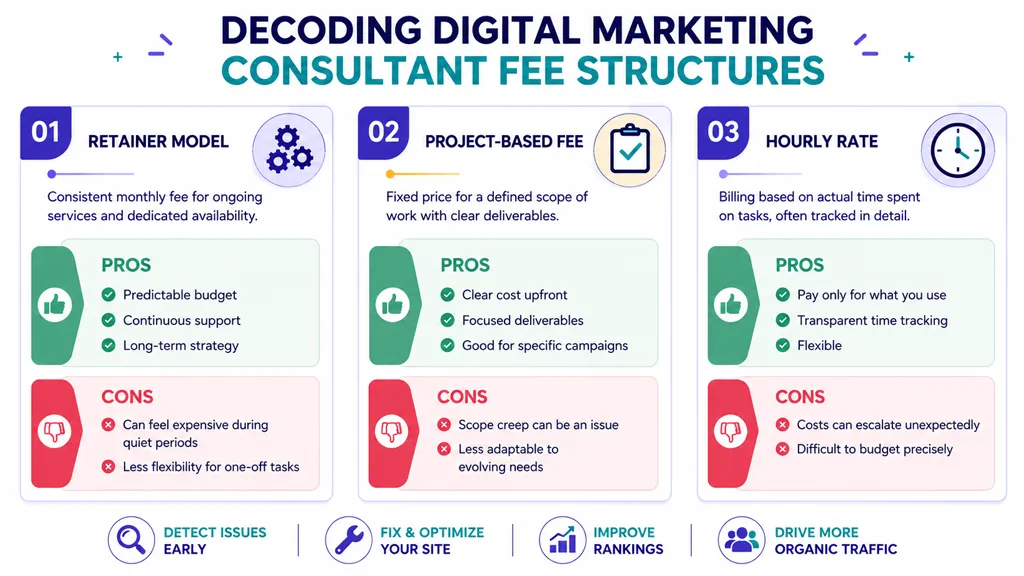
The useful question is not which model is cheapest. It is which model gives you the best commercial return for the job in front of you.
Hourly and day-rate work suits focused problems with a clear start point. That usually means an audit, workshop, channel review, tracking diagnosis, senior second opinion, or short-term support during a busy period.
Day rates vary widely by role and seniority across the UK freelance market. Buyers should anticipate this. A consultant who is fixing ad account structure is priced differently from one helping you decide where next quarter's budget should go.
Best for
Watch-outs
I usually recommend hourly or day-rate work when a business is still trying to answer, "What is broken here?"
Project pricing works when the deliverable is specific and both sides can define success before the work starts. Good examples include a marketing audit, an SEO migration plan, a paid media account rebuild, a measurement setup, or a go-to-market strategy.
The UK government's guidance on working out project costs is aimed broadly at pricing work, but the principle applies well here. Clear scope, clear assumptions, and clear exclusions protect both sides. If those three things are vague, a fixed fee often turns into a negotiation halfway through the job.
Best for
What can go wrong
Retainers fit work that needs continuity, judgement, and regular reprioritisation. They make sense when performance depends on ongoing testing, budget allocation, reporting, conversion improvements, and senior oversight across several channels or teams.
This model tends to work best when the consultant is helping you make decisions every month, not just delivering isolated tasks. That could mean reviewing lead quality, spotting wasted spend, coordinating agencies, pressure-testing campaign plans, or helping your team focus on the few activities most likely to produce revenue.
Best for
Watch-outs
A good retainer should feel like ongoing commercial guidance with clear priorities, not a standing fee for occasional calls.
A £400 day rate and a £1,200 day rate can both be reasonable. The key question is what decision-making you are buying, how much risk sits behind those decisions, and what happens if they are wrong.
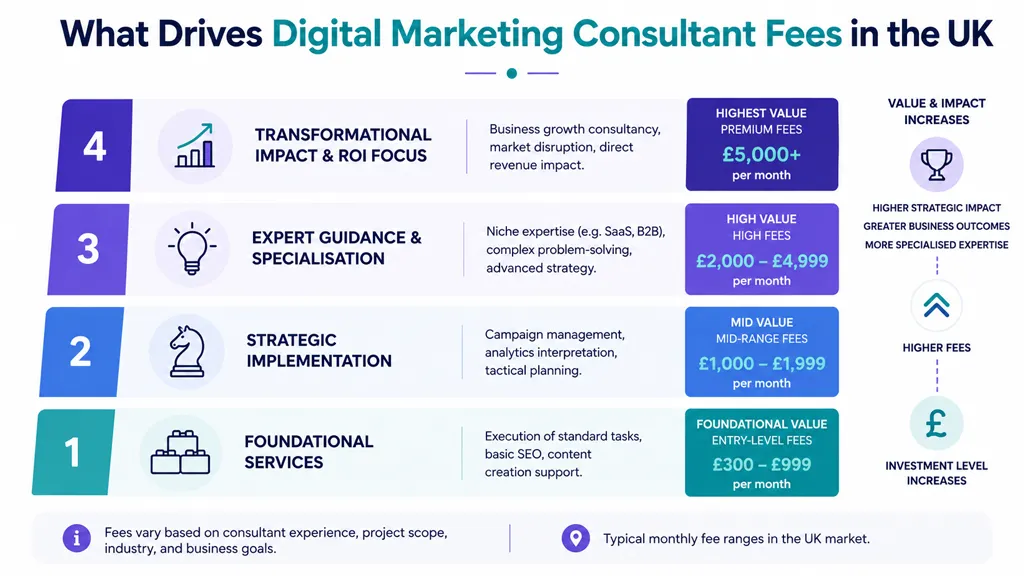
Fees rise when the consultant's work has a bigger effect on revenue, margin, and wasted spend. Someone brought in to audit campaigns or improve reporting will usually charge less than someone expected to set channel strategy, challenge internal assumptions, and help the leadership team make better commercial calls.
That difference matters because businesses often compare fees by the hour or day, then miss the bigger cost. Cheap advice is expensive if it keeps you backing the wrong channel, hiring the wrong agency, or scaling a weak offer.
| Fee driver | Lower-fee end | Higher-fee end |
|---|---|---|
| Business problem | Isolated task or channel issue | Growth bottleneck affecting sales, margin, or multiple channels |
| Scope | Defined support with clear boundaries | Broad remit across strategy, prioritisation, and oversight |
| Specialism | General digital marketing input | Hard-to-find expertise such as technical SEO, paid media efficiency, CRO, or attribution |
| Seniority | Delivery support | Commercial judgement for founders or senior management |
| Complexity | Short sales cycle, simple funnel | Longer sales cycle, CRM handoffs, multiple stakeholders, several traffic sources |
A senior consultant should cost more if they reduce the chance of an expensive mistake.
That might mean stopping a site rebuild that will not fix lead quality. It might mean holding back ad spend until tracking works properly. It might mean pointing out that the underlying issue is weak sales follow-up, not top-of-funnel traffic. Those are not production tasks. They are commercial decisions.
I see this most often in companies that say they need "more leads" when they need clearer positioning, better qualification, or tighter handover between marketing and sales.
A local service business with one offer, one decision-maker, and a short path to sale is simpler to advise than a B2B company with paid search, SEO, outbound, CRM workflows, and a sales cycle that runs for months.
The consultant is not just reviewing campaigns in the second case. They are dealing with tracking gaps, channel overlap, lead scoring, pipeline quality, and internal politics. Fees increase because the work takes more judgement, more stakeholder management, and more responsibility for outcomes.
This is also why specialist B2B consultants often charge more than generalists. If your revenue depends on how marketing and sales work together, the comparison is not only consultant versus consultant. It can also help to compare advisory spend with team build-out costs. This cost to hire SDRs guide is useful context if you are deciding whether the next investment should go into lead generation strategy, sales capacity, or both.
The best question is not "what is the cheapest day rate available?"
It is whether the fee matches the size of the decision, the complexity of the business, and the return you expect if the work goes well. A consultant who helps you avoid six months of wasted spend can be good value at a premium rate. A cheaper consultant who stays at surface level often costs more in the end.
A founder is about to launch, an agency lead pipeline has stalled, or an online store is paying for clicks that do not turn into orders. Those are three very different buying decisions, so the right consultant fee structure changes with the problem you need solved.

Early-stage businesses often need sharp thinking more than ongoing activity. The usual gap is not effort. It is clarity on offer, channel choice, messaging, tracking, and what the first 90 days should look like.
A fixed project fee usually suits this best. It gives the founder a defined outcome, a clear scope, and less risk of drifting into monthly spend before the basics are ready.
That project might cover:
If launch activity then needs active management, a short retainer can follow. Paying monthly from day one is often poor value when the site, offer, or measurement still needs work.
This is the UK SME case I see most. The business has some visibility, some referrals, and a site that brings in occasional enquiries, but growth is patchy and sales questions lead quality.
A project-led diagnostic is usually the right first move. The consultant needs room to examine search demand, service page performance, paid search overlap, CRM handoff, and where leads drop out of the funnel. Once that picture is clear, the business can decide whether ongoing support will produce enough commercial return.
The buying choice often looks like this:
| Business situation | Better starting fee model | Why |
|---|---|---|
| Need clarity before committing budget | Project fee | Finds the real constraint and sets priorities |
| Need regular optimisation across channels | Retainer | Supports steady improvement and accountability |
| Need senior strategy input a few times a year | Day rate | Works for workshops, planning sessions, and reviews |
Website quality has a direct effect on value here. Better rankings help less than owners expect if service pages are vague, forms create friction, or sales follow-up is inconsistent. Businesses reviewing this type of spend should also understand what a strategic marketing consultancy does before agreeing to a monthly arrangement.
This business often blames ad performance first. Sometimes that is right. Often the underlying issue sits on the site.
If product pages are weak, mobile UX is clumsy, shipping costs appear late, or checkout leaks sales, paying a consultant purely to buy more traffic rarely fixes the commercial problem. A project fee makes sense when the first job is diagnosis, conversion review, landing page recommendations, and implementation priorities.
Retained support becomes more sensible once the store has clear evidence that:
The fee decision should follow the economics of the store. A consultant who improves conversion by even a modest amount can justify a premium fee if traffic volume is already strong. A cheaper option that only reports on channel metrics can cost more overall if the site continues to waste paid clicks.
The practical question in all three scenarios is the same. Are you paying for activity, or are you paying to remove a growth constraint that has a clear commercial upside?
Most businesses ask the wrong first question. They ask, “What does a consultant cost?” The better question is, “What financial result would make this a sensible investment?”
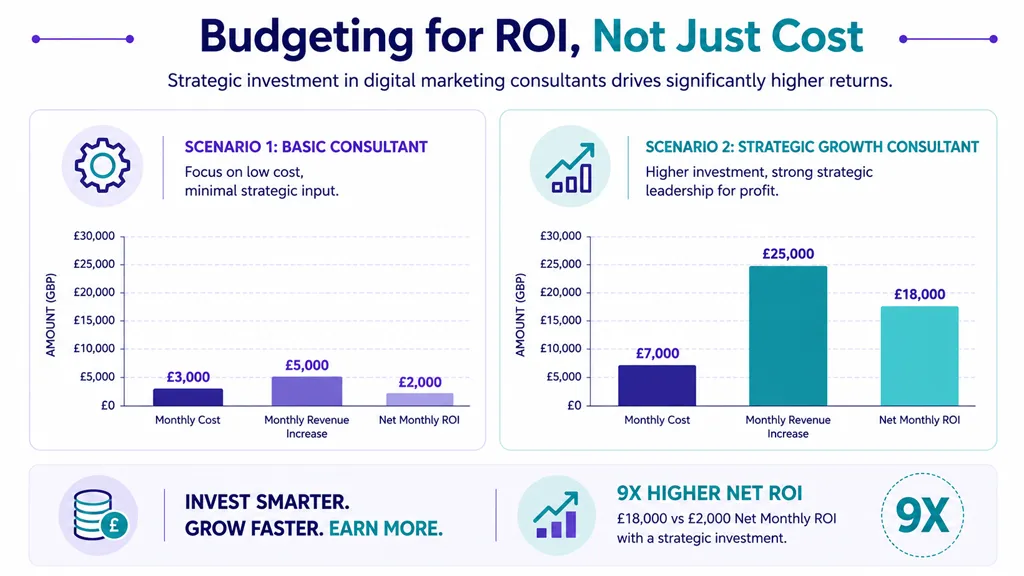
A consultant should be tied to commercial movement. More qualified enquiries. Better conversion rates. Improved lead handling. Stronger revenue from existing traffic. Lower waste in ad spend. Clearer attribution.
You don't need a complicated finance model to think properly about ROI. You need a simple line of sight between the fee and the likely business impact.
For example, ask:
Those questions lead to better buying decisions than comparing hourly rates in isolation.
A useful buyer question from this UK-focused consultancy cost guide is: when does a retainer become cheaper than repeated project work for a growing UK business? The same guide notes that monthly consultancy retainers commonly range from about £1,500 to £10,000+, while project work starts lower.
That matters because one-off projects are attractive when you want control. But repeated one-off projects can become inefficient if the business needs regular review, implementation support, reporting, and prioritisation. At that point, a retainer often creates better economics because the consultant isn't re-learning the business every time.
Commercial lens: A consultant should help you make better decisions about where to spend, what to fix first, and what to stop doing.
A sound ROI conversation usually includes:
If you want a practical framework for that conversation, this guide on how to measure marketing ROI helps connect spend to outcomes in a way leadership teams can use.
The key point is simple. A consultant fee only looks expensive when you compare it to nothing. Compare it to wasted ad spend, poor conversion, weak sales follow-up, or months of drift, and the maths often changes.
Good buyers ask better questions than “What's your rate?”
A proposal can look polished and still be a poor fit. Before signing, you need to know how the consultant thinks, how they measure success, and whether their way of working suits your team.
Ask these early:
How do you define success for a business like mine?
The answer should connect to enquiries, revenue, sales quality, or commercial movement. If they drift straight into impressions and clicks, keep digging.
What do you need from my team to make this work?
Strong consultants know results depend on access, responsiveness, implementation, and internal ownership.
What does your process look like in the first month?
You want to hear diagnosis, prioritisation, tracking, and decision-making. Not vague promises.
Have you worked with businesses that sell like we sell?
Selling low-ticket e-commerce is different from selling B2B services with a long consideration cycle.
What happens if the original scope needs to change?
This tells you whether they handle scope like a grown-up or let projects become messy.
Use this shortlist when reviewing the proposal itself:
| Ask this | Why it matters |
|---|---|
| What will you report on each month? | Shows whether reporting is tied to decisions |
| Who is doing the work? | Avoids hidden outsourcing or blurred responsibility |
| What is excluded from the fee? | Prevents disputes later |
| How often will strategy be reviewed? | Stops the engagement becoming purely operational |
It's also worth understanding the contract mechanics before anything is signed. If the paperwork is being handled digitally, this guide for freelancers to sign contracts is useful for checking what a clean, professional signing process should look like.
For a broader buyer checklist, how to choose a digital marketing agency covers many of the same decision points and helps you compare consultants, agencies, and hybrid options more confidently.
A low fee won't save you from a bad fit. A clear process, honest scope, and commercially literate reporting will.
Sometimes, but the better conversation is around scope, not haggling. If the fee feels high, ask what can be removed, phased, or handled internally. Strong consultants usually protect the quality of the work rather than discounting blindly.
It depends on the problem. A consultant is often the right choice when you need senior thinking, direct access, diagnosis, or specialist support without extra layers. An agency can make sense when you need wider execution capacity across multiple channels at the same time. Many growing SMEs start with a consultant to set direction, then add execution support once the strategy is clear.
Long enough to solve the actual problem, but not so long that you're trapped in vague activity. A project engagement works well for audits, strategy, or one-off planning. A retainer is stronger when performance depends on continuous testing, SEO growth, paid optimisation, website changes, and regular commercial review. If a consultant can't explain why the proposed term is necessary, that's a concern.
If you want straight answers on digital marketing consultant fees, channel strategy, SEO priorities, paid ads performance, or whether your website is helping or hurting lead generation, our marketing consultancy service at Gilkes Media offers practical support for UK businesses that want clarity before committing budget.
