
If you run more than one marketing channel, and most UK businesses beyond the very smallest do, you'll eventually hit the same frustrating question: which of these is actually generating the enquiries and sales, and which are quietly riding on the coattails of the others without contributing much themselves.
Marketing attribution is the discipline of trying to answer that question properly, and getting it right, or at least getting it meaningfully better than guessing, is one of the highest-impact things a business can do to spend its marketing budget more effectively and with more genuine confidence.
A customer's actual journey to becoming a client rarely follows a single, clean path.
Someone might first encounter your business through a paid social ad they scroll past without clicking, search for your service by name two weeks later after seeing a colleague mention you, click through from an organic search result, read three blog posts over the following fortnight, then finally convert after clicking a retargeting ad that reminded them to follow up.
Which of these touchpoints gets credit for the resulting sale is a genuinely non-trivial question, and different attribution approaches will give you meaningfully different, sometimes contradictory, answers.
This matters commercially because whichever channel your attribution model credits will tend to receive more budget, and whichever gets underweighted risks being cut, even if it was quietly doing essential work earlier in the journey that a simpler model can't see or credit properly.
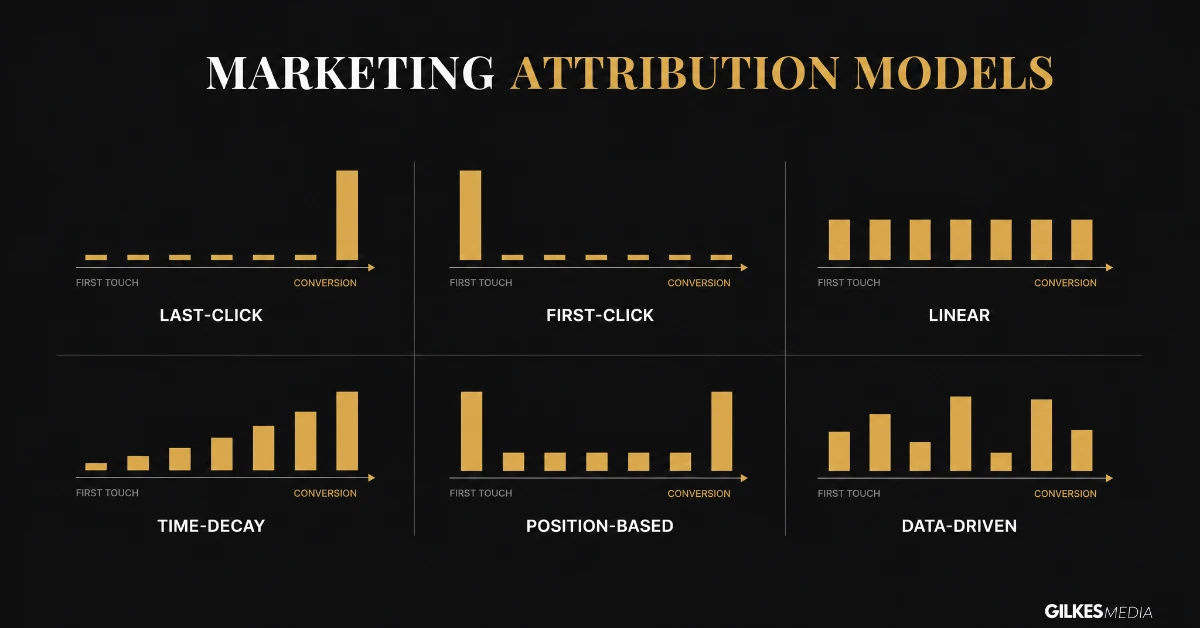
Last-click attribution. The simplest and still the most commonly used model by default in a lot of analytics tools, crediting the very last touchpoint before conversion with all the credit.
It's easy to understand and implement, but it systematically overvalues bottom-of-funnel channels, like branded search or retargeting, that tend to appear right at the point of conversion, and undervalues the channels that built the awareness and consideration earlier in the journey that made that final click possible at all.
First-click attribution. The opposite approach, crediting whichever channel first brought the person into contact with your business.
This corrects the previous model's bias in one direction but introduces the same distortion in the other, overvaluing awareness-stage channels and undervaluing whatever ultimately closed the sale.
Linear attribution. Spreads credit equally across every touchpoint in the journey.
This avoids the extreme distortion of either single-touch model, but treats every touchpoint as equally valuable, which rarely reflects reality either, a single high-intent search click close to conversion usually matters more than an early, passive ad impression, even though linear attribution counts them identically.
Time-decay attribution.
Gives more credit to touchpoints closer to the conversion and progressively less to earlier ones, a reasonable middle ground that reflects the genuine intuition that a touchpoint closer to the decision usually carries more weight, without completely disregarding the earlier journey the way last-click does.
Position-based (U-shaped) attribution.
Gives the most credit to the first and last touchpoints, with the remainder split among everything in between, on the reasoning that the initial discovery and the final conversion moment are usually the two most commercially significant points in the journey, with the middle providing valuable but comparatively secondary support.
Data-driven attribution. Available in more sophisticated analytics platforms, this uses actual conversion pattern data across your specific account to algorithmically determine how much credit each touchpoint genuinely deserves, based on real patterns rather than a fixed rule applied uniformly.
This is generally the most accurate approach available, provided you have enough conversion volume for the underlying model to produce statistically meaningful results, which smaller businesses with lower conversion counts sometimes don't have.

| Model | How it credits touchpoints | Main flaw |
|---|---|---|
| Last-click | All credit to the final touchpoint before conversion | Overvalues bottom-of-funnel channels like branded search |
| First-click | All credit to the first touchpoint | Overvalues awareness-stage channels |
| Linear | Credit spread equally across every touchpoint | Treats a high-intent click the same as a passive early impression |
| Time-decay | More credit to touchpoints closer to conversion | Still discounts early-stage influence |
| Position-based (U-shaped) | Most credit to the first and last touchpoints | Can undervalue the middle of a longer journey |
| Data-driven | Credit set algorithmically from real conversion patterns | Needs enough conversion volume to be statistically meaningful |
No attribution model is simply correct. Last-click, linear and time-decay each distort the picture in a different direction, so the real question is which model gives you a decision that's meaningfully less wrong, not which one is theoretically pure.
Every attribution model is, honestly, a simplification of a genuinely complex, multi-touch reality, and the useful question isn't "which model is correct" but "which model gives me a decision-making view that's meaningfully less wrong than the alternative I'm currently using."
A small business just starting to think seriously about attribution, currently relying purely on last-click by accepting whatever their analytics tool defaults to, gets a genuinely useful improvement simply by switching to a time-decay or position-based model, without needing to solve attribution perfectly to get real value from doing it better.
Get your tracking foundations right first. Attribution gets more useful once you factor in customer value, not just the first conversion - our guide to calculating lifetime customer value covers how to bring that into the picture.
No attribution model, however sophisticated, produces trustworthy output if the underlying tracking is broken, missing UTM parameters on campaign links, conversion tracking not properly configured across every channel, or cross-device journeys not being connected properly.
This unglamorous foundational work matters more than which specific attribution model you eventually choose, and it's worth confirming this is solid before investing further in more advanced attribution modelling that would otherwise be built on unreliable data.
Track assisted conversions, not just last-click ones. Most analytics platforms can show you which channels frequently appear earlier in a conversion path even when they weren't the final click, sometimes labelled as assisted conversions.
Reviewing this alongside your standard last-click reporting gives you a genuinely richer picture of which channels are contributing to the funnel even when a simpler model would credit them with nothing at all.
Match your attribution sophistication to your actual data volume.
A business with a handful of conversions a month doesn't have enough data for a sophisticated data-driven model to produce meaningful, stable results, and forcing one anyway can produce output that looks precise but is actually just noise.
A simpler model, applied consistently and understood honestly for its limitations, is more useful at lower volume than a falsely precise-looking sophisticated one.
Look at incrementality, not just attribution, for your biggest channel.
Attribution tells you which touchpoints appeared in a conversion path, it doesn't necessarily tell you whether that spend was the actual cause of the conversion happening, versus simply being present alongside a sale that would have happened anyway.
For your largest channel by spend, a periodic incrementality test, briefly pausing or significantly reducing spend in a controlled way and observing the effect on total conversions, gives you a genuinely more reliable read on real causal impact than attribution modelling alone can provide.
Review your model choice periodically, not just once. As your marketing mix and customer journey evolve, the attribution model that made sense a year ago may no longer reflect your current reality well.
A periodic review, checking whether your current model still produces sensible, actionable output against what you genuinely observe happening, keeps your reporting relevant rather than running on autopilot with an outdated assumption baked in.

Fix your tracking foundations before you touch your attribution model. UTMs, conversion tracking and cross-device matching that don't work properly will make even the best model produce confident, wrong answers, and low conversion volumes mean a sophisticated model can't be trusted anyway.
GA4 defaults to data-driven attribution for most properties automatically once there is enough conversion volume, but it is worth confirming this in the Attribution settings rather than assuming, since accounts migrated from older setups sometimes still carry legacy model settings.
Google does not publish an exact threshold, but data-driven attribution becomes noticeably more reliable once an account is recording at least a few hundred conversions a month across its tracked channels. Below that, treat its output as directional rather than precise, and cross-check against a simpler model.
GA4’s assisted conversions view, often ignored in favour of the simpler channel summary, shows which channels contribute without closing the sale. A channel with high assists and low direct conversions is not necessarily a weak one, it may be doing genuine top-of-funnel work that a last-click view would hide entirely.
This is where attribution decisions have the most direct budget consequence for most of our clients. Click-through rate is one of the metrics worth watching closely here - our guide on what a good click-through rate actually looks like gives you a benchmark to judge your own numbers against.
Our guide on SEO versus PPC covers the broader strategic decision between the two channels, and attribution is a big part of what makes that comparison genuinely difficult to get right with a naive last-click view.
SEO's organic contributions frequently appear earlier in a journey that a paid retargeting ad ultimately closes, making paid look disproportionately responsible for a result organic content actually did much of the real work to produce.
Getting your customer acquisition cost calculation right depends directly on getting attribution right too, since a genuinely accurate acquisition cost figure per channel requires knowing which spend genuinely produced which results, not just which channel happened to receive the final click before conversion.
A blog post or guide that ranks well often introduces someone to a business weeks or months before they convert through a branded search or direct visit. Last-click reporting credits that final touchpoint, not the content that generated the awareness in the first place, which makes SEO look weaker in a dashboard than it is in reality.
Branded paid search campaigns frequently capture people who were already going to convert anyway, having found the business through SEO, referral or word of mouth. Reviewing paid search performance with branded and non-branded terms split out, rather than blended together, gives a far more honest read on what paid spend is actually generating versus simply capturing.
Google Analytics 4's own attribution reporting includes data-driven attribution as an available model for accounts with sufficient conversion volume, and is a genuinely useful, free starting point for most businesses before considering a dedicated, paid attribution platform.
For businesses with a genuinely complex, high-volume, multi-channel setup, a dedicated attribution or marketing mix modelling tool can be worth the additional cost, but it's worth confirming your actual data volume and complexity justify it before adding another paid tool and subscription to the stack, rather than assuming more sophisticated tooling is automatically better regardless of scale.

SEO and paid search feed each other far more than last-click reporting admits, and getting attribution right there is what stops good channels being defunded for the wrong reasons. Start with GA4's own data-driven attribution before paying for a dedicated platform you may not need yet.
You don’t need a sophisticated model on day one. A basic process gets you meaningfully better data within weeks:
A UK B2B consultancy had been allocating budget almost entirely based on last-click data, which consistently showed branded paid search as their best-performing channel by a wide margin, and their SEO content as a comparatively weak contributor. It also helps to know what you're aiming for in the first place - our guide to what counts as a good conversion rate in the UK gives useful context for a worked example like this one.
Reviewing assisted conversion data told a different story: a meaningful share of the conversions credited to branded search had, earlier in the same journey, involved a visit to one of their SEO-driven blog posts, meaning the paid search click was frequently the final, easy step of a journey that organic content had done much of the real work to start.
Shifting to a position-based model, and reviewing assisted conversion paths regularly rather than relying purely on last-click totals, led to a more balanced budget allocation that continued investing properly in the content work actually building the pipeline, rather than concentrating spend entirely on the channel that happened to appear right before conversion.
The overall conversion volume improved over the following two quarters, not because more was being spent overall, but because the budget was finally being allocated based on a genuinely more accurate picture of what was actually driving results.
You don't need a perfect model to start, just a consistent process: solid tracking, UTMs on everything, one model reviewed monthly, and a habit of investigating any gap between the data and your gut. The worked example shows what changes when assisted conversions get taken seriously.
Digital attribution models only capture what happens online, and a meaningful share of genuine business impact happens outside that view entirely. For a broader look at this alongside attribution, our guide to measuring advertising effectiveness covers the wider mistakes businesses make when judging what's actually working.
Dynamic number insertion, showing a different tracked phone number depending on which channel or campaign brought a visitor to the site, lets a phone enquiry be credited back to the marketing that actually generated it, rather than disappearing into an untracked "phone" bucket that skews every other channel’s apparent performance upward by comparison.
A customer who researched extensively online before visiting a physical location, or who returns to buy again months after their original conversion, breaks most standard attribution windows entirely. CRM data, matching a sale back to an original lead source recorded at first contact, is usually the only reliable way to close this gap.
Someone who sees an ad, doesn’t click, but converts later after a direct visit or search, can still be counted by platforms offering view-through attribution, though the windows used are generous enough that this figure should be treated as a directional signal rather than a precise, verified number.
The channels attribution struggles hardest to measure, phone calls, in-person visits, brand awareness, are often exactly the ones quietly doing the most work. Treat "hard to measure" as a reason to look closer, not a reason to write it off as zero.

A dashboard nobody updates is worse than no dashboard at all, since decisions end up made against stale numbers everyone has quietly stopped trusting.
| Data point | Where it lives | How often to review |
|---|---|---|
| Channel breakdown by model (last-click vs data-driven) | GA4 | Monthly |
| Assisted conversions by channel | GA4 → Advertising → Attribution | Monthly |
| Average time to convert | GA4 → Explore | Quarterly |
| Multi-touch path patterns | GA4 → Advertising → Conversion paths | Quarterly |
| Call and offline conversions | Call tracking platform / CRM | Monthly |
Five data points, reviewed on a fixed schedule, beats a comprehensive twenty-metric dashboard nobody has time to open. Start with the table above, and only add complexity once every row in it is genuinely being reviewed and acted on.
There isn’t a single correct one. Data-driven attribution in GA4 is a sensible default for most businesses with enough conversion volume to support it, reviewed alongside first-click and linear views to sanity-check what it is showing.
Because these channels typically build awareness and consideration early in the journey, and last-click gives all the credit to whichever touchpoint happened right before conversion, usually a branded search or direct visit that content marketing helped create in the first place.
GA4’s free data-driven attribution is a genuinely useful starting point for most businesses. A dedicated paid platform is worth considering only once data volume and channel complexity are high enough to need it, which is a smaller share of UK businesses than the software industry’s marketing suggests.
Dynamic number insertion, showing a different tracked number per channel or campaign, is the standard approach and integrates with most major analytics and call tracking platforms.
A touchpoint that contributed to a conversion without being the final click that completed it, for example an early blog visit or an ad impression seen days before someone converted through a different channel.
Monthly for headline channel performance, quarterly for deeper multi-touch path analysis. Reviewing daily usually reacts to noise rather than genuine signal, since conversion paths need volume to average out properly.
Attribution only matters if you're tracking the right things in the first place. Our guides to calculating customer lifetime value and B2B digital marketing cover the wider measurement picture, and if email is one of your channels, our guide to email marketing in B2B covers what to track there specifically.
Attribution done properly won't give you a perfect, definitive answer, nothing genuinely does for a real, multi-touch customer journey, but it will give you a considerably more honest, useful picture than default last-click reporting, and that improvement alone tends to produce better, more confident budget decisions.
If you're not sure whether your current reporting is giving you an accurate view of what's actually driving results, or you suspect a channel is being over or undervalued by how your analytics currently attributes credit, that's worth a proper look before your next budget review.
Our paid ads management service includes a genuine attribution review as part of how we plan and report on client campaigns, rather than defaulting to whatever a platform's dashboard shows by default.
Get in touch through our contact page for a free discovery call, and we'll take an honest look at what your current data is really telling you, what it might be missing, and where your budget could genuinely be working harder.
The most common way attribution efforts go wrong isn't picking the wrong model, it's changing tracking without preserving comparability, ignoring offline conversions, or arguing about theoretical correctness instead of acting on signals that are already clear enough to act on.
Most attribution work eventually needs explaining to a business owner or a wider team who will not open GA4 themselves. A short, plain-language summary, "the three channels that most often first introduce a customer to us are X, Y and Z, and the two that most often close the sale are A and B", communicates the genuinely useful insight far better than exporting a raw multi-touch report full of unfamiliar terminology.
That translation step is frequently skipped, which is a large part of why attribution work often fails to change actual budget decisions even when the underlying data is genuinely good. The insight only creates value once it reaches the person who allocates the budget, in language they can act on.
No attribution model, however sophisticated, perfectly reconstructs the genuine influence of every touchpoint on a real human decision. The goal is a meaningfully better approximation than last-click alone provides, not a perfect, provably correct answer, and businesses that treat attribution modelling as a search for perfect certainty tend to abandon it in frustration long before it produces any useful decisions.
A good working standard: if the attribution view changes which channels get more or less budget in a sensible, defensible direction compared with last-click alone, it is doing its job, even if the exact percentages attached to each channel remain somewhat approximate.
Get comfortable with that level of approximation early, and attribution stops being a project that never quite feels finished and starts being a genuinely useful, ongoing input into how budget gets allocated across channels, reviewed and adjusted a little each quarter rather than solved once and left untouched.
That is a more realistic and more useful goal than chasing a single, perfectly accurate number that attribution modelling, however advanced the tool, was never actually going to produce.
Turn on GA4’s data-driven attribution, check it is actually active, review assisted conversions once, and add call tracking if phone enquiries are a meaningful part of the funnel. Those three steps alone move most UK businesses from a genuinely misleading last-click-only view to a materially better picture, without needing a dedicated platform, a data analyst, or months of setup work.
Everything else in this guide, the offline conversion tracking, the dashboard, the branded-versus-non-branded split, can be added incrementally once those fundamentals are in place and being reviewed regularly, rather than attempted all at once as a single overwhelming project.
That staged approach, three fundamentals first, everything else layered on afterwards, is what keeps attribution work from becoming another abandoned project sitting alongside the dashboard nobody updates and the tool nobody logs into any more.
Start small, review consistently, and let the picture sharpen gradually over a few quarters rather than expecting a finished, perfectly accurate attribution model on the first attempt.
That patience, more than any specific model or tool covered in this guide, is what ultimately separates businesses that get real, budget-changing value from attribution work from ones that set it up once, look at it twice, and quietly let it go stale.
Keep it simple, keep it reviewed, and treat it as a genuinely ongoing discipline rather than a one-time setup task, and attribution will keep earning its place in the marketing budget review long after the initial novelty of a new dashboard has worn off.
Do that consistently, and every budget conversation from here on starts from a genuinely clearer picture of what is actually working, rather than a last-click report that was quietly misleading everyone the whole time.
That clarity is worth the modest ongoing effort it takes to maintain.
Revisit this guide in six months, check whether GA4’s data-driven attribution is still switched on, whether the dashboard above is still being reviewed, and whether call tracking is still capturing what it should. Attribution setups drift quietly out of date in exactly the same way any other piece of marketing infrastructure does.
