
Most founders don't decide on the outsourcing of marketing because it's fashionable. They do it because the current setup has stopped working.
You're trying to run a business, keep delivery on track, manage cash flow, and somehow also review ad copy, chase website updates, question lead quality, and work out why campaigns aren't converting. Marketing becomes a pile of half-finished activity. A bit of paid search. A few LinkedIn posts. An SEO retainer nobody can properly assess. Plenty of spend. Not enough clarity.
That’s usually the true trigger. Not lack of effort. Lack of specialist execution, accountability, and time.
A founder often reaches the same point in one of two ways. Either growth has slowed and marketing has become inconsistent, or the business is growing and the current team can't support the next stage properly. In both cases, the issue isn't whether marketing matters. It does. The issue is whether the right person is leading it.
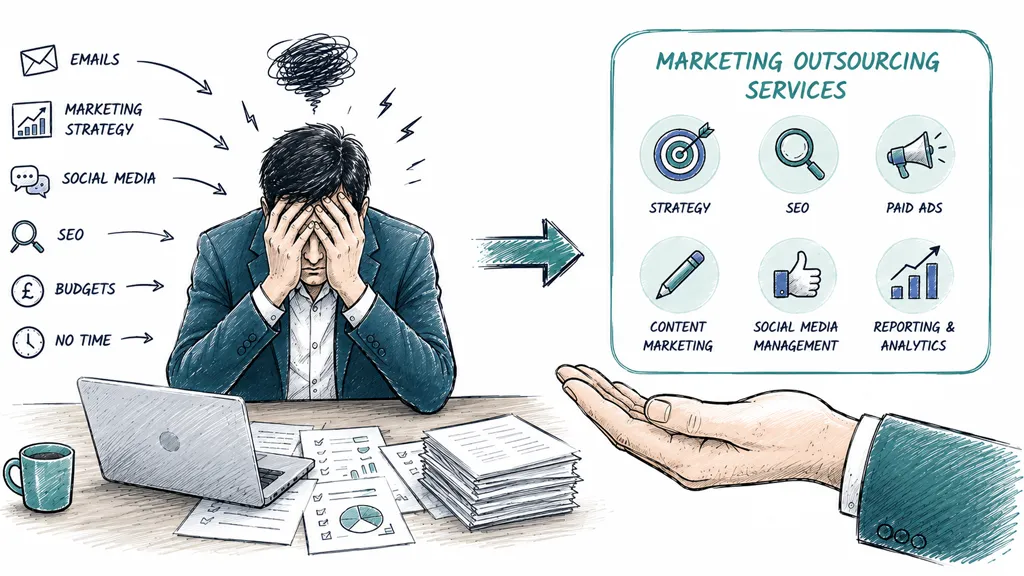
This is why outsourcing has moved into the mainstream. In 2024, 46% of UK companies outsourced some element of their marketing activities, rising to 50% for B2B companies, according to a Statista survey of 3,000 UK businesses.
Good outsourcing doesn't mean handing your brand to strangers and hoping for the best. It means bringing in capability you don't currently have in-house, or don't need full-time, then applying it against clear commercial goals.
The strongest founder-led businesses usually don't outsource because they want less involvement. They outsource because they want better decisions, faster execution, and tighter accountability.
A weak outsourcing arrangement looks like this:
A strong outsourcing arrangement is different:
Outsourcing of marketing works when you're buying judgement, not just labour.
If budget pressure is part of the decision, that's sensible. But cost alone is the wrong lens. The better lens is the strategic advantage. What expertise can you access now that would take months to hire, train, and manage internally?
For founders trying to stretch spend without diluting quality, outsourcing your marketing is beneficial so you can focus on prioritisation rather than cutting activity.
Outsourcing of marketing isn't one thing. It sits on a spectrum.
At one end, you're hiring someone to complete isolated tasks. At the other, you're effectively adding an external senior marketing function to your business. Those two options are often discussed as if they're interchangeable. They aren't.
A freelancer can be useful when the brief is narrow and the internal direction is strong. For example, a designer building paid social assets from an existing campaign plan. The problem starts when businesses hire tactical help to solve strategic problems.
If nobody has properly defined audience, offer, channel mix, attribution, and success criteria, more execution won't fix it. It just produces more activity.
The outsourcing field usually breaks down into four broad types:
The right partner should feel less like an external supplier and more like a commercially aware extension of the leadership team.
A lot of businesses say they need "marketing support" when they need one of these:
Those aren't the same need, so they shouldn't lead to the same buying decision.
A common reason for outsourcing relationships to go wrong is the measurement method. The supplier gets measured on output rather than business impact.
A body-shop style model gives you people, meetings, and deliverables. An embedded expert model gives you diagnosis, prioritisation, and accountability. One fills capacity. The other improves decisions.
That difference matters most when budgets are under pressure. If you only have room for one meaningful external hire or partner, it shouldn't be the option that creates the most noise. It should be the option that gives the business the clearest route to better performance.
Practical rule: If your internal team still needs to tell the external partner exactly what to do every week, you're probably outsourcing execution, not marketing leadership.
The best outsourcing model depends on the stage of the business, the complexity of the funnel, and how much internal marketing leadership already exists. A founder-led business with no senior marketer needs something very different from a company with an in-house team that lacks paid media depth.
There is one point worth keeping in mind before comparing options. UK businesses outsourcing full-service marketing strategies via managed team models achieve 20-35% higher campaign ROI compared to in-house efforts. That doesn't mean every outsourced setup performs better. It means a well-structured model can outperform when the expertise and workflow are right.
| Model | Best For | Typical Monthly Cost (GBP) | Key Consideration |
|---|---|---|---|
| Full-service agency | Businesses wanting broad channel coverage with one supplier | £3,000 to £15,000+ | Convenience is high, but senior attention can be diluted |
| Specialist consultant | Founders who need direct expertise, strategy, and execution in a defined area | £1,500 to £7,500+ | Strong accountability, but usually narrower than a full agency offer |
| Fractional CMO | Companies needing senior leadership, planning, and internal team direction | £2,500 to £10,000+ | Excellent for strategy, but execution may still require other suppliers |
| Hybrid model | Firms with some in-house resource but clear specialist gaps | £2,000 to £12,000+ | Works well when responsibilities are tightly defined |
Agencies appeal because they look simple. One contract, one account manager, access to several services.
That can work well if you need broad support and don't want to coordinate multiple specialists. The downside is that the person who wins the work often isn't the person doing the work. Founders buy seniority, then get process.
This model tends to suit businesses that want outsourced breadth more than direct senior involvement.
A consultant model is usually stronger when the business needs clearer thinking and tighter accountability. You're not buying a large delivery machine. You're buying experienced judgement and direct ownership.
This tends to work best when one area is commercially important enough to justify specialist attention. Paid acquisition is a good example. SEO strategy can be another. The consultant model is especially valuable when a founder wants fewer layers between problem and action.
For a broader view on the trade-offs, a comparison of in-house marketing vs agency is useful because it highlights where outside support helps and where internal ownership still matters. It also helps to consider a more detailed breakdown of in-house marketing versus agency support when you're weighing control against expertise.
This is the right fit when the business doesn't lack ideas. It lacks leadership.
A fractional CMO can set direction, challenge assumptions, build plans, and align marketing with sales and leadership. That can be highly effective for companies with existing delivery resource. It can be less effective if nobody is available to execute consistently once the strategy is agreed.
The hybrid route is often the most commercially sensible. Keep core brand knowledge, internal communication, and day-to-day business context in-house. Outsource the parts that demand deeper expertise or more technical execution.
Examples include:
The model matters less than the operating rhythm behind it. Good outsourcing has:
What doesn't work is hiring the cheapest option to solve an expensive growth problem.
Some businesses outsource too late. They wait until lead flow has dropped, internal confidence has gone, and every channel feels reactive. Others do it at the right time, when the first signs of strain appear and there's still room to fix the system before performance slips further.
The right time isn't based on company age or headcount. It's based on symptoms.
A common pattern is steady effort with little movement. Campaigns are running. Content is going out. Sales still say lead quality is mixed. Nobody can point to a clear bottleneck.
That usually means the business doesn't need more activity. It needs sharper diagnosis.
Outsourcing helps when an external specialist can identify where the breakdown sits: the offer, the targeting, the landing page experience, follow-up speed, or tracking quality. Most internal teams are too close to the current setup to challenge it properly.
Modern marketing is fragmented. Paid media, analytics, SEO, CRM automation, landing page testing, attribution, and creative strategy all require different skill sets. Few SMEs need all of that full-time. Many need parts of it done very well.
That’s the strongest argument for outsourcing of marketing in growing firms. You buy depth where it matters rather than trying to build a full team too early.
Useful signs include:
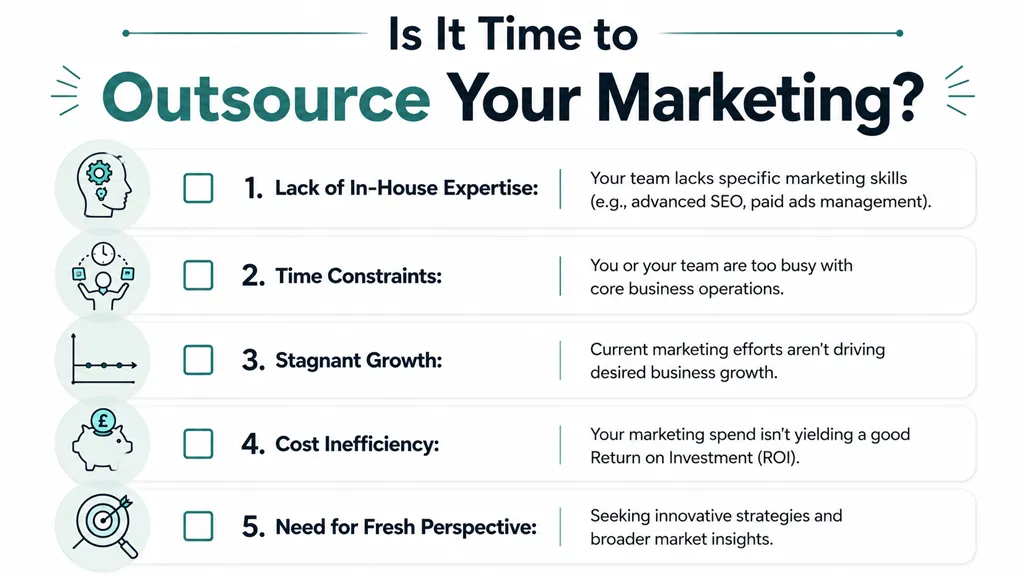
This is one of the clearest triggers to watch for.
The founder might still be approving every campaign, rewriting website copy, chasing agencies, checking ad spend, and acting as the bridge between sales and marketing. If so, the business has a structural problem: marketing may be happening, but it isn't properly owned.
At that point, outsourcing isn't just a capacity fix. It becomes a management fix.
If marketing only moves when the founder pushes it, the system isn't scalable.
Internal teams often inherit assumptions. They repeat channel choices because "that's what we've always done". External experts don't carry that baggage. They can question the brief, the market positioning, the offer structure, and the follow-up process.
That outside perspective is particularly useful when:
Sometimes the problem isn't poor results. It's poor visibility.
The business is investing in campaigns, software, creative, and support, but leadership still can't answer simple questions. Which channel is driving qualified leads? Which campaign should be scaled? What activity should stop?
That uncertainty is expensive. Good outsourced support creates decision clarity. It gives you a better answer than "we're doing a lot, so something should work".
Outsourcing should be judged like any other investment. Not by whether the monthly fee feels comfortable, but by whether it improves commercial performance.
Too many businesses compare an external partner's fee with an employee's salary and stop there. That's not a real comparison. The true in-house cost includes recruitment time, onboarding, management, software, training, and the risk of hiring one person who is good at some of what you need but not all of it.
A useful way to assess outsourcing of marketing is to compare three things:
If an external specialist improves output, sharpens decision-making, and removes internal drag, their fee should be assessed against total business impact, not against payroll in isolation.
There is one data point that makes this very tangible. UK SMEs outsourcing lead generation analytics report cost-per-lead reductions from £45 to £32, attributed to channel optimisation across paid search, social, and email.
That matters because lower CPL on its own isn't the full story. If the leads are also better qualified, sales efficiency improves too. Fewer wasted follow-ups. Better use of sales time. Stronger conversion economics.
Use a simple framework.
Define the target outcome
Pick the metric that matters most. That might be qualified leads, booked meetings, pipeline value, or revenue contribution.
Establish the current benchmark
What are you paying now to generate an opportunity? Where are campaigns leaking performance?
Model the upside
Estimate the value of stronger conversion, lower wasted spend, or faster campaign execution. Keep it conservative.
Add internal time saved
If outsourcing removes founder oversight, internal rework, or channel firefighting, that has value too.
Review over the right timeframe
Some channels improve quickly. Others need time to mature. Judge the partner against a realistic decision window, not a rushed one.
Marketing ROI improves when someone has both the skill to spot inefficiency and the authority to act on it.
You want a sharper framework for measurement, especially for businesses trying to separate vanity metrics from commercial ones. It also helps to set reporting expectations using a clear ROI model such as this approach to measuring marketing ROI properly.
They underestimate speed.
A capable external expert doesn't just improve results. They reduce the time it takes to identify what isn't working and correct it. That shortens the feedback loop between spend and learning, which is one of the biggest hidden drivers of return.
Outsourcing fails for predictable reasons. The problem usually isn't the idea itself. It's how the relationship is scoped, bought, and managed.
The biggest mistake is treating external marketing like a commodity. One supplier looks cheaper than another, so the cheaper one wins. Then the business spends months in vague meetings, gets unclear reporting, and ends up replacing the partner after avoidable waste.
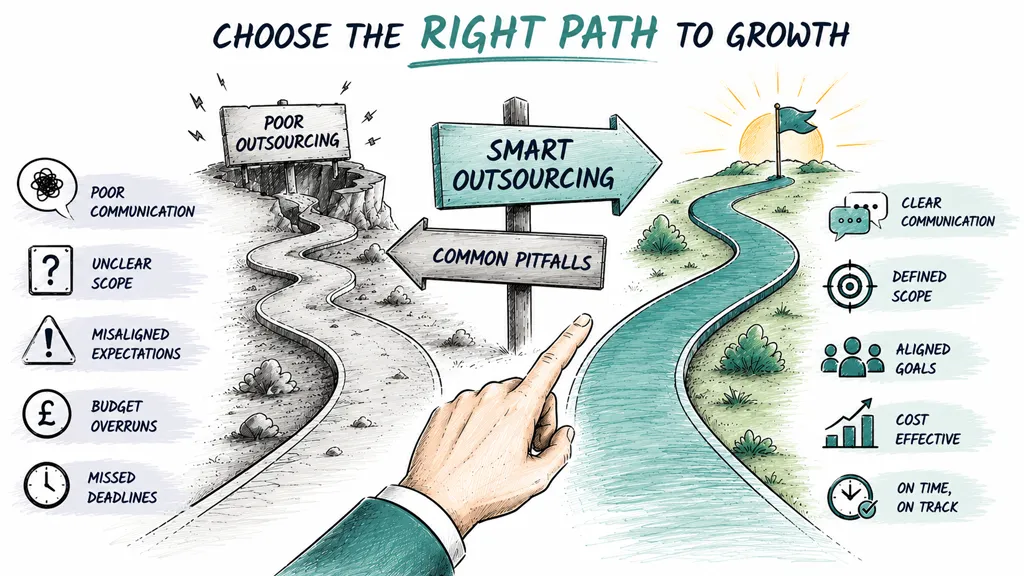
Low fees can hide expensive problems:
A better question is this. Who is accountable for the result, and how close are they to the work?
Founders often say they want "more leads" and leave the rest to the supplier. That sounds efficient, but it usually creates confusion.
A strong brief should cover:
Without that, even a good partner will waste time interpreting the assignment.
This is the part many generic guides skim over, and it’s one of the most important for UK businesses.
When you outsource marketing, you're often sharing CRM exports, customer lists, form data, website tracking access, ad account permissions, and commercially sensitive information. That creates real exposure if the partner is careless, poorly governed, or using subcontractors without proper controls.
82% of UK SMEs reported a cyber incident in 2025. Marketing data breaches cost an average of £10,400 per incident, and non-compliance fines averaged £4.2m for mid-sized firms that year. Vetting partners for GDPR compliance is critical.
That means you should ask direct questions about:
For a more structured shortlist process, this guide on how to choose a digital marketing agency helps frame the questions that matter before you sign anything.
After legal and operational checks, it helps to hear a plain-English view on common pitfalls:
A final trap is overvaluing visible output. More ads, more posts, more reports, more meetings. None of that guarantees performance.
What matters is whether the outsourced function is making the business easier to grow. Clearer decisions. Better lead flow. Tighter use of budget. Stronger follow-up between marketing and sales.
If those outcomes aren't becoming more visible, the relationship needs fixing or ending.
A good outsourcing relationship starts before you speak to any supplier. Most problems show up later because the business was unclear at the beginning.
Use this sequence instead.
Start with the business problem, not the tactic.
If you need more qualified pipeline, say that. If you need lower lead costs in a paid channel, say that. And say so too if nobody owns marketing properly and the business needs senior direction.
Keep the responsibilities that require daily internal context or close leadership access. Brand decisions, service knowledge, and sales feedback often belong inside the business.
Outsource the areas where specialist execution or external objectivity adds more value than internal control.
Don't hire a full-service agency because it sounds safer if what you really need is a consultant. Don't hire a strategist if nobody can execute after the plan is written.
Match the model to the actual bottleneck.
Agree upfront what will be measured, how often it will be reviewed, and what decisions follow from the data. That keeps everyone honest.
Useful measures often include:
Most outsourced partners underperform because the onboarding is too thin. Give them what they need. CRM context, sales feedback, historic campaign data, brand positioning, and access to the people who understand the customer properly.
The faster they understand the business, the faster they can improve it.
Monthly reporting isn't enough if major spend is live every day. Keep a practical cadence.
The best outsourcing relationships are built on clarity, speed, and mutual accountability.
This applies to channels, campaigns, and suppliers. If the data is weak and the explanation is vague, don't keep paying for hope.
Good outsourced marketing should create confidence because the reasoning is visible, the actions are deliberate, and the results are reviewable.
If you're weighing the outsourcing of marketing, you'll want a direct, commercially grounded view of what to keep in-house, what to outsource, and how to make it pay back. Gilkes Media is a strong place to start. The approach is hands-on, senior-led, and built around accountability, not agency theatre.
