A lot of UK SMEs arrive at Google Ads after the same frustrating cycle. SEO is taking time. Referrals are inconsistent. A previous agency drove clicks but not proper enquiries. The dashboard looked busy, yet the sales team kept saying the leads were poor.
That usually isn't a Google problem. It's a commercial strategy problem.
Google Ads still sits at the centre of lead acquisition for many UK firms. 65% of UK SMEs actively use paid search advertising, 67% of UK B2B marketers consider PPC essential for lead generation, and Google holds a 92.57% UK search market share. If you're selling a service in the UK, your buyers are already searching. The question is whether your account is built to attract profitable demand or just absorb budget.
Most guides obsess over features inside the platform. That misses the point. Google Ads for lead generation only works when the campaign structure, landing pages, tracking, bidding and sales follow-up all line up with commercial reality.
Most wasted spend starts before the campaign goes live. Businesses pick broad service terms, let Google fill in the gaps, and then act surprised when the phone rings with poor-fit prospects.
The first job is to define buyer intent, not just keywords. A founder searching for "accountant for construction company Leeds" behaves very differently from someone searching "what does an accountant do". One is near a buying decision. The other is researching. If you bid on both with the same message and same landing page, you'll pay for traffic that was never likely to enquire.
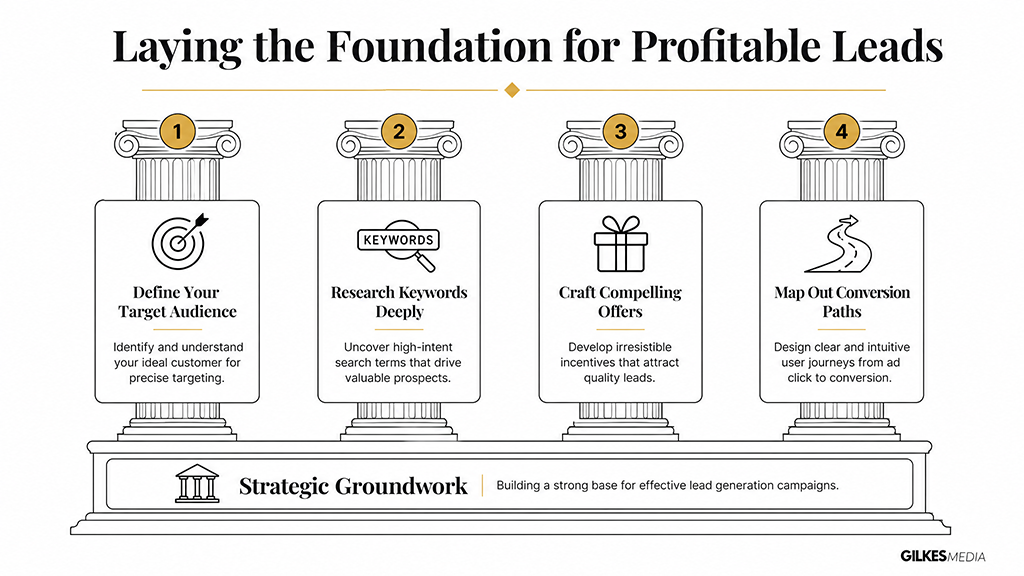
A useful pre-campaign brief needs four things:
Many agencies often cut corners. They pull a keyword list, group a few terms, and skip the difficult commercial questions. That produces activity, not strategy.
Practical rule: if you can't describe your best-fit lead clearly enough for sales to agree on it, your Google Ads targeting will drift.
For UK SMEs, blindly automating before mastering high-intent search campaigns leads to significant budget waste. Best practice in 2026 is to first profitably convert specific, high-intent keywords such as "construction firm Manchester" before layering on automation like Performance Max, as discussed in this UK Google Ads strategy video.
That means focusing first on search terms with obvious action behind them:
The same discipline shows up in outbound and agency growth too. If you're interested in how firms create repeatable enquiry flow beyond paid search, Landra on building agency pipelines is worth a read because it reinforces the same principle. Reliable pipelines come from intent and process, not random channel activity.
Competitor review isn't about copying ad copy. It's about spotting gaps.
Look for weak offers, generic headlines, thin landing pages, no location relevance, and no qualification. In many local markets, you don't need clever creative to win. You need a sharper offer, tighter message match and a clearer route to enquiry.
This strategic groundwork is also where broader search strategy matters. The same intent mapping that improves paid search often exposes SEO opportunities, service-page gaps and location landing pages worth building properly.
If you run a local service business, it is also worth weighing a standard Search campaign against Google Local Services Ads, which uses a pay-per-lead model rather than pay-per-click.
Once the groundwork is done, keep the account simple enough to control and structured enough to diagnose. Most SME accounts fail because they are either too loose or too bloated.
A high-intent Search campaign is usually the best place to start. It gives you clear visibility over search terms, ad relevance, budgets and lead quality. It also stops you hiding poor strategy behind automated campaign types that spread spend too widely.
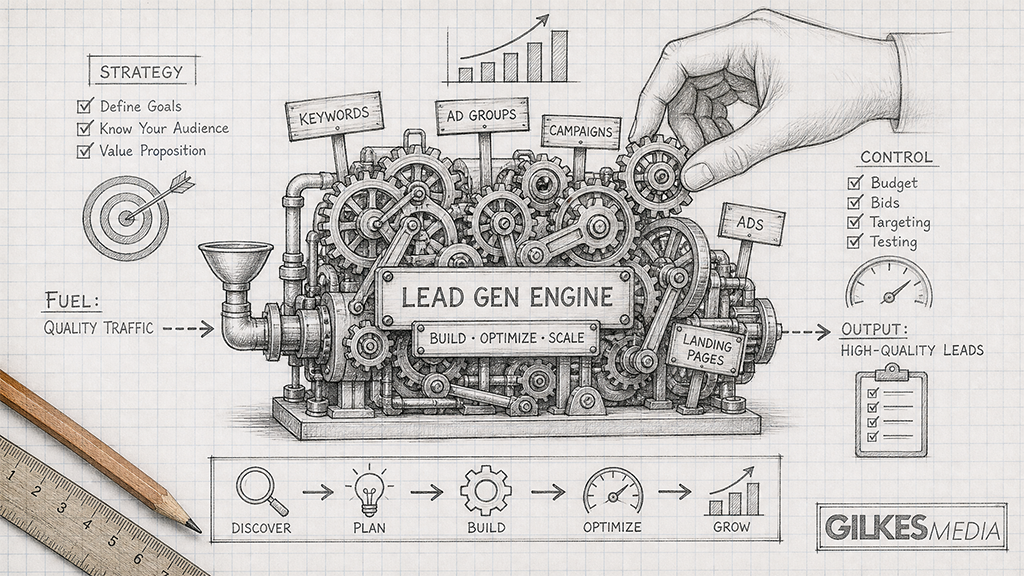
A clean setup usually follows one of these models:
| Structure type | When it works | Common mistake |
|---|---|---|
| By service | Businesses with distinct offers such as SEO, web design, paid ads | Bundling unrelated services into one ad group |
| By location | Regional firms or businesses with different performance by city or county | Using one national campaign and losing control |
| By intent theme | Accounts where problem-led and solution-led searches behave differently | Mixing early-stage and high-intent terms together |
For most UK SMEs, start narrower than you think. One service, one region, one strong landing page is better than ten weak campaigns.
There are a few checks that should be standard from day one:
In UK B2B Google Ads, 70% of wasted spend stems from missing keyword exclusions and misaligned landing pages, not platform inefficiency, and activating content suitability settings and brand exclusions is mandatory to protect budget and focus on qualified enquiry volume.
Bad search terms don't just waste spend. They train the account on the wrong intent.
A practical starting point:
Many agency accounts often fall short. They prioritise launch speed over control, then spend months patching around the mess. A more deliberate build gives you cleaner data, better message match and far less wasted spend.
Used properly, this is also where a managed service earns its keep. Gilkes Media's paid ads management service sits in this category of work. Not as a dashboard service, but as structured campaign management tied to commercial outcomes.
You can write a decent ad, win the click and still lose the enquiry. That's the bit too many advertisers ignore.
Clicks aren't the product. Qualified leads are. If the landing page doesn't continue the conversation the ad started, your campaign breaks at the point where money changes hands.
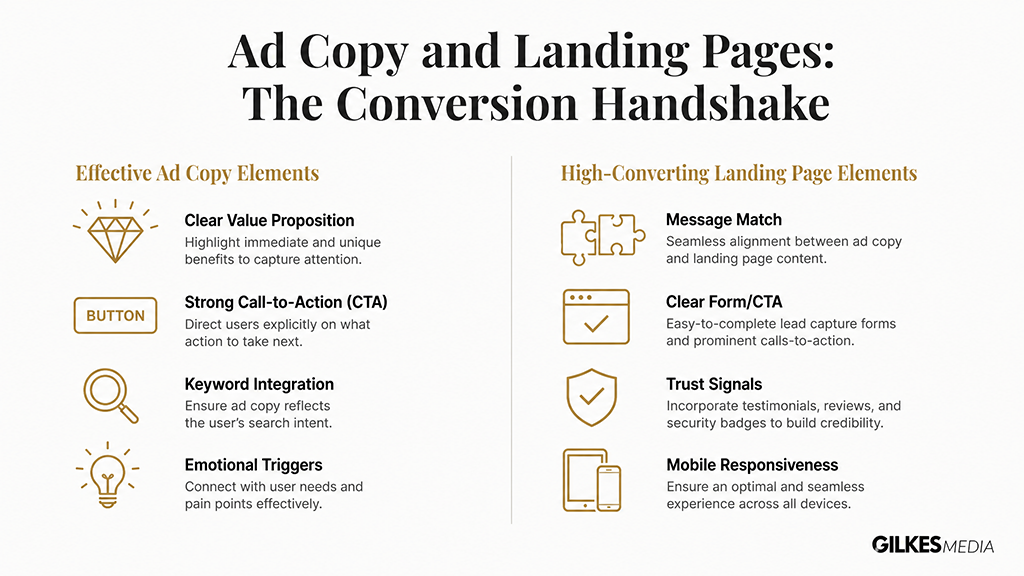
Strong ad copy for UK lead generation is rarely flashy. It is specific, relevant and commercially grounded.
A good ad usually does three things well:
Use assets properly too. Sitelinks, call assets and location details help qualify traffic before the click. If calls matter, use your actual UK business number and schedule call-focused assets around opening hours so enquiries reach a human being.
For UK businesses managing an average CPC of £3.50 to £3.65, the economics get tight quickly. The average Google Ads search conversion rate is 7.52% globally, and PPC traffic has a 50% higher chance of converting than organic traffic. If your landing page underperforms, those clicks become expensive very fast.
A landing page built for lead generation should feel obvious to use. Not clever. Not overly designed. Obvious.
Here are the essentials:
Most weak landing pages suffer from one of these problems:
A landing page doesn't need to impress a designer. It needs to reduce doubt and make the next step easy.
If your site is getting traffic but not enough enquiries, improving website conversion rate is usually a better place to look than rewriting ads for the fifth time.
Most accounts report conversions. Far fewer report revenue signals you can trust.
That's the split between amateur and professional lead generation. Amateur tracking counts form fills. Professional tracking connects keyword, ad, landing page and channel data to sales outcomes inside the CRM.
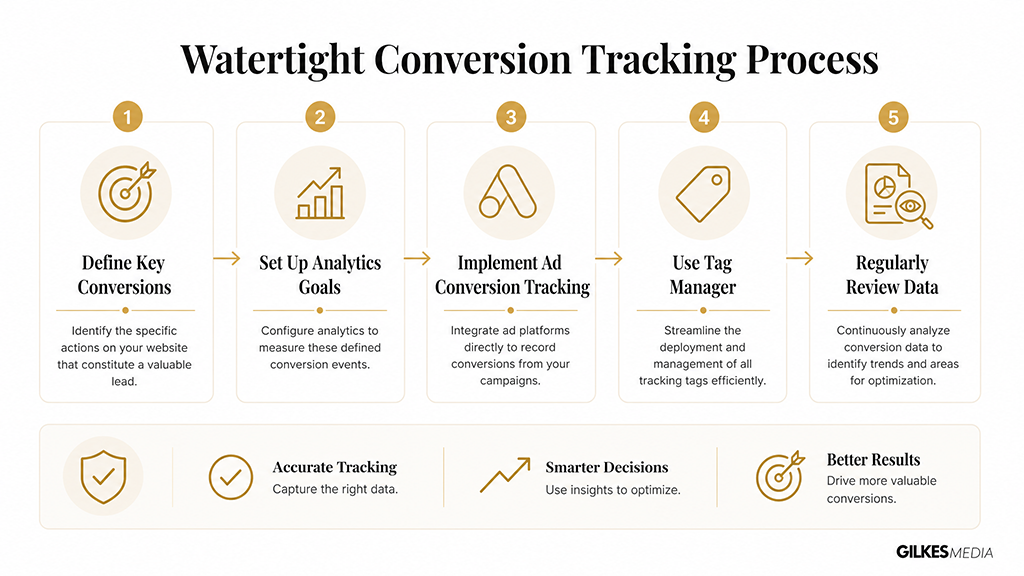
For many UK SMEs, a lead doesn't only come through a form. It may come through a tracked phone call, a live chat, a booked consultation, or a request for a quote.
At minimum, your setup should capture:
Accounts often go wrong when they optimise around the easiest event to track, not the one that best reflects commercial value.
Most UK businesses optimise for lead volume, flooding sales teams with low-quality enquiries. A minority use Offline Conversion Tracking, feeding CRM data back into Google so its systems can distinguish between a £100 enquiry and a £3,000 deal and bid accordingly for quality.
That changes how the account learns.
Instead of telling Google that every form fill is equal, you tell it which leads were qualified, which became opportunities, and which turned into revenue. Once that loop is working, bidding decisions become far more commercially useful.
A practical model looks like this:
| Stage | What gets tracked | Why it matters |
|---|---|---|
| Initial conversion | Form, call, booking | Confirms response volume |
| Qualified lead | Sales-accepted enquiry | Filters weak leads |
| Pipeline stage | Opportunity or proposal | Shows commercial intent |
| Won business | Revenue-linked outcome | Trains towards value |
Commercial insight: if your CRM and ad platform aren't speaking to each other, you're still optimising for paperwork, not profit.
For service businesses, especially in legal, trades, healthcare and professional services, some of the best leads still arrive by phone. If call tracking is weak, the account can look far worse than it really is.
If you're comparing systems, this review of leading call tracking tools is useful for understanding the options. The main thing isn't the software brand. It's making sure calls are attributed back to campaigns and judged by quality, not just duration.
For a broader view on attribution, reporting and paid search measurement, paid search analytics is where most businesses start seeing why surface-level conversion numbers often mislead.
Bidding strategy only works when it reflects business maths. Too many advertisers pick a Smart Bidding option because it sounds efficient, then force the account into a target that the sales model can't support.
The first number to work out isn't your daily budget. It's your maximum acceptable cost per lead, based on what a lead is worth to the business.
A useful example comes from the sales funnel itself. With an average global cost per lead around $70, and UK legal and financial leads often exceeding £85, the 10-to-1 sales funnel ratio matters: if 10 leads yield 1 sale, a £1,000 sale means each lead is worth £100, which should inform your maximum Target CPA for profitability, according to Snov's lead generation statistics.
That is the commercial anchor.
If your close rate is weak, your target CPA has to be lower. If your average customer value is higher or repeat revenue is strong, you may be able to tolerate a higher CPA. This is why generic platform benchmarks rarely answer the fundamental budgeting question for SMEs.
Here's the practical version:
One common mistake is setting an aggressive Target CPA too early. In UK B2B campaigns, launching straight into a restrictive efficiency target can choke delivery before the algorithm has enough useful data. In practice, volume first often beats forced efficiency in the opening phase.
Don't increase budget because the click volume looks healthy. Increase it when these conditions are met:
If sales can't keep up with follow-up, more budget usually makes the campaign worse, not better.
If you need a clearer framework for judging whether your lead costs are commercially workable, cost per acquisition in practical terms is the right lens. Budgeting decisions make sense once acquisition cost is linked to margin, close rate and revenue, not just dashboard efficiency.
Paid search is one lever among several. Our guides to social media for B2B marketing and PPC for B2B cover the adjacent channels, and if you're specifically targeting growth markets, our guide to strategies for growth markets covers how the mix shifts there. Once your campaigns are live, keep an eye on how your ads are performing against the market - our guide to what counts as a good click-through rate has the current benchmarks.
There isn't a universal starting budget that makes sense for every business. The right answer depends on your sector, location, sales cycle, average deal value and how quickly your team follows up.
A better question is this: can you afford enough data to learn? If your budget only buys a handful of clicks in a competitive sector, the account won't gather enough evidence to improve. In lower-cost sectors, the same budget may be enough to identify winning search terms and poor-fit traffic quickly.
The mistake isn't starting small. It's starting small with unrealistic expectations.
Usually, no.
For most SMEs, Performance Max gets used too early because it looks efficient and promises scale. But if you haven't already proved that high-intent Search traffic converts profitably, broader automation tends to hide weak intent, weak pages and weak qualification behind blended reporting.
Build the Search engine first. Let automation earn its place later.
That depends on timeframe and buying intent.
Google Ads is stronger when you need immediate visibility for commercial searches and want direct control over spend, message and landing page experience. SEO is stronger for long-term visibility, lower marginal traffic cost and broader topic coverage.
The strongest approach is usually combined. Paid search captures demand now. SEO builds authority and reduces dependence on paid media over time. Businesses that treat them as separate silos usually miss opportunities in both.
Because a lead isn't revenue.
This is one of the biggest misunderstandings in paid acquisition. If campaigns are optimised for cheap form fills, you'll often attract people who are curious, price shopping, outside your service area, or never likely to buy. The ad account may look healthy while the sales team loses faith in it.
Typical causes include:
If you're only measuring front-end conversions, the account will keep chasing volume whether those enquiries become customers or not.
Both can work, but they solve different problems.
Lead form assets reduce friction and can increase submission volume, especially on mobile. Landing pages usually give you more room to explain the offer, pre-qualify leads and build trust. For many service businesses, that extra context improves lead quality even if total volume is lower.
If the sale requires trust, explanation or qualification, a proper landing page is often the better route.
Long enough to gather useful evidence. Not so long that poor traffic keeps draining the budget.
That means reviewing search terms, lead quality and user behaviour early, but resisting the urge to rewrite everything after a few days. The worst accounts are often managed emotionally. Bid changes, ad rewrites and landing page edits happen before anyone has enough data to understand the problem.
Make changes with a reason. Keep notes. Judge the account on quality and commercial fit, not just platform activity.
It depends on who is doing the work.
A hands-on in-house marketer with commercial understanding can outperform a weak agency every day of the week. A weak agency usually hides behind jargon, reports on vanity metrics, and avoids difficult conversations about lead quality and sales conversion.
The critical question is whether the person managing the account understands the full chain from keyword intent to closed revenue. If they don't, the account will drift no matter where they sit.
The pattern is depressingly familiar:
Those failings don't just reduce performance. They create mistrust between marketing and sales.
If you need Google Ads to produce commercially sensible enquiries rather than vanity metrics, it helps to work with someone who can connect strategy, landing pages, tracking and budget decisions into one system. Gilkes Media supports UK businesses with that kind of joined-up approach across paid ads, SEO, conversion-focused websites and growth strategy.
