
Most keyword research advice is written for consumer businesses, high search volumes, obvious purchase intent, a straightforward path from search to sale.
B2B is different in ways that make a lot of that generic advice actively misleading if you follow it without adjusting for how B2B buyers actually search.
Here's how to do keyword research properly for a B2B business, based on what genuinely brings in enquiries rather than what looks impressive on a volume report.
Consumer keyword research is often driven by search volume, because higher volume broadly correlates with more potential customers for a product bought by almost anyone. B2B doesn't work this way.
Your total addressable market for a specific product or service might be a few thousand businesses in the UK, and the search volume for the exact terms those specific buyers use can be genuinely low by consumer standards, sometimes a few dozen searches a month, while still representing meaningful commercial value if even a handful convert into real client relationships.
This means a keyword research process built purely around chasing high volume will systematically steer a B2B business toward the wrong terms, either overly broad consumer-facing language that doesn't match how business buyers actually search, or generic industry terms so competitive that ranking realistically requires a budget disproportionate to what the resulting traffic is actually worth.
The most useful B2B keyword research doesn't start in a keyword tool at all, it starts with genuine conversations, sales call recordings, and the actual language your real prospects and clients use when describing their problem, not the language your industry uses internally to describe your solution.
These are frequently different, and the gap between them is where a lot of missed opportunity hides.
Mine your own sales conversations. Go through recent sales calls, discovery call notes, or support tickets, and note the exact phrases prospects use to describe their problem before they knew your product or service existed as the solution.
A prospect might describe their problem as "our team keeps missing follow-ups with leads" long before they'd think to search for "lead nurturing software," and content built around the problem-first phrasing often captures genuine buyers earlier in their journey than content built purely around the solution-category term.
Ask your sales team directly.
The people having live conversations with prospects every week have a genuinely rich, current sense of the language buyers use and the questions they ask repeatedly, often more current than any keyword tool's database, which reflects historical search behaviour rather than this month's actual conversations.
A short, regular conversation with sales about recurring questions and objections is one of the highest-value, lowest-cost inputs into B2B content planning.
Review your existing enquiry forms and chat transcripts.
If your site captures enquiries through a form with an open text field, or runs live chat, the actual questions and phrasing people use there are a genuine, first-hand source of exactly how your real prospects describe what they need, unfiltered by any keyword tool's normalisation of language into shorter, more generic phrases.
B2B keyword research can't be driven by search volume the way consumer research is - a term with a few dozen monthly searches can still represent meaningful commercial value for a niche market. Start with real sales call language, not a keyword tool, since the gap between how prospects describe their problem and how your industry describes the solution is where opportunity hides.
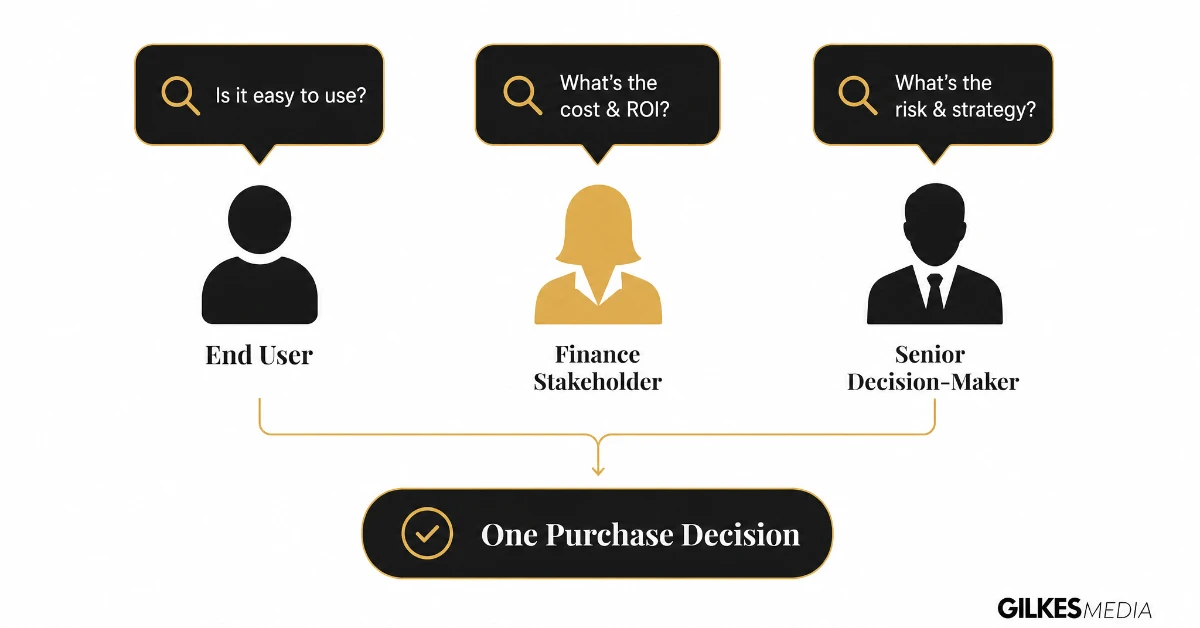
B2B purchases usually involve several people with different roles and different concerns, and each of them searches differently. The end user cares about how the product or service actually works day to day.
A finance stakeholder cares about cost and return.
A senior decision-maker cares about risk and strategic fit. A single keyword list built around only one of these perspectives misses content opportunities that speak to the other people who genuinely influence the final decision.
Map out who's likely involved in a typical buying decision for your product or service, and identify at least one content angle for each: practical, how-it-works content for the end user, cost and ROI-focused content for the budget holder, and strategic, risk-focused content for the senior decision-maker.
This produces a genuinely broader, more useful keyword and content map than one built around a single assumed searcher.

A page built only for the end user rarely gives the finance stakeholder or the senior decision-maker what they need to sign off. Strong B2B content maps specific sections, or specific supporting pages, to each stakeholder's actual concern: a features and workflow section for the end user, a cost and ROI section or page for finance, and a risk, compliance, or strategic-fit section for the senior decision-maker.
Trying to answer every stakeholder's concern in one undifferentiated page usually means answering none of them well. A page that briefly mentions price, briefly mentions features, and briefly mentions risk gives each stakeholder a shallow answer to the question they actually came with. Separate, clearly linked sections or pages, each written for one stakeholder's concern, consistently perform better.
For a B2B business with a realistic content budget, prioritising terms by genuine commercial intent, how close the searcher is to being a real, qualified buyer, matters more than prioritising by volume alone.
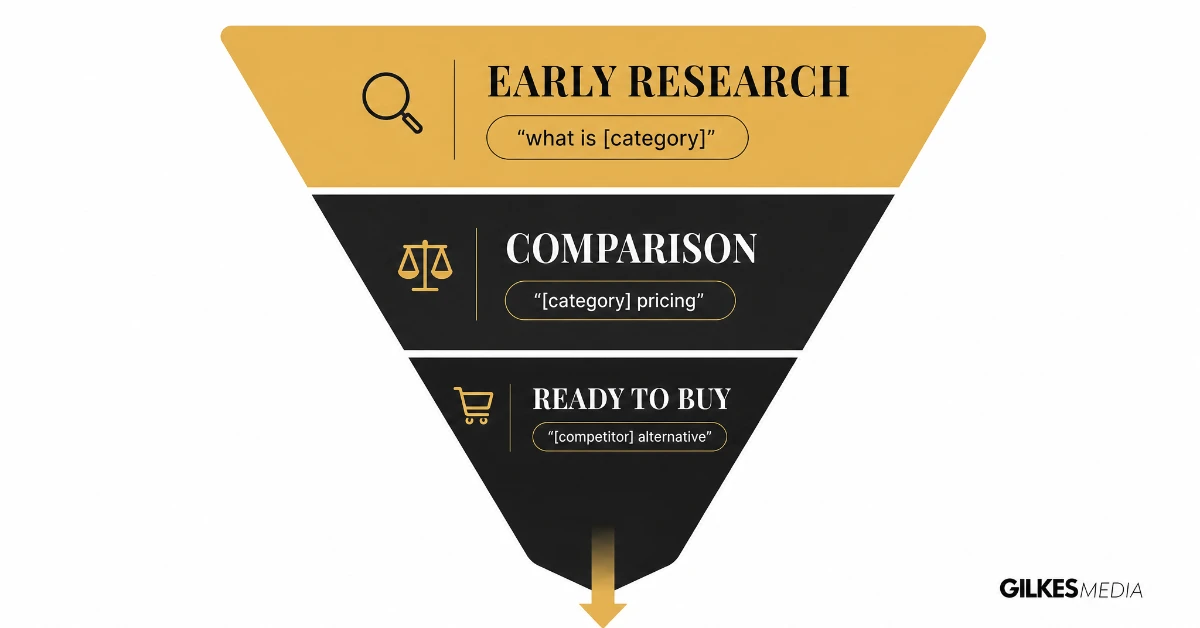
A term like "what is [category]" indicates early-stage research, useful for building broad topical authority but rarely converting directly.
A term like "[category] pricing," "[category] for [specific industry]," or "[competitor] alternative" indicates someone considerably further along and closer to an actual buying decision.
A sensible B2B keyword strategy covers all three intent stages, awareness, consideration, and decision, but weights the content investment toward the stages where your realistic budget produces the clearest commercial return, generally the consideration and decision stages, while building a smaller amount of genuinely useful awareness content to capture and nurture earlier-stage interest over time.
Our SEO for lead generation guide covers this prioritisation in more depth if lead volume, rather than traffic alone, is the actual goal.
| Search stage | Example query pattern | Content priority |
|---|---|---|
| Awareness | "what is [category]" | Useful for broad topical authority, rarely converts directly |
| Consideration | "[category] pricing", "[category] for [industry]" | Considerably further along; worth strong investment |
| Decision | "[competitor] alternative" | Closest to a buying decision; the clearest commercial return |
A B2B purchase usually involves several people with different concerns - the end user, the finance stakeholder, the senior decision-maker - and a keyword list built around only one of them misses the others who genuinely influence the decision. Prioritise by commercial intent over raw volume: an early-stage "what is X" term builds topical authority, while "X pricing" or "X vs Y" sits much closer to a real buyer.
B2B search behaviour skews more heavily toward longer, more specific phrases than consumer search does, partly because business buyers are usually searching with a genuinely specific problem or requirement in mind rather than browsing casually.
This works in a B2B business's favour: long-tail, specific terms are both closer to genuine buying intent and considerably less competitive than the broad category term everyone in your industry is chasing.
A term like "digital marketing agency" is extremely competitive and, honestly, not that useful even if you rank for it, since it doesn't tell you anything about what the searcher actually needs.
A term like "digital marketing agency for B2B manufacturing companies" or "PPC management for professional services firms" is far more specific, considerably easier to rank for, and represents a searcher who's already somewhat qualified themselves through the specificity of their own search.
Look at what your genuine competitors rank for, not to copy their content, but to understand what terms are proving valuable enough in your specific industry that competitors have invested in ranking for them.
This is useful market intelligence about where genuine demand exists, even when the resulting content you build should be meaningfully different and better than what's already ranking.
Search your own industry's specific terminology and jargon. Every industry has specific terms, acronyms, and phrasing that a generic keyword tool sometimes under-represents because the volume is concentrated in a genuinely narrow, specialist audience.
If you know your industry well, you'll often spot valuable, specific terms a general keyword tool misses entirely, simply because you understand the space better than a general-purpose database does.
Check what questions come up on industry forums and LinkedIn discussions.
Genuine questions being asked by real people in your industry, on LinkedIn groups, industry forums, or relevant subreddits, are a useful, current source of exactly the kind of specific, real-world phrasing that traditional keyword tools sometimes miss or under-represent in their volume estimates.

B2B search skews toward longer, specific phrases because buyers usually have a genuine problem in mind rather than browsing casually - these long-tail terms are closer to real buying intent and far less competitive than the broad category term everyone chases. Look at what real competitors rank for as market intelligence about where demand exists, not as something to copy directly.
Keyword research tools remain genuinely useful, for checking search volume estimates, seeing related terms you might not have considered, and understanding roughly how competitive a term is.
The mistake is starting the entire process there and only there, since a tool's suggestions are built from aggregated historical search data and tend to normalise language toward shorter, more generic phrasing than real B2B buyers, and specifically your real B2B buyers, actually use.
Google's own Trends tool for directional interest over time and comparing relative demand between terms, alongside whatever paid keyword tool you already have access to for volume and competition estimates.
Treat the tool's output as one input to check against, and build from, the buyer-language research covered above, not as the entire research process on its own.
Once you've identified a genuinely useful set of terms across the buying committee and intent stages, the next step is organising them into coherent topic clusters rather than a scattered list of individual keyword targets tackled in isolation.
A properly built cluster, a comprehensive core page supported by several more specific, related pages that link to and from it, builds genuine topical authority in a way that a set of disconnected individual pages targeting unrelated terms never does.
Our SEO content strategy guide covers how to structure this properly.

Keyword tools are genuinely useful as a supplement, but the mistake is starting there, since aggregated historical data tends to normalise language toward shorter, more generic phrasing than your real buyers actually use. Once you've identified a useful set of terms, organise them into a genuine topic cluster - a comprehensive core page supported by related pages - rather than a scattered list tackled in isolation.
Once you’ve got a list of keywords, the next step is deciding what to actually write. A short process keeps this from stalling:
A UK-based B2B software company selling a specialist compliance tool to financial services firms initially built their keyword strategy around the obvious category term, "compliance software," a highly competitive term dominated by considerably larger, more established competitors with far bigger content budgets.
Progress on this single term was slow and expensive relative to the traffic it generated.
Shifting the strategy toward buyer-language research changed the picture considerably.
Sales call reviews surfaced that real prospects consistently described their problem not as needing "compliance software" but as struggling with a specific regulatory reporting requirement by name, a far more specific phrase with lower volume but dramatically clearer buying intent, since anyone searching that specific regulatory term already understood precisely what problem they had.
Content built around that specific phrase, and several closely related regulatory terms surfaced the same way, ranked considerably faster than the broad category term ever had, and converted into qualified enquiries at a noticeably higher rate, since the searchers arriving were already further along in recognising their specific need.
Group keywords by buying stage, target one keyword per piece of content, and check what's already ranking before you write - a realistic, sustainable publishing cadence beats an ambitious one you can't keep up. One B2B software company shifted away from the highly competitive "compliance software" term toward more specific, financial-services-focused language and made faster, cheaper progress.
B2B keyword research isn't a one-off exercise completed at the start of a campaign and left untouched.
Buyer language shifts, new competitors enter the market, and your own sales conversations keep generating fresh insight into how real prospects describe their problems.
A quarterly review, checking recent sales call themes, any new terms competitors have started targeting, and how your existing content is actually performing against its intended terms, keeps the strategy genuinely current rather than built entirely on research done once, months or years ago.
B2B keyword research isn't a one-off exercise - a quarterly review of sales call themes, competitor terms and actual content performance keeps the strategy genuinely current as buyer language shifts. Ten genuinely qualified visitors from a specific, relevant term are worth more commercially than a thousand unqualified ones from a broad term that only shares a word.
A single, highly competitive category term rarely carries a whole content strategy on its own, especially when larger competitors already dominate it. Spreading effort across a genuine cluster of specific, winnable terms alongside that one aspirational term produces results considerably sooner.
A keyword list built once and never revisited goes stale as the market, competitors, and the business's own offering change. Buyer language shifts, new competitors enter, and genuinely new long-tail opportunities open up over time, so a static list eventually stops reflecting how people actually search.
The search results page for a target term is itself a research tool, and one many B2B businesses skip. Before committing content resources to a keyword, look at what is actually ranking for it.
If the top results for a term are all product comparison pages, the term has commercial, comparison-stage intent. If they are all long-form educational guides, the intent is informational and earlier in the buying journey. Trying to rank a product page against a search results page dominated by educational content is a common and avoidable mistake, since it fights the intent Google has already decided that term serves.
Search the term yourself in an incognito window and look at the top five organic results. Note whether they are blog posts, product pages, comparison pages, or tool pages. That pattern is a free, direct signal of what Google considers the correct intent match for that term.
Cannibalisation happens when two pages on the same site could reasonably target the same term, splitting authority between them rather than concentrating it. Before creating new content, search the target term restricted to your own domain to check whether an existing page already covers it, and either strengthen that page or clearly differentiate the new one's angle.
The "People Also Ask" box and the related searches at the bottom of a results page are genuine, real-world phrasings of the follow-on questions buyers have. For B2B terms specifically, these often surface the practical, implementation-level questions a buying committee raises after the initial research stage, which makes them a strong source of H3/H4 subheadings and FAQ content for a page already targeting the parent term.
The search results page for your target term is free research: it tells you the intent Google has already decided that term serves, before you spend a penny on content.
A keyword list on its own does not produce a good page. The research has to be translated into a brief that a writer, or an agency, can actually work from.
A workable content brief needs more than the primary term. It should set out the searcher's likely stage in the buying journey, the specific question or objection the page needs to resolve, two or three secondary terms to weave in naturally, the internal pages it should link to and from, and a realistic word count based on what is already ranking.
A specific, long-tail, low-competition term can realistically start moving within a small number of months of publishing genuinely strong content. A competitive, broad category term, especially one dominated by larger competitors with bigger content budgets, routinely takes considerably longer, and sometimes never overtakes established players without a wider authority-building effort behind it.
Competitive B2B category terms are usually held by sites with years of accumulated backlinks, brand recognition, and content depth. A single new page, however well written, is competing against that accumulated authority, not just against the words on the page. Setting a three-month first-page expectation on a genuinely competitive term sets a business up to judge a sound strategy as a failure before it has had a realistic chance to work.
There is no fixed number that suits every business. A more useful approach is to build out a small number of genuine topic clusters, each anchored by one commercially relevant pillar term with a handful of specific, related long-tail terms supporting it, rather than chasing a large flat list of disconnected keywords.
Commercial relevance, in almost every B2B case. A lower-volume term that closely matches a genuine buyer's search, at the stage they are actually searching, is worth more commercially than a higher-volume term that only loosely relates to what the business actually sells.
Not for a first pass. Talking to sales and customer-facing teams about the language real buyers use, reading the SERP itself, and using the free "People Also Ask" and related searches data will get a B2B business a genuinely useful starting keyword set. A paid tool becomes more valuable for ongoing volume tracking and competitor gap analysis, not as the only source of ideas.
A full review every six to twelve months suits most B2B businesses, with a lighter check-in whenever a new product, service line, or competitor changes the landscape meaningfully in between.
Building the whole strategy around a single obvious category term, then judging the entire approach as a failure when that one highly competitive term is slow to move, rather than building a broader set of more specific, more winnable terms alongside it.
Often yes, though the intent match still has to be right for each channel. A commercial, high-intent term that converts well in paid search is frequently also worth targeting organically, provided the organic page is built to match the same buying-stage intent rather than simply repurposing an ad landing page.
Generic B2B keyword advice can only take you so far, since the real value comes from the specific language your specific buyers use, which no general guide can tell you in advance.
Our SEO service starts with exactly this kind of research before any content gets written.
Get in touch through our contact page for a free discovery call, and we'll talk through what genuine buyer research could uncover for your specific market.
The businesses that get the most out of B2B keyword research treat it as an ongoing discipline rather than a one-off project completed at the start of a content programme. The buying committee, the language buyers use, and the competitive landscape all shift over time, and a keyword strategy built once and left untouched for years gradually drifts away from how people are actually searching.
None of this requires an enormous budget or a large in-house team. It requires talking to the people who already speak to buyers every day, reading the search results page honestly rather than assuming a term's intent, and being disciplined about prioritising commercial relevance over vanity search volume. Those three habits, applied consistently, outperform a far more expensive tool-driven approach that skips them.
If you want a second opinion on whether your current keyword targets actually match the way your buyers search, that's a conversation worth having before committing further content budget to the wrong terms.
Get the fundamentals right, the buyer-language research, the intent matching, and the honest prioritisation over vanity metrics, and the rest of the content programme built on top of it becomes considerably more effective, page for page and pound for pound.
That is the standard we hold our own keyword research work to, whether it is a first strategy for a new client or a refresh for one whose market and buying committee have moved on since the last review.
