
If your rankings have stalled, or an agency keeps reporting "steady progress" that never turns into enquiries, the honest next step usually isn't another retainer. It's a proper audit.
Quick answer: a genuine UK SEO audit checks technical health, on-page signals, content quality and backlink profile, rather than skimming the surface. It typically costs £500 to £7,500 for a standard business site.
A full audit that also reviews content and authority can run higher. A website migration audit, protecting rankings during a replatform or redesign, commonly runs £1,000 to £15,000.
What you actually get for that money varies enormously. That gap is the real problem this guide solves.
This guide covers what a professional SEO audit should check, and what UK agencies, freelancers and consultants actually charge for one. It also covers how that differs from the free checklist-style audits most tools hand out.
Finally, it covers how long a proper audit takes and the questions worth asking before you pay for one.
If you run paid search too, the same logic applies there: our Google Ads audit guide covers the PPC side of the same question.
A proper SEO audit is not a one-page report with a traffic-light score and a vague line about fixing your meta descriptions. It's a structured review of every layer that affects whether Google can find, understand and want to rank your site.
Every recommendation in it should come backed by evidence, not just an opinion.
Done properly, it moves through five broad areas in order. A technical fault underneath the site can make content and link-building work pointless until it's actually fixed, so a good auditor checks the foundation first.
This is the foundation layer: can Google's crawler actually reach every page that matters, and is it choosing to index the right ones? A proper audit checks robots.txt rules, XML sitemap accuracy, canonical tags and redirect chains.
It also looks for orphaned pages with no internal links pointing to them, and whether low-value pages, filtered URLs, tag archives, thin content, are quietly eating crawl budget that should go to the pages that actually convert.
A migration or a hurried redesign is the most common cause of serious crawlability damage. Redirect rules get missed and old URLs get dropped without a 301 in place.
A site that was ranking well can lose months of visibility in a few weeks if nobody checks this properly first.
Google has used Core Web Vitals as a ranking signal since 2021, and slow, janky pages lose both rankings and conversions. A proper audit measures Largest Contentful Paint, Interaction to Next Paint and Cumulative Layout Shift.
Crucially, it measures these on realistic device and connection speeds, not just a lab test run on fast office broadband. That is rarely how most visitors actually load the page.
Our guide to website speed and Core Web Vitals goes into this in more depth if speed is the main suspect.
A heavy page builder, an unoptimised image library, or a bloated plugin stack are the three most common culprits a proper audit will flag on a typical UK small business site, and all three are usually fixable without a full rebuild.
Title tags, meta descriptions, heading structure, keyword targeting, internal linking and content depth get reviewed page by page, not just on the homepage. These faults are far more common than most business owners assume.
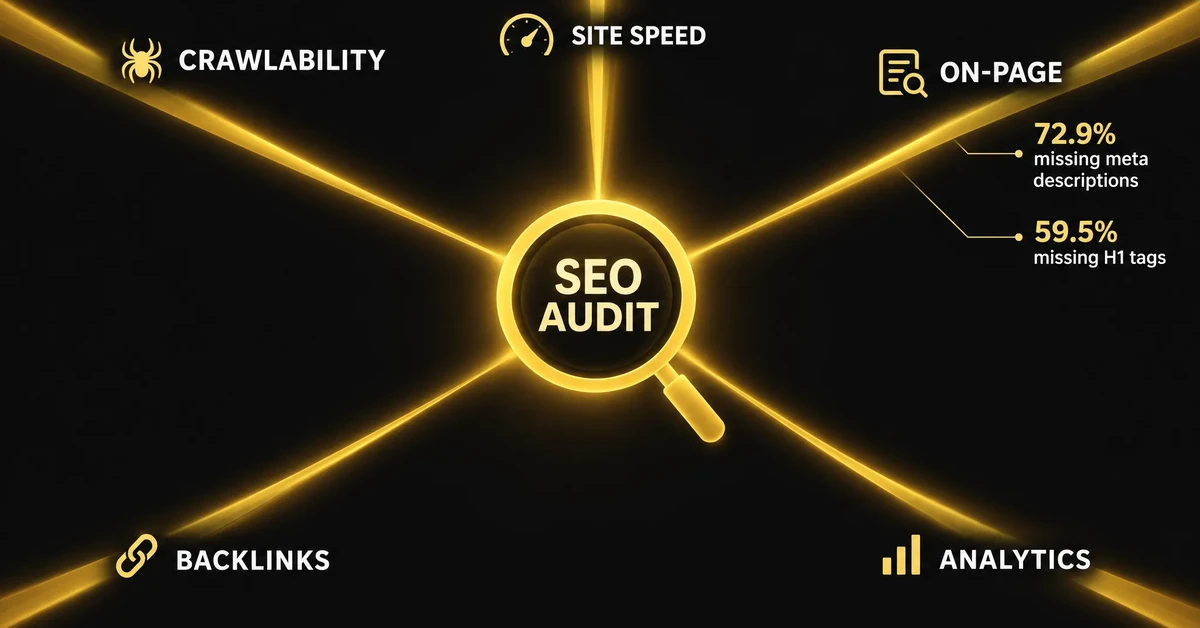
A large-scale Ahrefs study of just over a million domains found that 72.9% had a missing or empty meta description somewhere on the site. 59.5% had a missing or empty H1 tag.
Faults like these are exactly what a proper audit is built to catch. The same study found 63.2% of domains had at least one title tag too long to display properly in Google's results.
51.3% had pages carrying more than one H1 tag, a structural fault that confuses which heading Google treats as the page's main topic.
Backlink profile strength and any toxic or spammy links that could be holding the site back both get assessed here. So does how the site compares to genuine competitors on real authority signals, not just a vanity "Domain Authority" score.
See our guide to link building in 2026 for what actually counts as a healthy link profile right now.
None of the above means anything if you cannot measure whether fixing it actually worked. A proper audit checks that Google Analytics 4, Google Search Console and conversion tracking are correctly configured.
It also checks that those tools actually agree with each other, something that is wrong far more often than most business owners realise, particularly after a website redesign or a tracking setup nobody has revisited in years.
It is common to find a site still tracking goals that were retired years ago, a Google Tag Manager container with duplicate tags firing twice, or a Search Console property that was never verified for the current domain at all.
A proper SEO audit checks five layers in order: crawlability, speed, on-page content, backlink authority and analytics, because a technical fault underneath the site can make content and link-building work pointless until it's fixed.
An audit is worth the spend when one or more of the following is true for your business right now.
None of these require a crisis first. The cheapest time to fix a problem is usually before it has had a year to compound.
The third point is worth sitting with for a moment. Six months is long enough for genuine SEO work to show some measurable movement, even in a competitive market, so a flat line that long is itself a finding worth investigating.
The fifth point matters just as much. An agency switch is exactly the kind of decision where you want a neutral third party's read on the current state of play.
Neither the outgoing nor the incoming agency's own version of events is neutral. Both have an obvious incentive to shape it.
Any one of these on its own is a reasonable trigger. Several at once usually means the audit should have happened months ago.
Gilkes Media publishes its own free technical SEO audit checklist, and it is a genuinely useful starting point for catching the obvious faults yourself before spending anything. But a checklist and a paid audit answer different questions.
A checklist tells you whether a box is ticked. A paid audit tells you why it matters, how it is specifically affecting your site's rankings, and what order to fix things in so the highest-impact work happens first, not whatever is easiest.
A checklist also cannot tell you whether your current agency's work is actually any good, or whether your backlink profile has quietly picked up toxic links. Nor can it show how your technical health compares to the three competitors actually outranking you.
That judgement call needs a person, not a tick-box.
Running the free checklist first, then bringing in a paid audit only if it surfaces something concerning, is a perfectly sensible way to spend money carefully rather than committing to the bigger spend upfront.
A free checklist tells you whether a box is ticked. A paid audit tells you why it matters, how badly it is hurting your specific rankings, and what to fix first.
The process itself is fairly consistent across a decent UK agency or consultant, even though the exact tools and report format differ. Knowing the shape of it helps you judge whether a quote is actually offering a full job.
A proper audit starts with a conversation, not a crawl. The auditor needs to know your actual business goals, which pages matter commercially, and what has already changed recently, before they can judge what any finding actually means.
You grant read access to Google Analytics 4, Google Search Console and, where relevant, your CRM's lead data. A crawling tool then maps every page, every redirect and every internal link on the site.
This is the step a cheap automated tool skips entirely. A human reviews the crawl output against the site's actual goals, separating genuinely urgent issues from cosmetic ones a tool flags indiscriminately.
A tool will happily flag a minor spelling inconsistency with the same urgency as a broken canonical tag stopping an entire page type from being indexed. Only a person reviewing both in context can tell you which one is actually costing you enquiries.
Findings get ranked by likely impact against effort to fix, with specific URLs and specific recommendations, not a generic checklist repeated for every client regardless of their site.
A good auditor talks you through the findings live and takes questions, rather than emailing a PDF and disappearing. This is also your chance to judge whether they actually understand your business, not just your site's code.
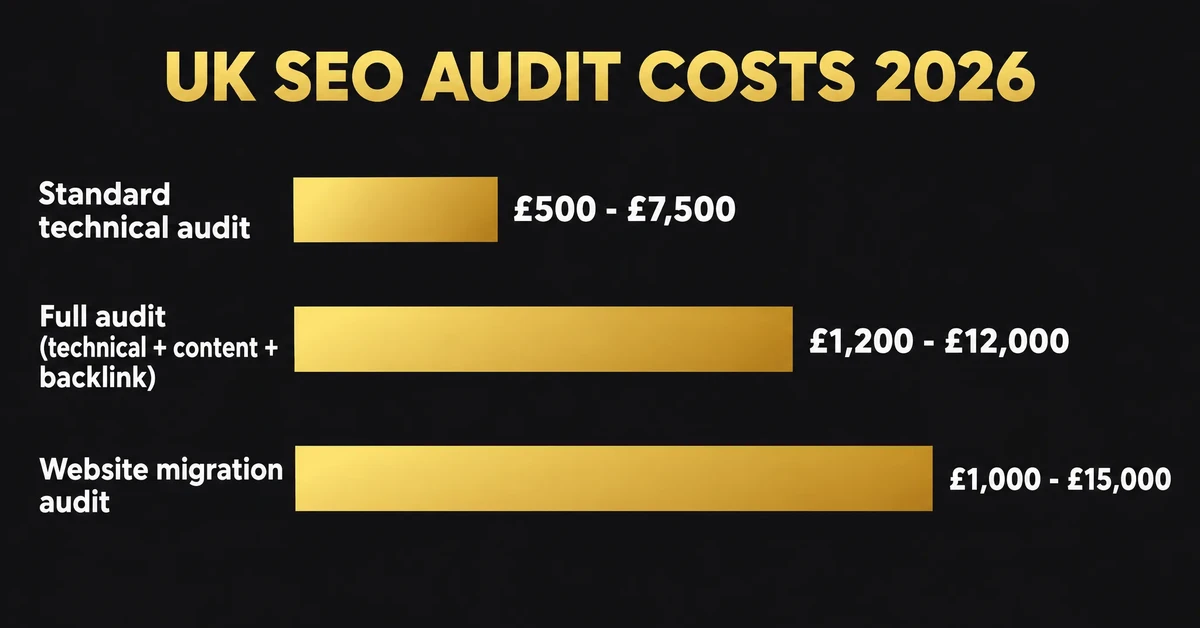
A standard technical SEO audit, covering crawlability, indexing, site speed and structural issues, typically costs £500 to £7,500 in the UK. It scales with site size and how messy the underlying code and history already are.
That's broadly in line with the project-based pricing in our wider SEO cost UK guide, which covers ongoing retainers too.
There is no single published UK market price for a combined audit, but it can be worked out honestly from day rates. A full audit commonly needs 15 to 40 hours of specialist time plus senior review.
At the UK agency blended rate of £80 to £300 an hour, that comes to roughly £1,200 to £12,000, which lines up closely with what agencies and consultants actually quote for this broader scope in practice.
Where a business sits in that range usually comes down to how much backlink and content work needs reviewing alongside the technical crawl.
A ten-page site with almost no existing content takes a fraction of the time a five-year-old blog with hundreds of posts does.
A migration audit, protecting rankings during a replatform, redesign or domain change, usually costs £1,000 to £15,000, scaling with how many URLs and how much existing traffic is at risk.
UK freelance SEO specialists typically charge £35 to £150 an hour, or £200 to £1,200 or more a day. You get one person's time and skill set.
That's fine for a focused audit, but it leaves no cover if technical SEO isn't actually their strength.
Agencies typically charge £80 to £300 an hour, blended across the team working on your account. Senior independent consultants and specialists, often brought in for exactly this kind of audit or an algorithm-penalty investigation, charge £150 to £1,000 or more an hour.
If you already employ an in-house SEO specialist, it is reasonable to ask whether they can just run the audit themselves. Current UK salary data from itjobswatch puts the median SEO Specialist salary at £37,500 a year.
The middle 50% of UK SEO Specialists earn between £33,750 and £41,250.
That is a capable, well-paid generalist, but a genuine technical audit often calls for skills, server log analysis, enterprise crawling tools, a cold read on your own team's past work, that sit outside a typical in-house specialist's day-to-day remit.
The strongest option for many UK businesses is a hybrid one: keep day-to-day SEO in-house, but bring in an independent specialist for the audit itself, precisely because they have no reason to be kind about anyone's past work, including their own.
That independence is the whole point. An in-house specialist marking their own homework is a conflict of interest, however good their intentions.
| Audit type | Typical UK cost | What it covers |
| Free DIY checklist | £0 | Self-run checklist, catches the obvious on-page and technical faults |
| Standard technical audit | £500–£7,500 | Crawlability, indexing, site speed, structural issues |
| Full audit (technical + content + backlink) | £1,200–£12,000 | Everything above plus content quality and backlink authority review |
| Website migration audit | £1,000–£15,000 | Protects rankings during a replatform, redesign or domain change |
| Freelance day rate | £200–£1,200+ per day | One specialist's time and skill set, narrower cover |
| Agency blended rate | £80–£300 per hour | Access to a wider team: technical, content, digital PR |
| Senior consultant or specialist | £150–£1,000+ per hour | Enterprise audits, migrations, algorithm-penalty recovery |
A standard technical audit runs £500 to £7,500. A full audit covering content and backlinks too commonly works out at £1,200 to £12,000. A migration audit can reach £15,000 on a large site with a lot of traffic at risk.
Two sites of a similar size can get quoted very different audit prices. In practice, a handful of factors explain almost all of that difference.
One thing worth flagging before you buy any audit in isolation: it is only useful if someone then actually fixes what it finds.
Ask upfront whether the fee includes implementation, or only identification. Budget separately for whichever part it does not cover.
A small site under roughly fifty pages usually takes one to two weeks from kick-off to final report. A mid-size SME site, somewhere between fifty and five hundred pages, typically takes two to four weeks.
Most of that time goes on the manual review and the write-up, not the crawl itself. A crawl can finish in minutes; interpreting it properly for your specific business takes considerably longer.
An enterprise site, or any audit tied to a platform migration, commonly runs four to eight weeks or longer, because the reviewer has to map every URL, every redirect and every piece of tracked traffic before signing anything off as safe.
Be wary of a quote promising a full technical, content and backlink audit back within 48 hours. That timeline is only realistic for an automated scan with no human review behind it.
For context on how that fits into a wider campaign, see our guide to how long SEO takes to work.
A small site takes one to two weeks to audit properly, a mid-size SME site two to four weeks, and an enterprise or migration audit four to eight weeks or more. A 48-hour turnaround on a full audit usually means no human actually reviewed it.
The report itself is where most cheap audits fall down. Here is what a genuinely useful one looks like in practice.
It is also worth asking, before you commission anything, whether the output will be a static document or something you can keep coming back to. A one-off PDF dates quickly.
A living spreadsheet or dashboard, updated as items get fixed, tends to actually get used.
If a report cannot answer "what should we do first, and why" in one clear sentence per recommendation, it has not actually done the job of an audit.
A genuinely useful audit report ranks fixes by impact against effort, gives exact URLs rather than generic advice, and tells you plainly whether your current agency's work has been worth the money.
A handful of warning signs reliably separate a genuine audit from a sales pitch wearing an audit's clothing. None of these are hard rules on their own, but together they are a reliable pattern worth trusting.
If you spot two or more of these in a proposal, it is reasonable to ask for a sample audit or references before paying anything. A legitimate provider will have both ready, because they have nothing to hide in either.
Backlinko's own analysis of click behaviour puts the number one Google result at roughly 27.6% of all clicks for a search. The top three results together take 54.4%.
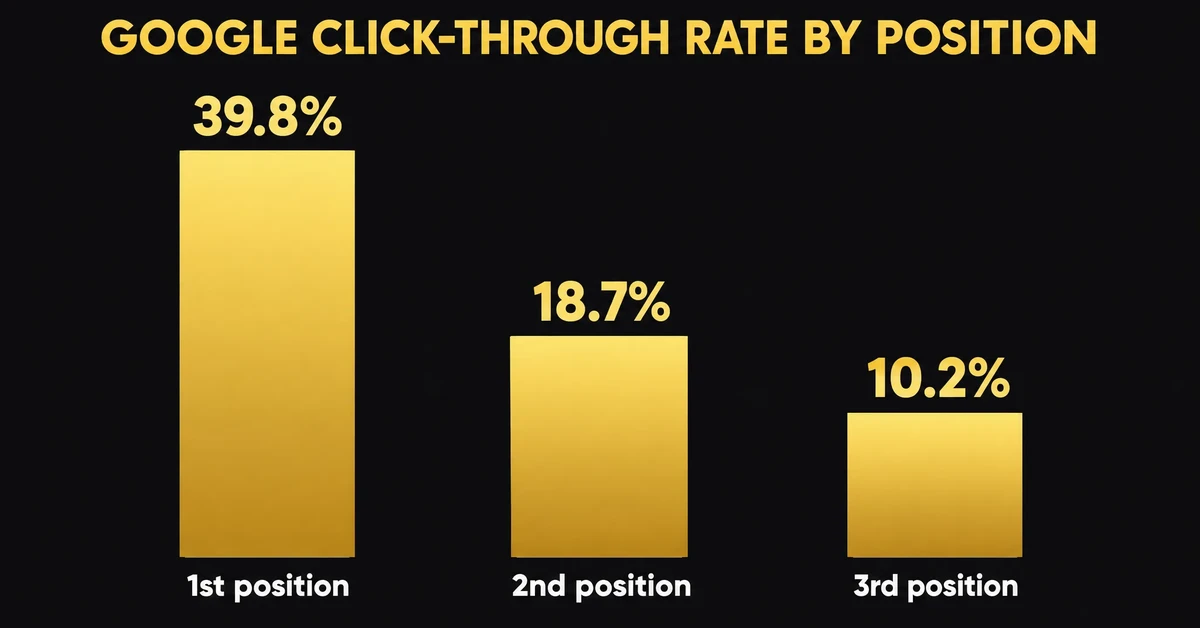
A separate 2023 study by FirstPage Sage breaks that top three down further: about 39.8% of clicks for position one, 18.7% for position two, and 10.2% for position three.
Take a page ranking third for a keyword that gets 5,000 UK searches a month. At 10.2% click-through, that is roughly 510 visits a month.
Now suppose an audit's fixes, better technical health, stronger on-page targeting, a cleaner backlink profile, help that page climb to first place. The same keyword at 39.8% click-through becomes roughly 1,990 visits a month.
That is nearly four times the traffic from the same keyword and the same search volume, with no extra advertising spend. It comes purely from closing the gap an audit would have identified and prioritised.
Multiply that across the handful of keywords that actually drive enquiries, not every keyword the site happens to rank for. The maths behind paying for a proper audit usually works out comfortably in your favour.
That gap matters more than it used to. Research from SparkToro and Similarweb found that 69.5% of UK Google searches between January and April 2026 ended without any click to the open web at all.
That is the highest zero-click rate of six countries studied. The clicks that remain are worth fighting harder for than they were a few years ago.
Moving a page from third to first place in Google can turn 510 monthly visits into nearly 2,000, using the same keyword and the same search volume. With over two-thirds of UK searches now ending in no click at all, the clicks left on the table matter more than ever.
It is a fair question. If fewer searches end in a click at all, why spend money fixing crawl errors and meta descriptions? The honest answer is that AI Overviews make the fundamentals matter more, not less.
Google's AI-generated answers are built by summarising the pages it trusts enough to rank highly in the first place. A page with crawl errors or thin content is far less likely to be pulled into one.
The same is true of a page with no clear structure. It is unlikely to reach a traditional top-three result either.
Our separate guide to ranking in AI Overviews and LLM answers covers that side specifically. A clean technical and on-page foundation, the exact thing a proper audit checks, is the prerequisite for both approaches, not a separate task to tackle afterwards.
A standard technical audit typically costs £500 to £7,500. A full audit covering content and backlinks too commonly works out at £1,200 to £12,000, and a website migration audit can run from £1,000 up to £15,000 depending on site size. The right figure within those ranges depends mainly on how many pages you have and how competitive your sector is.
A small site usually takes one to two weeks, a mid-size SME site two to four weeks, and an enterprise or migration audit four to eight weeks or longer. Be cautious of anyone promising a full audit within 48 hours.
A free tool or checklist flags obvious, surface-level issues. A paid audit explains why each issue matters for your specific site, prioritises fixes by real impact, and is backed by a person you can question, not just an automated score.
It is a genuinely useful first pass for catching the obvious faults yourself, but it will not assess backlink quality, benchmark you against real competitors, or tell you whether your current agency's work has actually been worth paying for.
Not always, and that is fine as long as it is clear upfront. Ask explicitly whether the price covers implementation or only identification, so you can budget separately for whichever part is not included.
Once a year is a sensible baseline for most businesses, with an extra audit triggered by a traffic drop, a planned migration or redesign, or genuine doubts about an existing agency's performance.
Yes, a proper independent audit will show whether technical health, on-page work and backlink quality have actually improved under the current provider, rather than just taking their own reporting at face value. It is one of the few genuinely neutral ways to settle the question.
Work through the prioritised fix list in order, starting with whatever the report ranks as highest impact against lowest effort, and agree who (in-house, your existing agency, or a specialist) is responsible for each item.
No, and anyone promising guaranteed rankings from an audit alone should be treated with caution. What a good audit guarantees is clarity: an evidenced, prioritised view of what is actually holding your site back, which is the necessary first step before any ranking improvement.
An SEO audit only pays for itself if someone actually works through what it finds. Gilkes Media's SEO service includes exactly this kind of independent audit as the starting point for any new engagement.
If you want a second, honest opinion on your site's technical health, on-page work or backlink profile before committing to another year of the same, book a free discovery call. We will tell you plainly what we find.
