If your marketing content is still mostly blog posts, PDFs, and static graphics, you're not doing anything wrong, but you are almost certainly leaving a genuinely effective, increasingly expected format underused.
B2B buyers in 2026 research differently to how they did even five years ago, and video has moved from a nice-to-have to one of the more reliably effective formats for building trust with a business audience that's naturally sceptical of marketing claims.
This is the case for why video earns a place in a B2B marketing plan specifically, not a generic "video is good" argument that applies equally to any business, and it's worth reading even if you've tried video before and weren't convinced, since the format matters as much as the decision to use it at all.
Consumer buying decisions are often fast and emotional. B2B buying decisions are slow, considered, and usually involve multiple people who each need convincing, sometimes people who never speak to your sales team directly at all.
A junior team member might do the initial research and shortlisting, then need to convince a manager, who needs to convince a budget holder, none of whom had the original conversation with you.
This is exactly where video does something text struggles to do as efficiently: it transfers trust and credibility to people who weren't in the room.
A well-made case study video or a demo can be forwarded internally and watched by a decision-maker who never spoke to your sales team, and it does a meaningfully better job of representing your business accurately than a summary written by whoever forwarded it.
A written case study requires someone to read it properly to get the full picture.
A video gets watched, and a two-minute video conveys tone, confidence, and credibility in a way a page of text simply can't replicate, however well written.
The longer, more considered nature of B2B sales cycles also means buyers spend more time in research before ever speaking to a salesperson, often significantly more than in consumer purchases.
Video content that answers real questions during this research phase, what does the product actually look like in use, what do existing customers genuinely say, keeps you credible and present throughout a research process you have limited visibility into and no direct control over.
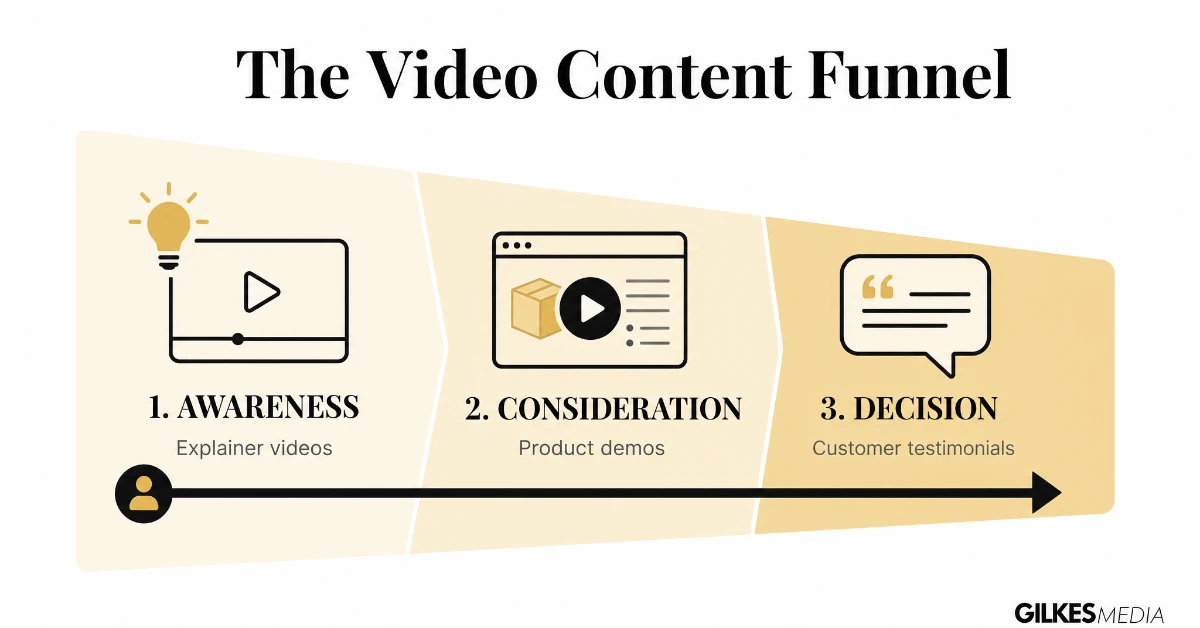
Awareness stage.
Short, useful content that demonstrates expertise without a hard sell, an explainer on a genuine industry problem, a quick tip, a myth-busting piece, works well here because the goal is building familiarity and trust with people who aren't ready to buy yet, not converting them immediately.
Consideration stage. This is where product demos, case studies, and comparison content do the heaviest lifting.
A prospect actively evaluating options wants to see the thing working, not just read a description of it working, and wants to hear from a real customer in a similar position to them, not just read a quote that could have been written by anyone.
Decision stage.
A short, direct video from a founder or senior team member addressing common objections or explaining exactly what working with you looks like can be the final piece of reassurance a hesitant decision-maker needs before signing off, particularly for a considered, higher-value purchase where the buyer wants a sense of who they'd actually be working with.
Post-sale onboarding.
Often overlooked in marketing planning specifically, but genuinely valuable: video walkthroughs and onboarding content reduce the support burden on your team and improve the new customer's early experience, which directly affects retention and the likelihood of referrals and repeat business down the line.
It's a small production investment relative to the ongoing support time it saves once a handful of common questions are answered once, on video, instead of repeatedly by a person.

| Funnel stage | Video that works hardest here | The goal |
|---|---|---|
| Awareness | Short explainers, quick tips, myth-busting content | Build familiarity and trust, not an immediate sale |
| Consideration | Product demos, case studies, comparison content | Show the thing working and let a real customer vouch for it |
| Decision | A short, direct video from a founder or senior team member | Address objections and give final reassurance before signing off |
B2B buying involves multiple people who often never speak to your sales team directly, so video does something text struggles to do - it can be forwarded internally and still transfer trust to someone who wasn't in the original conversation. Match the format to the funnel stage: short, useful, expertise-led content for awareness, more substantive proof further down.
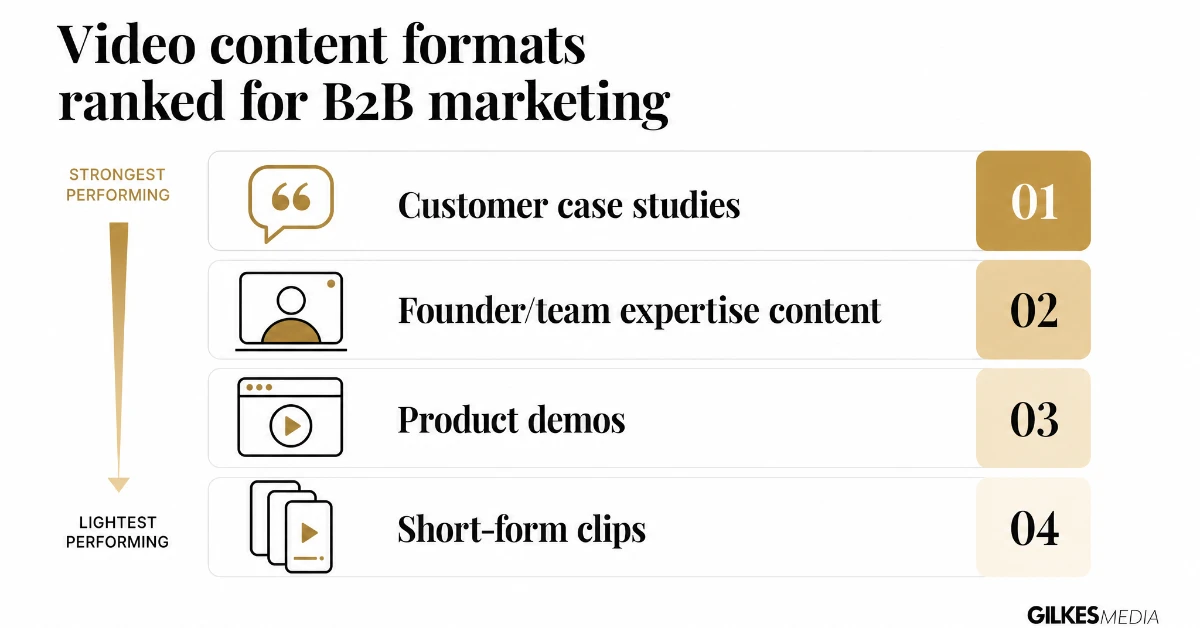
Not every video format performs equally, and B2B specifically rewards different formats than consumer marketing does.
Customer case study videos consistently perform among the strongest formats for B2B, because they let a real customer make the case for you in their own words, which carries more credibility with a sceptical business buyer than anything you say about yourself, however true it is.
Short-form founder or team content, a senior person sharing genuine expertise or opinion, builds trust and personality in a market where most competitors sound identical in their written content.
This has become increasingly important as more written content gets produced with AI assistance and starts to read as generic; a real person speaking with genuine expertise and personality cuts through that sameness in a way that's hard to fake.
Product demo videos, showing the actual thing working rather than describing it, remove ambiguity and answer the practical "how does this actually work" question that a lot of written product content dances around without ever quite showing.
Explainer videos for genuinely complex offerings earn their cost when your service or product needs more than a paragraph to understand properly.
If a prospect needs to understand several moving parts before they can properly evaluate whether you're a fit, video can convey that complexity considerably faster than text, provided it's well scripted rather than just narrated bullet points.
Generic brand films with no specific informational job to do tend to underperform the more specific formats above, not because they look bad, but because they don't answer any particular question a prospect actually has at the point they're watching.
A genuine customer describing a real result in their own words addresses the scepticism a business buyer brings to any vendor claim far more directly than polished company messaging ever can. This is why case study video consistently ranks as one of the highest-converting formats specifically for consideration and decision-stage B2B buyers.
View counts are the least useful metric for judging B2B video performance, because a view is often counted after just a few seconds of watching, telling you almost nothing about whether the content actually did its job.
Watch time and completion rate tell you whether the content held attention, which is a genuine signal of relevance and quality.
A video with a high view count but a low average watch time is a warning sign that the content isn't landing, however good the raw numbers look on a dashboard.
Click-through rate on any call to action within or after the video tells you whether it actually moved someone toward the next step, which is ultimately what marketing content is for.
And for gated or landing-page video content specifically, track conversion rate on the page it sits on before and after adding video, since this is often the clearest, most directly attributable signal of whether the investment is paying off.
Vanity metrics like social shares can be worth tracking too, but treat them as a secondary signal, not the main measure of success, particularly for B2B content where the buyer who matters most may never publicly engage with the post at all, simply watching quietly and moving on with their research.

Customer case study videos consistently perform among the strongest B2B formats because a real customer makes the case for you, which carries more credibility than anything you say about yourself. View counts are the least useful metric for judging performance - watch time and click-through actually tell you whether the content did its job.
You don’t need a big production plan to get started properly. A short, deliberate process beats winging it on the day:
Video performs best as part of an integrated approach rather than a standalone initiative sitting apart from the rest of your marketing.
Paired with paid social and search campaigns, video creative consistently produces stronger engagement than static image ads for a comparable spend, because it holds attention longer in a crowded feed and conveys more information in the same few seconds of attention.
Paired with your existing lead generation content, a well-placed demo or case study video on a landing page can lift conversion rate meaningfully compared to text and static images alone, for exactly the reasons covered in the funnel breakdown above.
As part of your lead generation, video isn't a separate initiative competing for a different part of your budget, it's a format that should be strengthening the campaigns and content you're already running, not sitting apart from them as its own project with its own separate goals.
If you're not sure what a first project should cost, our video production cost guide covers realistic UK pricing for exactly the formats discussed above.

A simple planning process beats winging it: pick one specific buyer question, write a rough outline first, and give the viewer one clear next step, not just a logo and fade-out. Video performs best paired with paid social and search rather than standing alone, since it consistently holds attention longer than static image ads for comparable spend.
Completely unscripted video can work for short, casual social clips, but longer-form content, a proper case study or product demo, benefits from at least a clear outline of the key points to hit, even when delivered conversationally. Rambling, unstructured longer content loses viewer attention noticeably faster than content with a clear, if loosely scripted, structure.
The broader research on this is consistent and worth knowing, even if the specific numbers shift year to year.
Marketers who use video consistently report it as one of the highest-ROI content formats they produce, and buyers across B2C and B2B alike report preferring to learn about a product or service through video where it's available, rather than reading an equivalent amount of text.
Check HubSpot's latest video marketing statistics if you want the current-year figures behind the general trend described here, since these numbers move year on year and it's worth checking the latest release rather than relying on any single year's snapshot indefinitely.
What's worth taking from this isn't a specific percentage to quote in a meeting, it's the consistency of the direction: year after year, across multiple independent studies, video keeps outperforming equivalent text and static image content on the metrics that actually matter, engagement, time spent, and stated buyer preference.
That's a strong enough, consistent enough signal to justify a real allocation of budget, even before you've measured your own specific results.
The most common wasted investment is treating video as a one-off project rather than an ongoing format that needs refreshing as statistics date and competitors catch up. The broader research is consistent: marketers who use video regularly report it as one of their highest-ROI content formats, and buyers consistently prefer it to reading.
One of the biggest barriers stopping B2B businesses from starting with video is an assumption that it requires a large production budget. That assumption is usually wrong.
Clear audio matters more than almost anything else. Viewers will tolerate imperfect lighting or a simple background far more readily than they will tolerate audio that is hard to hear or full of background noise. A modest clip-on microphone paired with a smartphone camera consistently outperforms excellent visuals recorded with poor built-in audio.
Founder and expert-led content in particular performs well with a noticeably lighter production style, a person speaking directly to camera in an office, filmed on a phone, because the credibility comes from the substance of what is said, not from cinematic production values. Over-polished, heavily scripted content in this format can actually read as less trustworthy to a sceptical B2B buyer than something that feels like a genuine, unscripted expert opinion.
A first case study video or founder-led explainer can realistically be produced for a few hundred pounds in equipment (a decent microphone and basic lighting, both reusable for future videos) plus the time to plan, film, and edit it, well before committing to a larger, ongoing production budget once the format proves itself.
Clear audio and a genuine, direct message beat expensive production values every time in B2B video, because credibility is what a business buyer is actually evaluating.
A well-made video that only lives on one platform, uploaded once and left there, gets a fraction of the value the same content could deliver spread properly across the channels a B2B audience actually uses.
A single twenty-minute case study interview can realistically produce a full-length YouTube or website video, three or four short clips for LinkedIn, a written blog post built from the transcript, and a handful of quote graphics pulling out the strongest statements, all from one filming session.
LinkedIn's algorithm has consistently favoured native video uploads over links out to externally hosted video, and B2B decision-makers spend meaningful time on the platform specifically in a professional mindset, making it one of the highest-value distribution channels for this kind of content, ahead of platforms with a more consumer-oriented audience.
Not for most formats. Founder-led and expert content in particular performs well with lighter, more direct production, provided the audio is genuinely clear. A professional crew becomes more worthwhile for a flagship brand film or a highly polished product demo, not for every piece of video content a business produces.
It depends entirely on the format and where it sits in the funnel. Awareness-stage social clips typically work best under a minute. Consideration-stage product demos and case studies often run several minutes, since a genuinely interested buyer will watch longer content if it is directly relevant to their evaluation.
Treating it as a one-off project rather than an ongoing content format. A single video, however well produced, ages and loses relevance over time, while a business that keeps producing modest, consistent video content steadily builds a genuine library of trust-building assets.
No, the two work best together rather than as a replacement for one another. Video tends to build trust and demonstrate expertise particularly well, while written content remains essential for SEO, detailed reference material, and the kind of content a buyer wants to scan quickly rather than watch.
YouTube for discoverability and SEO benefit, the company website for embedding directly on relevant pages, and LinkedIn natively (rather than just linking to YouTube) for professional audience reach, are the three channels most B2B businesses should prioritise before considering others.
We cover exactly how to make videos findable in Video SEO: How to Get Your Video Content Found and Ranked.
Watch time and click-through rate to a relevant next step (a landing page, a contact form, a demo request) tell you far more than view count alone. A video with modest views but strong watch time and a genuine conversion path is outperforming a video with high views and no meaningful engagement beyond the first few seconds.
You don't need a full video marketing programme running across every stage of the funnel from day one.
The sensible starting point for most B2B businesses is one strong customer case study video and one clear product or service demo, the two formats that consistently do the most commercial work for the least production complexity.
Get those right, measure how they actually perform against your specific goals, then expand into the other formats and funnel stages once you've proven the approach works for your specific audience rather than assuming it will because it worked for someone else's business in a different industry with a different buyer.
Get in touch through our contact page for a free discovery call.
We'll talk through what you're already doing and where video would genuinely add to it, rather than just recommending video for its own sake, and if the honest answer is that your budget is better spent elsewhere right now, we'll tell you that too.
It is worth being honest about the sequencing that tends to work best for a B2B business trying video for the first time. Starting with the highest-difficulty format, an ambitious, heavily produced brand film, is the most common way businesses stall out before ever publishing anything. A far more sustainable starting point is a single, modestly produced founder or expert video answering one genuine question your customers ask regularly, published, and then built on from there once the process feels comfortable.
This staged approach also builds internal confidence and momentum. A business that publishes a first, simple video and sees even modest engagement typically finds it far easier to commit to a second and third than a business that spent months and a significant budget on a single ambitious piece before publishing anything at all. Momentum, more than any individual video, is what turns a one-off experiment into a genuine ongoing content format.
It is also worth planning for how a video ages before committing significant resource to producing it. Content built around evergreen expertise, a genuine explanation of a process, a real customer story, a founder's honest take on an industry problem, holds up considerably longer than content built around specific statistics, current pricing, or a particular product version, all of which date quickly and eventually need retiring or updating. Where possible, structure a video so the parts likely to date are kept separate from the parts that will remain accurate for years, an approach editors sometimes call "future-proofing" a script.
None of this means video needs to dominate a B2B marketing budget from day one. A modest, consistent commitment, one or two videos a month once the process is comfortable, produced to the standard described above rather than left to an ambitious but never-completed brief, will typically outperform an occasional expensive production that only happens once or twice a year.
If you're considering video for the first time and unsure where to start, a genuinely useful first step is simply listing the five questions your sales team gets asked most often by prospects. Nearly every one of those questions is a natural candidate for a short, direct video answer, and that list alone will usually give you a more useful starting content plan than any generic video marketing framework.
If you'd like help turning that list into a genuine first video plan, from the right formats for your specific market to how to distribute it properly once it exists, that's exactly the kind of project we enjoy helping B2B businesses get right from the start.
The businesses winning with B2B video in 2026 are rarely the ones with the biggest production budgets. They are the ones treating it as a genuine, ongoing part of how they communicate with prospects, consistent rather than occasional, direct rather than over-produced, and built around real customer problems rather than company self-promotion. That approach costs considerably less than most businesses assume, and delivers considerably more than a single polished but isolated video ever could.
Whatever stage your business is at with video right now, whether that's never having attempted it or having a single unused brand film sitting on a hard drive somewhere, the path forward looks the same: pick one genuine customer question, answer it clearly and directly on camera, distribute it properly across the channels your buyers actually use, and measure whether it earns real engagement before deciding how far to take the format from there.
That single step, more than any elaborate strategy document, is what actually gets a B2B video content programme off the ground and keeps it moving.
If your competitors haven't committed to this yet, and in most B2B niches, many still haven't, that gap is a genuine opportunity worth acting on now rather than waiting until video becomes the expected baseline rather than a point of differentiation.
Start small, stay consistent, and let the results guide how much further you take it.
That is the whole approach in one sentence, and it works considerably better in practice than most businesses expect once they actually try it.
Get the first video out, learn from how it lands, and build from there.
Getting the strategy right is only half the job; the finished video still has to look and sound professional. If you’re weighing up outsourcing production, our guide to choosing a video production company covers what to check before you commit, and you can browse our other video production guides for more.
