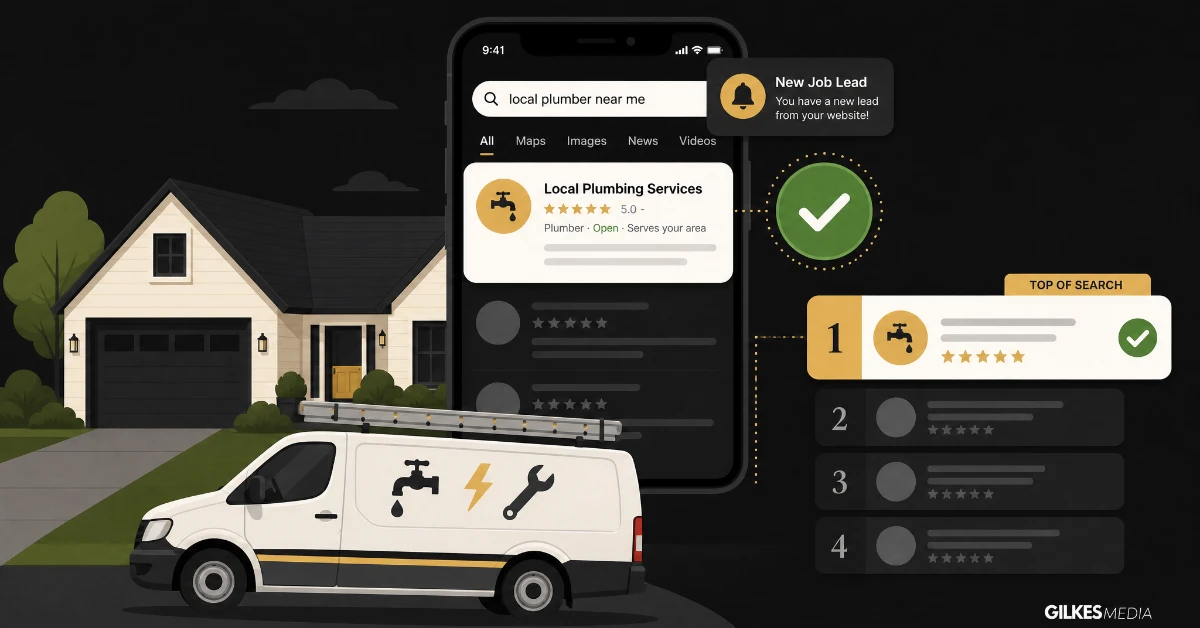
If you run a plumbing, electrical, roofing or legal services business in the UK, you have probably noticed a small cluster of listings at the very top of Google. Each one sits above the normal paid ads, with a green checkmark and a star rating attached.
That is Google Local Services Ads, and it works completely differently from the Google Ads campaigns most agencies, including us, build every day.
More UK trades and professional services firms are asking about it every month. Usually this happens after a competitor's listing keeps showing up above theirs, or after a standard Google Ads campaign has become too expensive to justify.
Both are good reasons to look into it properly rather than guessing. This guide covers what Local Services Ads actually are, which UK businesses can use them, and what they cost in 2026.
It also covers how to get verified, how the ranking system really works, and - most importantly - whether they are worth your budget compared with standard Google Ads for small business. Every figure here comes from Google's own published guidance or independent UK agency data, not invented numbers.
Local Services Ads (LSA) is Google's pay-per-lead advertising product for local service businesses. Instead of paying every time someone clicks your ad, as you would with standard Google Ads, you only pay when a potential customer actually contacts you through the ad.
That contact can be a phone call, a message, or a booking request. Your listing appears at the very top of relevant local searches, above both organic results and standard paid ads.
It carries your average review rating, your years in business, and a trust badge. There is no keyword list to build, no ad copy to write, and no landing page required.
Google handles the matching based on your service area, your chosen categories, and the details on your Google Business Profile.
Home service businesses that pass verification earn the Google Guaranteed badge. This comes with a customer satisfaction guarantee backed financially by Google itself, up to a set limit per claim.
Professional service businesses - solicitors, accountants and similar - earn the Google Screened badge instead. This confirms licensing and background checks without the same money-back guarantee, since Google cannot underwrite the outcome of a legal case the way it can a botched boiler repair.
Either badge signals to a searcher that Google has already checked your credentials. That matters a great deal when someone is choosing a tradesperson or a solicitor they have never used before.
Standard Google Ads works well for businesses that can build a good landing page and write persuasive ad copy. Many trades businesses cannot, or do not have the time to.
Local Services Ads removes that barrier entirely by generating the listing from your Google Business Profile and your reviews. That is exactly why it appeals to time-poor tradespeople and small professional practices.
Local Services Ads flips the usual paid advertising model: you pay for a genuine enquiry, not a click, and Google builds the ad for you in exchange for tighter eligibility and a verification process.
Local Services Ads is not open to every industry. Google restricts it to a defined list of home service and professional service categories.
That list has grown steadily since it launched in the UK, but it remains far narrower than standard Google Ads, which any legitimate business can use regardless of trade.
This is the larger of the two groups, covering more than 30 trades and home-based services, including:
This smaller group, around 18 categories, covers regulated professional services. It includes several types of solicitor - corporate, criminal, family, immigration, property and tax law - alongside estate agents and insolvency specialists.
If your business falls into one of these, you will be working towards the Google Screened badge rather than Google Guaranteed. The verification documents differ accordingly.
If your business does not fall into any listed category, Local Services Ads is simply not available to you, whatever your budget. Most B2B software, most manufacturing, and most professional services outside the list above fall into this group.
That is the single biggest disqualifying factor, and it is worth checking before you spend any time on the rest of this guide.
The quickest way to check is directly from your Google Business Profile dashboard. It will show a Local Services Ads option if your listed business category matches one of the eligible types.
Category lists change over time as Google expands the programme. It is worth checking again even if you were told "not available" a year or two ago.
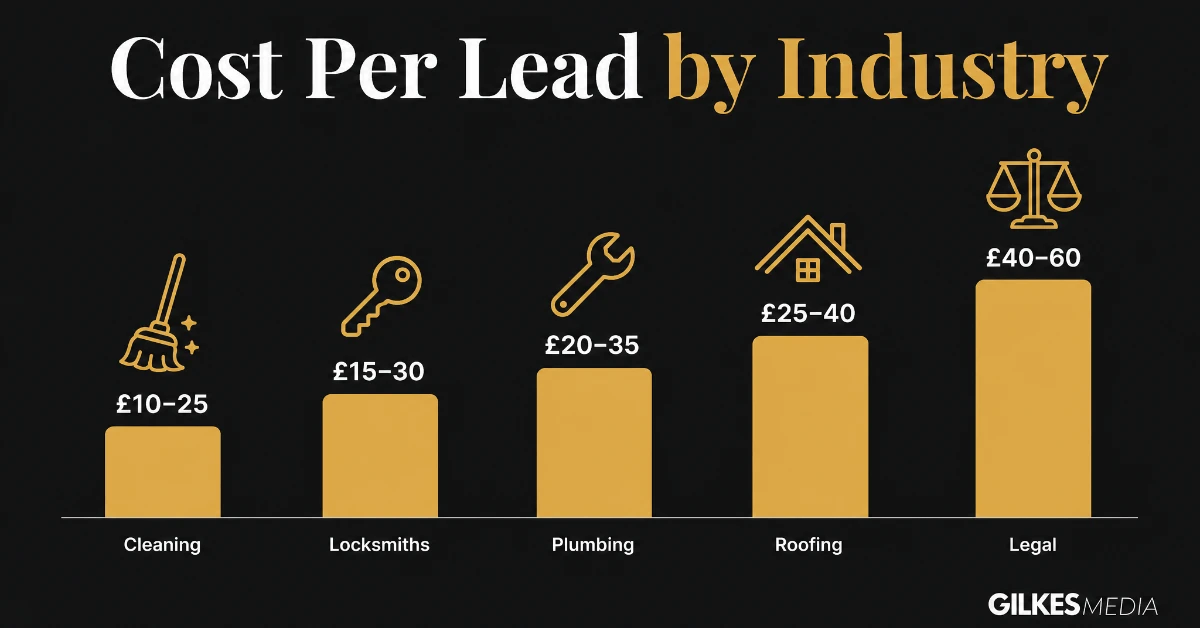
Because you pay per lead rather than per click, cost per lead (CPL) varies a lot by trade and by how competitive your local area is.
Prices in busy cities run noticeably higher than in smaller towns. The categories with the highest average job value tend to carry the highest CPL too.
| Industry | Typical cost per lead |
|---|---|
| Cleaning and landscaping | £10 - £25 |
| Locksmiths and general trades | £15 - £30 |
| Plumbing and electrical | £20 - £35 |
| Roofing and home improvement | £25 - £40 |
| Legal services | £40 - £60 |
Three things move the price within your own category. Competition is the biggest of the three: a plumber in central Manchester competes with far more businesses for the same searches than one in a small market town.
Expect to sit towards the higher end of the range in bigger cities. Seasonality matters too, and it cuts both ways depending on your trade.
Roofers often see costs rise after a storm, when demand spikes across an entire region. Boiler engineers typically see the same pattern every winter, for the same reason.
Your own review score and response speed also affect price indirectly. A business that ranks better tends to get a healthier mix of lead types over time.
A common starting point for a small local service business is somewhere between £250 and £750 a month. That is enough to generate a meaningful flow of leads in most trades.
It does this without committing to a large spend before you know how well your business converts leads into paid jobs.
Take a mid-range plumbing business spending £400 a month at an average £27 cost per lead. That works out to roughly 14 to 15 leads in a typical month.
If half convert into booked jobs, which is realistic for a business that answers quickly and quotes fairly, that is seven paying jobs from a £400 spend. Repeat customers and referrals are not even counted in that figure.
Cost per lead on Local Services Ads ranges from around £10 for cleaning and landscaping up to £60 for legal services, and most small trades businesses can test the water with a £250-£750 monthly budget.
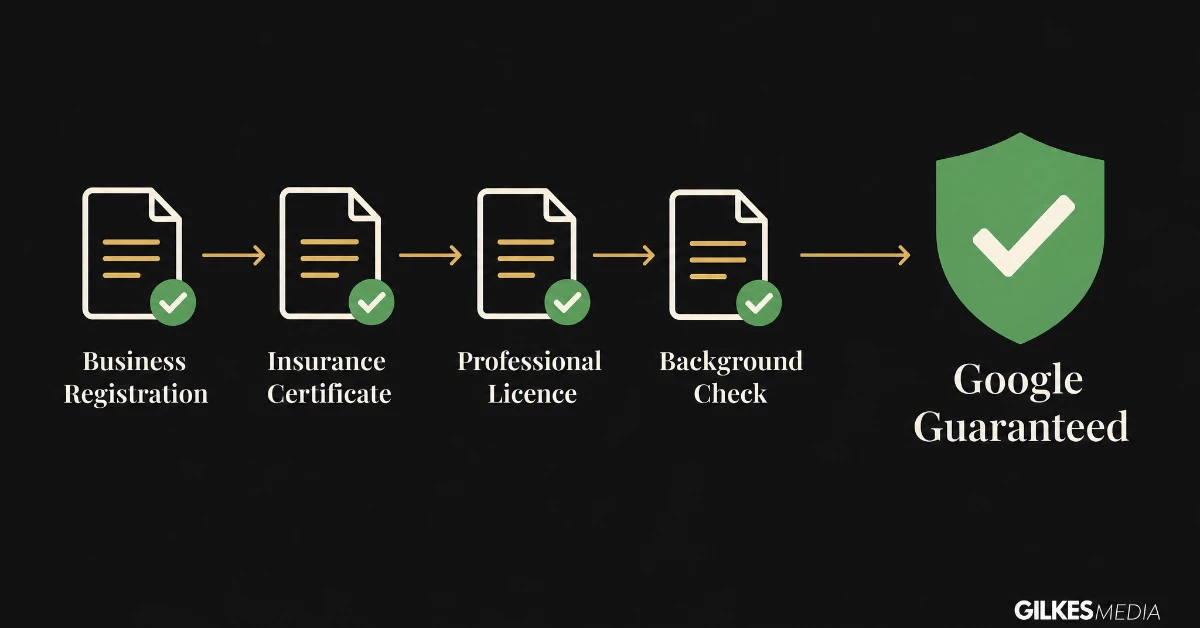
Verification is the part most businesses underestimate. It is not a same-day process, and Google will not run your ads until it is complete.
This needs to start well before you expect your first lead to arrive, not the week you decide to launch.
Verification can move quickly in quieter areas but has been reported as slow in competitive city categories, sometimes taking a few weeks rather than a few days.
Start the process as soon as you decide to test Local Services Ads. Do not build a launch date, marketing push, or seasonal campaign around it finishing on a specific day.
Once you know your business is eligible, the setup sequence itself is fairly linear. Most delays come from missing documents rather than the platform itself.
Gathering everything up front is the single best way to speed things up.
Once your campaign is live, a lead arrives as a notification in the Local Services Ads app, by phone call, text message, or booking request. It depends on how the customer chose to reach you.
The clock starts immediately, whether you notice it or not. Missed calls and unread messages do not just cost you that one job.
They quietly lower your ranking for the next search too. That is why businesses that assign a specific person, or rotate cover during busy periods, tend to outperform ones that leave it to whoever happens to be near a phone.
After the job is complete, mark the outcome in the app - booked, not proceeded with, or genuinely invalid. This record feeds your booking rate figure directly.
Over time, it also shapes how Google views the quality of your leads compared with other businesses in your category.
Answer or reply within a few minutes wherever possible. Quote honestly rather than lowballing to win the call, and ask for a review within a day or two of a completed job while the experience is still fresh.
None of this is complicated, but very few businesses do it consistently. That is exactly why it works as a competitive advantage.
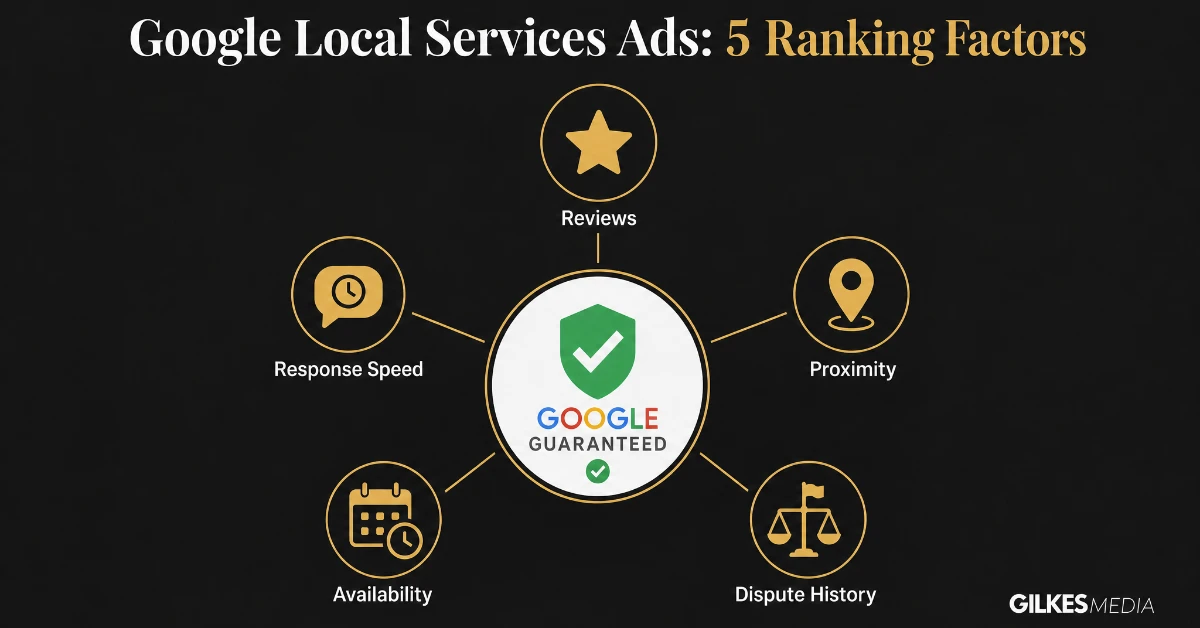
Unlike standard Google Ads, there is no bid amount that guarantees you the top spot. Google ranks Local Services Ads listings on a mix of signals.
Businesses that treat it as a "set and forget" channel tend to fall down the list within weeks of a strong start.
In practice, this means the businesses that do best on Local Services Ads already answer the phone quickly and ask happy customers for a review.
Those are the same habits that help with local SEO and your Google Business Profile more broadly.
These two products solve different problems. For most eligible trades businesses, the honest answer is eventually both rather than either/or.
But if you are choosing where to put your first pound of budget, the differences below matter.
| Factor | Local Services Ads | Standard Google Ads |
|---|---|---|
| Billing model | Pay per genuine lead | Pay per click |
| Ad copy and keywords | Not required | Fully managed by you or your agency |
| Eligibility | Limited category list | Open to almost any legitimate business |
| Trust signal | Google Guaranteed / Screened badge | None built in |
| Management effort | Lower, mostly reviews and responsiveness | Higher, ongoing optimisation needed |
No landing page or ad copy to get right, and a lower barrier to a decent result for a business with strong reviews. It also offers a trust badge that standard search ads simply cannot.
It is a genuinely good fit for a well-reviewed local trade with limited marketing time.
Full control over which keywords you target, what your ad says, and where a click lands. That matters if your business is not yet eligible for Local Services Ads, or competes outside its category list.
It also matters if you need to promote a specific offer or service page. Our guide to PPC management for small business covers that side in full.
Plenty of well-run trades businesses use Local Services Ads for steady, low-effort lead flow. They run standard Google Ads alongside it to target specific services, seasonal offers, or areas just outside their usual Local Services Ads range.
The mechanics of Local Services Ads are the same whether you are a plumber or a solicitor. The buying behaviour behind each enquiry is very different, and that changes how you should think about the channel.
A burst pipe or a broken boiler is an emergency for the person searching, not a considered purchase. Whoever answers first, sounds competent, and can attend soonest usually gets the job, regardless of price.
For these trades, response speed and honest availability matter more than almost anything else on this list.
A new roof or a landscaping project is a bigger, less urgent decision. The person searching is more likely to compare two or three businesses before choosing.
Here, a strong, recent set of reviews and clear photos of past work carry more weight than being the very first to answer the phone.
A solicitor or accountant lead usually represents a higher-value, longer engagement than a single home repair job. The person enquiring is often comparing credentials as much as price.
The higher cost per lead in this category reflects that. A single new client can be worth many multiples of the lead cost itself, so the calculation looks different from a £200 callout job.
Cost per lead on its own tells you very little. The number that actually matters is cost per booked job, which depends on how many of your leads turn into paying work.
Track your total leads received, your booking rate (the percentage that turn into confirmed jobs), and your average job value.
Multiply booking rate by average job value against your total spend, and you have a genuine return figure rather than a vanity metric.
A legal services firm paying £50 per lead with a 30% booking rate and an average case value of £1,200 is doing very well. That is true even though £50 looks expensive next to a £15 cleaning lead.
A cleaning business paying £15 per lead but converting only one in ten, because it responds to messages a day late, may be doing worse despite the lower headline cost.
Set a short monthly review: total leads, booking rate, cost per booked job, and anything unusual in your ranking position.
A sudden drop in leads with no change in budget is almost always a ranking issue - usually reviews, response speed, or an accidental change to your service area or hours.
Cost per lead is not the number that decides whether Local Services Ads is working. Cost per booked job, driven by your booking rate and average job value, is what actually tells you.
Rather than a flat yes or no, run through these questions honestly before committing budget.
Are you actually eligible? If your trade is not on Google's category list, this decision makes itself. Check the current list on your Google Business Profile dashboard before doing anything else.
Can you answer the phone fast? Since response speed drives both ranking and conversion, a business that cannot pick up calls promptly during working hours will see a poor return regardless of budget.
Do you already have a handful of genuine reviews? A handful of solid, recent reviews puts you in a far stronger starting position than a blank profile, since ranking rewards recency as much as volume.
If you can answer yes to those three, Local Services Ads is very likely worth a modest test budget.
If you are weak on reviews or response time, that is worth fixing first - through tightening your cost per lead on channels you already run - before adding a new one.
Local Services Ads rewards businesses that already answer quickly and collect reviews consistently. If those habits are not in place yet, fix them first - a new ad channel will not make up for a slow phone line.
Local Services Ads has a lower day-to-day management burden than standard Google Ads, since there is no ad copy or keyword list to maintain.
Plenty of well-organised trades businesses run it themselves successfully, particularly once verification is done and reviews are flowing steadily.
Where an agency earns its fee is in the parts that are easy to get wrong from the outside. That includes getting verification through cleanly the first time, and setting a realistic budget against your real job value.
It also includes spotting when your ranking has slipped and diagnosing why, and running it properly alongside a wider paid media and SEO plan rather than as an isolated channel nobody is watching.
We also see a lot of value in combining Local Services Ads management with a proper look at your review generation process and your Google Business Profile. Those two things drive ranking on this platform more than budget ever will.
If you would rather have someone else handle the setup and ongoing management while you focus on the jobs it brings in, that is exactly the kind of work we do for trades and professional services clients across the UK.
A free consultation is the easiest way to find out whether it is worth it for your specific business and area.
No. It is limited to a defined list of home service trades (plumbing, electrical, roofing, cleaning and similar) and a smaller group of professional services such as certain solicitors and estate agents. Most other industries are not eligible at all, regardless of budget.
You pay per genuine lead rather than per click. Cost per lead typically ranges from around £10 for cleaning and landscaping up to £60 for legal services, with most small trades businesses starting on a monthly budget of £250 to £750.
Google Guaranteed applies to home service trades and comes with a customer money-back guarantee backed by Google. Google Screened applies to professional services like solicitors and confirms licensing and background checks, without the same guarantee.
Yes. You can dispute a genuinely invalid lead within the Local Services Ads dashboard within 30 days of receiving it. Disputing leads that were valid but simply did not convert can affect your standing, so use this for genuine issues only.
For most eligible trades businesses, the two work best together rather than as a straight choice. Local Services Ads is well suited to steady, low-effort lead flow, while standard Google Ads gives you control over specific services, offers, or areas outside your usual range.
It varies. Verification can complete within a week or two in quieter areas, but has been reported as slower in competitive city categories. Start the process as early as possible rather than building a launch date around a specific completion time.
Yes, but each location generally needs its own verified Google Business Profile and its own Local Services Ads verification, since the platform is built around a single service area per profile rather than a national listing.
Your listing stops showing for new leads once your set budget is used for that period, and resumes automatically when the next weekly or monthly cycle starts. You can raise your budget at any time if you are consistently running out early.
Cost per lead has generally risen as more UK businesses have joined the platform in each category, the same pattern seen on most advertising channels as competition grows. This makes response speed and reviews more important over time, not less, since they are what keep your cost per booked job under control even as the headline cost per lead increases.
If you would rather not set this up and manage it yourself, we run done-for-you Google Ads management for UK businesses, including Local Services Ads setup, verification and ongoing optimisation. Get in touch for a free consultation and we will take it off your plate.
