
A client asked us a version of this question three times last month: “should we be on Google, Meta, LinkedIn, or TikTok?” Each time, the honest answer started with another question, not a platform name.
There is no universally best paid ad platform. There is only the platform that fits your buyer, your budget, and how ready your business is to handle the leads it produces.
This guide compares Google Ads, Meta Ads, LinkedIn Ads, and TikTok Ads on the things that actually decide the outcome: how each one targets a buyer, what it realistically costs a UK business in 2026, and which situations genuinely favour one over the others.
By the end, you should be able to rule two or three of these out for your own business with confidence, rather than guessing or copying whatever a competitor happens to be running.
Every platform comparison article eventually tries to crown a winner. That framing is the first mistake, because these four platforms don’t compete for the same job.
Google Ads catches someone who has already decided they have a problem and is actively searching for a solution. Meta, LinkedIn, and TikTok interrupt someone who wasn’t looking for you at all.
That single distinction, intent versus interruption, explains most of the cost and performance differences you’ll see later in this guide. It’s worth holding onto as you read the rest.
So instead of asking which platform is best, ask three narrower questions: who is your buyer, how do they actually behave online, and what can your business handle operationally once the leads start arriving.
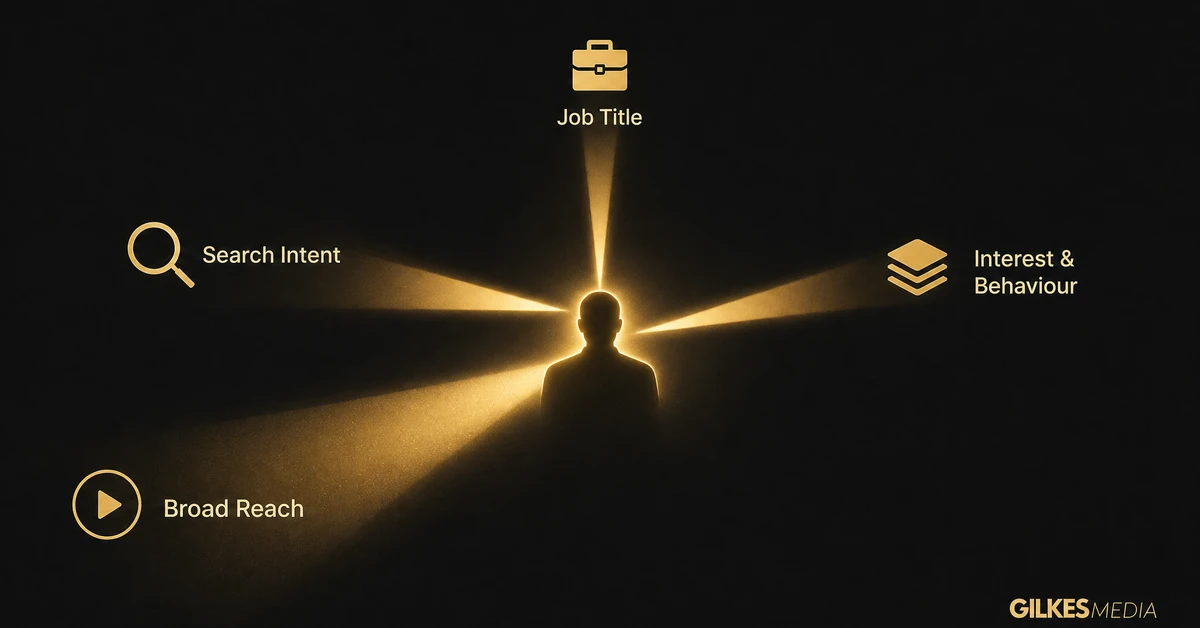
The targeting mechanism behind each platform is the real product you’re buying, not the ad format. Get this part wrong and no amount of creative or budget fixes it.
Google Ads doesn’t guess who might want your service. It shows your ad to someone who has just typed the exact words describing what they need.
That’s why Google Ads tends to convert at a higher rate than the other three platforms, and why it usually costs more per click. You’re paying for demonstrated intent, not attention.
The trade-off is volume. If nobody is searching for what you sell, Google Ads has nothing to show, however well-funded the campaign. See our full breakdown of what Google Ads actually costs in the UK for sector-by-sector detail.
Facebook and Instagram target people based on behaviour, interests, and lookalike audiences built from your existing customers, not what they’ve typed into a search bar.
This makes Meta genuinely powerful for reaching people before they know they have a problem, which is exactly the audience Google Ads can’t reach at all.
It also means your ad has to work harder. You’re competing for attention someone wasn’t planning to give you, in a feed built to keep them scrolling past ads. Our Meta Ads cost guide covers realistic UK budget bands in more depth.
LinkedIn is the only platform of the four that reliably targets by job title, seniority, and company size, rather than inferred interest. For B2B, that precision is close to irreplaceable.
You’re not paying for reach here. You’re paying to guarantee that a “marketing director at a UK software company with 50 to 200 staff” sees your ad, and almost nobody else does.
That precision is exactly why it’s the most expensive platform on this list, click for click. Narrow, valuable audiences are always the most contested ones in any auction, as our LinkedIn Ads cost guide breaks down in full.
TikTok reached 26.8 million adult users in the UK by late 2025, around 48% of the UK adult population, according to DataReportal’s Digital 2026 UK report. That’s genuinely mainstream reach now, not a niche youth app.
What it hasn’t become is a place people go to research a B2B purchase. Its core behaviour is still entertainment and discovery, and its targeting reflects that: broad interest and behaviour signals, not job title or buying intent.
It earns a place in specific situations, which we cover later, but it’s the platform most likely to disappoint a business that treats it as a cheaper LinkedIn.
We go into more depth on that specific comparison in TikTok Ads for B2B: is it worth it in 2026.
Google catches people who are already looking for a solution. Meta, LinkedIn, and TikTok interrupt people who weren’t looking at all — and each one interrupts a different audience, in a different way, at a different price.
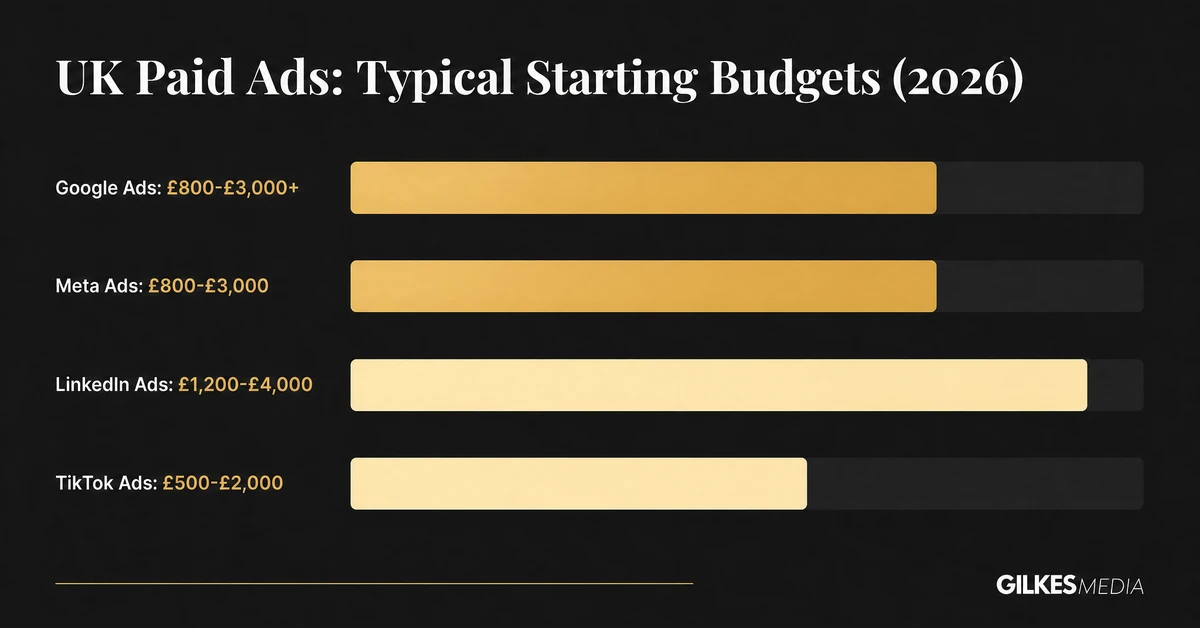
None of these platforms publish a fixed price list. Every one of them runs a live auction, so your actual cost depends on your industry, your audience, and who else wants the same person at the same moment.
That said, based on live UK campaign data across these four platforms, some realistic starting points hold up consistently enough to plan a first budget against.
| Platform | Typical starting monthly budget (UK) | Cost per click guide | Targeting model |
|---|---|---|---|
| Google Ads | £800 – £3,000+ | £0.95 – £8.25 (varies hugely by sector) | Search intent |
| Meta Ads | £800 – £3,000 | Typically £0.40 – £1.50 | Interest & behaviour |
| LinkedIn Ads | £1,200 – £4,000 | Typically £3.00 – £9.00+ | Job title & seniority |
| TikTok Ads | £500 – £2,000 | £0.10 – £0.80 | Interest & behaviour |
Google’s cost per click swings the most of the four, because it tracks how valuable a converted customer is in that sector. Legal services average around £8.25 a click; retail and e-commerce averages closer to £0.95.
LinkedIn sits consistently above Meta and TikTok on a like-for-like click basis, because you’re buying certainty about who sees the ad, not just volume of impressions.
These are starting points for planning, not guarantees. Your own numbers will move once you have live data, which is exactly why every platform here rewards a proper testing phase before you scale spend.
A quick worked example shows why click cost alone is misleading. A UK B2B SaaS business paying around £3.65 a click on Google, with a typical 3% landing page conversion rate, is looking at roughly £122 per lead before any qualification.
The same business on LinkedIn, paying £3 to £9 a click with a more typical 2% landing page conversion rate for that platform, lands somewhere between £150 and £450 per lead. On paper, that looks worse than Google.
What that comparison misses is lead quality. LinkedIn’s job title targeting often produces a far higher proportion of genuinely qualified leads, so the real cost per qualified opportunity can end up close between the two, or even favour LinkedIn, once you account for it.
This is exactly why cost per click is the wrong number to optimise for in isolation. Cost per qualified lead, tracked properly, is the only comparison that tells you anything useful across platforms.
Seasonality moves every one of these numbers too. Costs typically rise 15 to 30% across all four platforms from late November through December, as UK retailers compete hard for the same Black Friday and Christmas attention, then ease back into the new year.
Budget is only half the real cost of running paid ads. Each of these four platforms makes a different, ongoing demand on your time, your creative, or your website, and it’s worth being honest about which one your business can actually sustain.
Google Ads demands the least creative production but the most strategic groundwork upfront: proper keyword research, tightly matched landing pages for each campaign, and conversion tracking that’s actually wired up correctly before you spend a penny.
Meta Ads is the opposite. Ad creative fatigues fast, often within one to two weeks at meaningful spend, so it needs a steady supply of fresh images, video, and copy variations to keep performance from sliding.
LinkedIn Ads sits between the two. It needs less creative rotation than Meta, but it rewards a more considered, slightly longer-form message aimed at a specific job title, which usually means more thought per ad, not more volume of ads.
TikTok Ads is the most demanding on production, full stop. Its audience can spot a repurposed TV advert instantly, and performs far better with genuine, native, semi-raw short-form video, ideally produced weekly, not quarterly.
Be honest about this before you choose. A business with no capacity to produce weekly video has no business running a serious TikTok budget, however good the cost per click looks on paper.
Cost per click is the wrong number to compare platforms on. Cost per qualified lead, and whether your team can actually sustain the creative each platform demands, is what decides the real winner for your business.
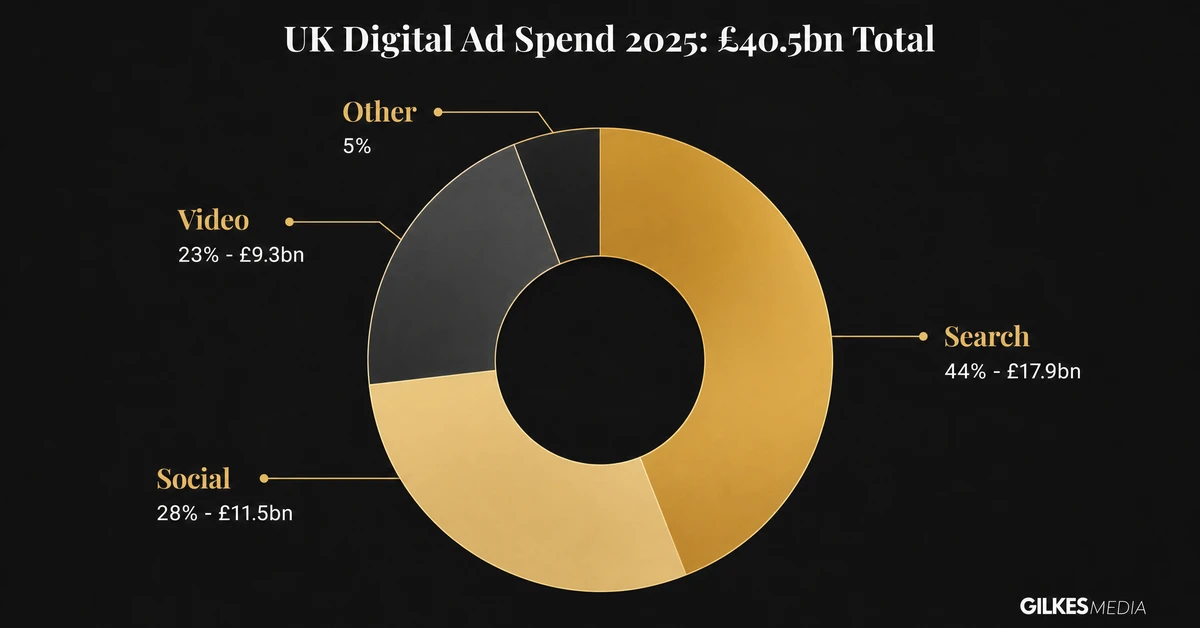
The UK’s digital ad market reached £40.5 billion in 2025, up 10% year on year, according to the IAB UK Digital Adspend report. That growth rate is well ahead of UK GDP growth, which sat at 1.4% over the same period.
Search advertising, dominated by Google, still takes the largest single share at £17.9 billion, 44% of all UK digital ad spend, growing a comparatively modest 6% year on year.
Social media spend, which covers Meta, LinkedIn, and TikTok combined, reached £11.5 billion, 28% of the total, but grew far faster at 21% year on year. Video formats added a further £9.3 billion, up 20%.
The pattern is clear even without a marketing degree to interpret it: search is the mature, high-intent channel everyone already relies on, while social and video are where the growth, and increasingly the competition, is happening.
For your own planning, that means two things. Search intent budgets are unlikely to get meaningfully cheaper as more advertisers pile in, and social platforms are the more likely place to still find room to grow efficiently before costs catch up.
UK digital ad spend hit £40.5 billion in 2025, and social media spend grew more than three times faster than search. Search is still the biggest single channel, but social is where the room to grow efficiently is opening up.
Rather than a single recommendation, here’s how we’d generally think about it for different kinds of UK business, based on what we see actually working across client accounts.
These are starting points, not rules. A B2B business with a highly visual product, industrial machinery demonstrations are a real example we’ve seen work, can genuinely justify TikTok earlier than this list suggests.
The size of your addressable market matters too. A niche B2B product with only a few hundred realistic UK buyers will exhaust a broad Meta or TikTok audience quickly.
LinkedIn’s precision targeting, by contrast, can keep finding the right people within that same small pool for far longer, which is exactly what you’re paying the premium for.
Conversely, a consumer product with a genuinely broad market rarely justifies LinkedIn’s premium at all, since you’re paying for job-title precision you don’t actually need.
The single most expensive mistake we see is a business choosing one platform and expecting it to carry the entire journey from stranger to paying customer on its own.
Google Ads is excellent at capturing someone who already wants what you sell. It’s a poor tool for building awareness with someone who doesn’t yet know they have a problem.
Most of these mistakes come from treating each platform as a stand-alone campaign rather than one stage in a longer journey. The fix is usually structural, not creative.
The most expensive paid ads mistake isn’t picking the wrong platform. It’s expecting one platform to carry a customer from complete stranger to paying client entirely on its own.
Yes, and for most established UK businesses with a genuine ongoing marketing budget, running two platforms together outperforms running one in isolation.
The most common effective pairing we run for clients is Google Ads plus Meta: Google captures people actively searching, and Meta retargets everyone who visited the site but didn’t convert, at a fraction of the cost of a fresh click.
For B2B specifically, LinkedIn plus Google tends to outperform LinkedIn alone, because LinkedIn builds recognition with the right job titles while Google catches the same people once they start actively searching.
The one combination we’d caution against for a limited budget is spreading across three or four platforms simultaneously before any single one has proven itself. Depth beats breadth in the early months of any paid programme.
A realistic rule of thumb: don’t add a second platform until your first one is converting predictably and you understand your genuine cost per lead on it. Adding complexity before you have a baseline just makes every result harder to read.
There’s also a practical sequencing question worth asking: which platform is cheapest to learn on.
Meta and TikTok tend to be more forgiving places to make early mistakes, since a wasted £500 stings far less than a wasted £1,500 on LinkedIn while you’re still learning what works.
If you’re still weighing this up, run through these steps in order. Most businesses land on a clear answer by step three or four.
This framework won’t remove every judgement call. What it does is stop you picking a platform because a competitor is on it, or because someone in a Facebook group said it worked for them.
Revisit the decision every quarter, not every week. Platforms, audiences, and your own business change slowly enough that a quarterly review catches real shifts without you chasing every short-term fluctuation in the data.
Write down who your buyer actually is and whether they’re searching for you today. That one answer, more than any platform’s reputation, decides where your first pound of ad spend should go.
We don’t default every client to the same platform, and we won’t recommend adding a second or third one until the first is genuinely proving itself.
Every paid ads engagement starts the same way: understanding who your buyer actually is, what they’re searching for, and where they spend their attention, before a single pound is spent on any platform.
From there, we set up proper conversion tracking so you can see real cost per qualified lead, not just clicks or impressions, and we report on that number honestly, including when a test isn’t working.
Where it makes sense, that also includes connecting paid ads to the wider question of SEO versus PPC, since the two rarely compete for the same budget as directly as they’re often made out to.
We’d rather tell you honestly that a platform isn’t the right fit, and say why, than run it anyway because it’s already been sold. That’s the same reasoning behind this entire guide.
If you’re weighing up Google, Meta, LinkedIn, or TikTok for your own business and want a second opinion before committing budget, a free discovery call is the easiest way to get a straight answer specific to your situation.
You can also see how we approach paid ads management in more detail, including how we structure testing budgets and report results.
TikTok Ads generally has the lowest cost per click, often between £0.10 and £0.80, followed by Meta. LinkedIn is consistently the most expensive on a per-click basis, because of the precision of its job title targeting.
Start with Google Ads if people actively search for what you sell. Start with Meta if you need to build awareness with people who don’t yet know they have the problem you solve.
For most B2B businesses selling to a specific job title or seniority level, yes. You’re paying for precision that Meta and TikTok can’t reliably match, which usually produces a lower cost per qualified lead even at a higher cost per click.
Usually not well. Spreading a limited budget across four platforms means none of them gathers enough data to optimise properly. One or two platforms, run properly, beats four run thinly.
Give it 60 to 90 days at a realistic budget for your sector before deciding it isn’t working. Most platforms need that long to move past the initial learning phase and produce a reliable cost per lead.
Sometimes, mainly for employer branding, visual or demonstrable products, and founder-led content aimed at building awareness. It’s rarely a good direct lead generation replacement for LinkedIn or Google in B2B.
As a general guide, £500 to £800 a month on Meta or TikTok, or £800 to £1,200 on Google or LinkedIn, is enough to gather usable data from a genuine test. Below that, results are usually too thin to draw a reliable conclusion from.
Plenty of UK small businesses run their own paid ads successfully, particularly on Google and Meta, where the platforms’ own tools have improved a lot. An agency tends to earn its cost back once budgets grow past a few thousand pounds a month, or once tracking, creative testing, and cross-platform strategy start taking more time than the business can spare. See our guide to hiring a PPC agency for ROI for what to look for.
There isn’t a single right answer to Google versus Meta versus LinkedIn versus TikTok, and anyone who gives you one without asking about your business first is guessing.
What does help is being honest about who your buyer is, how they behave, and how much budget you can commit to a genuine test. Get those three things right and the platform choice usually becomes obvious.
If you’d rather talk it through than work it out alone, book a free discovery call and we’ll give you a straight recommendation for your specific business, budget, and buyer.
