
If you have asked three SEO agencies for a quote this month, you have probably had three very different answers, with very little explanation behind any of them. That is not because SEO pricing is a mystery. It is because "SEO" covers a wide range of work, and the honest answer to "how much does SEO cost" always starts with "it depends on what you actually need."
This guide sets out real UK pricing for 2026, drawn from current agency rate cards, freelancer marketplaces and salary data rather than guesswork. It covers monthly retainers by business size, hourly and day rates, one-off project costs, the true cost of hiring in-house, and the warning signs that a cheap quote is going to cost you more than it saves.
Quick answer: most UK small and mid-sized businesses pay somewhere between £750 and £5,000 a month for ongoing SEO, depending on how competitive their market is and how much work is involved. A local business with light competition can get meaningful results nearer the bottom of that range. A B2B company competing nationally for commercial keywords should expect to sit nearer the top, or above it.
SEO pricing in the UK is set by three things: how much hands-on work a campaign needs, how senior the person doing that work is, and how competitive your market is. A single-location tradesperson competing on local search terms needs far fewer hours a month than a B2B software company chasing national commercial keywords against well-funded competitors.
That is why "how much does SEO cost" never has one number as an answer. It has a range, and the honest way to use that range is to work out which part of it actually applies to your business, not to anchor on whichever figure sounds cheapest.
Across current 2026 UK pricing data, most agencies and consultants price ongoing SEO in four broad bands. We will break each one down properly below, but as a starting point: local and startup SEO typically runs £300 to £1,500 a month, a growing SME sits around £1,500 to £3,000, a competitive mid-market B2B business is usually £2,500 to £7,500, and enterprise or highly competitive sectors run £5,000 to £25,000 or more.
There is no single "correct" SEO price. The right budget depends on how much competition you are up against and how many hours of skilled work your market genuinely requires, not on which agency quotes the smallest number.
Most UK SEO is sold as a monthly retainer rather than a one-off fee, because SEO is an ongoing process, not a single task you finish and walk away from. Rankings need maintaining, content needs updating, and competitors do not stand still. The table below sets out what that retainer typically buys at each business size.
| Business type | Typical monthly cost | Approx. hours/month | What it usually includes |
|---|---|---|---|
| Local or startup | £300–£1,500 | 5–10 | Local SEO, Google Business Profile, light on-page fixes, a handful of content pieces |
| Growing SME | £1,500–£3,000 | 15–30 | Regular content, technical fixes, some link building, monthly reporting |
| Mid-market B2B | £2,500–£7,500 | 30–50 | Dedicated strategy, consistent content output, active digital PR/link building |
| Enterprise or highly competitive | £5,000–£25,000+ | 50–100+ | Multi-person team, large-scale technical SEO, international/multi-site work, aggressive link acquisition |
These bands overlap on purpose. A growing SME in a genuinely uncompetitive niche might sit at the bottom of the mid-market range. A "small" business in a brutally competitive sector, like personal injury law or short-term lending, often needs enterprise-level spend just to be visible at all. Sector competitiveness matters more than headcount.
Local SEO specifically, aimed purely at ranking in Google's local map pack and "near me" searches, tends to sit in a narrower band of its own: roughly £1,000 to £1,800 a month for a single location, since the work is more contained than a full national SEO campaign.
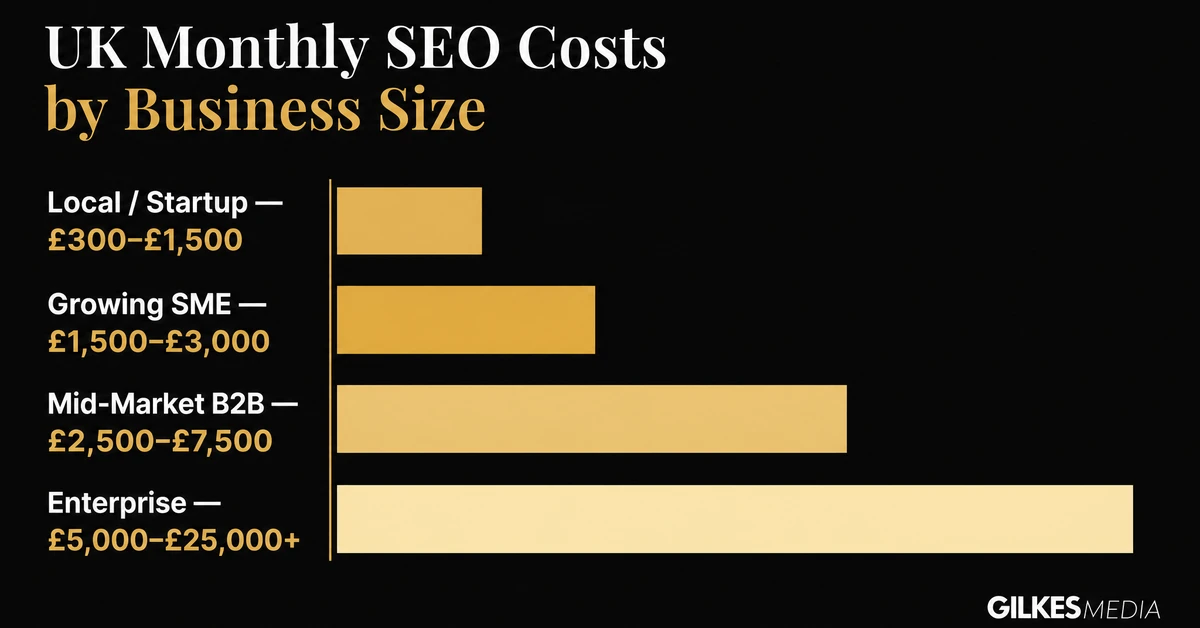
One point worth being blunt about: if a quote lands well under £300 a month for genuine, ongoing SEO work, it is very unlikely to include enough hours to move the needle. At that price, you are usually paying for automated reporting and a light touch, not a real campaign.
Not every business wants an ongoing retainer straight away. Some start with a freelancer for a defined project, or bring in a consultant for a technical audit before committing to anything bigger. Here is what that costs by route.
UK freelance SEO specialists typically charge £35 to £150 an hour, depending on experience, or £200 to £1,200+ a day. A junior freelancer with 0-3 years' experience usually sits at £200-£400 a day, a mid-level specialist with 3-7 years at £400-£700, and a senior or niche specialist with 7+ years at £700-£1,200 or more.
Freelancers are usually the cheapest route to genuine hands-on expertise, but you are buying one person's time and one person's skill set. If they are off sick, on holiday, or simply weaker at technical SEO than at content, there is no one else on the account to cover the gap.
Agencies typically charge £80 to £300 an hour, blended across the team working on your account. That blended rate is the trade-off for agency SEO: you are paying more per hour than a single freelancer, but you get access to a wider skill set, from technical specialists to content writers to digital PR, without having to hire and manage each of them yourself.
Senior independent consultants, and specialists brought in for a specific problem such as a Google penalty, a migration, or an enterprise technical audit, charge £150 to £1,000+ an hour. London-based specialists in particular can charge £250-£400 an hour or more, reflecting both cost of living and the concentration of high-value clients based there.
Two businesses of a similar size, in similar sectors, can get quoted very different prices for what sounds like "the same" SEO work. In practice, a handful of factors explain almost all of that difference.
This is also why a like-for-like comparison between two agency quotes matters more than comparing the headline monthly number. A £1,500-a-month quote that includes 10 hours of real strategic work is a different proposition to a £1,500-a-month quote that includes 25.
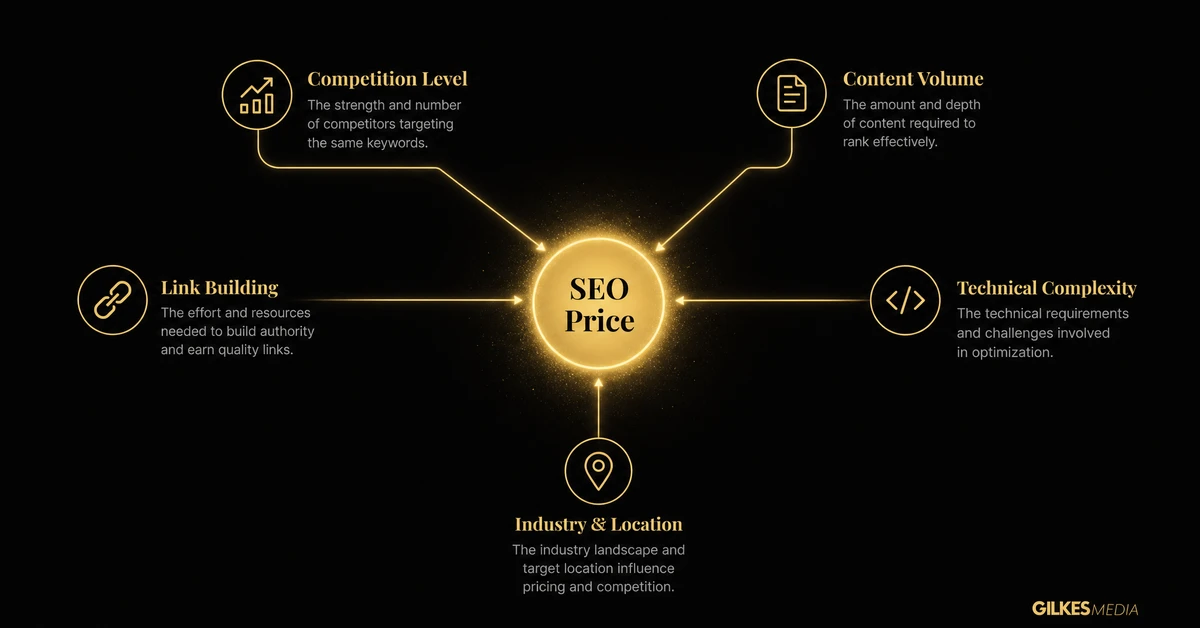
Two SEO quotes at the same monthly price can involve very different amounts of real work. Always ask how many hours, and what specifically those hours are spent on, before comparing price alone.
Not everything in SEO is sold as an ongoing retainer. Several common pieces of work are priced as standalone projects, which is often a sensible way to test a provider before committing to a longer engagement.
A technical SEO audit, covering crawlability, indexing, site speed and structural issues, typically costs £500 to £7,500 depending on site size, and can run higher for very large or complex sites. A website migration audit, protecting your rankings during a replatform or redesign, usually costs £1,000 to £15,000, scaling with how many URLs and how much traffic are at risk.
Content is often priced per piece: expect roughly £80 to £300 per 1,000 words for well-researched, SEO-informed content from a competent UK writer, more for content requiring specialist industry knowledge or original research. Link building and digital PR retainers, aimed at earning coverage and backlinks rather than buying them, typically run £1,500 to £5,000 a month on top of core SEO work.
Project-based work is a reasonable way to test whether a provider's thinking and communication actually suit your business, before signing up to a twelve-month retainer. Just be clear upfront about what happens to the relationship, and the price, once the initial project is done.
One thing worth flagging before you buy any project-based work in isolation: a technical audit or migration plan is only useful if someone then actually fixes what it finds. A common, expensive mistake is paying for a thorough audit document that then sits unread, because the audit itself was never scoped to include the implementation work. Ask upfront whether a project fee includes fixing the issues found, or only identifying them, and budget separately for whichever it does not cover.
At a certain size, "should we just hire someone" becomes a genuine question. The salary line looks straightforward, but it is rarely the whole cost.
A UK in-house SEO Manager earns £38,358 a year on average, with a typical range of roughly £27,900 to £52,736 depending on experience and location. A junior in-house specialist starts closer to £24,000-£32,000, while a Head of SEO or SEO Director commands £70,000-£140,000, with London roles usually 18-22% higher across the board.
The salary is only the starting point. Add roughly 15% for employer National Insurance, a minimum 3% employer pension contribution, and typical SEO tool subscriptions, often £150-£400 a month for a stack covering keyword research, technical crawling and rank tracking. Recruitment, onboarding and management time add further cost that rarely appears on a spreadsheet.
Worked example: a £38,358 salary, plus roughly £5,750 in employer National Insurance, £1,150 in minimum pension contribution, and £3,600 a year in tools, comes to a true annual cost of around £48,858, or just over £4,070 a month, for one mid-level in-house hire. That is broadly equivalent to a mid-market agency retainer, except it buys one person's time and skill set rather than a small team's.
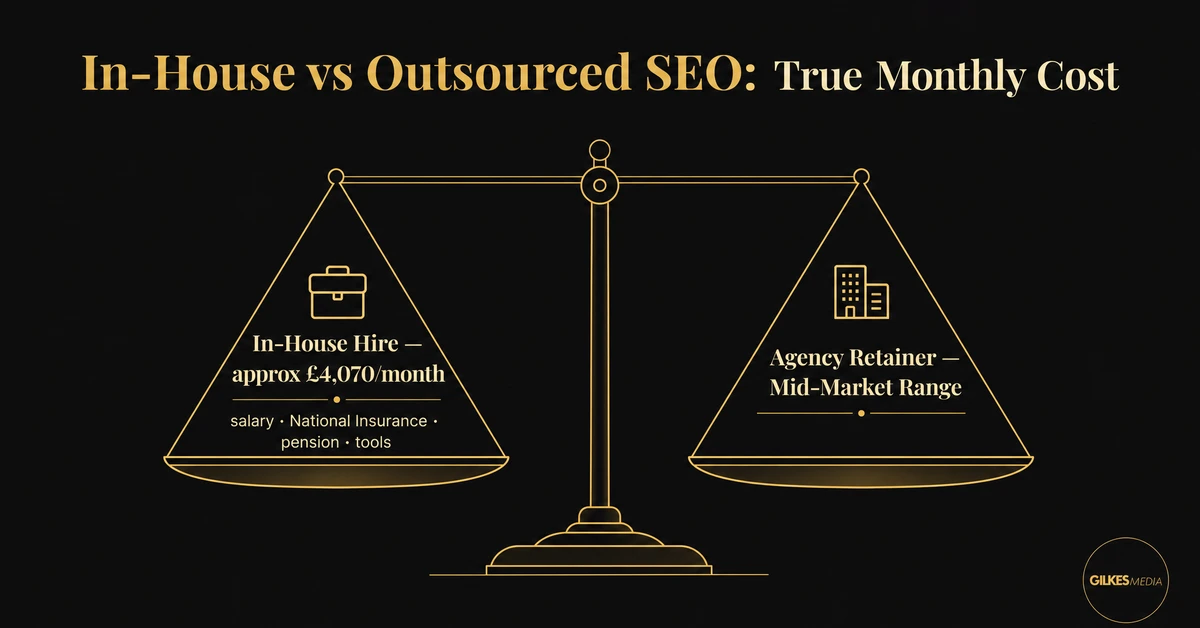
A single in-house SEO hire often costs about the same each month as a mid-market agency retainer, once National Insurance, pension, tools and management time are counted properly. The real question is whether you need one person's time or a team's range of skills.
Cost only means something next to timeline. SEO is not a paid ads campaign you can switch on and see results from within days. It compounds, which is exactly why it eventually becomes cheaper per lead than channels you have to keep paying for just to stay visible.
Most realistic UK timelines put early movement, better crawling, initial ranking improvements on lower-competition terms, at three to four months. Meaningful traffic and lead growth on competitive terms usually takes six to twelve months, and the full compounding effect, where organic search becomes a genuinely low-cost, high-volume channel, tends to show up from month twelve onward. We cover this in full, including what changes that timeline, in our guide to how long SEO actually takes.
This is the main reason cheap, short-term SEO contracts rarely deliver: if a provider needs six to twelve months of consistent work to show real results, a rock-bottom three-month contract was never going to be enough runway, whatever the sales pitch promised.
A low price is not automatically a bad sign. But certain patterns in a cheap SEO quote are a reliable warning that you are about to waste your budget, or worse, damage your site's long-term visibility.
Guaranteed rankings, vague reporting and bulk cheap backlinks are the three most reliable signs a low SEO quote will cost you more in the long run than it saves you now.
Rather than starting from "what feels affordable", it helps to start from a sensible percentage of revenue and work down to a real monthly figure, the same approach that applies to marketing budgets generally. Gartner's 2026 CMO Spend Survey puts average marketing budgets at 7.8% of company revenue, while the well-known US Small Business Administration guideline puts total marketing spend at 7-8% for an established business defending its position, rising to 12-20% for a business actively pushing for growth. We set this out in more depth, with worked examples by business type, in our guide to marketing budgets for UK businesses.
SEO is usually one part of that total marketing budget, not the whole of it. As a starting point, a business relying heavily on organic search as a lead source might allocate a third to a half of its digital marketing budget to SEO, with the rest split across paid ads, content and other channels. A business earlier in its growth, or in a less search-driven category, might allocate less to SEO and more to paid search for faster, more controllable results while SEO compounds in the background.
Whatever the split, treat the first three to six months as a floor, not a trial. Committing to a genuinely useful budget for half a year, then reviewing the data properly, tells you far more than spreading a smaller amount thinly across twelve months of half-hearted activity.
Whatever budget you land on, a few habits consistently separate SEO spend that pays for itself from SEO spend that quietly disappears. Ask for scope in hours, not just a headline price, so you can compare quotes properly. Ask what success looks like in three, six and twelve months, and hold the provider to those milestones. And ask to see examples of similar work for businesses your size, not just logos of famous clients who may have had a completely different budget and scope.
If you are trying to work out what a realistic SEO budget looks like for your specific business, competitors and goals, rather than a generic industry range, that is exactly the kind of conversation worth having before you commit to anything. You can book a free discovery call with Gilkes Media to talk through your market, your current site, and what a properly scoped SEO budget would actually look like, with no obligation to go any further than that conversation. You can also see how our SEO service is structured and what is included at each level.
If you are further along and already comparing specific agencies rather than just working out a number, our separate guide on how to choose a B2B SEO agency in the UK covers the questions worth asking beyond price, from how they report results to how they handle a client relationship that is not working out.
For a practical next step, our free technical SEO audit checklist is a good way to understand what a provider should actually be doing with your budget once you have committed to one, and where your own site might already be losing visibility before you spend a penny.
The businesses that get the best return from SEO spend are the ones who ask for scope in hours, hold providers to clear milestones, and judge examples against businesses their own size, not against famous client logos.
Price only tells you what you are spending. It does not tell you whether that spend is working, which is a separate question most businesses do not track closely enough until a review meeting forces the issue.
Four numbers matter more than any others. Organic traffic growth over time, ideally segmented so you can see growth on pages that actually target commercial, buyer-intent keywords rather than informational ones. Keyword rankings, specifically for the terms your actual customers search when they are close to buying, not vanity terms that sound impressive but rarely convert. Organic-attributed leads or enquiries, tracked through proper analytics rather than guesswork. And cost per lead from organic search, compared honestly against your paid channels, once SEO has had long enough to compound.
A provider who cannot show you movement on at least the first two of those within four to six months, even if leads and revenue are still catching up, is either working on the wrong keywords or not reporting honestly. Our guide to measuring marketing ROI covers how to build this kind of reporting properly, including how to separate genuine SEO impact from seasonal or market-wide traffic swings that have nothing to do with the work being done.
This is also where the earlier point about hours and scope pays off. If you know roughly what a provider is doing each month, technical fixes, a defined number of content pieces, a target number of links, it becomes far easier to judge whether slow early results reflect a genuinely competitive market or simply not enough work being done for the price you are paying.
Most UK businesses pay between £300 and £7,500 a month, depending on size and competitiveness. Local and startup SEO typically runs £300-£1,500, a growing SME £1,500-£3,000, and a competitive mid-market B2B business £2,500-£7,500. Enterprise or highly competitive sectors can run £5,000-£25,000 or more.
SEO usually costs more upfront and takes longer to show results, but it does not stop working the moment you stop paying, unlike paid ads. Over 12 months or more, the cost per lead from SEO is often lower than paid channels, though most businesses benefit from running both together.
Because the number of hours included, the seniority of the people doing the work, and how competitive your specific market is all vary hugely between quotes, even when the headline monthly price looks similar. Always ask for scope in hours, not just a price.
As a starting point, most small businesses budget £500-£1,500 a month for meaningful, ongoing SEO. Businesses in low-competition local markets can see results nearer the bottom of that range; those in more competitive niches usually need to budget higher to be genuinely visible.
A single in-house hire and a mid-market agency retainer often cost roughly the same per month once National Insurance, pension, tools and management time are counted. The real difference is that in-house buys one person's time, while an agency buys access to a wider team of specialists.
Freelancers typically charge £35-£150 an hour, agencies £80-£300 an hour blended across the team, and senior consultants or specialists £150-£1,000+ an hour, with London-based specialists often at the top of that range.
Early movement is usually visible from three to four months, meaningful traffic and lead growth from six to twelve months, and the full compounding benefit tends to show from around month twelve onward. Short contracts under six months rarely give SEO enough time to prove its value.
Yes, particularly if the price comes with guaranteed rankings, no clear scope in hours, vague automated reporting, or bulk cheap link building. These are the most common signs of a low-effort service that can actively harm your site's rankings.
