"How much should I be spending on marketing?" is one of the most common questions we hear from UK business owners. It is also one of the hardest to answer honestly.
Ask five different agencies and you will likely get five completely different numbers, usually with very little real explanation behind any of them. This guide sets out the real UK and international benchmarks for 2026, then shows how to turn a percentage into an actual figure for your business.
It breaks that figure down by channel using genuine UK pricing data, walks through several worked examples across different business types, and covers the common mistakes that quietly waste the budget you do set aside.
Marketing spend is not like rent or insurance. There is no fixed cost for a fixed thing. A five-year-old plumbing business with a full order book and a two-year-old SaaS start-up chasing its first hundred customers both "do marketing", but their sensible budgets look nothing alike.
Three things drive most of the difference: how established the business is, how competitive its market is, and what it is actually trying to achieve. A business defending existing market share needs far less than one trying to take share from someone else.
A regulated, high-value B2B sale needs a different budget shape to an impulse-buy e-commerce product. That is why the benchmarks below are ranges, not answers.
Used properly, a range gives you a sensible starting number. What you do with that number, and where you point it, matters more than the number itself.
Start with the percentage-of-revenue view, because it is the fastest way to sanity-check whatever number you already have in mind.
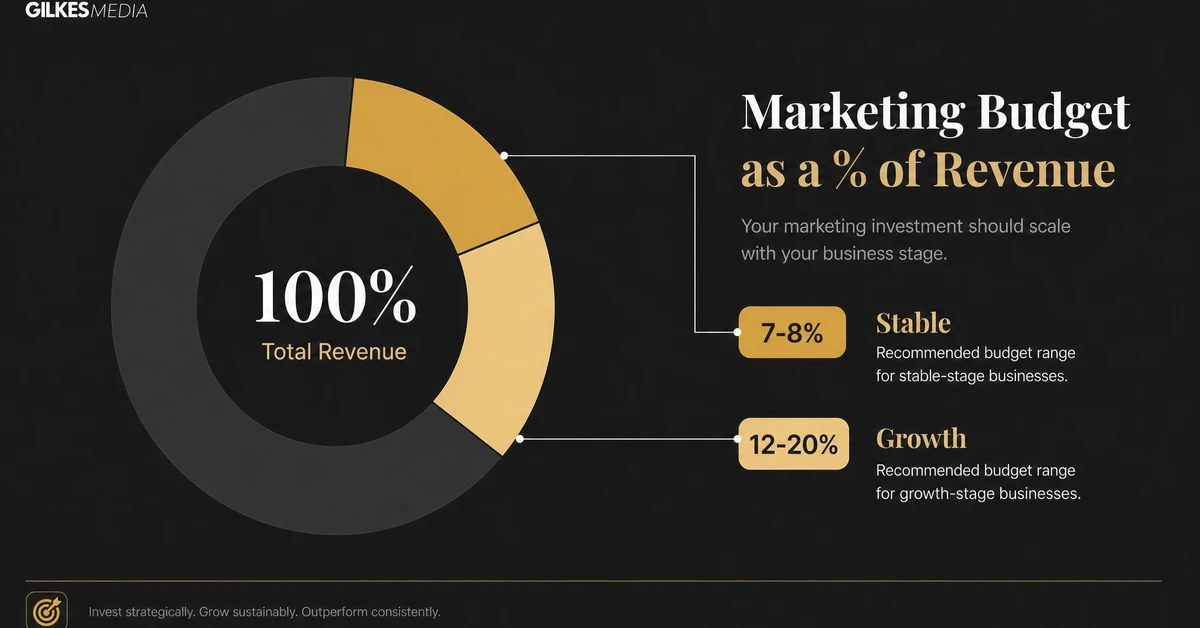
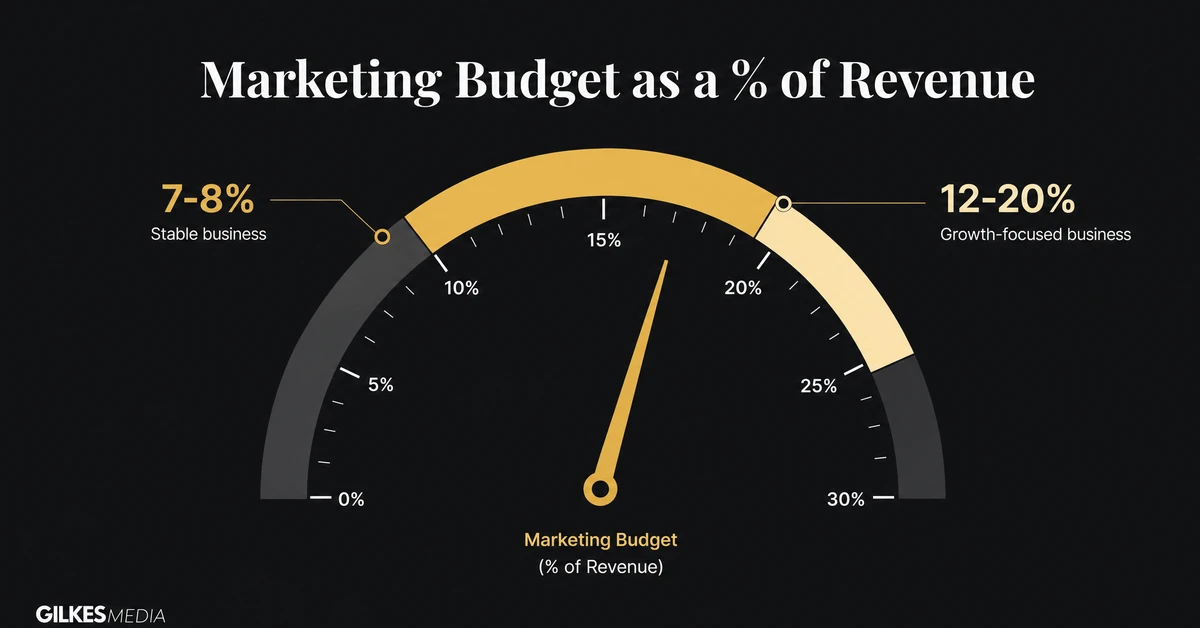
The most widely repeated guideline, originally popularised by the US Small Business Administration, is still the most common starting point cited by UK marketing consultants. It puts total marketing spend at around 7-8% of revenue for an established business mainly defending its position.
Businesses actively pushing for growth, or launching something new, are advised to budget closer to 12-20%. That is a wide range on purpose. A business happy with steady, predictable turnover sits at the bottom.
A business trying to double in eighteen months sits nearer the top, because new customers cost more to win than existing ones cost to keep.
Gartner's 2026 CMO Spend Survey, which polled senior marketers across the US and Europe, put average marketing budgets at 7.8% of company revenue in 2026, up only slightly from 7.7% in 2025.
The separate CMO Survey (Spring 2026, its 35th edition) put the figure a little higher, at around 9%. Both surveys skew toward larger organisations with dedicated marketing teams, so treat them as an upper reference point rather than a direct match for an SME.
What matters is that they land squarely inside the 7-8% baseline above, which is reassuring corroboration rather than a coincidence. One more figure from the same survey is worth flagging: 56% of CMOs said their 2026 budget was not enough to deliver their strategy. Under-budgeting is not just a small business problem.
The IPA's Bellwether Report tracks UK marketing budget revisions every quarter and is the most consistently cited UK-specific source in the industry. In Q2 2026, 23.8% of UK companies surveyed increased marketing spend, 16.9% cut it, and 59.4% left it unchanged.
That gave a net balance of +6.9%, down slightly from +7.3% in Q1 2026. In plain terms, more UK businesses are still raising marketing budgets than cutting them, but the pace of increases has been slowing through 2026.
Within that total, video and events spend has been holding up best, while some traditional print and out-of-home categories have kept shrinking.
The Advertising Association and WARC's January 2026 expenditure forecast added useful colour on where that money goes. Total UK ad spend was forecast to pass £50 billion in 2026, up 7.5% year on year.
Search and online display now account for around 83% of that spend, with digital channels overall making up roughly 89% of the total. If you are wondering whether digital deserves the lion's share of your own budget, the market has already answered that question.
Most credible 2026 benchmarks, UK and international, land in the same place: roughly 7-8% of revenue for a stable business, rising toward the high teens for one pushing hard for growth. Digital channels now account for the large majority of UK ad spend, so that is where most of the budget should go by default.
Before working out a number, it helps to agree what it covers. Most of the benchmarks above refer to media spend and agency or consultant fees: the money spent buying attention and expertise, not building the business itself.
Website builds, marketing software subscriptions, and any in-house marketing salaries are usually counted too, since they are directly funding the same activity. What generally sits outside the figure is general branding work like signage or uniforms, and sales team costs once a lead has already been handed over.
One practical UK-specific point worth flagging: agency and consultant quotes are almost always given excluding VAT, while your own revenue figure for the percentage calculation should be your turnover, not turnover plus VAT collected on sales. Mixing the two up is a common way business owners end up under or over-budgeting by 20% without noticing.
Percentages are only useful once you turn them into a figure you can commit to and defend. Here is the process we walk clients through.
A worked example: a UK B2B services business turning over £1.2m a year, growing steadily but not aggressively, would land on a baseline of roughly £84,000-£96,000 a year, or £7,000-£8,000 a month.
A newer competitor in the same space trying to double revenue inside two years might reasonably budget £144,000-£240,000 a year, using the 12-20% band, to fund that pace of growth.
Percentage-of-revenue budgeting has an obvious problem for a pre-launch or first-year business: there is no meaningful revenue yet to take a percentage of. Work from customer acquisition cost targets and forecast revenue instead.
Start by estimating what a single customer is worth to you over a realistic period, not just their first purchase. Then use the cost-per-lead benchmarks below for your sector to work out a rough cost per customer.
Multiply that by how many customers you need in your first six to twelve months to hit a credible revenue target. For example, a new B2B services business targeting 20 customers in its first year, with a typical customer worth £4,000 and a realistic cost per acquisition of £400, needs to plan for roughly £8,000 across that year.
That works out to around £650-£700 a month. It should sit comfortably inside the founder's funding runway, not stretch it, since a new business rarely has the cash buffer to absorb a channel that underperforms for several months.
Keep the testing allowance proportionally larger than an established business would, typically 25-30% rather than 10-20%, because you genuinely do not yet know which channel and message will work best. Expect to spend the first two to three months mostly learning, not scaling.
With no trading history, work backwards from your target customer acquisition cost and required customer numbers instead of a revenue percentage. Keep a larger testing allowance than an established business would, and make sure the result fits inside your actual funding runway.
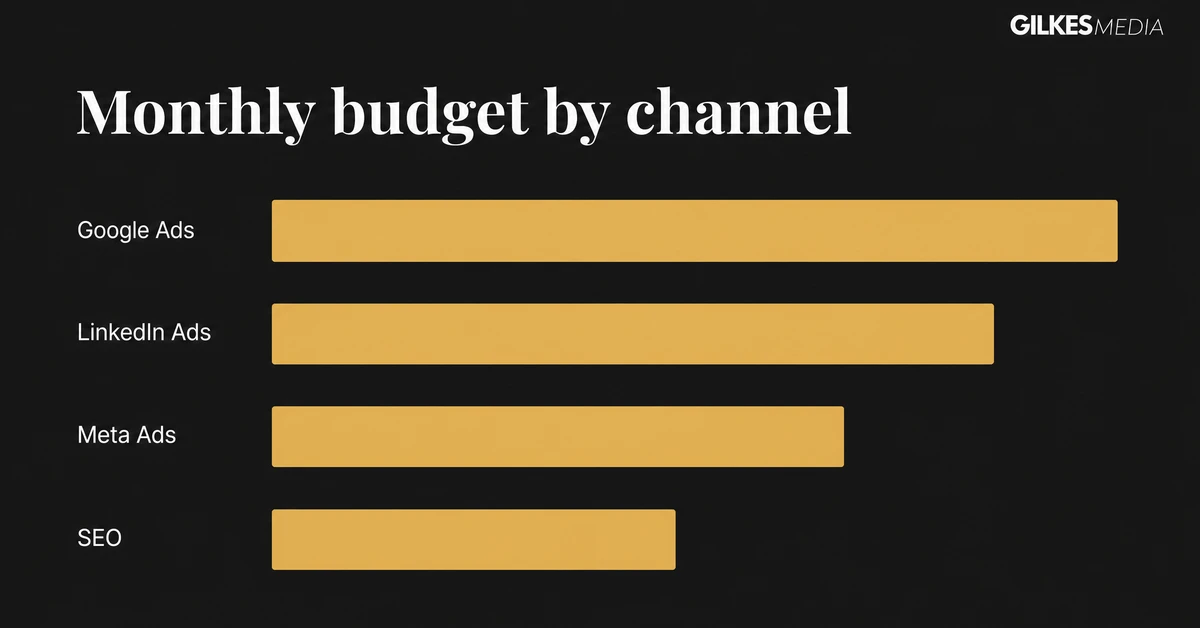
Once you have a total figure, the next question is allocation. The table below uses genuine UK monthly budget bands for each channel, so you can see roughly what a given spend actually buys.
| Channel | Testing phase | Genuine lead generation | Scaled, multi-campaign |
|---|---|---|---|
| Google Ads | £600-£1,500 | £1,500-£5,000 | £5,000-£20,000+ |
| Meta Ads (Facebook/Instagram) | £300-£800 | £800-£3,000 | £3,000-£10,000+ |
| LinkedIn Ads | £500-£1,200 | £1,200-£4,000 | £4,000-£15,000+ |
| SEO (retainer) | £300-£750 (local) | £750-£3,000 (SME) | £3,000-£6,000+ (national) |
| Website (one-off build) | £800-£3,000 (template) | £3,000-£10,000 (semi-custom) | £10,000-£25,000+ (bespoke) |
A few things stand out once you see the channels side by side. Google Ads generally needs the largest budget because it is captured, high-intent demand, and the auction reflects that.
Most UK small businesses land somewhere between £1.50 and £2.50 a click on average, though this varies enormously by sector. Meta Ads is usually the cheapest way to test a new offer or audience, which is why it gets the smallest testing budget on the table.
LinkedIn costs roughly three to five times more per click than Meta, which only makes sense to spend if your average customer value clearly justifies it, typically B2B services and higher-ticket products.
SEO works differently to paid channels. It is a compounding investment rather than a switch you turn on and off, so the monthly figure matters less than the commitment length.
Budget for at least six to twelve months before judging results, because that is genuinely how long organic rankings take to build in competitive UK markets.
Your website sits slightly outside the monthly-budget conversation because it is usually a one-off or periodic cost rather than an ongoing line item. It still deserves a mention here, because a weak website quietly wastes every pound spent on the channels above it.
Video sits outside the monthly media-spend table too, because it is usually commissioned per project rather than billed as an ongoing channel. It increasingly funds the channels above it, since one testimonial or explainer video can be cut down into weeks of paid social creative.
UK pricing for a simple testimonial or social-first video typically runs £500-£1,500, a mid-tier brand or explainer video £2,500-£7,000, and a full campaign shoot with multiple assets £8,000-£20,000+. Our video production cost guide breaks these bands down by what is included at each level.
As a rule of thumb, businesses running meaningful paid social spend should budget for at least one video project a quarter, since static creative fatigues faster than video on most platforms.
Cost per lead is the number that ultimately tells you whether any of this is working. Benchmarks vary enormously by what you sell.
Expect roughly £12-£25 for e-commerce opt-ins, £40-£90 for local services like healthcare or home services, £90-£165 for B2B services and legal, and £200-£600+ for high-value SaaS and enterprise sales. Our full breakdown of cost per lead in the UK covers these figures by sector and channel in more depth.
Allocate paid budget in proportion to buying intent and average customer value: Google Ads for captured demand, Meta for cheap testing, LinkedIn only where the deal size justifies its premium cost per click. Treat SEO as a six-to-twelve-month investment, not a monthly switch, and fix a weak website before spending more to drive traffic to it.
One channel is missing from the table above on purpose. AI lead nurturing does not really compete for the same budget line as Google or Meta, it sits downstream, deciding how well you convert the leads those channels already produce.
Most UK businesses lose leads not because their ads or SEO underperform, but because a new enquiry sits unanswered for hours, or gets one follow-up email and nothing after that. AI lead nurturing closes that gap by responding instantly and following up consistently.
Pricing here varies more than almost any other channel, because "AI lead nurturing" covers everything from a self-managed £50-£400 a month tool subscription to a fully agency-built and managed system.
Our own AI lead nurturing cost guide puts a fully managed service at £750-£3,000+ a month, once you include the initial £1,500-£6,000 build.
The maths usually justifies it quickly for a business generating real lead volume. A business converting 80 enquiries a month at a £2,500 average customer value only needs to lift its conversion rate by two percentage points to add tens of thousands of pounds a year, against a monthly cost that is a fraction of that.
As a budgeting rule, allocate 5-10% of your total marketing budget to lead follow-up once you are generating more than roughly 30-40 enquiries a month, since that is the point where manual follow-up typically starts to slip.
The annual or monthly figures above are useful starting points, but few UK businesses actually spend the same amount every month, and most should not. Demand, competition and cost per click all move through the year.
A fixed budget often means overpaying in quiet months and underspending in the ones that matter most. Retail and e-commerce businesses typically see auction prices rise sharply from late October through December, as every competitor chases the same Christmas demand.
That argues for building a larger November-December allowance into the annual total rather than spreading it evenly. B2B businesses often see the opposite pattern, with a quieter August and a genuine surge in January and September as budgets reset.
A practical approach is to set your annual total using the percentage-of-revenue method above, then allocate roughly 70% of it evenly across the year to keep every channel consistently fed with data.
Hold the remaining 30% back as a flexible pool, weighted toward your genuinely busiest one or two months. This avoids the common trap of either ignoring seasonality altogether, or overcorrecting so heavily that quieter months starve your always-on channels of the consistency they need to perform.
AI lead nurturing is not another media channel competing for budget, it protects the return on every channel above it. Build seasonality into the plan by holding back roughly 30% of the annual budget as a flexible pool for your busiest months, rather than spending evenly all year or reacting late.
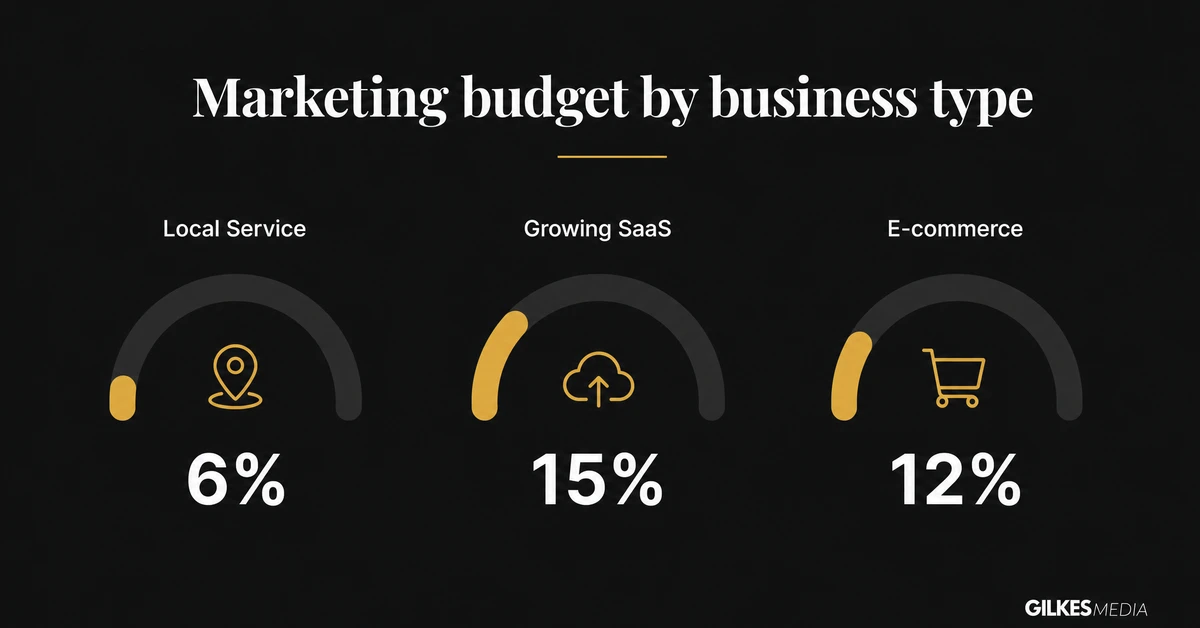
Percentages and bands only click into place once you see them applied. Here are three realistic UK examples, built from the ranges above.
A well-established dental or physiotherapy clinic turning over £400,000 a year, mostly stable with steady referrals, might sit at the lower end of the baseline: around 6% of revenue, or roughly £2,000 a month.
A sensible split would be £900 on local SEO and Google Business Profile management, £700 on a modest Google Ads budget for high-intent searches, and £400 on website and content upkeep.
A SaaS business turning over £800,000 and trying to grow 40% year on year sits nearer the top of the range, around 15%, or £10,000 a month.
That might break down as £4,500 on LinkedIn and Google Ads combined, £2,500 on SEO and content aimed at bottom-of-funnel keywords, £1,500 on conversion rate optimisation and landing pages, and £1,500 on AI-assisted lead nurturing to follow up every enquiry consistently.
An e-commerce brand turning over £600,000, competing hard for market share against larger retailers, might run closer to 12%, around £6,000 a month.
A typical split leans heavily on Meta Ads for prospecting and retargeting (£3,000), Google Shopping and search (£2,000), and SEO and content to reduce long-term reliance on paid traffic (£1,000).
An accountancy or consultancy firm turning over £900,000, with high customer lifetime value but a long, considered sales cycle, might sit around 8%, roughly £6,000 a month.
A sensible weighting favours LinkedIn Ads and organic content (£2,500) aimed at decision-makers, SEO targeting specific service and sector keywords (£2,000), and AI lead nurturing to keep slow-moving enquiries warm over a multi-month decision process (£1,500).
None of these splits are formulas to copy exactly. They are illustrations of the same underlying logic: start from a percentage of revenue, weight it toward growth or stability depending on your goals, then allocate by channel according to buying intent and customer value.
A sensible total budget still gets wasted if it is spent badly. These are the mistakes we see most often when a new client's marketing spend is not delivering what it should.
A well-sized, well-allocated budget still needs a way to prove itself, and this is the step UK small businesses skip most often. Without it, you cannot tell whether to spend more, spend less, or shift money between channels next quarter. Ultimately this comes back to customer value, not just channel cost - our guide to calculating lifetime customer value covers how to bring that into the picture.
Three numbers matter more than any others: customer acquisition cost, what you spend to win one customer, all-in; customer lifetime value, what that customer is worth over the full relationship, not just the first purchase; and payback period, how long it takes to earn back what you spent to acquire them.
A healthy business generally wants lifetime value at three times acquisition cost or higher, with a payback period short enough that cash flow does not become a constraint on growth.
Getting these numbers right depends on solid attribution, meaning you can actually trace a sale back to the channel that produced it rather than guessing. Our guide to marketing attribution covers how to set this up properly, starting with the fundamentals before adding complexity.
Review these numbers monthly. Treat any channel that is not moving toward your target payback period after a reasonable trial as a candidate to pause, not necessarily a failure of marketing itself.
A common question at this point is whether to manage this in-house or bring in outside expertise, and what that costs on top of the media spend itself.
UK marketing consultants typically charge £150-£500 an hour, or £5,000-£25,000+ a month for an ongoing retainer, depending on scope and seniority. Our guide to marketing consultant fees covers the different pricing models in detail.
As a rough rule, once your combined paid media spend passes roughly £1,500-£2,000 a month across channels, the overhead of specialist management usually starts paying for itself in wasted spend avoided alone, before any uplift in results.
Below that, the media budget may simply be too small to justify a dedicated management fee, and an in-house approach or a lighter-touch consultancy arrangement often makes more sense.
If you are weighing up agencies, we have written a separate guide on how to choose a digital marketing agency, which sets out the questions worth asking before you commit any budget to someone else managing it.
Most budgets fail from being spread across too many channels, judged too early, or left with no room to test. Outside management tends to pay for itself in wasted spend avoided once combined paid budgets pass around £1,500-£2,000 a month.
New businesses typically need to budget toward the higher end of the range, often 15-20% of revenue or more in the first one to two years, because they are building brand awareness and customer data from nothing. This usually falls as the business establishes repeat custom and referrals.
Not automatically. IPA Bellwether data has repeatedly shown that businesses which maintain or grow marketing spend through a downturn tend to gain market share from competitors who cut back, since visibility and cost per click often fall when rivals retreat. A better response is usually to review efficiency, not switch everything off.
A single in-house marketing hire in the UK typically costs £30,000-£50,000+ a year in salary alone before software, ad spend and management time are added, and usually covers only one or two disciplines. An agency or consultant retainer often costs less overall for a small business needing several disciplines covered at once, such as SEO, paid ads and website work together.
Paid advertising can produce measurable leads within days, though genuine optimisation takes four to eight weeks. SEO typically takes six to twelve months to show meaningful ranking movement in competitive UK markets. Plan for both timelines rather than judging every channel against the fastest one.
No, but there is a practical floor. Testing budgets from around £300-£800 a month on Meta or £600-£1,500 on Google Ads are enough to validate an offer and start gathering data, though genuine, consistent lead generation usually needs closer to £1,000-£3,000 a month per channel.
Work out your percentage against turnover excluding VAT, and expect agency, consultant and media quotes to be given excluding VAT too, since that is the standard UK convention. Add VAT back in only when checking the figure against your actual bank balance and cash flow.
How you allocate that budget depends on your situation. If you're weighing up business growth consulting services against building an in-house team, or trying to work out which digital marketing service actually suits your business, those guides go into more depth. And if you're in a more specialised sector, our guide to digital marketing for manufacturers covers the budget and channel trade-offs specific to that industry.
The honest answer to "how much should I spend on marketing" is that the percentage is the easy part. The harder, more valuable work is deciding where that budget goes, in what order, and how you will know within a reasonable time whether it is working.
That is the conversation we have with every business before we touch a campaign or a keyword: what the number should be, where it should go first, and what a good result actually looks like for your specific business, not a generic industry average.
If you want a second opinion on your own budget and how it is currently split, our marketing consultancy service starts with exactly that conversation.
You can book a free discovery call and we will give you a straight, honest answer, whether or not that answer ends up involving working with us at all.
