You're probably here because you've had at least one of these experiences already.
An SEO company sent over a proposal full of jargon. Another promised rankings without explaining what that would mean for enquiries. A freelancer quoted one price, an agency quoted something far higher, and neither made it easy to understand what you'd get for the money.
That confusion is normal. SEO is one of the most valuable marketing channels for a small business, but it's also one of the least clearly explained. Most providers talk about tasks. Business owners care about outcomes. You want to know whether SEO will bring in calls, quote requests, bookings, and sales. You also want to know what it should cost in the UK, how long it takes, and how to tell whether a provider is doing real work or just producing reports.
Most advice falls short by treating SEO as a technical checklist when it should be judged as a business investment. If you're buying SEO services for a small business, the right question isn't “what keywords will you target?” It's “how will this improve my visibility for the searches that turn into revenue?”
A small business owner asks three SEO providers for a quote and gets three completely different offers. One sells 20 backlinks a month. One leads with a technical audit. One talks about authority, content and local search, but never explains what happens first or how any of it turns into enquiries. That is why buying SEO feels harder than it should. If you're a very early-stage business, our guide to SEO services for startups covers the specific challenges of getting this right before you've got a trading history to work from. Some tactics get overlooked entirely too - our guide to video SEO covers a channel most small businesses ignore.
The problem is not that SEO is mysterious. The problem is that the market mixes serious consultancy with low-cost production work, and both are sold under the same label.
A proposal can look busy and still tell you very little. Audits, metadata, content, links, schema and reporting all have their place. What matters is whether the provider can explain which work matters for your business, in what order, and why.
A useful proposal should answer four things clearly:
If a provider cannot connect the work to revenue in plain English, they are asking you to buy effort on trust.
That is a weak position for any business owner.
Search visibility is shaped by competition, geography, website quality, brand strength and budget. Two firms in the same town can need very different plans. A plumber with weak local landing pages and poor reviews has one set of priorities. A B2B software company with long sales cycles has another.
That is why fixed deliverables often miss the point. Monthly blog quotas, backlink counts and generic audits are easy to sell because they look tangible. They are harder to justify if they do not address the bottleneck that is holding back growth.
In practice, strong SEO work often starts with uncomfortable prioritisation. Some businesses need technical fixes before content. Some need better service pages and on-page SEO best practices before any link building. Some need local prominence and stronger trust signals before they publish another article. The right answer depends on where money is currently being lost.
Low fees often mean templated delivery, light strategy and very little senior input. High retainers can also be poor value if they include layers of process that a small business will never use.
The better question is whether the provider is solving a commercial problem.
Commoditised SEO usually sells units of activity. Strategic SEO starts with opportunity, margin, competition and conversion. It looks at whether your website can turn visibility into business, including basics such as page intent, trust signals and enhancing user engagement. Those details affect lead volume as much as rankings do.
That is why finding good SEO services is hard. You are not only choosing a supplier. You are choosing whether SEO will be treated as a cheap monthly task list or as a channel that should produce measurable growth.
SEO only feels confusing when it's presented as a black box. In practice, most worthwhile SEO services for a small business sit across four areas: technical SEO, content marketing, local SEO, and link building. Each one supports a different part of the buying journey. For a deeper look at how a specialist agency approaches this, our guides to a performance-driven B2B SEO service and SEO for professional services firms both go further into what measurable, well-run SEO looks like in practice.
If most of your customers are local, this often matters more than anything else - see our Local SEO and Google Business Profile guide for the specifics.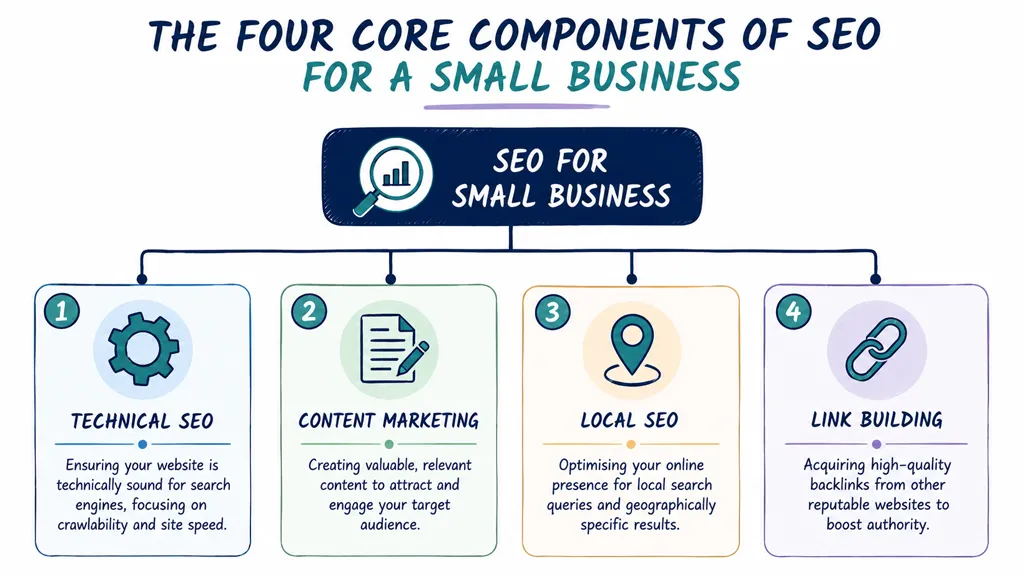
Technical SEO is the foundation. If your website is hard for search engines to crawl, slow to load, confusing on mobile, or cluttered with structural issues, everything built on top becomes less effective.
Imagine fitting out a shop. You can invest in signage and promotion, but if the front door sticks and the lights don't work, customers still walk away.
A technical SEO service usually looks at things like:
Technical work matters beyond rankings because it affects conversion. Fast-loading pages, clear navigation, and a simpler user journey all help turn visits into leads. If you want a deeper look at on-page fundamentals, this guide to on-page SEO best practices is a useful reference point.
It also overlaps heavily with web development. If the site is poorly built, SEO becomes more expensive because you're trying to fix performance, structure, and conversion problems after launch rather than designing them properly from the start.
Content is where many businesses either overdo it or completely neglect it.
The point of SEO content isn't to publish for the sake of publishing. It's to create pages that match what your buyers are searching for, especially when they're comparing providers, checking costs, or trying to understand a service before making contact.
A smart content plan usually includes:
Good content also supports enhancing user engagement. That matters because the best SEO pages don't just attract clicks. They help a visitor understand the offer and take the next step.
The strongest small-business SEO content usually isn't the cleverest. It's the clearest.
For many UK SMEs, local SEO is the highest-value part of the whole strategy. It's how you show up when someone nearby is actively looking for your service.
Consistency matters. Google's local ranking systems rely heavily on relevance, distance, and prominence, and inconsistent business details can weaken visibility. A practical tactic is to standardise the same business name, address, and phone number across your website, Google Business Profile, and UK citation sites such as Yell and Thomson Local.
That sounds basic, but it's often missed. A different phone number on a footer, an old address in a directory listing, or inconsistent naming across profiles can all dilute local trust signals.
Link building is the part many providers either oversell or do badly. At its best, it's about earning authority signals from relevant websites that make your business look more established and credible.
At its worst, it becomes a numbers game built around weak placements that do little for rankings and nothing for reputation.
For a small business, sensible link work often includes:
You don't need a huge volume of links. You need links that fit your market, support your key pages, and make sense commercially.
A small business owner usually asks the same four questions before signing an SEO proposal. What am I getting, what will it cost, how long should I fund it for, and how will I know it is paying back. Your platform matters too - if your site's built on Wix, our guide to SEO and Wix for UK businesses covers what that means for cost and approach.
That is the right frame.
SEO pricing varies because you are not buying one standard product. You are buying a mix of strategy, implementation, tracking, and problem-solving. A local accountant with a decent site and clear service pages may need focused monthly work. A multi-location trades firm or regulated healthcare business will need more planning, more content control, and tighter technical oversight.
In practice, small business SEO budgets often sit anywhere from a few hundred pounds a month for narrow local support to several thousand pounds for ongoing strategy and delivery. The gap is wide because the scope is wide.
A cheap service usually buys a light-touch process. Basic reporting, a handful of page edits, maybe some directory work. That can be enough if the site is already strong and the market is easy.
A higher fee should buy more than activity. It should buy better decisions, faster implementation, stronger commercial focus, and reporting tied to enquiries and sales. If a provider cannot explain the link between the monthly fee and lead generation, the proposal is probably built around tasks, not outcomes.
For extra context on market benchmarks and expectations.
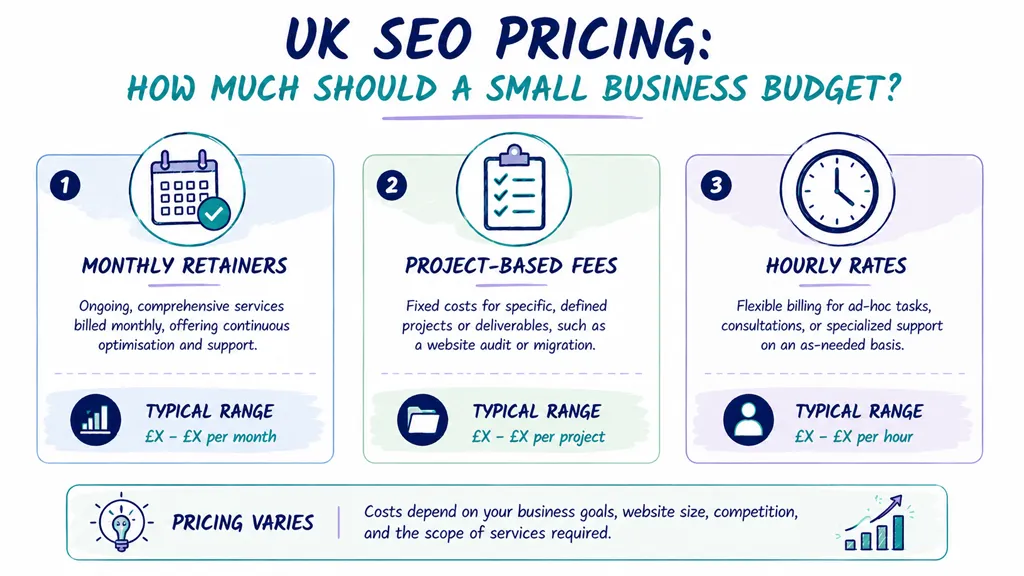
Most providers price SEO in one of three ways:
| Model | Best for | Watch out for |
|---|---|---|
| Monthly retainer | Businesses that need steady improvement and ongoing accountability | Vague deliverables, recycled reports, and no commercial targets |
| Project fee | Audits, migrations, local SEO cleanup, or a defined technical issue | A long recommendations document with no implementation support |
| Hourly consultancy | Senior input, planning, troubleshooting, or in-house team support | Paying for advice your team cannot act on |
Monthly retainers are common because search performance improves through repeated work over time. Pages need refining. Tracking needs tightening. Weak spots get found and fixed.
Project pricing suits a defined problem. If the site is being rebuilt, technical indexing has gone wrong, or local listings are a mess, a project can make financial sense.
Hourly consultancy works well when the business already has internal resource. In that case, paying for senior direction instead of full delivery can be the more efficient investment.
A serious quote should reflect workload, difficulty, and expected commercial return.
Price usually changes based on:
The question is not whether the fee is high or low. It is whether the expected return justifies the spend. A low price can be fair if the scope is narrow. A high price can be fair if the service improves lead flow.
That is why I recommend reviewing SEO budgets the same way you would review any other channel investment. Look at cost against pipeline contribution, not cost in isolation. If you need a useful framework for that, this guide on how to measure marketing ROI gives a sensible starting point.
The easiest way to waste money on SEO is to judge it by the wrong scoreboard.
Managing expectations on timing matters just as much as measuring results - our guide on how long SEO actually takes to work sets out a realistic UK timeline.Rankings matter, but only in context. A number one position for a phrase nobody searches when they're ready to buy won't do much for your pipeline. A lower-profile keyword that triggers calls and quote requests is far more valuable.
For small businesses, the most important search visibility is usually local and high-intent. According to AIOSEO's SEO statistics compilation, 46% of monthly Google searches have local intent, the top three organic results receive 68.7% of clicks, and Google held 93.84% of the UK search market in April 2025. That combination tells you where to focus.
If your business depends on local demand, success is not “more impressions” in the abstract. It is stronger visibility for the searches that trigger:
That's why a serious SEO strategy often prioritises a smaller set of commercially valuable searches rather than broad traffic chasing.
A useful SEO report should help you answer one question. Is organic search bringing in more of the right business?
That means tracking:
If you're already reviewing wider attribution, this guide on how to measure marketing ROI gives a sensible framework for tying channel activity back to commercial return.
The right SEO question isn't “did we move up?” It's “did better search visibility create better sales opportunities?”
Some metrics are useful diagnostically, but weak as headline measures on their own.
Be careful with reports that overemphasise:
A good provider should explain why each metric matters, not just include it because it fills a dashboard.
SEO is rarely a switch you flip. It behaves more like a compounding asset. Technical fixes remove drag. Better service pages improve relevance. Local signals improve discoverability. Stronger authority helps key pages compete.
That's why short-term reporting should be linked to long-term direction. Early signs matter, but they need to build towards lead quality and revenue contribution.
Who you hire matters as much as what they say they'll do. If it's a B2B agency specifically you're weighing up, our guide on how to choose a B2B SEO agency in the UK sets out the questions worth asking.
Small businesses often assume a larger agency is automatically safer. Sometimes it is. Agencies can offer breadth, process, and specialist support across several disciplines. But they can also bury a straightforward SEO requirement under layers of account management, templates, and slow-moving delivery.
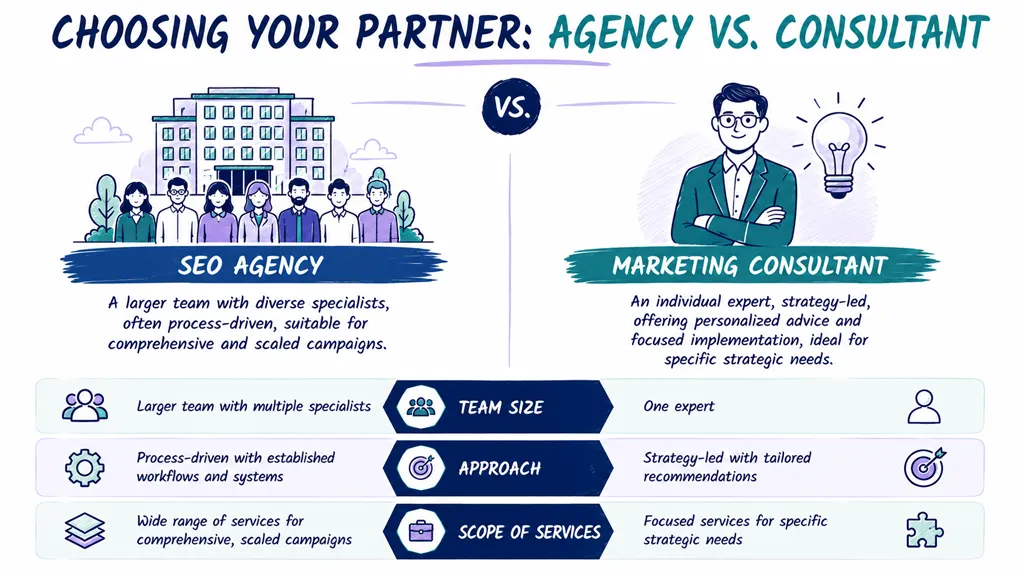
An established agency can be a strong fit when you need multi-channel execution and have enough budget to support it.
Typical advantages include:
That model suits businesses that already know their direction and want a team to execute against a reasonably settled plan.
The problem is often distance from strategy.
A small business may buy into the senior team during the pitch, then get handed to an account manager who follows a standard process across very different clients. The reporting arrives on time, but the work can become formulaic.
That's usually where business owners start feeling that SEO is happening around them rather than for them.
A specialist consultant is often stronger when the business needs judgement before scale.
That usually means:
This is often the better route for founder-led businesses, professional services firms, and SMEs where every marketing pound needs a clear reason behind it.
If you're comparing options more broadly, this guide on how to choose a digital marketing agency helps frame the decision beyond SEO alone.
A good partner doesn't just ask what keywords you want. They ask what kind of business you want more of.
When you're screening providers, the strongest questions are usually commercial, not technical.
Ask things like:
Those questions quickly separate strategic thinking from rehearsed sales talk.
One reason business owners delay SEO is simple. They don't know what happens after they sign. For the specific tactics an onboarding plan like this puts into action, our guide to the best website SEO strategies covers them in detail.
A proper onboarding process should reduce uncertainty, not add to it. The first ninety days are usually about diagnosis, prioritisation, implementation, and building a reporting baseline.
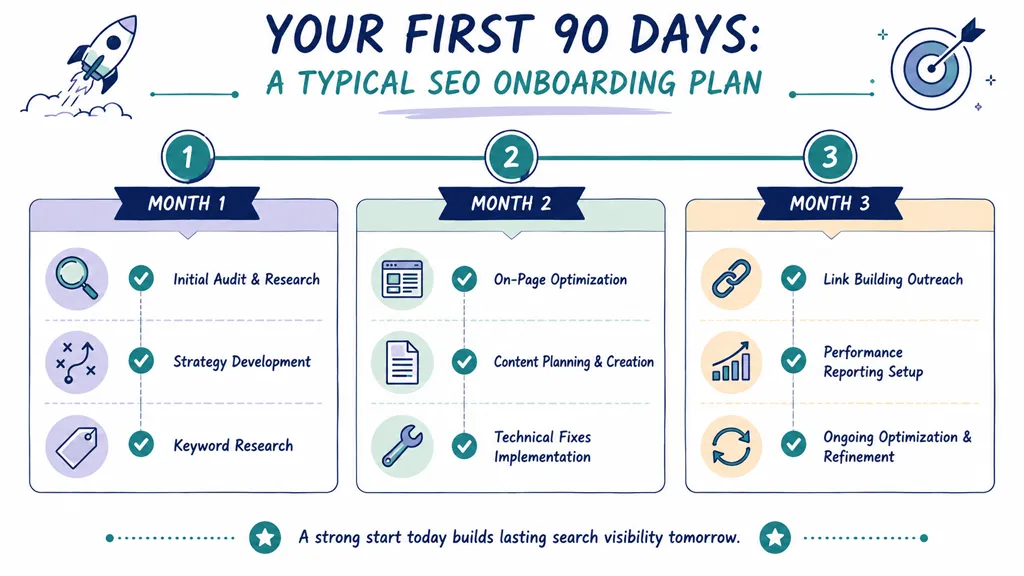
The first month should not be about random optimisation. It should be about understanding the business and the current state of the website.
That usually includes:
This is also the point where a provider should evaluate your SEO strategy in the context of your commercial goals, not just generate a technical report.
By the second month, the plan should narrow. Not every issue deserves immediate attention.
Useful early actions often include:
This stage should feel practical. You should be able to see what is being worked on and why it matters.
By month three, the engagement should start producing a working rhythm.
Expect to see:
| Area | What should happen |
|---|---|
| Execution | Priority fixes and page improvements go live |
| Tracking | Enquiry points, forms, and key actions are measured properly |
| Review | Early movement is assessed against the original priorities |
| Next steps | The roadmap becomes clearer based on evidence, not guesswork |
The client's role matters too. Good SEO is collaborative. Providers need access, feedback, service knowledge, and a clear sense of what counts as a good lead.
If your business fits a more specific bracket, it's worth reading the more targeted version of this guide: our breakdown of SEO services for startups covers the early-stage priorities, and if you're on Wix specifically, our guide to SEO and Wix covers the platform's particular quirks and workarounds.
A common scenario looks like this. You invest for three months, tidy the site, improve the main service pages, fix tracking, and then ask why the phone has not doubled.
SEO usually starts showing early traction in visibility and enquiries over months, not weeks. The timeline depends on your starting point, your market, and how commercially focused the work is. A well-built site in a local niche can move faster. A business in a crowded sector with weak pages, poor tracking, and little authority will take longer.
The useful question is not just how long SEO takes. It is how soon the work starts improving the parts of the site that influence enquiries and sales.
SEO and Google Ads do different jobs in a growth plan.
Google Ads can put you in front of buyers quickly. That makes it useful for testing offers, covering gaps in organic visibility, and generating leads while SEO work is still building. SEO takes longer, but it creates an asset you keep benefiting from after the initial work has been done.
For many small businesses, the best answer is not choosing one over the other. It is using paid search for immediate demand capture and SEO to reduce reliance on paying for every click over time.
Yes, if the business is small, the website is simple, and you have time to stay consistent.
Many owners can handle the basics well enough. That includes improving service page copy, tightening title tags and headings, updating Google Business Profile details, and publishing useful local content. Where DIY usually starts to break down is prioritisation. Knowing whether to fix technical problems, rewrite key pages, build location relevance, or improve conversion tracking is what separates activity from return.
That is the trade-off. Doing it yourself can save fees. It can also cost far more if the business spends six months working on low-value tasks while competitors improve pages that bring in enquiries.
Ask four things first.
What will you do in the first 90 days? How will you measure success in business terms? Who is doing the work day to day? What do you need from me to make this succeed?
Good answers are specific. You should hear clear priorities, realistic timescales, named deliverables, and a sensible reporting approach tied to leads, sales opportunities, or booked jobs. If the pitch leans on rankings alone, vague monthly activity, or generic audits with no commercial context, keep looking.
If you want a clearer view of what SEO, paid acquisition, and your website should each be doing to drive growth, Gilkes Media helps UK businesses turn marketing activity into measurable enquiries and revenue. That includes strategic SEO consultancy, paid ads management, and website design and development built around lead generation rather than vanity metrics.
