
Let's get straight to the point. A proper lead generation strategy b2b is not about chasing every new trend. It is the disciplined process of finding and attracting potential business customers who are a perfect fit for what you offer. Far too many B2B marketing efforts fail because they are built on shaky ground, leading to an inconsistent flow of leads and campaigns that just burn cash.
Does this sound familiar? Many founders and marketing leaders I speak to are wrestling with the same issues: unpredictable lead volume, sky-high costs per lead, and a sales team that constantly complains about lead quality.
The problem is usually not a lack of effort. It is the absence of a coherent strategy. Instead of a structured system, marketing becomes a series of disconnected tactics, a random LinkedIn campaign here, a hopeful blog post there, with no clear line back to actual revenue. This reactive approach almost always leads to wasted time and money.
Without a dependable system, growth feels more like luck than a predictable process. This guide is designed to move beyond the generic advice you will get from most agencies and give you a clear, consultant-led framework for building a lead generation engine that actually works.
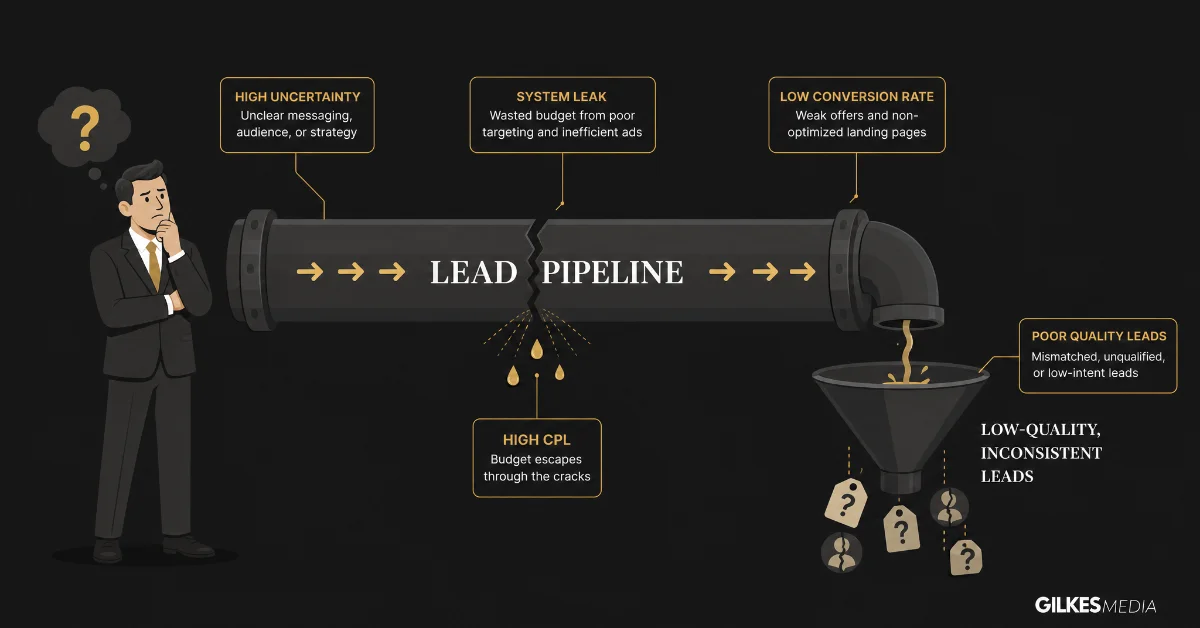
As a hands-on consultant, my entire focus is on building practical, performance-driven strategies. It all comes down to four essential pillars. Getting these right is non-negotiable if you want sustainable growth.
To really fix your approach, you first need a solid grasp of What Is B2B Lead Generation. This foundational knowledge is key to diagnosing exactly where the cracks are in your current process.
The goal here is simple: stop gambling with your marketing budget and start building a predictable system for acquiring high-value customers.
Effective lead generation never starts with choosing channels or launching campaigns. It begins with getting crystal clear on two fundamental questions: who are you really trying to reach, and why should they care?
Nailing the answers here is the single most important step in building a predictable B2B lead generation machine.
Without this clarity, you are just setting your budget on fire. Your paid ads hit the wrong people, your content falls flat, and your sales team wastes hours on calls that go nowhere. As a consultant, the very first thing I lock down with any client is a razor-sharp Ideal Customer Profile (ICP).
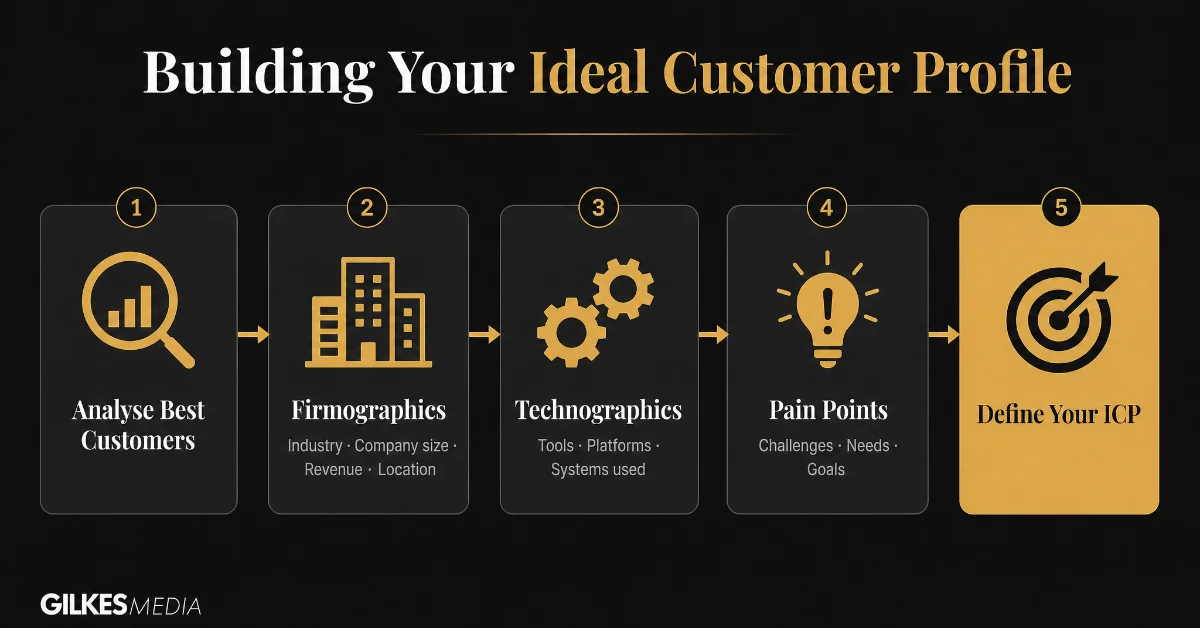
A weak ICP is where most strategies crumble. It is not enough to know a job title and an industry. A truly powerful ICP goes much deeper, acting as a strategic compass for every single marketing decision you make. We need to build a multi-layered picture of who you are selling to.
This means moving beyond the basics and digging into three critical areas of B2B insight:
Key Takeaway: A strong ICP is not just a marketing document; it is a business intelligence tool. It forces your sales and marketing efforts into perfect alignment, focusing them exclusively on prospects with the highest chance of becoming profitable, long-term customers.
Building a data-driven ICP is not a guessing game. It is about looking at the real-world evidence you already have sitting in your business.
Once you have a sharp definition of your ICP, you can finally craft a value proposition that hits them right between the eyes. A great value proposition is not a vague, fluffy slogan; it is a clear, concise statement that explains the tangible outcome you deliver.
It has to answer three questions from your customer's perspective:
For example, instead of saying, "We offer innovative marketing solutions," a much stronger value proposition aimed at a specific ICP might be: "We help UK-based SaaS companies with over 50 employees cut their Cost Per Demo by 30% using targeted LinkedIn Ads."
See the difference? It is specific, outcome-focused, and tailored to the audience. Every single part of your lead generation strategy b2b, from ad copy and landing pages to email subject lines, should be built on the foundation of this clear and compelling promise.
Once you have a sharp understanding of your ideal customer, the next logical step is figuring out where to actually find them. A classic B2B marketing mistake is the "be everywhere" approach. It is a guaranteed way to stretch your budget too thin and get mediocre results across the board.
A disciplined lead generation strategy b2b is about making smart, deliberate choices. Instead of chasing every platform, the goal is to identify and master the one or two channels where your ideal customers are most active and receptive. This focus ensures every pound you invest is working as hard as possible.
As paid advertising specialists, we see the impact of focused investment every single day. Concentrating your budget lets you gather meaningful performance data quickly, learn what resonates, and optimise your campaigns for profitability, not just presence.
Your Ideal Customer Profile (ICP) is the compass for this decision. You absolutely have to go where your customers are. For instance, targeting senior finance directors in the UK construction sector is a completely different challenge from reaching junior IT managers in high-growth tech startups. Their online habits, professional networks, and information sources will be miles apart.
This process forces you to align channel selection with the tangible characteristics of your target market, moving from theory to a practical, data-led decision.
Sure, a multi-channel approach is often necessary, but it must be strategic. The data for the UK market is compelling; companies that coordinate touchpoints across multiple channels see a 287% higher conversion rate than those relying on a single method. With 73% of UK decision-makers now expecting initial contact to be digital, a focused, professional online presence is no longer optional.
While dozens of channels exist, a handful consistently deliver the best results for B2B companies. Your choice really depends on your budget, sales cycle, and whether your customers are actively looking for a solution (intent-based) or need to be made aware that one exists (interruption-based).
To help you decide where to place your bets, here is a simple framework comparing the most effective B2B channels.
| Channel | Best For | Time to ROI | Initial Budget |
|---|---|---|---|
| LinkedIn Ads | Precisely targeting specific job titles, industries, and company sizes. Ideal for complex, high-value sales. | 2–4 months | £1,500 - £4,000+ |
| Google Ads | Capturing active buyer intent. Perfect for services that solve an immediate, known problem people are searching for. | 1–3 months | £1,000 - £5,000+ |
| SEO & Content | Building long-term authority and a consistent flow of inbound leads. Best for businesses with a long-term growth outlook. | 6–12 months+ | £1,000 - £3,000+ |
| Strategic Email | Nurturing relationships and driving repeat business. Essential for long sales cycles to maintain engagement. | Ongoing | Low |
This table should give you a clear starting point, balancing speed, cost, and strategic fit.
So, where should you actually start?
For some businesses, particularly in the SaaS sector, webinars are an incredibly powerful channel. When considering your options, this strategic guide to lead generation webinars offers deep insights into mastering production and measuring ROI for this specific tactic.
Key Takeaway: Do not try to do everything at once. Pick one primary channel based on your ICP and business model. Test it, measure it, and prove its ROI before layering on additional channels. This disciplined approach is the foundation of a scalable and profitable B2B lead generation strategy.
A meticulously designed sales funnel is the engine that converts a flicker of interest into a qualified, sales-ready lead. It is the practical framework that guides your Ideal Customer Profile (ICP) from a curious click on an ad to a proper conversation with your sales team.
Without a clear path, you are just generating traffic. With one, you are building a predictable pipeline.
A successful B2B lead generation strategy depends entirely on engineering this journey. It is about creating a smooth experience that pulls in the right people, captures their details with a genuinely valuable offer, and nurtures their interest until they are ready to talk. This process turns marketing spend into a measurable, scalable investment.
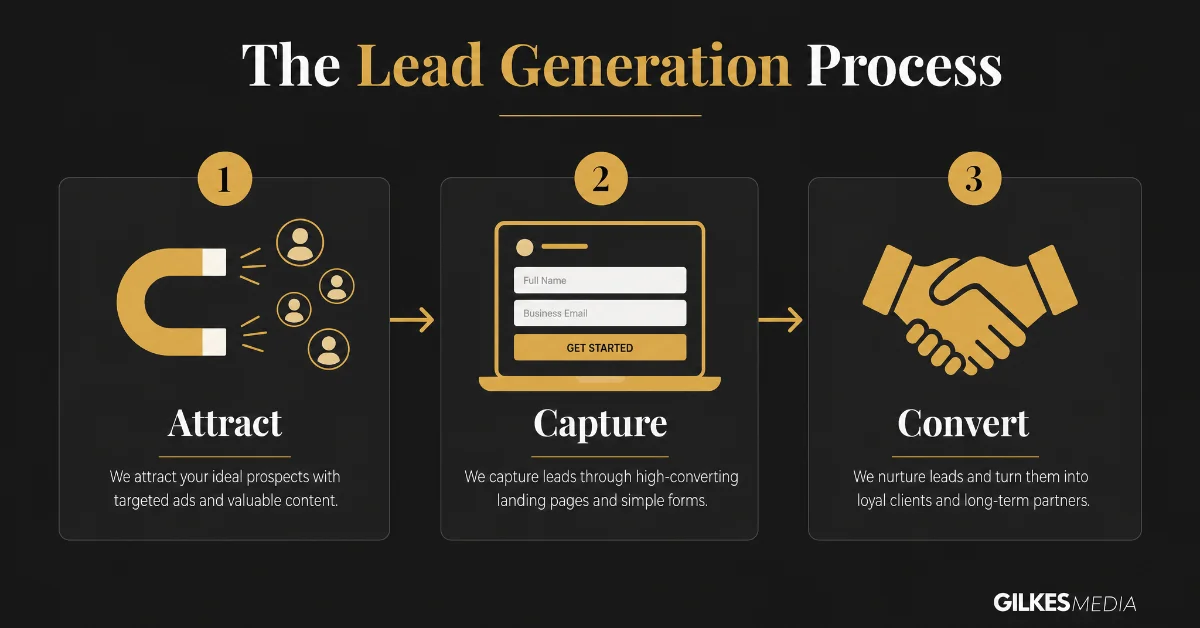
The top of your funnel is all about quality, not quantity. Your chosen channels, like Google or LinkedIn Ads, are there to drive traffic, but the creative and messaging have to be perfectly aligned with your ICP's biggest pain points.
The goal is not just to get clicks. It is to attract prospects who are actively searching for a solution to a problem you can solve.
This means your ad copy, headlines, and imagery must speak their language. Drop the generic business jargon and focus on the tangible outcomes you deliver. A great top-of-funnel ad pre-qualifies the audience, making sure the people who click through are already a strong potential fit.
Once a prospect lands on your page, you need to offer them something valuable in exchange for their contact details. This is the make-or-break capture stage. A generic "contact us" form just will not cut it for someone who is still in the early stages of their buying journey.
Instead, you need a high-value lead magnet that solves an immediate problem or answers a pressing question. The best ones provide real utility and position you as a credible expert right from the start.
Here are a few B2B lead magnet examples that consistently work:
The key is to create an offer so relevant and useful that your ideal customer feels like they are getting a bargain just for giving you their email address. We have seen well-designed lead magnets increase landing page conversion rates by over 50% for our clients.
Capturing a lead is just the beginning. The B2B sales cycle is often long and complex, requiring a thoughtful nurturing process to build trust and keep the conversation going. This is where many businesses stumble, letting promising leads go cold.
Email is still the cornerstone of this process. In the UK, a massive 87% of B2B companies rely on it as a primary channel. Its effectiveness, however, hinges on personalisation. B2B leads can take an average of 84 days to become opportunities, with only a fraction of those converting to sales. That means automated nurturing sequences are essential for staying top-of-mind.
A typical nurturing sequence might look something like this:
This sequence educates the prospect and builds your credibility over time. It is a critical step in turning a marketing qualified lead into a sales qualified one. To get this right, you might also be interested in our guide on how to properly qualify sales leads.
Gilkes Media Insight: The single landing page is your most critical conversion asset. Every single element, from the headline down to the call-to-action button colour, should be tested. We always start with a clear, benefit-driven headline, use bullet points to outline outcomes, and keep the form dead simple. Removing just one unnecessary field from a form can sometimes boost conversions by over 10%.
An effective B2B lead generation strategy is not about being busy; it is about driving measurable results. You can generate thousands of clicks, but if they do not turn into profitable customers, it is all just noise. It is absolutely critical to move past vanity metrics and zero in on the numbers that actually inform your strategic decisions.
Tracking the right Key Performance Indicators (KPIs) is the only way to truly understand what is working. It allows you to allocate your budget with confidence and systematically improve your return on investment. Without this data, you are flying blind.
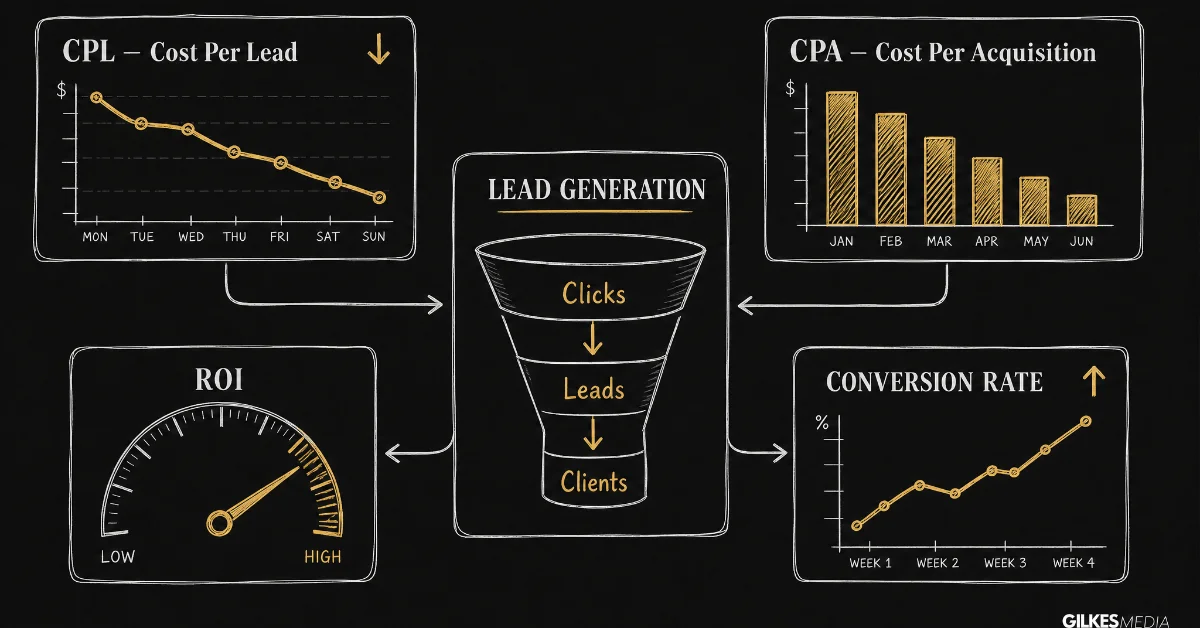
To get a clear picture of campaign performance, you need to focus on a handful of metrics that are commercially focused. These are the numbers that connect your marketing spend directly to your sales pipeline and, ultimately, to revenue.
Here are the essential KPIs for any serious B2B lead generation effort:
Tracking these numbers gives you a clear, honest view of performance. It means you can have data-driven conversations about what is working and where to double down. For a more detailed breakdown, you can check out our guide on how to measure marketing ROI.
You do not need a complicated business intelligence platform to get started. A simple spreadsheet can be a surprisingly powerful performance dashboard, giving you a weekly snapshot of your lead generation engine. This dashboard should become your single source of truth for all marketing performance discussions.
Here is a simple structure you can start with:
| Channel | Ad Spend (£) | Leads (MQLs) | CPL (£) |
|---|---|---|---|
| LinkedIn Ads | £1,200 | 40 | £30 |
| Google Ads | £800 | 25 | £32 |
| Total / Avg | £2,000 | 65 | £30.77 |
This basic view helps you compare channel efficiency at a glance. You can then expand it to include sales opportunities and CPA as that data becomes available, giving you a complete view of the entire funnel.
A data-driven approach is not about finding one perfect campaign and running it forever. It is about adopting a mindset of continuous testing and iteration. Small, controlled experiments are the key to driving significant performance improvements over time.
Gilkes Media Insight: We never assume we know what will work best. Instead, we run small-budget tests on different headlines, landing page layouts, or audience targets. By isolating one variable at a time, we can clearly see what moves the needle, double down on the winners, and systematically improve CPL and ROAS.
When looking at channels, for example, LinkedIn has become the dominant platform for B2B marketers in the UK. A staggering 82% report their biggest success on LinkedIn, making it a clear starting point for testing. This focus can really pay off, as companies with strong social selling strategies see 48% larger deal sizes on average, proving it is not just about lead volume, but value too.
Start with small, focused experiments. Test one new ad creative against your current control. Try a different call-to-action on your landing page. These small wins compound, turning your B2B lead generation strategy into a highly optimised, predictable source of growth.
A lot of UK SMEs either ignore compliance until it becomes a problem, or overreact and avoid perfectly legitimate outbound activity. Both approaches cost money.
The more useful view is this. Compliance and lead management are operational disciplines. When done properly, they make growth easier, not harder.
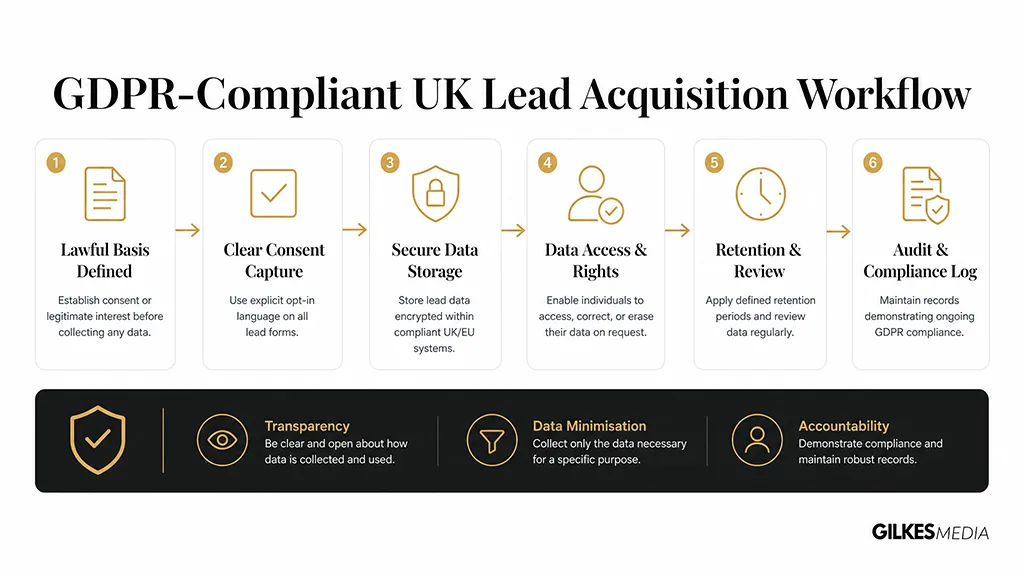
One of the biggest mistakes in B2B lead generation UK is assuming every outbound email needs prior consent. That isn't how many UK businesses operate in practice.
UK tribunals rarely penalise cold emails to B2B contacts under legitimate interest if the message is relevant, non-intrusive, and includes an opt-out. That's a practical distinction many SMEs miss.
That doesn't mean blasting purchased lists is fine. It means compliant outreach usually follows a common-sense test:
If your team needs a plain-English explainer on list hygiene and contact handling, this article on GDPR compliance for email lists is a useful supporting resource.
Generating leads is only half the job. If sales and marketing aren't aligned, qualified opportunities get ignored, mishandled, or judged too early.
The same Click2Leads source notes that organisations with aligned sales and marketing operations achieve 24% faster three-year revenue growth. The reason is straightforward. Better handover creates better follow-up, cleaner feedback, and fewer wasted leads.
A compliant lead with no process behind it is still wasted budget.
You don't need a complicated tech stack to improve lead handling. For most SMEs, a practical setup includes:
Keep the workflow simple enough that sales updates it. A beautifully designed process that nobody uses is worthless.
A healthy lead management flow usually works like this:
| Stage | What should happen |
|---|---|
| New lead | Source is recorded and ownership assigned |
| Initial review | Fit is checked against service, sector, and need |
| Sales contact | Follow-up happens promptly and context is visible |
| Nurture | Non-ready leads stay in the system with a reason |
| Closed outcome | Win or loss reason is captured for future decisions |
When compliance, CRM discipline, and follow-up are connected, outbound becomes safer, inbound becomes easier to manage, and reporting gets far more trustworthy.
Worth flagging separately: the compliance basics above cover general lead-capture consent and outreach. If you're using AI tools to nurture or follow up with leads automatically, that raises its own GDPR questions (automated decision-making, data retention, disclosure) covered in our guide to AI lead nurturing and GDPR.
This decision shouldn't be framed as agency versus in-house alone. For many SMEs, the choice is between three models: build internally, outsource broadly, or bring in senior strategic support with hands-on execution.
Each has a place. Most problems start when businesses choose based on assumption rather than operating need.
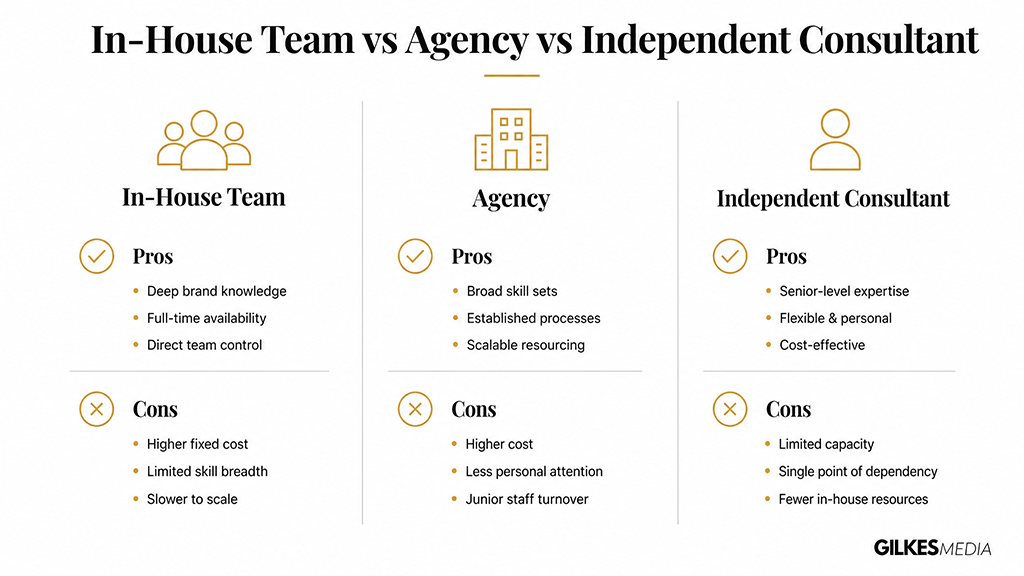
An internal team makes sense when your business already has clear positioning, a functioning CRM, decent reporting, and enough volume to justify specialist roles.
The upside is control. The downside is cost, management overhead, and skill gaps. One in-house marketer rarely covers strategy, paid media, SEO, content, CRO, reporting, and sales alignment well.
A full-service agency can move quickly and bring channel specialists into the room. That's useful when you need execution across multiple platforms.
The trade-off is that some SMEs end up buying more service than they need. If your real issue is messaging, sales handoff, or offer clarity, broad delivery won't fix the core problem.
A consultant model tends to work best when the founder needs senior judgement, channel clarity, and accountability without hiring a full internal leadership layer.
This matters even more for higher-value B2B deals. AI agents convert at only 10 to 15% for deals over £50K in the UK, while human-led ABM achieves 35 to 40% conversion. For complex sales, expert oversight and real commercial judgement still matter.
That has two implications:
If your deal size is meaningful, don't outsource judgement to automation.
A strong consultant should help you decide what to keep in-house, what to outsource, what to stop doing, and what to measure. That's often more valuable than adding another generalist supplier. If you're weighing structure and accountability, this breakdown of in-house marketing vs agency is a useful comparison point.
Once your core channels are in place, it pays to sharpen your execution. Our roundup of B2B lead generation best practices covers the finer details that separate average campaigns from ones that convert consistently. And if you're weighing up whether to bring in outside help, our guide to vetting B2B lead generation companies walks through exactly what to look for in a partner.
Theory is one thing, but results only come from disciplined action. A great B2B lead generation strategy is not some complex academic exercise; it is the consistent execution of a few core principles. It boils down to getting crystal clear on who you serve, making focused bets on the right channels, and measuring what actually matters.
This guide was designed to give you a practical framework, cutting through the generic advice to provide a clear, commercially focused plan. The goal here is to build a predictable engine for growth, not just run a series of disconnected marketing campaigns.
To turn all this insight into impact, let's get focused. This is not about trying to do everything at once. It is about doing the right things in the right order to build real momentum.
A great strategy is defined by the things you choose not to do. Your focus is your most valuable asset. Resist the temptation to chase multiple channels or tactics until you have a proven, profitable model with one.
If you are ready for expert guidance to implement this strategy with confidence and precision, we should talk. At Gilkes Media, we partner directly with businesses to build and manage high-performance lead generation systems that deliver.
Book a free, no-obligation strategy call with me today, and let's build your plan for sustainable growth.
Here are the answers to a few questions we hear all the time from businesses looking to build a B2B lead generation strategy that actually works.
There is no magic number here, but for a small or medium-sized UK business dipping its toes into paid channels, a sensible starting point is usually between £1,500 - £5,000 per month in pure ad spend.
Why that amount? It is enough to gather meaningful data, which lets you make informed decisions instead of just guessing what works.
Honestly, though, the approach you take is far more important than the initial number.
Your goal is to figure out your Cost Per Lead (CPL) and your Lead-to-Opportunity rate. Once you have a predictable model, you can scale your budget with confidence, knowing every pound is being put to good use.
The “best” channel depends entirely on your industry, your ICP, and how long your sales cycle is. The highest ROI always comes from mastering the channel where your customers are most receptive, not from chasing the latest trend.
For example, a business solving an immediate, known problem (like ‘emergency commercial IT support’) will almost certainly get the best ROI from Google Ads. They are capturing active buyer demand; people are literally searching for a solution right now.
On the other hand, a company selling complex, high-value services with a longer sales cycle (think enterprise software or strategic consultancy) will find a multi-channel approach far more effective. This is usually anchored by hyper-targeted LinkedIn campaigns and supported by strategic email nurturing to build trust over months, not days.
The timeline for seeing real results varies massively depending on the channel you pick. A smart, balanced strategy often uses paid channels for immediate impact while building the long-term, high-value asset of SEO in the background.
With paid advertising on platforms like Google or LinkedIn, you can start generating website traffic and even a few leads within days. However, the crucial process of testing and optimising for high-quality, cost-effective leads typically takes 60-90 days.
In contrast, Search Engine Optimisation (SEO) is a long game. It is an investment in building your brand's authority. While the leads it generates are often incredibly qualified and cheap in the long run, it can easily take 6-12 months to see significant organic traffic and a consistent flow of inbound leads.
At Gilkes Media, we design and execute practical, performance-driven B2B lead generation strategies that deliver measurable results. If you are ready for a focused plan for sustainable growth, let’s have a chat.
