
You have read the case for conversion rate optimisation a dozen times. More leads and more sales from the traffic you already have, without paying Google or Meta another penny for it.
What nobody tells you upfront is what it actually costs to get a proper CRO programme running in the UK in 2026.
This is not a "CRO is priceless, just start testing" piece. It is the real numbers: audit costs, retainer tiers, in-house salaries, and the red flags that mean you are about to waste a chunk of your marketing budget on someone else's guesswork.
We run CRO alongside paid ads, SEO and web design for UK businesses, so the figures below come from live UK pricing data, not one agency's rate card dressed up as an industry standard. Where a number is thin or disputed, we say so.
You will see figures elsewhere online quoted in dollars, borrowed from US agencies, or presented as a single flat number with no context for site size or traffic.
None of that is much use when you are trying to budget in sterling for a UK-based programme, so every figure below is UK-specific and sourced accordingly.
"CRO" gets used as a catch-all for anything that touches conversions, which is exactly how some agencies pad invoices with work that never moves a single number. Before you agree a price, you should know what a proper programme is actually built from.
A proper audit combines a heuristic review of your key pages against established usability principles, an analytics deep-dive into where visitors actually drop off, and often a short round of user testing or session recordings.
The output should be a prioritised list of test hypotheses, ranked by potential impact and ease of implementation, often starting with the same fundamentals covered in our guide to landing page design best practices.
If an "audit" arrives as a generic checklist with no reference to your actual data, you have been sold a template, not an analysis.
Turnaround for a proper audit usually runs two to four weeks for a small site, and up to six to eight weeks for a complex, high-traffic one.
If an agency promises a full audit back within a couple of days, ask exactly how much of your actual data they had time to look at.
This is the part most people picture when they think of CRO: running two or more versions of a page against each other and measuring which one converts better. It sounds simple. Done properly, it is not.
A test needs enough traffic to reach statistical significance, a clearly defined success metric agreed before it starts, and someone who understands why a "winning" variant won, not just that it did. Testing without that discipline just produces noise you mistake for insight.
Heatmaps, scroll maps and session recordings show you what visitors actually do, as opposed to what your funnel report implies they do. This is where a lot of genuinely surprising findings turn up, usually somewhere far more boring than anyone expected.
A broken filter, a form field nobody understands, a trust signal buried below the fold. This research work is what turns a testing programme from guesswork into something built on evidence.
A serious retainer includes access to a testing platform, a heatmap/session recording tool, and proper analytics instrumentation. Ask upfront whether software licences sit inside the quoted price or get billed separately. This single question catches a lot of vague pricing.
One practical point UK businesses often miss: heatmap and session recording tools capture user behaviour, which brings GDPR and cookie consent into scope. A CRO partner worth hiring should default to anonymised or consent-gated tracking, not bolt compliance on as an afterthought once you ask.
Layout and button colour get most of the attention, but messaging usually moves the needle further. Headline framing, the order benefits appear in, and how clearly a page answers "why should I trust this business" often outperform purely visual changes.
A CRO team without a strong copywriter, or without close access to one, is missing one of the highest-leverage levers available. If a proposal only covers layout and design testing, ask directly how messaging and copy get tested too.
CRO is research, hypothesis-led testing and interpretation, not just changing a button colour and hoping. Knowing what is actually included in a quote is what tells you whether the price is fair.
Cross-referencing current UK agency pricing and freelance day rates gives a reasonably consistent picture, even though no two providers structure their tiers identically.
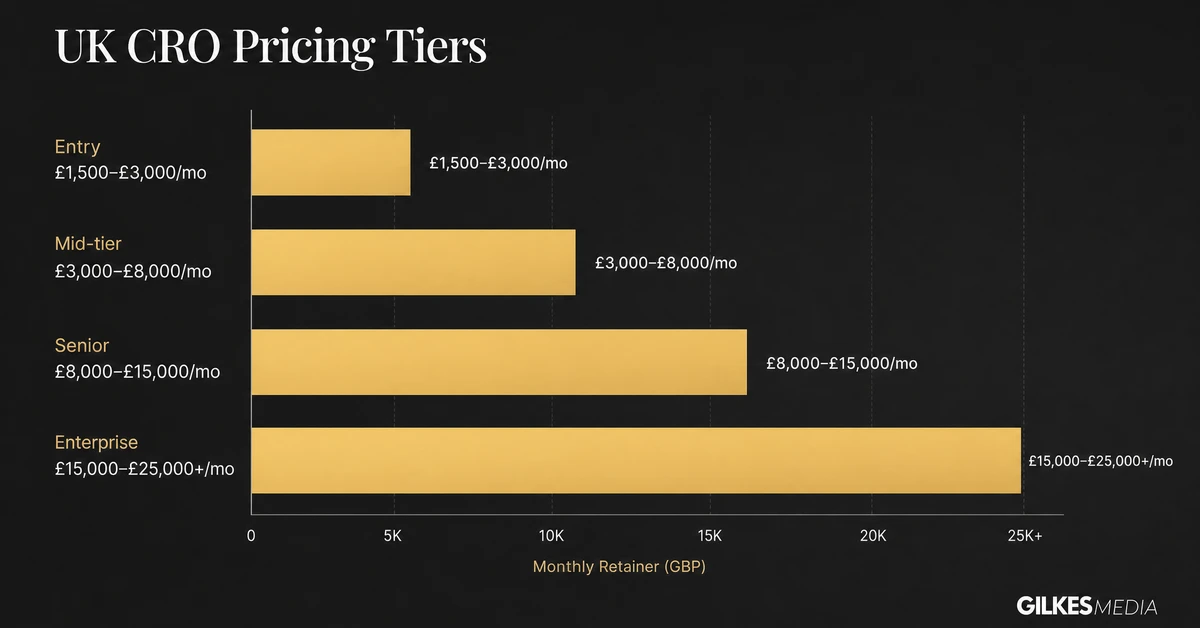
That mirrors the range we found when we researched what a website actually costs in the UK. Here is how it breaks down.
| Engagement type | Typical UK cost | What it usually includes |
|---|---|---|
| One-off audit (small site) | £500 – £2,000 | Heuristic review, analytics audit, prioritised recommendations, no testing |
| One-off audit (complex/high-traffic site) | £2,000 – £15,000 | Full audit plus UX research, stakeholder workshops, testing roadmap |
| Entry-level retainer | £1,500 – £3,000/month | 1–2 tests a month, basic reporting |
| Mid-tier retainer | £3,000 – £8,000/month | 4–8 tests a month, UX research, dedicated strategist |
| Senior/specialist retainer | £8,000 – £15,000/month | Full testing programme, personalisation, senior-led |
| Enterprise/multi-channel | £15,000 – £25,000+/month | Dedicated team, multi-channel testing, cross-functional work |
| Freelance/hourly (regional) | £50 – £100/hour | Ad hoc project or advisory work |
| Freelance/hourly (London) | £100 – £200/hour | Ad hoc project or advisory work |
A handful of factors push a quote up or down within these bands, and it is worth checking each one before you compare two proposals side by side.
UK CRO pricing runs from a £500 audit to a £25,000-a-month enterprise programme. Site complexity, traffic volume and the revenue actually riding on the page you are testing explain most of that gap.
Not every business needs a retainer, and plenty get sold one before they are ready to use it properly. The right starting point depends on your traffic and how much you already know about where visitors are dropping off.
If you have never had a structured look at your conversion funnel, an audit is the right first step. It gives you a prioritised list of fixes your own team, developer or agency can implement without an ongoing testing contract.
It also suits lower-traffic sites, where you simply do not have the volume to run statistically valid A/B tests every month. Fixing obvious friction points first, then testing later once traffic grows, is often the more sensible order.
A retainer earns its keep once you have meaningful traffic, a live tracking setup, and a genuine appetite to keep testing after the "obvious" fixes are done. That is where the compounding value of CRO actually shows up.
The pricing bands above hold roughly true across sectors, but what you are actually optimising for, and how quickly you can test it, changes a lot depending on what kind of business you run.
E-commerce sites usually have the highest traffic and the clearest success metric: a completed purchase. That makes testing faster, since pages reach statistical significance sooner, but it also means basket abandonment, checkout friction and product page trust signals dominate the roadmap.
Because volume is usually high, e-commerce businesses often see faster payback on a retainer than B2B sites, which is why agencies sometimes price e-commerce CRO slightly higher than the generic bands above, reflecting the greater number of tests that can realistically run each month.
B2B sites typically have lower traffic and a longer, more considered path to conversion, so testing takes longer to reach significance.
The "conversion" itself, a form fill or a booked call, needs to be weighted by lead quality, not just volume, a trade-off we cover in our guide to designing a B2B website that converts.
A B2B CRO programme that only optimises for raw form completions can quietly make lead quality worse, by stripping out the qualifying questions that put genuine buyers through and low-intent visitors off.
Any B2B quote should explicitly address how it protects lead quality, not just raw conversion rate.
SaaS businesses usually care about two separate conversion points: getting someone to start a trial, and getting that trial user to actually activate and pay. A CRO agency that only tests the sign-up page while ignoring onboarding is optimising half the funnel.
This is one area where in-house product and CRO work genuinely overlap, since onboarding sits inside the product itself. A strong SaaS CRO partner should be comfortable working alongside your product team, not just your marketing site.
The same pricing bands apply across sectors, but what gets tested differs sharply: checkout friction for e-commerce, lead quality for B2B, and trial activation for SaaS. A generic CRO quote that ignores this is a warning sign.
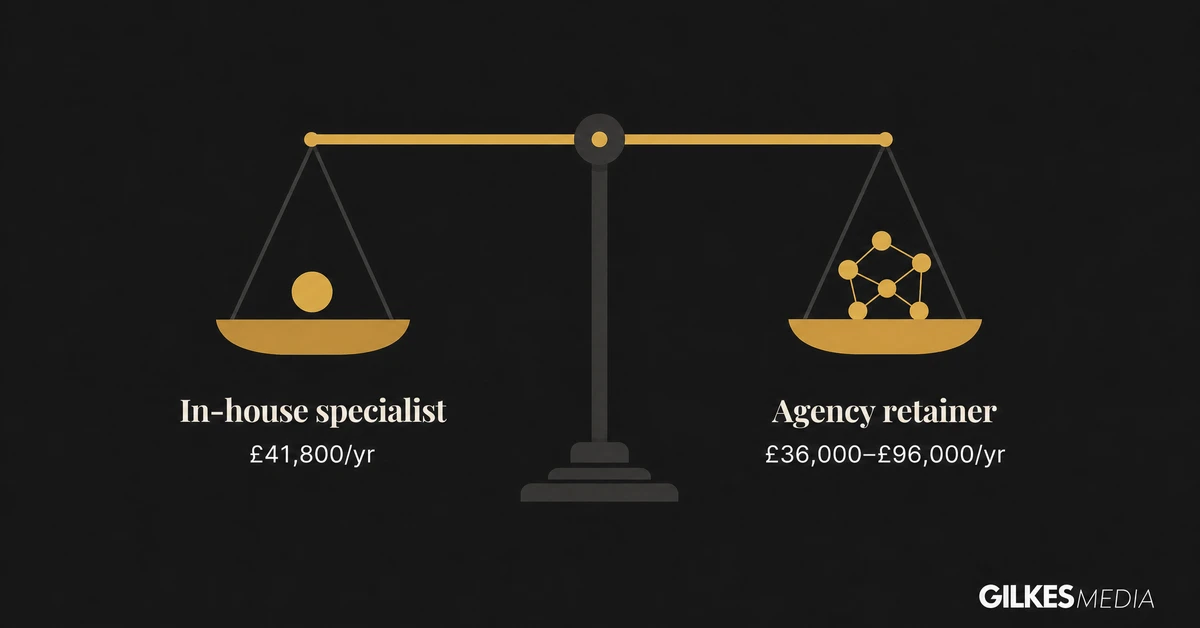
The average UK base salary for a Conversion Rate Optimisation Specialist sits around £37,000, with a typical range of £28,000 to £49,000 depending on seniority and location. It is a genuinely thin data set, which is itself telling.
Dedicated CRO job listings in the UK are rare enough that salary trackers struggle to gather a solid sample.
Most businesses that do CRO well either fold it into a broader marketing or product role, or bring in a specialist agency instead of hiring one person.
Add employer National Insurance at 15% above the £5,000 secondary threshold for 2026/27, and a £37,000 salary costs closer to £41,800 fully loaded, before pension contributions, recruitment fees, or a paid testing platform.
There is also a timing cost most salary comparisons ignore. Recruiting a genuinely skilled CRO specialist in the UK, given how thin the talent pool is, can easily take two to three months. An agency retainer can start testing within a few weeks of signing.
On salary alone, a single in-house hire looks cheaper than a £3,000–£8,000-a-month mid-tier retainer. The comparison falls apart once you account for what one person cannot realistically deliver alone.
For most UK SMEs, a mid-tier agency retainer delivers more tested changes per pound than a single junior-to-mid in-house hire, at least until the business has enough scale to build out a proper internal team.
A single in-house CRO hire looks cheaper on salary alone, but one person cannot match an agency team's testing velocity, tooling access or cross-site pattern recognition until you have the scale to build a full internal team.
Mobile and desktop visitors rarely behave the same way, and a test that wins on desktop can easily lose on mobile once you account for smaller screens, thumb reach and slower connections.
Results should always be segmented by device before anyone declares a test a clear winner.
Before you judge whether a CRO spend is paying off, you need a realistic sense of what "good" looks like.
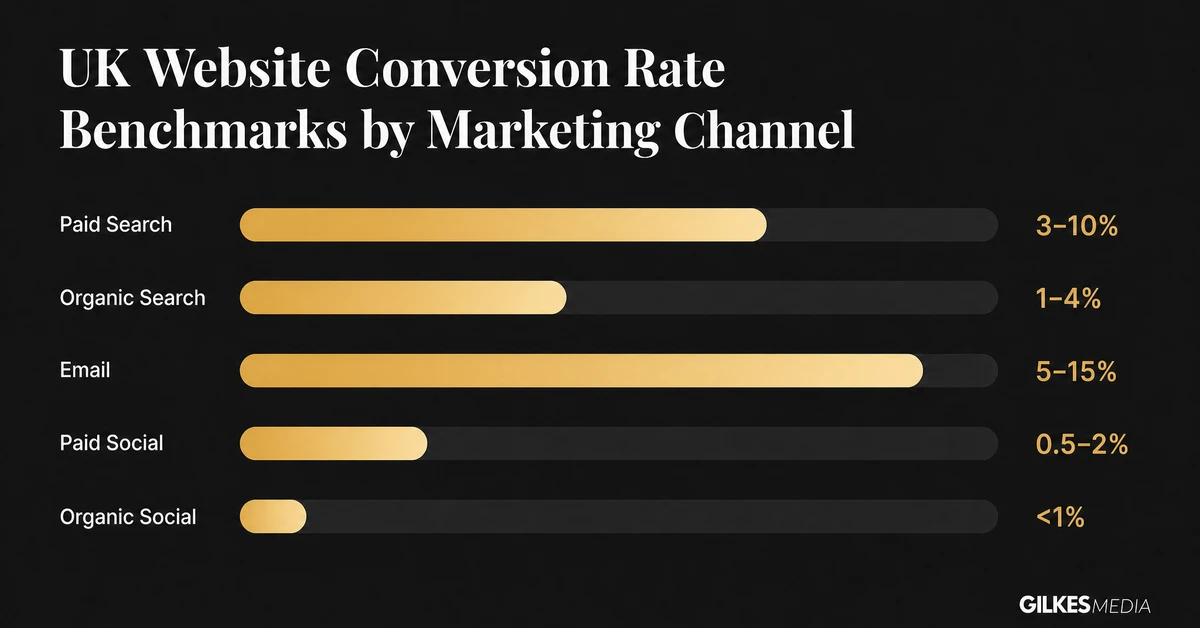
The all-industry average website conversion rate across the UK sits around 2.6%, according to Ruler Analytics' benchmark research, which we cover in more depth in our guide to good conversion rates in the UK.
That average hides enormous variation by channel. Paid search typically converts at 3–10%+, organic search at 1–4%, email at 5–15%, paid social at 0.5–2%, and organic social usually stays well below 1%.
A CRO agency quoting you one flat "good" number without asking about your channel mix has not done its homework.
Seasonality skews results too. A test launched in the run-up to Christmas or during a January budget freeze can show a swing that has nothing to do with the change being tested.
A competent team accounts for this by comparing like-for-like periods, or by re-running an inconclusive test outside a seasonal spike.
Only 39.6% of companies have a formally documented CRO strategy, according to research cited by Invesp. That means most businesses running tests are doing so without a clear hypothesis framework, which is exactly the gap a proper CRO programme is meant to close.
Realistic test cadence also matters when you judge a proposal.
A mid-tier retainer running four to eight tests a month sounds impressive until you realise not every test needs to run simultaneously, and rushing tests to hit a quota is exactly how statistical significance gets ignored.
A good CRO partner would rather run three properly powered tests a month and tell you honestly when a result is inconclusive, than manufacture eight "wins" that do not hold up once the novelty of a new page layout wears off.
A widely cited figure from 99firms puts average CRO tool ROI at 223%. Treat that as a directional industry number rather than a promise. Your actual return depends entirely on your traffic, your starting conversion rate, and how disciplined the testing is.
CRO is easy to sell badly, because "we ran some tests" sounds like progress even when nothing meaningful was learned. Watch for these before you sign anything.
We have seen all of the following happen to UK businesses that came to us after a bad experience elsewhere. None of it is hypothetical.
A promised uplift before an audit, tests called winners after a few days, or reporting built on page views instead of revenue are the clearest signs a CRO budget is about to be wasted.
Numbers land better with a worked example, so here is an illustrative one built from the figures above. Treat it as a way of sense-checking a proposal, not a guaranteed outcome.
Say a UK professional services firm gets 10,000 monthly visitors to its core lead-generation pages, converting at the 2.6% all-industry average. That is 260 leads a month.
If each lead is worth £150 in average deal value to the business, that is £39,000 in monthly pipeline value.
A modest, realistic CRO uplift of half a percentage point, taking the conversion rate from 2.6% to 3.1%, adds 50 leads a month at the same traffic level. At £150 per lead, that is an extra £7,500 a month in pipeline value.
Against a mid-tier retainer of £3,000–£8,000 a month, that single half-point improvement roughly covers or exceeds the entry-to-mid retainer cost, before accounting for every other test that runs across the programme.
A serious CRO agency should be able to walk you through a version of this calculation for your own numbers before you commit.
The same maths works differently for e-commerce. A shop with 40,000 monthly visitors converting at a 1.8% B2B e-commerce average makes 720 sales a month. At an average order value of £65, that is £46,800 in monthly revenue from that traffic alone.
A 0.3 percentage point uplift, from 1.8% to 2.1%, adds 120 sales a month, or £7,800 in extra monthly revenue. Because e-commerce traffic is usually higher, smaller percentage gains translate into meaningful pounds faster than they typically do for lower-traffic B2B sites.
If a full retainer is not realistic yet, there is genuine value you can capture before spending a penny on an agency.
You do not need a retainer to start. A free heatmap tool, a proper look at your own analytics, and five honest customer conversations will surface most of what a paid audit would tell you.
Price alone tells you very little about whether an agency will actually move your numbers. Two proposals at the same monthly fee can represent completely different levels of rigour, so the checklist below matters as much as the figures earlier in this guide.
Once you know roughly what CRO should cost, the harder question is who actually delivers it well. A handful of checks separate a genuine specialist from someone selling a testing tool subscription with a consultancy fee attached.
Contract terms matter as much as the headline price.
A CRO retainer with a long minimum term and no early exit clause is a bigger risk than the monthly fee alone suggests, especially in the first few months while you are still assessing whether the team is any good.
A rolling monthly contract, or a short initial term with a clear review point, protects you if the fit is not right.
At Gilkes Media, CRO sits alongside our website design and development work rather than as a bolted-on extra, which is exactly why we push back on generic uplift promises before we have looked at your actual data.
If you want a straight answer on whether CRO is the right next spend for your business, or whether your budget is better placed elsewhere first, that is a conversation worth having before you sign a retainer.
You can book a free discovery call and we will tell you honestly either way.
Pulled together, the honest summary is this: expect to pay somewhere between £500 for a basic audit and £25,000 a month for a full enterprise programme.
Most UK SMEs land in the £1,500–£8,000-a-month range once they move from a one-off audit to an ongoing retainer.
The right number for your business depends far more on your traffic, your current conversion rate and what a single extra lead or sale is actually worth to you, than on any generic industry benchmark.
Get those three figures straight first, and any proposal becomes far easier to judge.
Most UK businesses pay between £1,500 and £15,000 a month for an ongoing CRO retainer, depending on site complexity, traffic volume and how senior the team is. Entry-level retainers start around £1,500–£3,000, mid-tier programmes run £3,000–£8,000, and senior or enterprise programmes go from £8,000 up to £25,000 or more.
An audit alone is a sensible first step if you have never had a structured review of your conversion funnel, or if your traffic is too low to run statistically valid tests every month. A retainer earns its cost once you have meaningful traffic and want continuous, evidence-led testing.
On salary alone, often yes. The UK average base salary for a CRO specialist is around £37,000. Once you add employer National Insurance, tooling, recruitment and the fact one person cannot match an agency team's testing speed, a mid-tier retainer frequently delivers more tested changes per pound for most SMEs.
The UK all-industry average sits around 2.6%, but this varies hugely by channel and industry. Paid search often converts at 3–10%, organic search at 1–4%, and email at 5–15%. Our guide to good conversion rates breaks this down by sector.
A single well-designed test can show a valid result within two to six weeks, depending on your traffic volume. A full programme that meaningfully shifts your overall conversion rate usually needs three to six months of continuous testing to show its real value.
Web design creates the site. CRO tests and refines it using real visitor data after launch. The two work best together, since a site built without conversion principles in mind usually needs far more testing to fix later than one designed with them from the start.
Yes, to a point. A free heatmap tool, a proper read of your existing analytics, and structured customer conversations will surface real friction points at no cost. Running statistically valid, hypothesis-led testing at scale is where most in-house teams need outside expertise.
Ask for a real example of a past test including one that lost, whether strategy time is included in the quote, who owns your data afterwards, how they define statistical significance, and whether CRO work is tied to actual leads and revenue rather than conversion rate alone.
