
Digital marketing for professional services is not a ‘nice-to-have’ anymore. It is the core engine for winning clients and growing your firm. For consultancies, law firms, and accountants, it builds a predictable pipeline of high-value leads by putting your expertise right in front of people actively looking for it on Google and LinkedIn. The goal is to stop relying on sporadic referrals and start building a measurable, scalable system for generating new business.
If you're new to the idea of bringing in outside help for this, our guide to what marketing consultancy actually involves covers how a consultancy engagement works before you get into the professional-services specifics below.
For decades, professional services firms grew on the strength of a good reputation, a firm handshake, and a steady stream of word-of-mouth referrals. That model, while still valuable, is no longer enough.
Your next high-value client is not waiting for a recommendation at a networking lunch. They are online, right now, researching their specific business challenges and vetting potential partners on Google.
The commercial reality is that a sophisticated approach to digital marketing for professional services is now the single most critical driver of sustainable growth. This is not about just having a website or a social media page. It is about engineering a strategic system designed to deliver tangible business outcomes.
Prospective clients today are more informed and self-directed than ever before. Before they even think about picking up the phone, they have already:
If your firm does not show up during this critical research phase, you are invisible to a massive chunk of your potential market. Relying only on your existing network means you are leaving the vast majority of opportunities on the table for your competitors to scoop up.
The real purpose of digital marketing is not just to be seen; it is to generate a clear, measurable return on your investment. A well-executed strategy moves marketing from a cost centre to a profit driver.
The numbers back this up. In the UK, digital ad investment is projected to hit a staggering £38.07 billion in 2025. This is a 9.4% year-on-year increase, making up over 80% of the nation's total ad spend. This trend is especially vital for B2B firms, highlighting the massive opportunity to reach decision-makers with targeted ads on platforms like LinkedIn and Google. For a deeper dive, you can read the full UK digital report.
The objective is to engineer a predictable client acquisition machine. This means knowing that for every £1,000 you invest in a specific channel, you can reliably expect to generate £5,000, £10,000, or more in new business revenue.
This data-driven approach allows you to scale growth with confidence, knowing exactly which levers to pull to fill your pipeline with qualified leads. It gives you the clarity needed to make sharp strategic decisions, justify your marketing spend, and forecast future growth with real accuracy.
Inaction is no longer a neutral choice; it is a direct decision to concede ground to more forward-thinking competitors.
Jumping into digital marketing without a solid strategy is like building a house without blueprints. It feels like you are making progress, but it is an expensive way to learn that foundations really do matter. Before you put a single pound into ads, you need to do the groundwork that separates successful campaigns from costly experiments.
This is not about abstract theory; it is the practical framework that ensures every piece of content, every ad, and every campaign is targeted, efficient, and pulls directly towards your firm's growth goals.
The most common mistake we see is firms trying to target everyone. When you market to everybody, you connect with nobody. The first and most critical job is to define, in granular detail, who your absolute best client is. We call this the Ideal Client Profile (ICP).
This goes way beyond basic demographics like a job title or company size. A strong ICP gets under the skin of the individuals you want to work with, uncovering their real-world challenges and what truly motivates them. Before spending a penny, you need to get this clear. Learning how to create buyer personas ensures your efforts are focused from day one.
To build an ICP that is actually useful, ask these commercially focused questions:
Answering these questions transforms your marketing from a generic broadcast into a precise, compelling conversation with the exact people who need your expertise.
This simple flow shows how identifying a client need and meeting it with targeted digital ads directly drives firm growth.
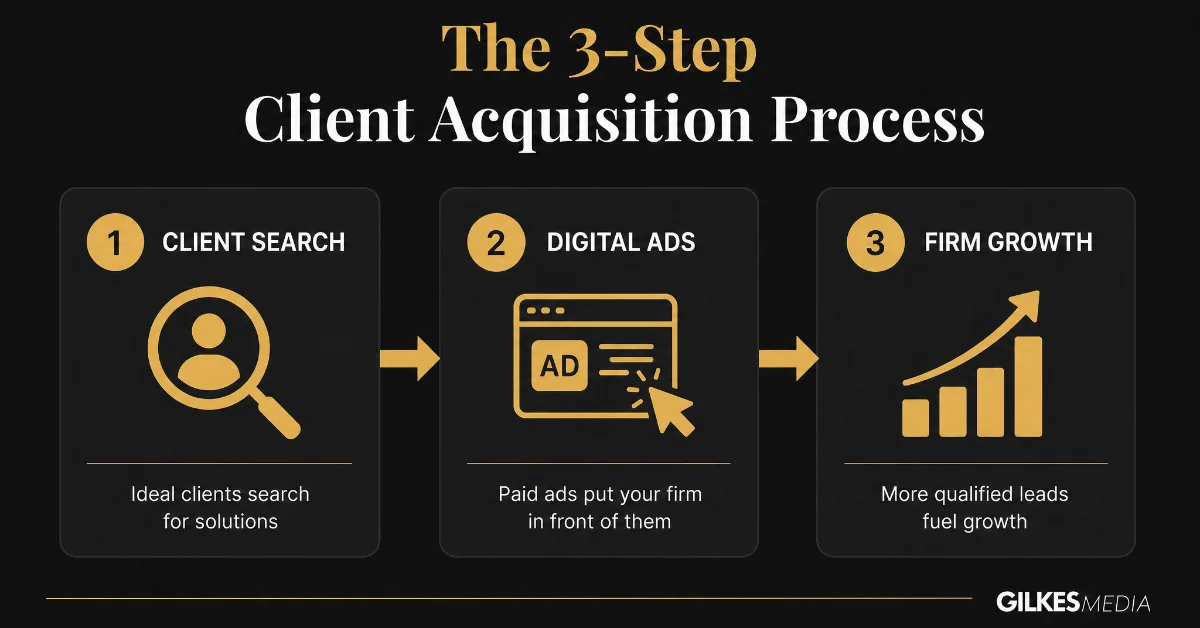
Growth is not accidental. It is the direct result of understanding what your clients are searching for and showing up with a relevant digital solution.
Once you know exactly who you are talking to, you need to be crystal clear about what you offer them. Your value proposition is a simple, powerful statement that answers one critical question for your ideal client: "Why should I choose your firm over all the other options?"
It is not a list of your services. It is the tangible outcome and unique value you deliver.
A powerful value proposition sits at the intersection of what your ideal client desperately needs and what your firm does better than anyone else. It is the core of all your messaging.
To sharpen yours, try this simple exercise. Fill in the blanks:
We help [Your Ideal Client] to achieve [Primary Outcome] by providing [Your Unique Approach/Service].
Here is an example for a boutique law firm that specialises in commercial contracts for tech startups:
This statement hits hard because it is specific, client-focused, and highlights key differentiators (fixed-fee, partner-led). It speaks directly to the ICP's needs for cost certainty and senior expertise. This message now becomes the guide for your website, your Google Ads, and your LinkedIn content. For a deeper dive, our complete guide on how to create a marketing strategy builds on these foundations.
With a razor-sharp ICP and a compelling value proposition, you have the strategic cornerstones in place. Now you can confidently pick the right channels and set your budget, knowing every pound is working towards a measurable business goal.
When a potential client has a business problem, where do they go first? Almost always, it is Google.
That search bar is the modern-day battleground for professional services firms. Being visible at that exact moment of need is the difference between winning a new client and never even knowing they existed.
This is where Search Engine Optimisation (SEO) and Paid Search (PPC) come in. Forget the technical jargon; these are the two most powerful tools you have for capturing high-intent demand and turning searches into clients. They work together to make sure your firm dominates the search results page.
Search Engine Optimisation is the art of making your website more visible in the unpaid, organic search results. Think of it as building valuable digital real estate. It is a serious investment in your firm's authority and credibility that pays dividends for months and years to come.
For a professional services firm, a practical SEO strategy is not about chasing complicated technical fixes. It is grounded in three core pillars:
SEO is not a quick fix. It is a strategic commitment to becoming the most relevant and trusted answer for the problems your firm solves. The payoff? A sustainable flow of high-quality, inbound leads who already see you as an expert before they even pick up the phone.
Paid Search, often called Pay-Per-Click (PPC), is much more direct. You pay to have your ads appear right at the top of the search results for specific keywords. With platforms like Google Ads, you are placing your firm directly in front of prospects who are actively looking for your expertise right now.
Unlike SEO, the results are almost immediate. A well-structured campaign can start generating calls and enquiries within hours of going live. This makes PPC an incredibly powerful tool for driving targeted leads with precision and speed.
A commercially focused PPC campaign for a professional services firm should involve:
The real beauty of PPC is its measurability. You can track exactly how much you spend, how many leads you generate, and calculate your precise cost per lead. It is marketing with the lights on.
The most effective digital marketing for professional services rarely uses just one. The real question is not about choosing one over the other; it is about understanding when and how to deploy each channel for maximum commercial impact.
UK marketing professionals show a strong reliance on SEO, with 48% incorporating it into their core strategies, well ahead of channels like direct mail or even paid search. This makes sense given its long-term value, especially as Google's AI Overviews continue to change search behaviour, making deep, authoritative content more critical than ever. You can read more about UK digital marketing trends on localiq.co.uk.
Here is a simple framework for deciding where to put your budget.
| Consideration | Invest in SEO When… | Invest in PPC When… |
|---|---|---|
| Speed to Results | Building a long-term, sustainable lead pipeline is the priority. | You need to generate qualified leads quickly to fill your pipeline. |
| Budget | You can commit a consistent monthly investment for 6+ months. | You have a defined budget and need immediate, trackable ROI. |
| Market Position | You want to be recognised as the leading authority in your niche. | You need to break into a new market or compete against established firms. |
Strategic Takeaway: Use PPC to generate immediate cash flow and validate demand. Then, reinvest the profits from those new clients into a long-term SEO strategy that builds a valuable, lasting asset for your firm.
By understanding how to use both SEO and PPC, you can build a comprehensive search strategy that captures clients at every stage of their journey. You ensure your firm is the one they find when they need expert help the most.
To get started on your organic strategy, you might find our guide on the best free SEO tools available helpful.
In professional services, people are not just buying a service; they are buying expertise. They are buying your judgement. Most of all, they are buying trust in your ability to solve a critical problem.
While search engines are brilliant for capturing people actively looking for a solution right now, the long game is won by building unshakable authority. This is where a focused content and LinkedIn strategy becomes your most powerful asset. It shifts marketing from a simple sales function to an educational one, positioning your firm as the go-to voice in your industry. When a need arises, you are the first name they think of.
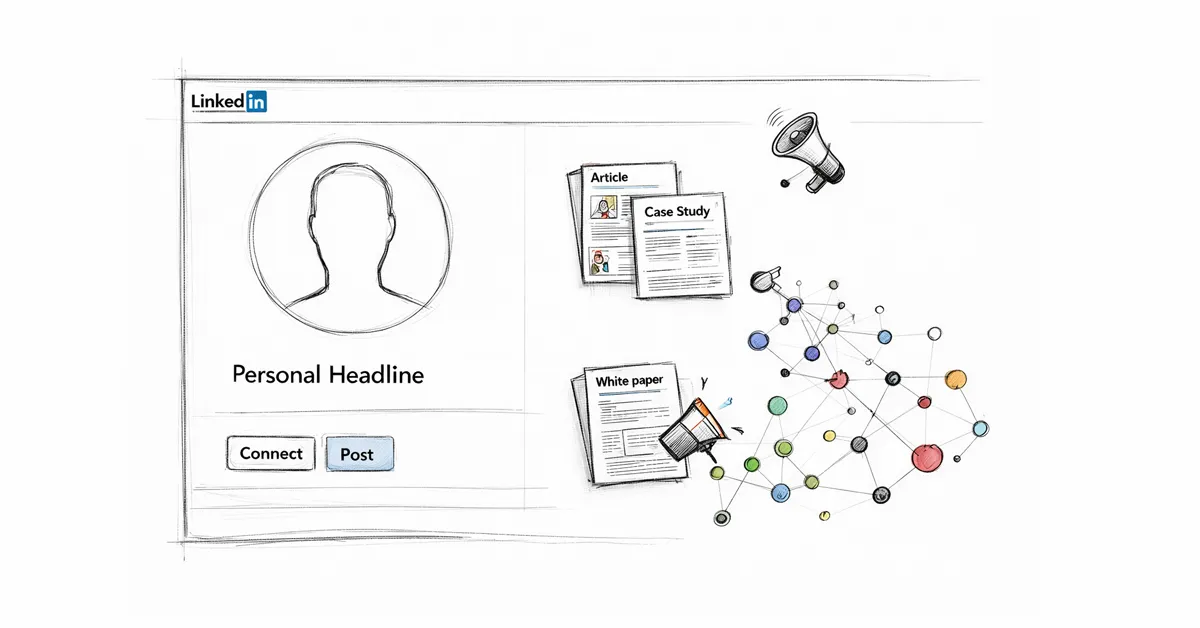
Let us be honest, your company's LinkedIn page is a necessary brochure, but it is not where real influence is built. The real power is in the personal brands of your firm’s partners, directors, and key fee-earners. These are the experts your clients actually want to hear from.
A smart strategy transforms their static profiles into dynamic platforms for showcasing that expertise.
Your firm’s collective expertise is your most powerful marketing tool. LinkedIn is the platform that lets you showcase it at scale, building trust with hundreds of potential clients at once.
The goal here is not to sell; it is to educate. You are proving your firm’s value by giving some of it away for free. This builds incredible trust and pre-qualifies potential clients who resonate with your approach long before they ever need to hire you.
Your content should be laser-focused on solving the specific, high-stakes problems your ideal clients are wrestling with.
Practical Content Formats for Professional Services
| Content Type | Primary Goal | Why It Works for Your Firm |
|---|---|---|
| In-Depth Articles | Demonstrate expertise | Shows your depth of knowledge on a complex topic. |
| Case Studies | Build trust and proof | Provides concrete evidence of how you solve client problems. |
| White Papers | Generate high-value leads | A detailed, data-driven resource in exchange for contact info. |
| Checklists | Offer immediate value | A simple, actionable tool that clients can use right away. |
This content becomes the fuel for your entire LinkedIn strategy. It is the material your partners share to start the meaningful conversations that lead to business.
Beyond organic activity, LinkedIn’s advertising platform offers surgical precision for reaching specific decision-makers. It is more expensive than other platforms, but the quality of targeting for B2B services is simply unmatched. You can get in front of people based on:
This allows you to run incredibly focused campaigns. Imagine promoting a white paper on tax efficiency directly to Finance Directors in the manufacturing sector, or a case study on commercial litigation to General Counsels at a handful of target companies.
The UK B2B marketing sector is forecast to hit a £20.44 billion market size, and digital channels are essential for growth. With 51% of marketers planning to expand digital PR, using platforms like LinkedIn for thought leadership is critical. You can read more on how B2B marketing statistics are shaping strategies.
When you combine the organic authority-building from your partners' profiles with these precision-targeted paid campaigns, you create a powerful system. You build a strong brand presence and generate a steady stream of warm, well-informed leads who already see your firm as the expert they need.
Marketing without measurement is just expensive guesswork. Any investment you pour into digital marketing for your professional services firm has to be tied directly to a commercial outcome.
This is where so many agencies fall flat. They hide behind confusing jargon and ‘vanity metrics’ like impressions or clicks. These metrics look impressive on a report but do not pay the bills.
To get a real grip on performance, you have to focus on the key performance indicators (KPIs) that directly impact your bottom line. This simple shift moves the conversation from "how many people saw our ad?" to "how much new business did that ad actually generate?".
It is the only way to make smart, data-driven decisions about where your budget will drive maximum growth.
Forget about chasing likes or shares. For a professional services firm, only a handful of metrics truly matter. These are the KPIs that draw a straight line from your marketing spend to your bank balance.
Your core focus should be on tracking three critical data points:
Tracking these numbers gives you undeniable clarity. If you know a new client is worth £10,000 on average and your CAC from Google Ads is £1,500, you have just found a profitable, scalable engine for growth.
The goal is to build a simple, commercial dashboard that links every pound spent on marketing directly to new business revenue. This empowers you to prove value, justify investment, and make strategic decisions with confidence.
You do not need complex or expensive software to get started. A straightforward spreadsheet is all it takes to track performance and calculate your return on investment. The real secret is just being disciplined enough to log the data each month.
Accurately measuring impact is a non-negotiable step in any serious marketing effort. If you want to dive deeper into this, many great resources explain how to measure marketing ROI in more detail.
To get you started, here is a simple breakdown of the essential metrics to track, what they tell you, and how to calculate them.
This table breaks down the key metrics you should have on your dashboard, what they mean for your business, and a simple formula for calculating each one.
| Metric (KPI) | What It Measures | Simple Calculation | Business Implication |
|---|---|---|---|
| Cost per Lead (CPL) | The efficiency of a channel at generating enquiries. | Total Ad Spend / Total Leads | A low CPL indicates an efficient channel. |
| Lead Conversion Rate | The quality of leads and the effectiveness of your sales process. | (New Clients / Total Leads) * 100 | A high rate means you are attracting the right people. |
| Client Acquisition Cost (CAC) | The total cost to acquire one new paying client. | Total Ad Spend / New Clients | This is the ultimate measure of marketing profitability. |
| Return on Ad Spend (ROAS) | The revenue generated for every pound spent on advertising. | Revenue from New Clients / Total Ad Spend | Directly proves the financial return of your campaigns. |
This commercially-focused approach demystifies marketing performance. It removes emotion and opinion from the equation, allowing you to have objective, productive conversations with partners and stakeholders about what is actually working.
You can confidently double down on the channels delivering profitable clients and cut the ones that are not. Our own guide on how to measure marketing ROI provides even more depth on building these systems from the ground up.
By measuring what truly matters, you transform your marketing from an unpredictable expense into your firm's most reliable and scalable driver of growth.
When I sit down with partners and directors, the conversation always turns to the practicalities: budget, timelines, and resources. These are not just details; they are the critical questions that determine whether a marketing plan gets off the ground.
Here are the straight-talking, commercially-focused answers to the questions I hear most often.
There is no magic number, but a good rule of thumb for a professional services firm that is serious about growth is to earmark 7-10% of your target revenue.
But forget the percentage for a moment. The method is far more important than the initial figure. Do not commit a huge, speculative budget across a dozen channels hoping something sticks. That is a recipe for waste.
Instead, start lean and prove the model first.
Once you can confidently walk into a board meeting and show that for every £1 you put in, you get £5 or £10 back in fees, the budget conversation changes entirely. You are no longer asking for money based on guesswork; you are presenting a data-backed case for investment.
For getting the phone to ring this month, Paid Search (PPC) on Google Ads is almost always the fastest way to generate leads.
Why? Because you are getting in front of people who are actively looking for a solution to a problem they have right now. Their intent is sky-high, which means the journey from search to becoming a client is often much shorter.
But speed is not the whole story. PPC is fantastic for quick wins, but it is a tap you have to keep paying to keep on. The moment you switch off the spend, the leads dry up.
For building a long-term, sustainable pipeline and a powerful brand, SEO and content marketing on LinkedIn will almost always deliver a higher quality of lead over time.
These channels are about building assets. You are establishing your firm's authority and creating a digital footprint that works for you 24/7. It takes longer to get going. You are typically looking at 6-12 months to see significant momentum, but the leads that come through often see you as the expert before they have even spoken to you.
The smartest strategy balances both: use PPC for immediate pipeline while building your long-term market leadership with SEO.
This is a huge strategic decision. Sure, some basic tasks like updating the company LinkedIn page or writing a simple blog post can be handled internally. But when it comes to getting a real return from complex channels, you need specialist expertise.
The digital world moves incredibly fast. Google’s algorithms are constantly changing, new targeting features roll out on LinkedIn every quarter, and what worked last year is often obsolete today. An in-house marketing generalist, who is likely juggling ten other things, simply cannot keep up with the depth of knowledge required to compete and win.
Think about the true cost:
The right partner does not just run campaigns; they build a profitable client acquisition engine for your firm, accelerating your growth far faster than you could alone.
At Gilkes Media, we are that specialist partner. We work with leadership teams to design and run practical, performance-focused digital marketing strategies that deliver the one thing that matters: measurable growth. If you need a clear plan and accountable execution, let's talk.
