
TikTok has gone from a place teenagers danced to a genuine advertising channel UK businesses budget for. But ask five agencies what TikTok ads actually cost and you will get five different answers.
That is partly because TikTok's auction works like Google's and Meta's, so your own cost per click depends on your industry, targeting and creative.
It is also because a lot of the pricing information online is American, priced in dollars, and years out of date.
This guide sets out what TikTok advertising actually costs a UK business in 2026: real click and view prices, the platform's own minimum budgets, and what an agency or in-house hire costs on top of media spend.
It also shows how TikTok compares on price to Google Ads and Meta Ads.
We have used TikTok's own published platform minimums plus current UK agency pricing data throughout, not guesswork or a single agency's rate card.
Every figure below is explained, so you can see exactly where it comes from and judge it for your own budget.
TikTok sells ads through an auction, the same basic model as Google and Meta. You are not charged a flat rate.
Instead, you bid against other advertisers targeting the same audience, and the platform awards impressions based on bid and ad quality.
That means any cost figure is a range, not a fixed price. But current UK pricing data gives a reliable working range for budgeting purposes, broken down by the three most common ways TikTok charges for ads.
| Pricing model | Typical UK range | Used for |
|---|---|---|
| Cost per click (CPC) | £0.10 – £0.30 | In-feed ads driving traffic or conversions |
| Cost per view (CPV) | £0.01 – £0.07 | Video view and awareness campaigns |
| Cost per action (CPA) | £1 – £3 | Conversion-optimised campaigns (leads, sign-ups, sales) |
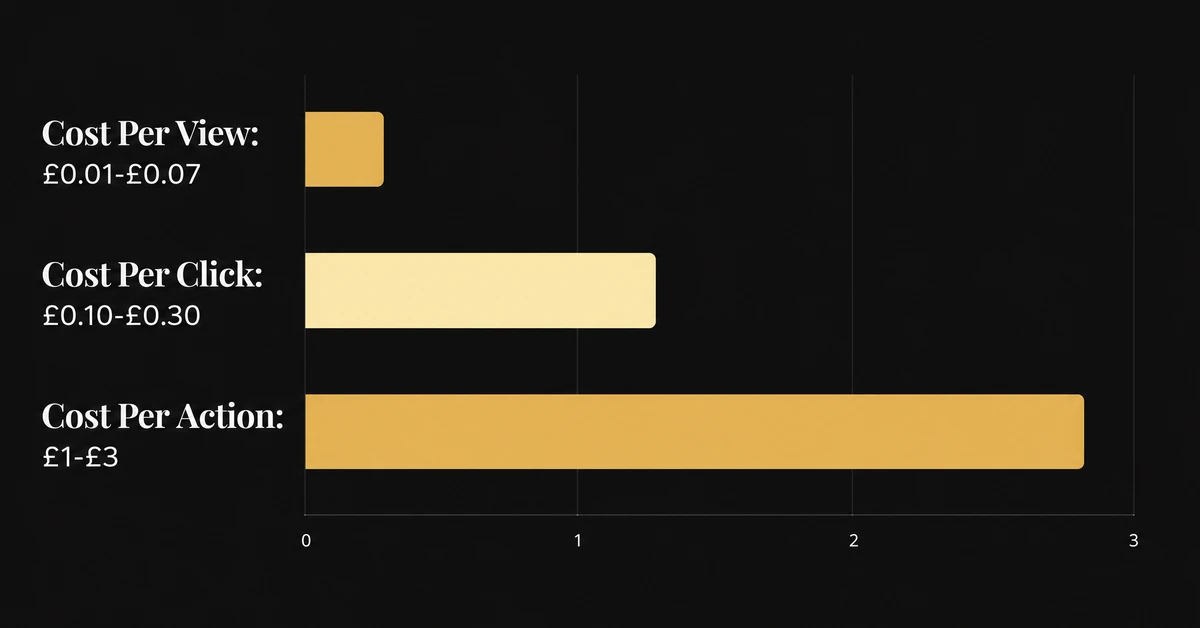
Those ranges sit broadly in line with Meta, and usually cheaper than Google Ads on a pure click basis.
Our own Google Ads Cost UK guide puts average UK search CPCs well above £1 in competitive sectors, so TikTok's click prices can look like a bargain on paper.
The catch is intent. Someone searching Google has already decided they want something; someone scrolling TikTok has not.
That means a cheap click does not automatically mean a cheap lead, which is why cost per action matters more than cost per click for most businesses.
TikTok's headline click and view prices are genuinely cheap next to Google and Meta, but a low CPC only matters if those clicks turn into the actions your business actually needs.
TikTok sets its own platform minimums in US dollars, not pounds. At the time of writing, that is $50 a day at campaign level and $20 a day at ad group level, which converts to roughly £40 and £16.
Those are floors, not sensible starting budgets. A campaign running at the bare $50-a-day minimum rarely collects enough data for TikTok's algorithm to optimise properly within a normal testing window.
Realistic UK small business budgets tend to sit between £500 and £3,000 a month once you include enough spend to test two or three creative angles and at least one audience variation.
Larger, always-on campaigns with multiple ad groups and ongoing creative refreshes commonly run at £10,000 a month or more. Where you land depends on your sales cycle, average order value and how quickly you need results.
Most UK businesses only ever use one TikTok ad format: in-feed ads, the standard video ad that appears in someone's For You feed. These are priced on the CPC, CPV and CPA ranges above.
TikTok also sells several premium, reservation-based formats aimed at large brands with five and six-figure budgets.
These are worth knowing about even if you will never buy one, so a salesperson cannot quote you a premium-format price for a standard campaign.
The standard, auction-based format almost every small and mid-sized UK business actually uses. Priced per click, per view or per action as set out above, with full control over daily and lifetime budget.
Boosts an existing organic TikTok post, either your own or a creator's, as a paid ad. Priced on the same CPC/CPV/CPA auction as in-feed ads, so there is no separate premium cost.
The trade-off is that it needs content that already exists and already performs organically, which is not always available to a brand just starting out.
Full-screen ads that appear the moment someone opens the app. These are sold on a reserved, fixed-cost basis rather than an open auction, and UK pricing for Brand Takeover runs from roughly £35,000 to £70,000 per day.
Only one advertiser can hold this placement per day, which is why the price is fixed rather than bid for. It suits a national product launch far more than an ongoing lead generation campaign.
A sponsored campaign encouraging users to create their own content around a branded hashtag. UK pricing for this format starts at around £100,000 per campaign, which puts it well outside the budget of most Gilkes Media clients.
Unless you are running a national brand campaign, you will almost certainly be buying standard in-feed ads or Spark Ads, both priced on the same auction as everything else on this page.
Two UK businesses in different sectors, running the same budget, routinely see very different costs per click or per lead. A handful of factors explain most of that gap.
None of these factors are unique to TikTok. They are the same forces that move prices on Google and Meta.
That is one reason a genuinely experienced paid social team tends to produce lower costs across every platform, not just one.
Your TikTok ad costs are driven by the same handful of factors as every other paid platform: who you are targeting, how good your creative is, and what you are asking the algorithm to optimise for.
Industry matters on TikTok just as it does on Google and Meta. Some sectors face far more competition for the same attention, and that pushes their costs up regardless of how good the campaign itself is.
Global industry data from TikTok's own ad platform, converted from the dollar figures most reporting uses, gives a useful relative picture even though the UK-specific pound figures are not separately published.
| Industry | Typical CPM (USD) | Relative cost |
|---|---|---|
| Finance and insurance | $11.00 – $14.50 | Highest |
| Fashion and apparel | $7.30 – $9.00 | Above average |
| Beauty and skincare | $6.00 – $8.50 | Above average |
| Home and garden | $6.80 – $8.20 | Average |
| Health and fitness | $6.50 | Below average |
The pattern holds in the UK too, even without separate sterling figures: financial services and insurance compete hardest for TikTok attention, so expect costs toward the top of every range in this guide if that is your sector.
Health, fitness and home-and-garden brands typically see costs toward the lower end, reflecting less advertiser competition rather than a deliberate platform discount.
Professional and B2B services sit outside this table entirely, since TikTok does not publish a dedicated benchmark for it. That is itself a sign of how new B2B TikTok advertising still is.
Media spend, what you pay TikTok directly, is only one side of the cost. Someone also has to plan, build, test and optimise the campaigns, and that work carries its own price whichever route you choose.
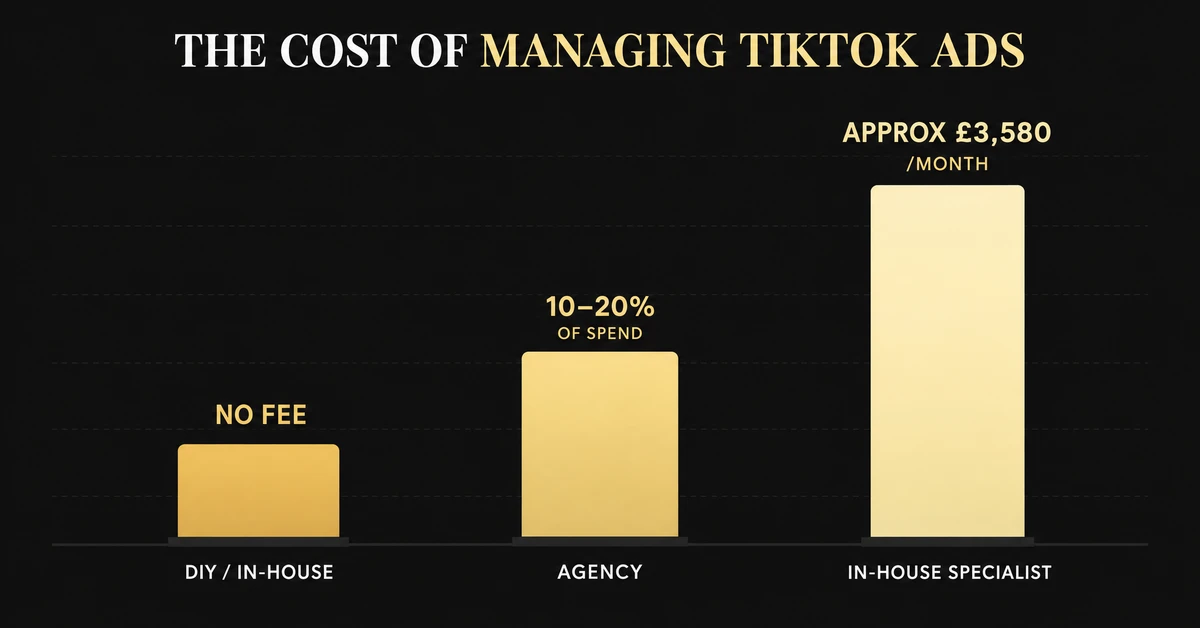
The cheapest option on paper: no fees beyond ad spend itself. The real cost is time, and a steep learning curve, since TikTok's ad manager, auction dynamics and creative requirements differ meaningfully from Google and Meta.
UK paid social and PPC agencies typically charge either a flat monthly fee of roughly £150 to £500 for smaller accounts, or a percentage of ad spend.
That percentage commonly runs 10% to 20% for SME-sized budgets, tapering toward 5% to 10% at enterprise spend levels.
This lines up closely with the retainer bands we found researching our own guide to choosing a PPC agency.
Those bands run roughly £300 to £10,000-plus a month depending on agency size and scope, with a UK average retainer around £1,040 a month across all paid channels.
A dedicated UK paid social manager earns an average base salary of around £38,000 a year, with a typical range of £34,000 to £43,000.
Add employer National Insurance at the 2026/27 rate of 15% above the £5,000 secondary threshold, and that £38,000 salary costs the business closer to £42,950 a year once NI alone is added, before pension contributions, equipment or management overhead.
That works out at roughly £3,580 a month, fully loaded, for one person managing TikTok ads alongside whatever else sits in their job description.
For most SMEs, that only makes sense once paid social spend is substantial enough to justify a full-time role.
| Route | Typical monthly cost | Best suited to |
|---|---|---|
| DIY (in-house, no specialist) | £0 fee, but significant time cost | Very small budgets, early-stage testing |
| Agency (flat fee) | £150 – £500 | Smaller accounts wanting predictable cost |
| Agency (% of spend) | 10% – 20% of ad spend (SME), 5% – 10% at scale | Growing budgets, ongoing optimisation needed |
| In-house specialist hire | ~£3,580 fully loaded (NI included) | Established, multi-platform paid social budgets |
TikTok's prices in 2026 are noticeably higher than they were two or three years ago, and that trend is likely to continue rather than reverse.
More UK advertisers now compete for the same inventory as the platform has matured from an early-adopter channel into a mainstream one, which naturally pushes auction prices up over time.
TikTok has also introduced more ecommerce and shopping features, which brings in advertisers with larger budgets and a direct-response mindset, further increasing competition for attention.
The practical takeaway is not to wait for prices to come back down. A business testing TikTok now, while it is still cheaper than Google or LinkedIn, is better placed than one that waits another year or two.
Cost only means something next to the alternatives. Here is how TikTok's pricing compares with the other three paid platforms Gilkes Media manages for UK clients.
| Platform | Typical UK CPC |
|---|---|
| TikTok Ads | £0.10 – £0.30 |
| Meta Ads (Facebook/Instagram) | £0.40 – £1.50 (varies heavily by objective) |
| Google Ads (Search) | £1 – £5+ in competitive sectors |
| LinkedIn Ads | £4 – £9, highest of the four |
On raw click price, TikTok usually wins. But cheap clicks and cheap leads are not the same thing, and the right platform depends on what you are selling and to whom.
Our Google Ads vs Meta vs LinkedIn vs TikTok comparison covers this platform-choice question in full.
TikTok's audience skews toward discovery and entertainment rather than active buying intent, which is exactly why it is cheap.
Our Cost Per Lead UK benchmarks put B2B services leads at roughly £35 to £150 depending on sector.
A TikTok campaign built around cold, top-of-funnel audiences can struggle to hit the lower end of that range without a genuinely strong offer and creative.
TikTok wins on click price against every other major platform, but the real comparison that matters is cost per qualified lead, not cost per click.
Price alone does not answer whether TikTok is the right channel. The audience has to be there, and it has to be reachable in a way that fits how your buyers actually behave.
TikTok now reaches around 26.8 million adult users in the UK, with the 25 to 34 age bracket the single largest group on the platform, and almost 70% of the whole user base now over the age of 25.
Engagement is high: the average UK user spends around 88.5 minutes a day on the app, and TikTok now reaches roughly 65% of UK adults aged 18 to 34, according to Ofcom's Online Nation research.
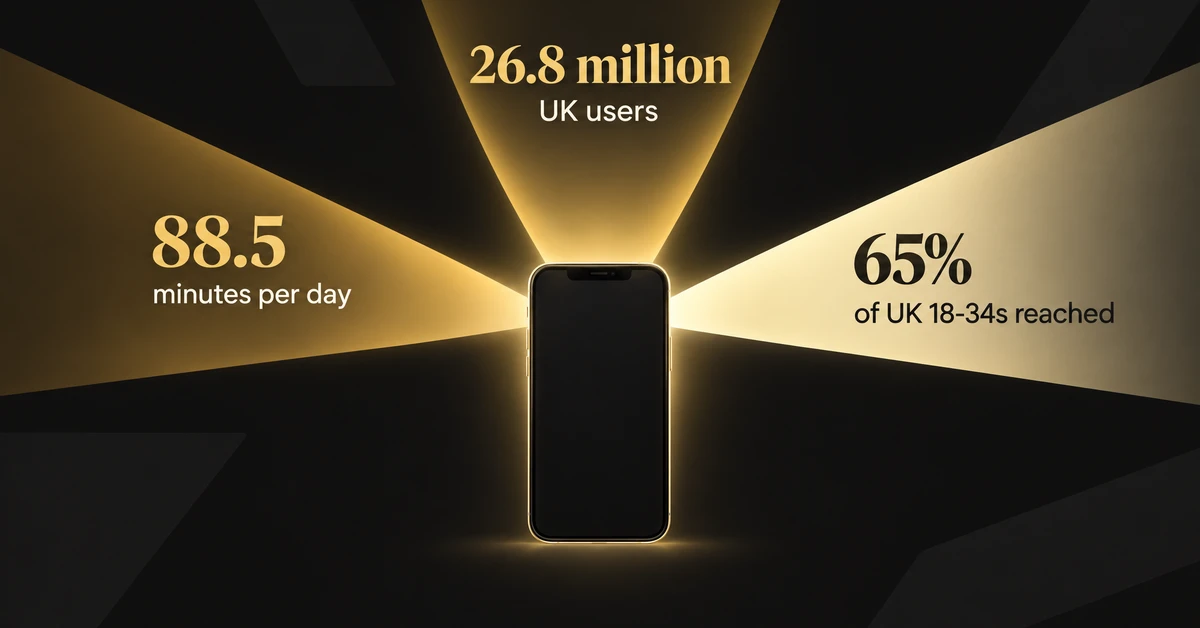
That makes TikTok a genuinely mainstream channel in the UK now, not a niche teenage platform. For consumer brands, recruitment, education and hospitality it is frequently worth testing on cost alone.
Recruitment in particular has become one of TikTok's fastest-growing UK use cases, since the platform reaches younger jobseekers who increasingly ignore traditional job boards and LinkedIn in favour of short-form video.
For complex, high-value B2B sales it is a harder case, which we cover in detail in our dedicated TikTok Ads for B2B guide.
The short version: it works best as a brand-awareness layer on top of Google or LinkedIn, not as a replacement for either.
TikTok's UK audience is now mainstream rather than niche, which makes it worth testing for most consumer-facing businesses and a more selective bet for complex B2B sales.
TikTok advertising is newer than Google or Meta, which means the agency and freelancer market around it is less mature, and less regulated by experience. A few warning signs are worth checking for before you commit budget.
Numbers are easier to apply with a worked example. Here is a realistic first-campaign budget for a UK ecommerce business testing TikTok for the first time.
Give any new TikTok campaign a genuine four-week learning period before judging it. Switching off too early is the single most common reason a test campaign looks like it failed.
Beyond strategy and creative, a handful of account-level setup mistakes routinely inflate TikTok ad costs without the advertiser ever realising why their numbers look worse than they should.
None of these mistakes are expensive to fix once spotted, but all of them are common in accounts run by someone learning TikTok ads on the job rather than someone with hands-on platform experience.
Most inflated TikTok ad costs are not a pricing problem. They are an account-setup problem: overlapping audiences, uncapped frequency, or a bid cap set without enough data to justify it.
Every cost figure in this guide covers media spend and management fees. It does not cover the video content itself, which is the part most new TikTok advertisers underestimate.
TikTok ads need native, platform-first video, not a repurposed Instagram or YouTube ad. Filming in-house with a phone and natural light works for many brands, and genuinely costs nothing beyond staff time.
If you commission a creator instead, published global rates scale with following size. A nano-creator under 10,000 followers typically charges the equivalent of £150 to £400 per video.
A micro-creator with 10,000 to 100,000 followers typically charges roughly £400 to £1,600 per video.
Larger creators and agencies producing a small batch of polished video ads can run into several thousand pounds per project.
Budget for this as a separate line item from your media spend, not an afterthought once the campaign is already live.
A handful of practical habits consistently separate UK businesses getting a good return on TikTok from those who try it once and give up.
Treat creative as the main lever, not targeting. On TikTok, a genuinely native, entertaining video routinely outperforms a technically perfect audience built around average demographics.
Install proper conversion tracking before you spend a single pound, not after the first disappointing report. Without it, you are optimising blind and paying TikTok to guess.
Budget for creative refreshes as an ongoing cost, not a one-off. TikTok audiences fatigue on a single ad faster than on Google or Meta, often within one to two weeks of heavy rotation.
Finally, judge TikTok against cost per qualified lead or cost per sale, never cost per click alone. A cheap click that never converts is not a cheap result, whatever the headline CPC looks like.
Review performance weekly once a campaign is live, but resist the urge to change targeting, creative and budget all in the same week. Changing one variable at a time makes it possible to actually learn what moved the number.
There is no TikTok-specific rule here, so start from your overall marketing budget.
Benchmark guidance from Gartner and the US Small Business Administration puts a sensible total marketing budget at roughly 7% to 8% of revenue for an established business, rising to 12% to 20% for one still actively growing market share.
Treat TikTok as one channel within that total, not an additional pot on top of it.
A sensible starting allocation for a first test is 10% to 20% of your existing paid social budget, scaled up only once it proves a lower cost per lead than your best-performing channel.
No. TikTok's cost per click typically runs from £0.10 to £0.30, usually cheaper than both Meta and Google Ads in the UK. The trade-off is that TikTok's audience has lower buying intent, so a cheap click does not always translate into a cheap lead or sale.
TikTok's own platform minimums are $50 a day at campaign level and $20 a day at ad group level, roughly £40 and £16. In practice, most UK small businesses need £500 to £3,000 a month to test properly and gather enough data for the algorithm to optimise.
UK agencies typically charge either a flat monthly fee of around £150 to £500 for smaller accounts, or 10% to 20% of ad spend for SME-sized budgets, tapering toward 5% to 10% at higher spend levels.
A dedicated in-house paid social hire costs roughly £3,580 a month fully loaded once employer National Insurance is included, which is usually more than a flat agency fee or percentage-of-spend arrangement unless your TikTok budget is already substantial.
It can, but it suits brand awareness and top-of-funnel visibility better than direct lead generation for complex, high-value B2B sales. Our dedicated TikTok Ads for B2B guide covers this in more detail.
Give a new campaign at least four weeks before judging results. TikTok's algorithm needs a genuine learning period, and switching a campaign off after only a few days is one of the most common reasons a test looks like it has failed.
Creative quality, more than on most other platforms. A genuinely native, entertaining video that blends into the For You feed consistently costs less per result than an ad that looks like traditional advertising.
For most consumer-facing businesses, yes, given TikTok's low click costs and a UK audience of 26.8 million adults that now skews mainstream rather than teenage. For complex B2B sales it is worth testing as a supporting channel rather than a primary one.
TikTok advertising in the UK is genuinely affordable on a cost-per-click basis, but the real cost of running it well includes creative, tracking and ongoing management, not just media spend.
If you want a second opinion on whether TikTok fits your budget and sales cycle, or you want someone else to plan and run the campaign, we can help.
Our paid ads management service covers TikTok alongside Google, Meta and LinkedIn.
We offer a free, no-obligation discovery call to talk through your numbers honestly, including telling you if TikTok is not the right fit yet. Get in touch to book one.
