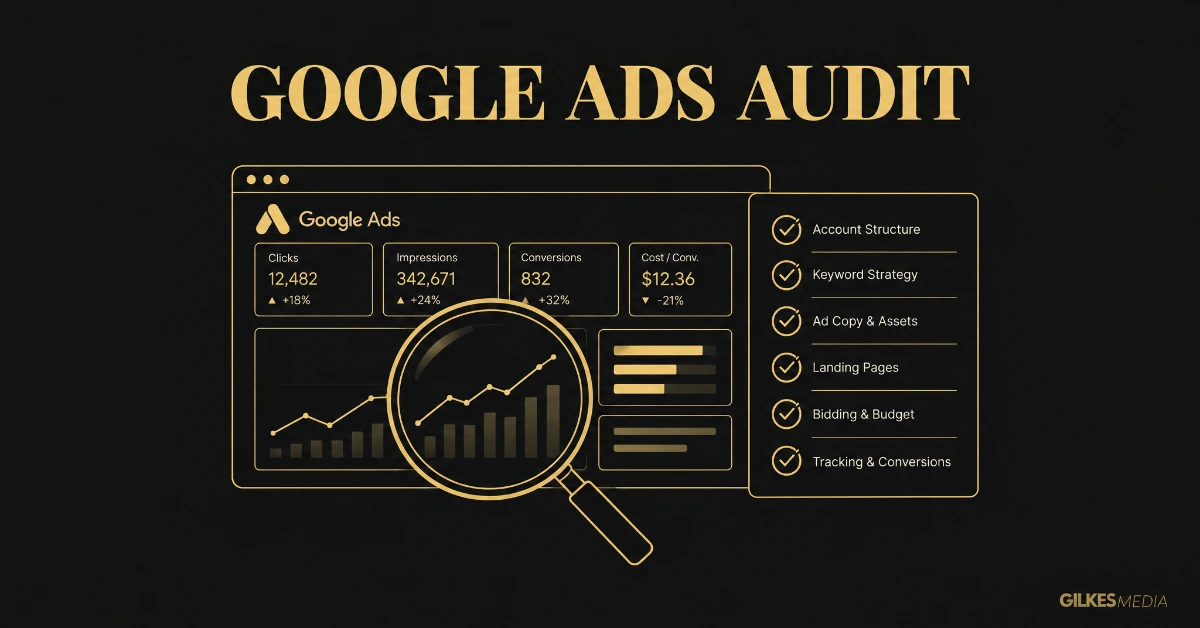
If your Google Ads account has been running for more than six months without a proper outside review, there is a good chance it is quietly wasting a meaningful slice of your budget. Not because anyone did anything obviously wrong, but because accounts drift.
Keywords that made sense a year ago stop earning their place. Negative keyword lists stop getting updated. A conversion tag breaks after a website update and nobody notices for three months, because the clicks and the spend look exactly the same either way.
The same thing happens to accounts run in-house and accounts run by an agency, so this is not really about who is managing it. It is about whether anyone is looking at the whole account on a regular basis, rather than just the headline numbers on a dashboard.
A Google Ads audit is the process of catching all of that before it costs you another quarter of budget. This guide covers what a proper one actually checks, what it should cost in the UK in 2026, and how to tell a genuine audit from a sales pitch dressed up as one.
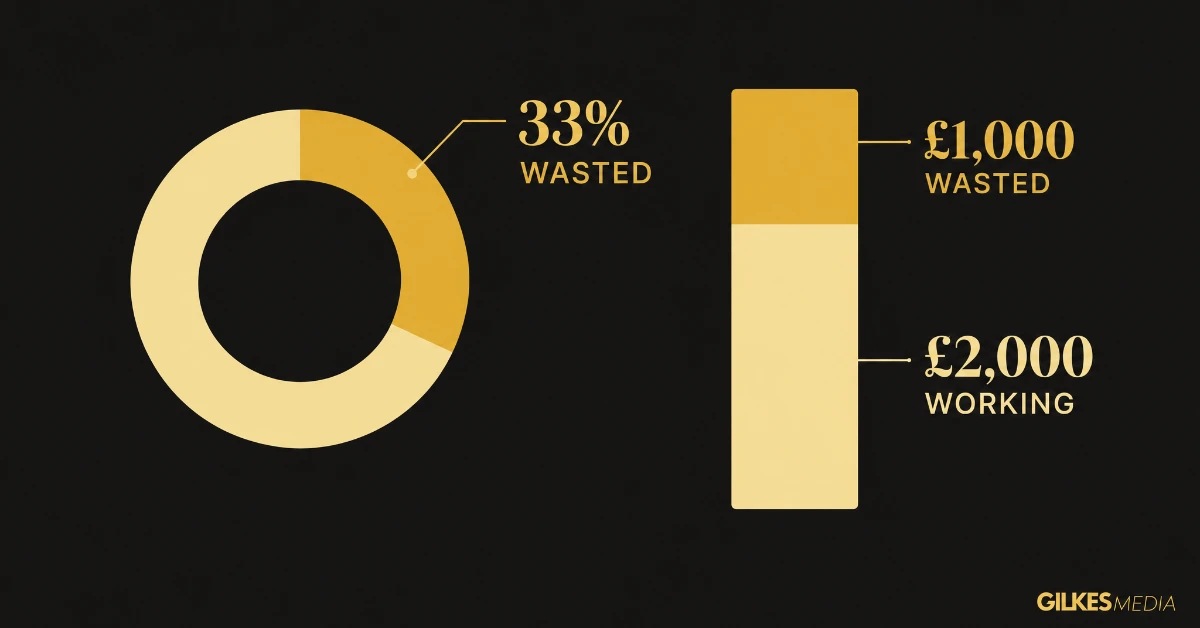
WordStream's Google Ads Performance Grader, which analysed 251,236 account assessments between January and November 2025 across more than 23 industries, found the average account wastes around $1,127 a month. That is roughly a third of a typical monthly budget, disappearing with nothing to show for it.
That figure comes from a large, international dataset rather than a UK-only survey, so treat the exact dollar amount as directional rather than gospel. The pattern behind it is the part worth paying attention to.
The same research found 29% of accounts recorded zero conversions over a 90-day period, despite averaging close to 12,667 impressions a month. Even among accounts spending more than $10,000 a month, 4% still converted nothing at all.
None of that shows up as an obvious problem day to day. The dashboard still shows clicks, impressions and a reasonable click-through rate. The only thing missing is the thing that actually matters, which is why so many businesses only find out once someone goes looking specifically for it.
Budget size is not the main driver either. The same study found accounts spending under $1,000 a month converted at 18.8% on average, against 14.2% for accounts spending over $10,000. Account discipline, not budget, is what separates a healthy account from a wasteful one.
Wasted spend in Google Ads rarely shows up as an obvious mistake. The clicks are real, the dashboard looks fine, and the account can run for months before anyone notices the conversions simply never caught up.
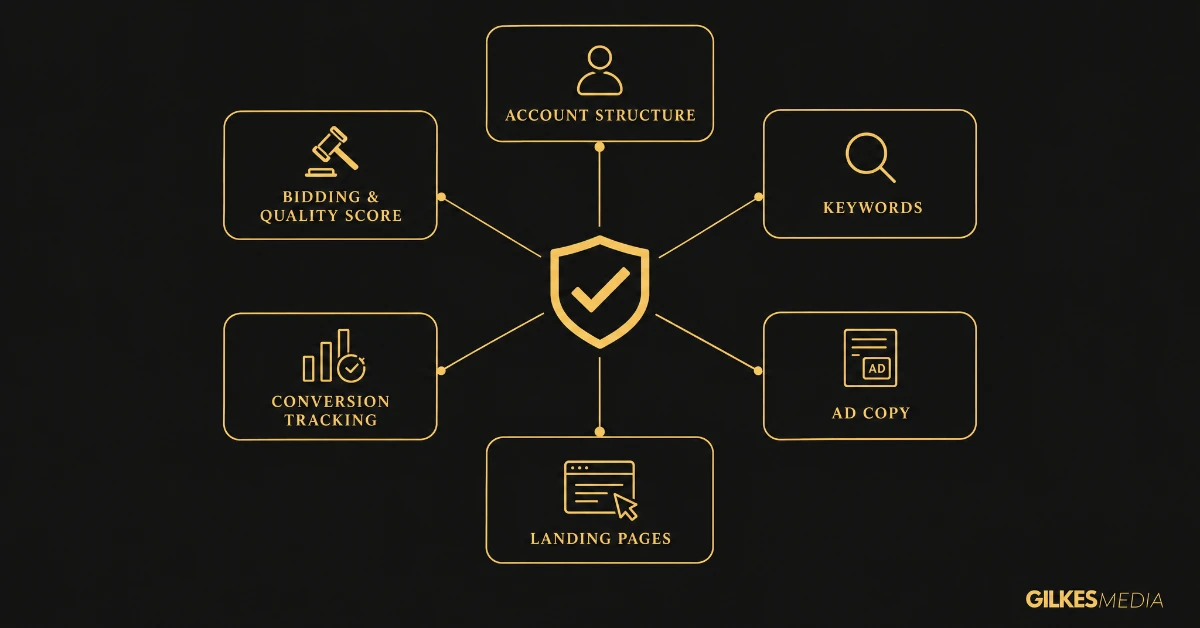
A genuine audit goes through the account methodically, not just a quick scroll through the campaigns tab. There are six areas worth checking properly, and a rushed audit usually skips at least two of them.
Search and Display campaigns should be kept separate, with their own budgets and bidding strategies. Combining them is one of the most common structural mistakes, and it quietly muddies performance data for both.
A proper audit checks whether ad groups carry too many keywords, a genuine warning sign once a single ad group passes around 50. It also checks whether Google's own automatic recommendations have been accepted blindly rather than reviewed one by one.
Account structure sounds dry, but it is the foundation everything else sits on. A messy structure makes every other problem on this list harder to spot and harder to fix.
This is where most of the wasted spend actually lives. WordStream's data found 25% of accounts audited had added no negative keywords at all, and the gap in results is substantial.
Accounts with at least one negative keyword list averaged a 13% conversion rate. Accounts with none averaged 4.6%. That is not a rounding difference, it is nearly three times the result from the same spend.
Impression volume tells a similar story. Accounts generating under 20,000 impressions a month converted at 4.1%, against 2.4% for accounts over 80,000. More impressions sounds like more opportunity, but it usually means broad match keywords are pulling in searches with no real buying intent.
An audit checks for duplicate keywords, conflicting match types, and search terms triggering ads in the wrong ad group. It should also flag any genuinely high-converting search terms that have never been added as their own keyword.
Every ad group should carry at least two or three active ads, so Google has something to test against. An audit flags any ad group running on a single ad, since there is nothing to compare it to and no way to know if it is the best available option.
Extensions, now called assets, matter more than most advertisers assume. Campaigns should use at least three types, typically sitelinks, callouts and structured snippets, each meeting a sensible minimum count. Ads with approved, well-used assets consistently earn a stronger click-through rate.
If any budget runs through Performance Max, an audit checks the asset groups carry real audience signals, that ad strength is acceptable, and that search term insights are being monitored. Performance Max can cannibalise an existing Search campaign if nobody is watching for the overlap.
An audit should click through to every unique landing page a campaign sends traffic to, not just the homepage, and check each one actually loads, uses HTTPS, and loads reasonably quickly on mobile.
Conversion tracking deserves the most scrutiny of anything on this list, because a broken or misconfigured tag does not throw an error. It simply under-reports results, which can make a genuinely working campaign look like it is failing, with nobody able to explain why.
A proper check confirms conversions are being counted correctly, that duplicate conversions are not being double-counted, and that the values assigned to each conversion action genuinely reflect what that action is worth to the business.
A slow mobile landing page is worth checking specifically rather than assuming desktop speed is good enough. Most Google Ads traffic now arrives on a phone, and a page that loads fine on an office broadband connection can still lose a meaningful share of visitors on mobile data before it finishes rendering.
WordStream's data put the average Quality Score across its sample between 5 and 6 out of 10, with 36% of accounts scoring below 4. Top-performing accounts in the same dataset used two to three times as many ad groups as the average, giving each one a tighter, more relevant set of keywords.
An audit checks whether your highest-spending keywords carry a Quality Score of 7 or above, and if not, which of the three sub-factors, landing page experience, expected click-through rate or ad relevance, is actually dragging it down.
It should also check search lost impression share due to budget, which estimates how many extra conversions a slightly higher daily budget would realistically generate on campaigns that are currently capped.
Google Ads surfaces a running list of "recommendations" inside every account, and some of them are genuinely useful. The problem is that Google benefits when you spend more, and a meaningful share of these suggestions push in that direction regardless of whether it suits your account.
An "optimisation score" close to 100% is sometimes treated as proof an account is healthy. It is not the same thing. The score mainly reflects how many of Google's own recommendations have been accepted, not whether those recommendations were actually right for your business.
A proper audit reviews every outstanding recommendation individually and accepts, rejects or adjusts it on its own merits, rather than treating a high optimisation score as a finished job.
A real audit works through account structure, keywords, ad copy, landing pages, conversion tracking and bidding in that order, because each layer affects the ones below it. Skip a layer and you are only ever treating a symptom.
A worked example makes this easier to picture than a percentage on its own. Our own guide to Google Ads cost in the UK puts a genuine, properly optimised lead generation budget at roughly £1,500 to £5,000 a month for most established UK businesses.
Take a business spending £3,000 a month, roughly the midpoint of that range. If that account is wasting a similar proportion to WordStream's global average, around a third of spend, that is close to £1,000 a month disappearing with nothing to show for it.
Over a year, that is roughly £12,000, more than enough to fund a proper audit many times over and still have budget left to fix what it finds. The audit itself is almost never the expensive part of this process.
Put another way, using the retail sector's typical cost per click of roughly £0.95 to £2.00 from our Google Ads Cost UK guide, £1,000 of wasted monthly spend is somewhere between 500 and 1,000 clicks a month that never had a realistic chance of converting in the first place.
Quality Score adds a second, compounding effect on top of that. Our Google Ads Cost UK guide notes that moving a keyword's Quality Score from a 5 to an 8 can lower its cost per click by a meaningful margin on exactly the same bid, simply because Google rewards relevance directly in the auction.
That means an audit which fixes both the wasted-spend problem and the Quality Score problem is not just removing a leak. It can genuinely reduce what you pay for every click that was already converting, which is a second saving on top of the first.
That is the real cost of skipping an audit. It is rarely one dramatic mistake. It is hundreds of small, invisible leaks that add up to a genuinely large number over twelve months.
Most UK agencies offer a free Google Ads audit, usually to businesses spending above a minimum threshold such as £1,000 a month. It is worth understanding what that free version is actually for before you request one.
A free audit is a sales tool as much as a genuine diagnostic, and there is nothing wrong with that as long as you go in understanding it. It is usually built to surface two or three clear, easy-to-explain problems quickly, enough to demonstrate value without giving away a full consultancy's worth of work for nothing.
That makes it genuinely useful as a first filter. If a free audit cannot find anything at all to flag in an account that has never been reviewed, that is itself worth noticing, since genuinely clean accounts are the exception rather than the rule.
The minimum spend threshold for a free audit varies by agency, but £1,000 to £2,000 a month in ad spend is a common starting point. Below that, most agencies cannot justify the time without some expectation of winning the account afterwards.
A paid, standalone audit goes considerably deeper. It should produce a genuinely prioritised list of fixes, ranked by expected impact against effort, rather than a handful of headline problems picked because they are easy to pitch.
It should also come with no obligation to hire the agency that produced it. A genuine paid audit is a standalone deliverable you can hand to any agency, or action yourself, and that independence is exactly what you are paying for.
If an agency will only share the full findings once you sign a management contract, that is not really a paid audit. It is a free audit with a price tag attached to create urgency.
There is no single published UK survey of audit pricing specifically, so the figures below are worked out from the day rates UK PPC specialists actually charge, typically £75 to £150 an hour according to pricing research across UK agencies, applied to the hours a thorough audit genuinely takes.
A single, well-structured Google Ads account takes a competent specialist somewhere between four and ten hours to audit properly against every item in the previous section. A messier account, or one running several campaign types at once, takes longer.
| Audit type | Typical UK price | What you should actually get |
|---|---|---|
| Free agency audit | £0 (often requires £1,000+/month ad spend) | Two or three headline issues, used as a sales tool rather than a full review |
| Paid one-off audit, single platform | £300 – £900 | Full checklist review, prioritised fix list, no obligation to hire |
| Paid one-off audit, multiple platforms (e.g. Google + Meta) | £800 – £1,500+ | Same depth of review repeated across every platform audited |
| Audit bundled into a new management contract | Usually included in month one | Useful, but less independent, since the same agency benefits from whatever it finds |
Treat any audit quoted well above £1,500 for a single, straightforward account with some suspicion, in the same way our guide to choosing a PPC agency flags unusually high setup fees as a red flag worth questioning before you sign anything.
Equally, treat a quote that feels too low with some caution. A genuinely thorough audit against every item on the checklist above takes real hours from someone who knows what they are looking for, and that time has to be paid for somewhere.
A sensible way to sanity-check any quote is to ask exactly how many hours it covers and what the audit's deliverable actually looks like. A genuine report runs to several pages with specific findings, not a single-screen summary with three bullet points and a call to action.

Not every audit is worth the paper, or the PDF, it is written on. A handful of warning signs crop up often enough to be worth watching for specifically.
If any of this feels familiar from an agency you are already working with, it is worth reading our guide on when it is time to switch marketing agencies, which covers the wider warning signs beyond just the audit itself.
A genuine audit names your actual campaigns and your actual numbers. If a report reads like it could be dropped into any Google Ads account with the company name swapped out, it probably was.
A checklist of settings and keywords catches most problems, but not all of them. Click fraud sits outside the usual checklist entirely, because the clicks it generates look completely genuine in the account.
Independent research puts the average invalid click rate across all industries at around 11.5%, rising to 18.3% in retail and 14.7% in legal services, two sectors with a high enough value per lead to make fraudulent clicks worth generating.
Google's own filters catch most of this automatically, but an estimated 5.8% of invalid clicks still slip through and get billed regardless. A proper audit checks for the specific warning signs of this rather than assuming Google's protection has already handled it.
Our full guide to click fraud in Google Ads covers the specific warning signs and the practical fixes in detail, including how to tell fraud apart from a genuine rise in competition.
Once you have a genuine audit in hand, the next decision is who actually fixes it. Both routes are realistic, depending on how much time your team genuinely has and how complex the findings turn out to be.
Fixing it yourself makes sense when the findings are mostly structural or settings-based, things like missing negative keywords, an uneven split between ad groups, or extensions that were never set up properly. None of that needs specialist tools, just time and attention.
Handing it to an agency makes more sense when the findings touch conversion tracking, bidding strategy, or Quality Score across dozens of keywords at once, since fixing those properly tends to need ongoing attention rather than a single afternoon of changes.
A sensible middle ground many UK businesses land on is fixing the free, structural issues themselves immediately, then bringing in a specialist specifically for the parts of the fix list that need ongoing monitoring rather than a one-off change.
In-house time is not free, even though it does not show up on an invoice. A marketing manager spending a genuine day a week keeping an account properly maintained is a day a week not spent on anything else the business needs from them.
Our guide to choosing a PPC agency covers this comparison properly, but as a rough rule, an account under around £3,000 a month in spend rarely justifies a full-time or even part-time in-house hire once salary, training and tool costs are counted honestly.
A single audit fixes the problems that exist on the day it is run. It does nothing about the ones that creep in over the following six months, which is exactly how most accounts ended up needing an audit in the first place.
A full audit every six to twelve months is a sensible baseline for most accounts, with a lighter monthly check on the handful of items most likely to drift: negative keywords, conversion tracking, and Quality Score on the highest-spending terms.
Businesses going through a website redesign, a tracking platform change, or a significant budget increase should treat that moment as a trigger for an extra audit outside the usual schedule, since all three are common points where conversion tracking quietly breaks.
Seasonal businesses have an extra reason to audit twice a year rather than once. A set of negative keywords and bids tuned for a busy pre-Christmas period can actively hurt performance once that period ends, if nobody adjusts them back down.
An audit is a snapshot, not a cure. The account that needed fixing in January can drift back into the same state by autumn if nobody is checking in between.
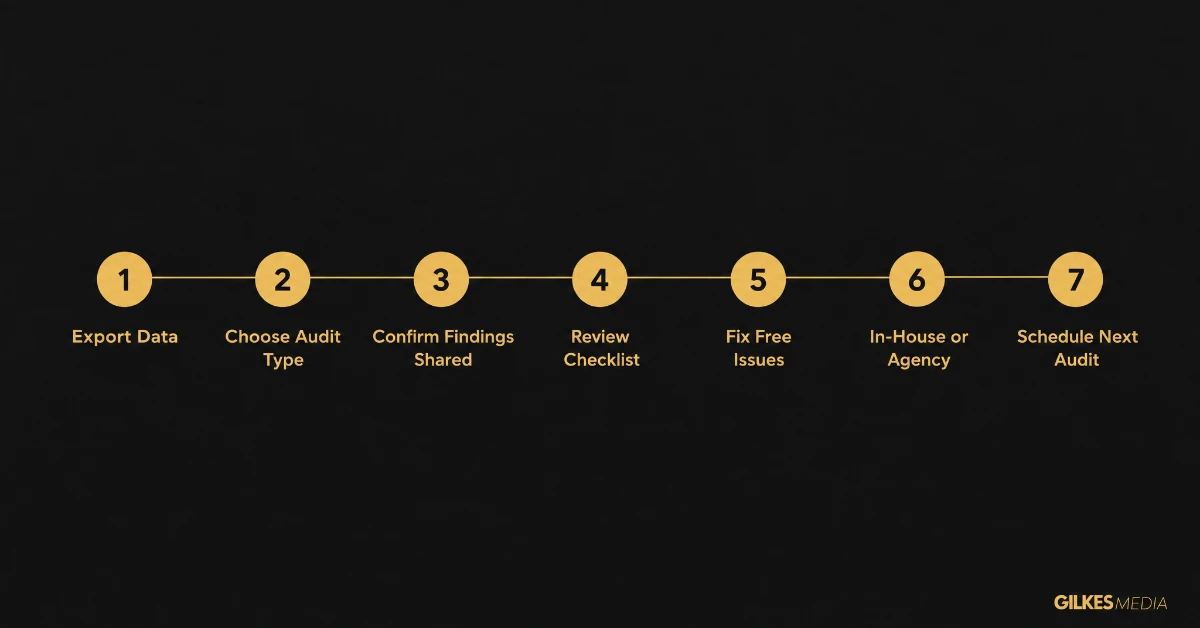
Whether you book a free audit, a paid one, or work through the checklist yourself, following a sensible order gets you a usable answer rather than a pile of disconnected observations.
If you would rather have someone who already knows the current UK benchmarks run the audit and action the findings, that is exactly the kind of work our paid ads management team does day to day.
We manage Google, Meta, LinkedIn and TikTok accounts for clients across the UK, and a proper audit is always the first thing we do before recommending a single change to an existing account.
That order matters. Recommending a bigger budget or a new campaign type before fixing the structural problems underneath it just means the same waste happens at a larger scale, which helps nobody but the platform collecting the extra spend.
You can get in touch via our contact page for a free, no-obligation discovery call if you would like a second opinion on what your own account is actually doing with your budget.
If Google Ads is only one part of a wider paid strategy, our guide to Google Ads for lead generation and our breakdown of cost per lead in the UK are both worth reading alongside this one.
A proper audit checks account structure, keywords and negative keywords, ad copy and extensions, landing pages, conversion tracking, and bidding and Quality Score.
It should name specific campaigns and numbers from your own account rather than giving generic advice.
A paid, one-off audit on a single platform typically runs £300 to £900, rising to £800 to £1,500 or more if several platforms are audited together.
Many UK agencies also offer a free audit, usually to businesses spending above a minimum monthly budget.
It is both. A free audit is a genuine sales tool, but it can still be a useful first filter, since most accounts that have never been reviewed do have real issues to flag.
Treat it as a starting point rather than a full review.
If it has been more than six months since the last proper review, if cost per lead has drifted upward with no obvious explanation, or if nobody can tell you your current Quality Score, it is worth auditing.
Global research from WordStream's Performance Grader found the average account wastes around a third of its monthly budget, though this varies significantly by account and is not a UK-specific figure.
Yes, for the structural and settings-based findings, such as missing negative keywords or uneven ad groups. Findings involving conversion tracking, bidding strategy or Quality Score across many keywords usually benefit from specialist attention.
A full audit every six to twelve months is a sensible baseline, with a lighter monthly check on negative keywords, conversion tracking and Quality Score in between.
No. A genuine paid audit is a standalone deliverable with no obligation attached. You can action the findings yourself, hand them to your existing agency, or use them to decide whether it is time to switch.
