A proper marketing strategy for your small business isn’t about doing everything. It’s about doing the right things exceptionally well. It’s a focused, practical plan that stops you wasting money and starts turning your marketing spend into a reliable engine for leads, sales, and genuine growth.
Trying to market a small business in the UK can feel like a constant battle. You are juggling cash flow, you never have enough time, and there are a dozen other things demanding your attention. Every pound you spend has to count.
This means that focus is not just a nice-to-have; it is absolutely essential for survival.
Too many business owners get pulled into the trap of thinking they need to be on every social media platform, run complex ad campaigns, and churn out endless content. This is a fast track to burnout and wasted money, pulling you away from the activities that actually move the needle.
This guide is designed to get you away from that overwhelming "do everything" mindset. The core principle I have seen deliver results for my clients time and again is simple: figure out the handful of high-impact activities that connect you directly with your ideal customer, then execute them with absolute consistency.
It is about making deliberate choices based on commercial reality. For instance, a local plumbing company will get a far better return mastering Local SEO and Google Ads than trying to build a following on TikTok. On the other hand, a B2B software startup is much better off focusing its energy on LinkedIn and targeted content marketing.
The goal is to build a marketing engine, not a list of marketing chores. An effective strategy makes sure your limited time and budget are invested only in channels that reliably generate qualified leads and measurable sales.
Throughout this guide, we are going to build a clear, no-nonsense blueprint for that engine. We will skip the abstract theory and focus entirely on practical application, giving you the tools to create a plan that works for your specific business.
This is about turning marketing from a confusing cost centre into your most predictable and powerful growth driver. Consider this your roadmap, built on years of hands-on experience and the realities faced by businesses just like yours. Together, we will build a marketing strategy for your small business that delivers real, bottom-line results.
Before a single pound is spent on ads, we need to get the commercial foundations right. An effective marketing strategy is not built on guesswork; it is built on a crystal-clear understanding of who you serve, what makes you different, and exactly what you are trying to achieve.
Think of this as your commercial blueprint.
Without this clarity, you risk wasting your entire budget talking to the wrong people with the wrong message. It is the most common and costly mistake I see small businesses make. Let’s get it right from the start.
First, let's ditch the vague idea of a "target audience" and create a detailed Ideal Customer Profile (ICP). This is not just about demographics. It is about identifying the specific type of customer who gets the most value from your service and, in turn, is most valuable to your business.
Think about your best-ever clients. What did they have in common?
Answering these questions gives you a laser-focused profile. You will know exactly who you are selling to, which makes every marketing decision that follows simpler and far more effective.
Next, we need business objectives, not fluffy marketing metrics. Forget about "increasing brand awareness" for now. We need goals tied directly to revenue and growth.
Your objectives must be SMART: Specific, Measurable, Achievable, Relevant, and Time-bound.
For instance, instead of a vague goal like "get more leads," a SMART objective sounds like this:
"Generate 15 qualified sales leads per month from Google Ads within the next 90 days, at a Cost Per Lead of under £75."
This gives you a clear target to aim for and a benchmark to measure your performance against. It forces discipline and ensures your marketing is directly accountable for driving commercial results. This focus on ROI is essential, especially as 63% of UK companies are increasing their digital marketing budgets.
To give you a real-world benchmark, here’s how budget allocation typically breaks down for SMEs in the UK, based on the national average spend of 7.7% of revenue on marketing.
| Annual Revenue | Recommended Marketing Spend (7.7%) | Example Monthly Budget (£) |
|---|---|---|
| £250,000 | £19,250 | £1,604 |
| £500,000 | £38,500 | £3,208 |
| £750,000 | £57,750 | £4,812 |
| £1,000,000 | £77,000 | £6,416 |
This table is not a strict rule, but it provides a solid starting point for planning your investment and reinforces why every pound needs to be tracked against a commercial objective.
Finally, you need to know exactly where you fit in the market. This does not require a huge spreadsheet. Instead, just answer three simple but powerful questions:
Your USP is the heart of all your messaging. It is not just what you do; it is why a client should choose you over anyone else. As you start putting these pieces together, you might find this practical guide on how to advertise your small business useful for setting initial goals.
By defining your ICP, setting commercial goals, and mapping your market position, you create a simple one-page strategic brief. This document becomes your north star, ensuring every marketing decision is deliberate, focused, and directly supports the growth of your business.
Once you have your commercial blueprint sorted, it is time to decide where to put your marketing budget. This is the exact spot where so many small businesses trip up. They develop marketing FOMO and try to be everywhere at once, stretching their limited cash and energy so thin that nothing really works.
The secret to a marketing strategy that actually moves the needle is focus. It is about ditching the ‘spray and pray’ method and picking one or two core channels to truly master. Having personally managed over £3,000,000 in ad spend, I can tell you this with absolute certainty: a well-executed campaign on one right channel will always beat a sloppy, scattered effort across five.
Let's break down the main digital channels from a practical, ROI-first point of view.
When someone knows they have a problem and is actively hunting for a solution, they have high intent. Your only job is to show up as the first and most credible solution they find. This is where high-intent channels are extremely valuable.
For a local service business, say an electrician or a roofing contractor, a combination of Local SEO and a tightly targeted Google Ads campaign is almost always the most profitable place to start. You are getting in front of people in your service area who need your help right now.
Not everyone is ready to buy today. Awareness channels let you introduce your business to your ideal customer before they even realise they need you, building essential familiarity and trust for when the time comes.
A B2B consultancy, for instance, will get far better results from a blend of LinkedIn advertising and in-depth SEO content than they ever would from local service ads. Their sales cycle is longer; they need to build authority and educate their market. When it comes to building that authority, understanding effective video marketing for small businesses can provide a serious competitive edge.
To stop yourself from getting overwhelmed, use this simple framework. It will help you make a confident decision and stick to it. The goal is to master just one or two channels that perfectly match your business model and how your customers behave.
| Channel Type | Primary Goal | Best For Businesses That... |
|---|---|---|
| High-Intent | Generate immediate leads from active searchers. | Solve an urgent or specific, known problem. |
| Awareness | Create demand and build an audience. | Have a longer sales cycle or sell a new concept. |
| Retention | Nurture relationships and drive repeat business. | Have an existing customer base to re-engage. |
The most common mistake I see is businesses chasing the latest shiny object. The best channels are not the newest or the trendiest; they are the ones where your ideal customers are either actively looking for what you sell or are most open to hearing your message.
By starting with a focused approach, you give yourself the best chance of learning, optimising, and actually getting a positive return. Once you have mastered one channel and it is delivering predictable results, you can then strategically reinvest those profits to expand into a second. This methodical, disciplined approach is the foundation of a durable marketing strategy.
A great strategy is useless without execution. This is where the theory stops and the real work of growing your business begins. To make this tangible, let's break down your initial marketing push into a manageable 90-day action plan, split into three distinct phases.
This phased approach stops you from getting overwhelmed and focuses your energy where it matters most at each stage. It is all about building momentum through methodical, results-driven action from the very first day.
The first month is all about getting the essential groundwork in place. We are not aiming for massive sales targets just yet. Instead, we are launching a small, controlled campaign to start gathering real-world data. The goal is to prove the concept and make sure your measurement systems are working correctly.
Your absolute priorities for this phase are:
With 30 days of data under your belt, you now have a foundation to build upon. The next 60 days are dedicated to optimising what is working and methodically increasing your investment. This is where you start turning those early insights into a more predictable lead-generation engine.
Your focus shifts from setup to performance improvement. This means digging into your pilot campaign data to identify the best-performing ads, keywords, or audiences. You then reallocate your budget to double down on these winners while pausing the elements that did not deliver.
This diagram shows a simplified flow for deciding where to focus your efforts across the main channel types.
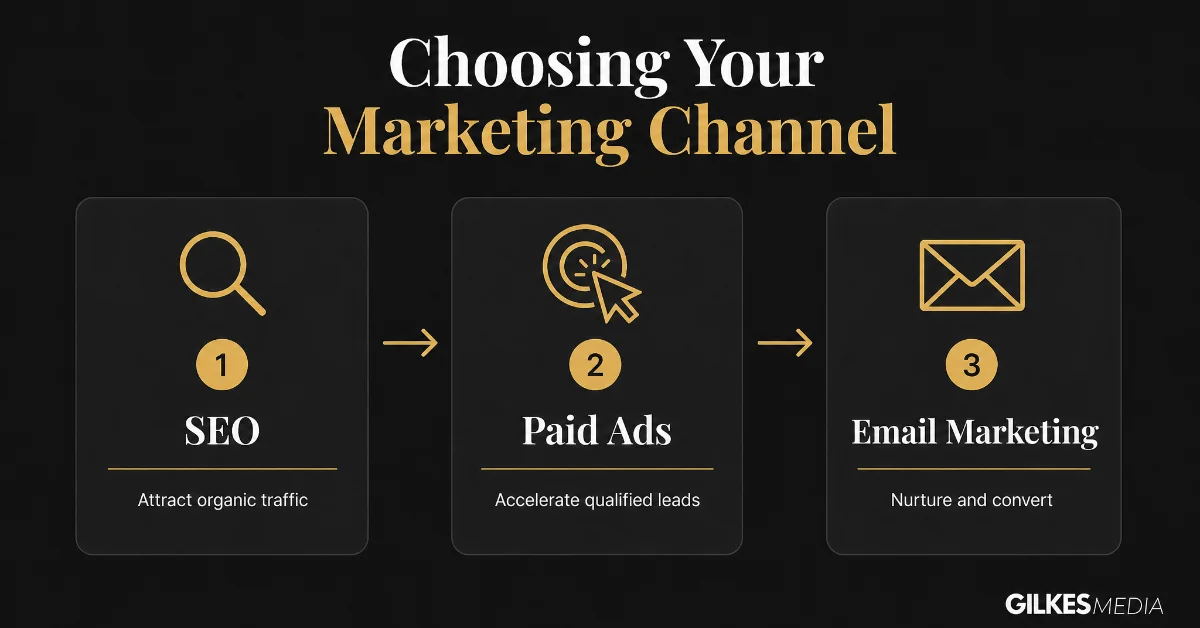
This visualises the path from building long-term organic assets with SEO, to capturing immediate demand with paid ads, and finally nurturing those prospects through email.
This is also the perfect time to explore efficiency gains. As your lead volume starts to increase, you can look into marketing automation for your small business to handle follow-ups and nurture leads without adding to your manual workload.
Your goal by day 90 is not perfection; it is predictability. You should have a clear understanding of what a lead costs from your chosen channel and a system that can be scaled up or down based on your business's capacity.
To help you stay on track, here is a simple framework for your 90-day sprint. It breaks down the entire process into clear, manageable chunks.
This table provides a clear, actionable plan, breaking down your marketing activities into manageable phases. The aim is to ensure focused execution and measurable progress every step of the way.
| Phase | Primary Focus | Key Actions | Success Metric |
|---|---|---|---|
| Days 1-30 | Foundation & Testing | Install analytics, set up tracking, launch a small test campaign. | Accurate data collection & baseline CPL. |
| Days 31-60 | Optimisation | Analyse test data, pause underperformers, reallocate budget to winners. | A 15-20% reduction in your Cost Per Lead. |
| Days 61-90 | Scaling | Methodically increase spend on proven campaigns, forecast lead volume. | A predictable and consistent flow of leads. |
This structured plan transforms your marketing strategy from a document on a shelf into a living, breathing process. It creates a rhythm of execution, measurement, and improvement that builds sustainable growth over time.
Once your marketing plan is in motion, it is easy to get lost in a sea of data. Clicks, impressions, and follower counts can feel productive, but they often do not tell you the full story.
These are what we call 'vanity metrics'. They look good on paper but do not directly tell you if you are making money. An effective marketing strategy for small businesses cuts through this noise to focus only on the key performance indicators (KPIs) that directly impact your bottom line.
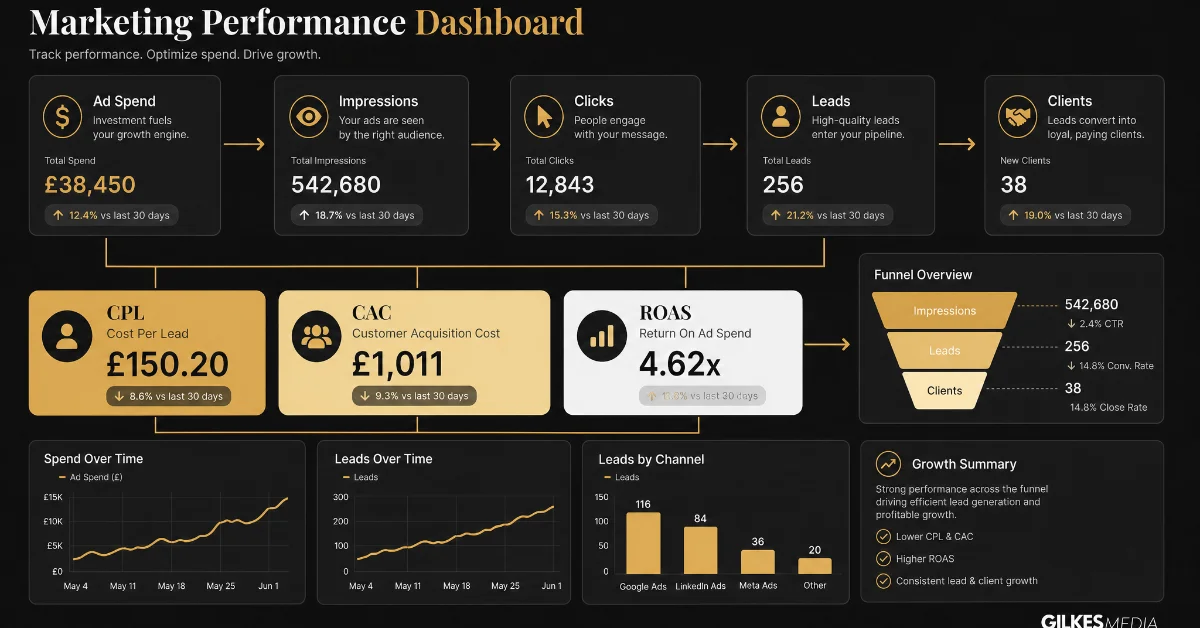
This is not about becoming a data scientist. It is about building a simple, powerful feedback loop where real performance data informs your next strategic move. It is how you prove the commercial value of every pound spent.
To measure what truly matters, we need to move beyond campaign metrics and focus on core business KPIs. For any small business serious about growth, these three are non-negotiable. They connect your marketing spend directly to customer acquisition and revenue.
These metrics transform marketing from a cost into an investment. When you know your CAC is £200 and a new customer is worth £2,000 over their lifetime, you can confidently invest in your campaigns knowing the return is there.
You do not need complicated software to track these numbers. A simple spreadsheet or a basic dashboard in Google Analytics is all you need to get started. The key is to review it consistently, ideally weekly, to make informed decisions.
Your dashboard should answer three fundamental questions at a glance:
This discipline forces accountability. It stops you from throwing money at channels that are not working and empowers you to double down on the ones that are. Our guide on how to measure marketing ROI provides a more detailed framework for setting this up.
As you gather data, protecting it is paramount. With 87% of small businesses now operating a website and 70% using online marketing, secure digital assets are non-negotiable.
This is especially true when your marketing generates leads containing sensitive customer information. Cybersecurity is a major hurdle; 58% of small businesses suffered a cyber-attack in the past year, making data protection a critical component of a trustworthy marketing strategy. You can discover more insights about the IT challenges facing UK SMEs on Confidence IT.
The purpose of measurement is not just to report on the past, but to improve the future. Every metric you track should lead to a clear action. If your CPL is too high, you either need to improve your ad creative, refine your targeting, or optimise your landing page.
By focusing on these commercially-driven KPIs, you create a marketing function that is accountable, predictable, and directly tied to the financial health of your business. This is how you build a sustainable engine for growth.
We have walked through the core building blocks of a marketing strategy that actually drives commercial results. From zeroing in on your ideal customer to measuring what truly matters, a winning plan always comes down to the disciplined, consistent execution of these fundamentals.
The goal is to stop treating marketing as a confusing cost centre and transform it into your primary engine for business growth.
The next logical step is to take these principles and apply them directly to your own business. This final section gives you a clear, no-nonsense checklist to help you move forward with confidence and start building real momentum.
Use these points as your guide to turn strategy into action. This is not about trying to do everything at once; it is about taking methodical, intelligent steps forward.
A great strategy is simply a series of smart decisions, executed consistently over time. Focus on getting the foundations right, and the results will follow. This focused approach is the most reliable path to building a sustainable growth engine for your business.
As a senior marketing consultant and paid ads specialist, I provide expert, hands-on guidance to build focused plans that get results. If you are looking for personal involvement and a performance-driven strategy to achieve your commercial goals, we can schedule a no-obligation consultation.
If you're still deciding how many channels to run at once, our guide to omni-channel vs multi-channel marketing covers that trade-off directly, and our guide to building a go-to-market strategy template is a practical next step once your strategy's in place. If your business has outgrown the small-business playbook, our wider guide to creating a marketing strategy covers the fuller framework.
Over the years, I have heard the same handful of questions from business owners trying to get their marketing right. Here are some straight, no-nonsense answers to the most common ones.
For most UK SMEs, a sensible starting point is to allocate 5-10% of your total revenue to marketing. If you are a new business or you are pushing for aggressive growth, you will want to be at the higher end of that range.
The most important part is to start with a budget you can genuinely commit to for at least three to six months. Marketing is not a tap you can turn on and off. It needs time to gather data, build momentum, and start showing a real return. Pulling the plug too early is one of the most common mistakes I see.
If you need speed, paid advertising channels like Google Ads or Meta Ads are almost always the answer. The moment your campaign goes live, you can start generating traffic, phone calls, or form fills. It is immediate.
However, you have to be careful not to confuse 'fast' with 'profitable' or 'sustainable'. While paid ads give you that instant impact, SEO is the long game. It is an investment that builds a valuable, long-term asset for your business. Ranking organically in Google often leads to a much lower cost per lead over time, but it demands patience and consistent effort.
Simple: stop focusing on vanity metrics and start tracking business metrics. Clicks, impressions, and likes feel good, but they do not pay the bills. The only numbers that truly matter are the ones tied directly to your bottom line.
Your marketing is working if the money you put in generates more money coming out. It is that straightforward.
You need to become obsessed with tracking these three KPIs:
If these numbers are heading in the right direction and you can see a clear, positive return on what you are spending, your marketing strategy for your small business is doing its job perfectly.
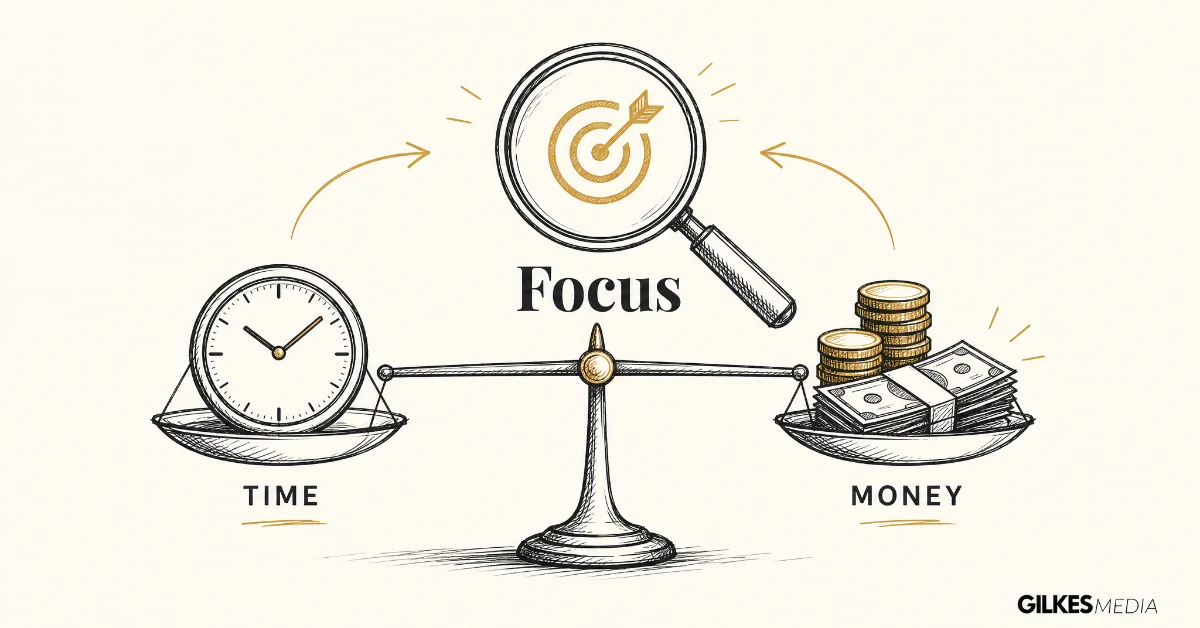
This decision really boils down to a classic trade-off: your time versus your money.
If you have more time than cash, I strongly recommend getting your hands dirty and managing one channel yourself to begin with. The understanding you will gain from that hands-on experience is incredibly valuable and will serve you well forever.
On the other hand, if you have more money than time and your main priority is to scale lead generation quickly, bringing in a specialist consultant or a small, focused agency is the smarter move. It gives you immediate access to expert knowledge and frees you up to do what you do best which is run the business.
At Gilkes Media, I work one-on-one with business owners to build and run practical marketing strategies that are all about results. If you are looking for hands-on, expert support and an accountable partner to help you grow, let's talk. You can find out more and book a free consultation at https://gilkesmedia.co.uk.
