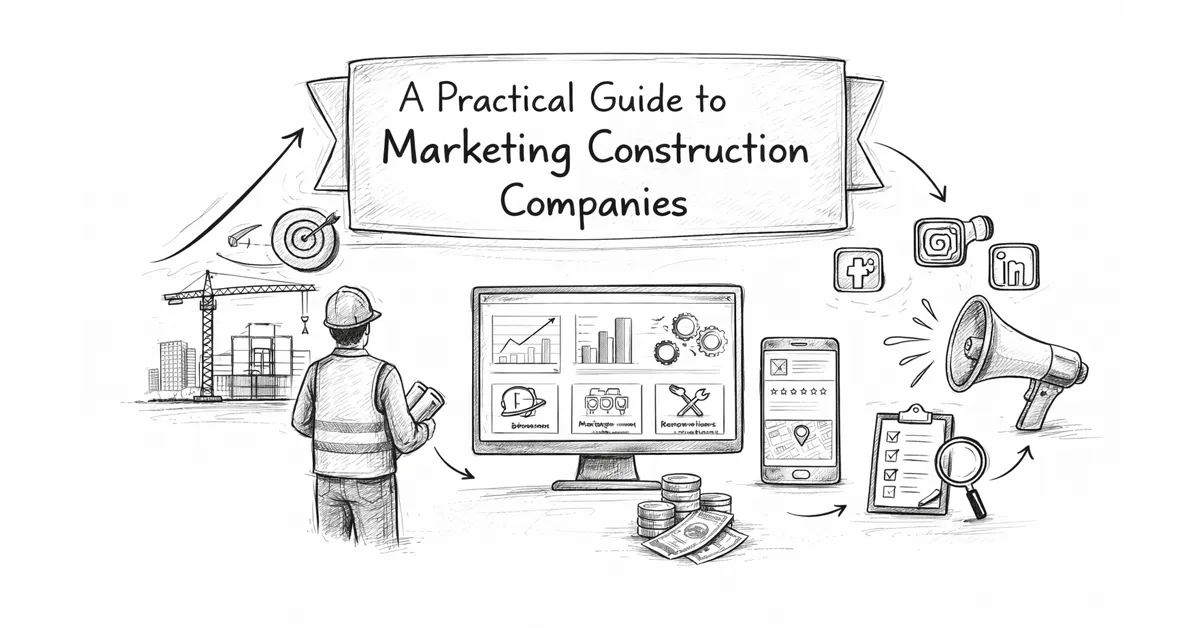
Effective marketing for construction companies is not a luxury. It is the engine that drives your project pipeline and fuels real commercial growth. It is the system that turns a vague awareness of your brand into qualified enquiries and, ultimately, profitable contracts.
Without a clear strategy, you are stuck relying on sporadic referrals and forced to compete on price. This is a reactive way to run a business in a very crowded market.
Relying purely on word-of-mouth is a vulnerable position. A proactive marketing strategy puts you back in control, letting you target the specific, high-value projects you want, instead of just taking what comes your way. It is about building a predictable, reliable system for generating leads.
This shift in mindset is essential. In the UK, the construction sector is forecast to hit £212 billion by 2025, driven largely by the relentless demand for housing. With over 57,000 residential building firms all chasing a piece of that pie, just being good at your job is no longer enough to guarantee a full order book.
A smart approach to marketing, especially digital marketing, is what separates the firms that thrive from those that just about survive. You can get more detail from this construction market report.
Too many construction leaders still see marketing as a cost. The correct way to view it is as a direct investment in revenue. Every pound you spend should be accountable and aimed at delivering a clear return. It is time to move beyond vague ideas of ‘getting your name out there’ and focus on tangible, measurable outcomes.
Here is a snapshot of the essential marketing activities that drive growth for construction firms, along with their objectives and how we measure success.
| Marketing Channel | Primary Objective | Key Performance Indicator (KPI) |
|---|---|---|
| Website & SEO | Generate consistent, inbound organic enquiries | Number of qualified leads from search |
| Paid Search (Google Ads) | Capture immediate demand from active buyers | Cost Per Qualified Lead (CPQL) |
| Case Studies & Content | Build trust and demonstrate expertise | Time on Page, Download Rate |
| Local SEO (GBP) | Dominate local search for regional services | Phone Calls, Direction Requests |
| Partnership & Referrals | Secure high-value projects via trusted networks | Number of Referred Tenders |
This table shows that each channel has a distinct role. A strong marketing plan integrates these pillars to create a system where each part supports the others, turning marketing from an expense into a powerful growth engine.
So, what should your key commercial objectives be?
This simple visual breaks down the process of turning marketing activity into commercial results.
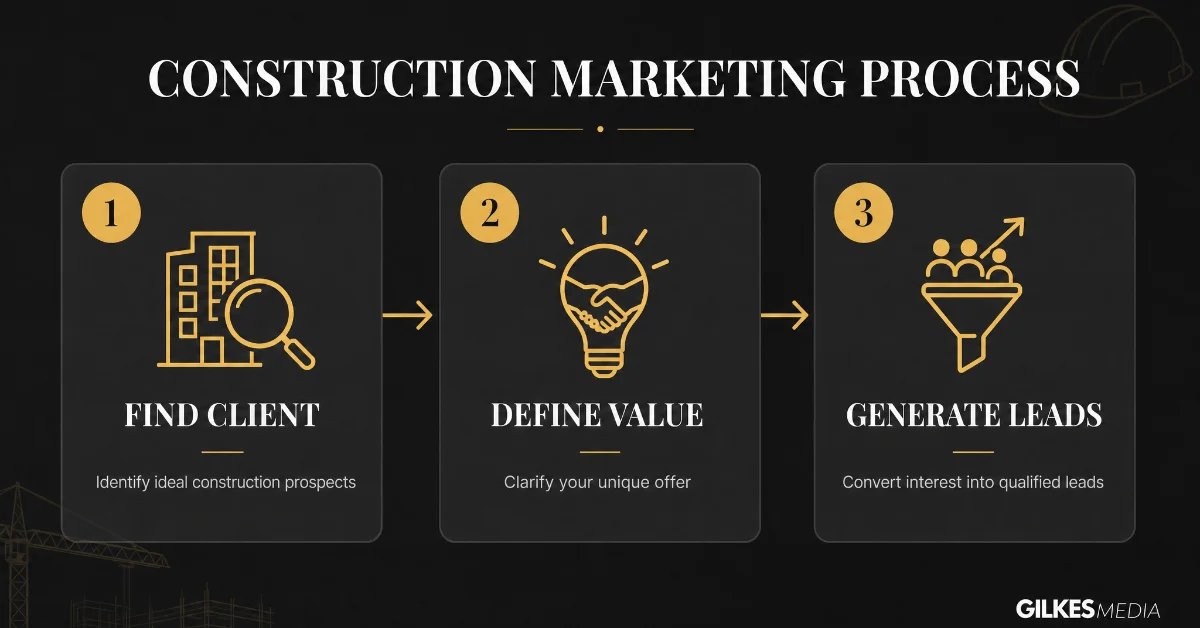
It all starts with a deep understanding of your ideal client. That insight then shapes how you define your value, and only then do you decide how to generate the leads.
Before you spend a single pound on ads or SEO, you must define what success looks like for your business.
Is your goal to secure three more commercial fit-out projects worth over £500k each quarter? Or is it to become the go-to firm for high-end residential extensions in Surrey? Be specific.
Your marketing strategy must be built backwards from your business goals. A clear commercial objective provides the focus needed to allocate your budget effectively and measure what truly matters.
Once you have defined these targets, every marketing decision becomes simpler. You know exactly who you need to reach and what message will resonate with them. This clarity is the bedrock of a marketing plan that delivers a tangible return. For a deeper dive, read our guide on how to measure marketing ROI.
Different roles within the construction buying process are measured by different yardsticks. Your marketing absolutely must acknowledge these distinct priorities to have any impact.
The table below breaks down a few of the most common personas you will encounter. While these are a great starting point, it is crucial to develop these further for your specific niche and service offering.
| Buyer Persona | Primary Goal | Key Challenge |
|---|---|---|
| Procurement Manager | Reduce project risk and secure reliable supply chains at a competitive price. | Avoiding supplier failure, project delays, and budget overruns. |
| Property Developer | Maximise the return on investment (ROI) for the entire project. | Managing tight budgets and timelines to ensure profitability. |
| Architect/Specifier | Ensure materials and services meet design, quality, and compliance standards. | Sourcing innovative, reliable materials that fit the creative vision and regulations. |
| Site Manager | Maintain project schedule and ensure on-site efficiency and safety. | Coordinating trades, managing logistics, and avoiding costly downtime. |
Understanding this matrix is the bedrock of a commercially focused marketing strategy. For instance, your Google Ads copy targeting a Procurement Manager should scream reliability and proven track records. In contrast, content aimed at a Property Developer must focus squarely on efficiency, cost-effectiveness, and ROI.
This targeted approach ensures your marketing spend works harder, connecting you directly with the people who hold the authority and the budget to sign contracts. It is the difference between shouting into a crowded room and having a direct, persuasive conversation with your ideal client.
Your website is your single most important digital asset. Let us be clear: it is not an online brochure. It is your 24/7 sales engine, built to attract, convince, and convert your ideal clients.
A poorly structured website leaks potential revenue. But a strategically built one becomes a predictable, reliable source of high-quality leads.
The goal is to move visitors from browsing to actively getting in touch as efficiently as possible. This demands a ruthless focus on clarity, proof, and user experience. Every page, image, and sentence must serve a commercial purpose. Nailing this digital blueprint is critical. For a wider view, a good guide to mastering lead generation online offers solid principles that translate perfectly to the construction sector.
Forget trends and flashy features for a moment. A construction website that generates business is built on three core pillars. Get these right, and you have taken the most important step in turning your site into a lead machine.
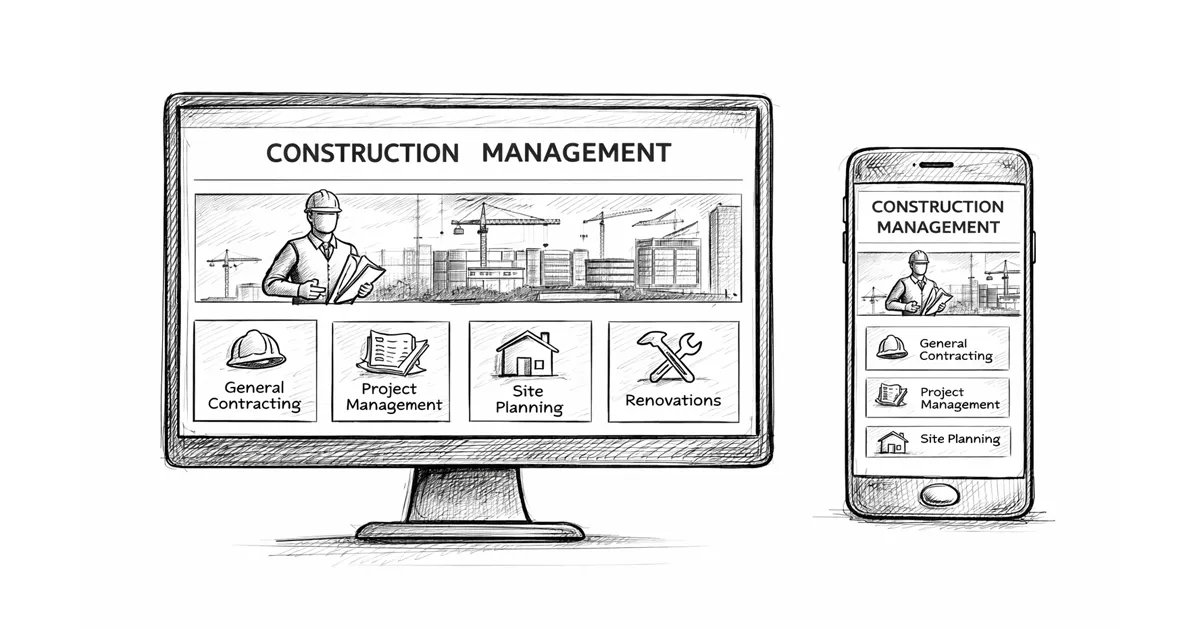
Clear Service Pages: A potential client must know instantly what you do and who you do it for. Vague descriptions like "building services" are useless. You need dedicated pages for each core offering, such as 'Commercial Fit-Outs', 'New Build Homes', or 'Loft Conversions'. Each page must detail your process, showcase relevant expertise, and answer the specific questions a client for that service will have.
High-Quality Project Galleries: In construction, seeing is believing. Your project portfolio is your most powerful sales tool. Do not just dump a random collection of images online. Curate them. Turn them into compelling case studies with high-resolution photos and concise descriptions that explain the project's scope, the challenges you overcame, and the successful outcome.
Prominent Calls-to-Action (CTAs): Never make a potential client hunt for your contact details. Your phone number needs to be visible at the top of every page. Enquiry forms should be simple and placed where a user would expect them. Use clear, direct language like "Request a Consultation" or "Get a Project Estimate" to guide visitors towards the next logical step.
A brilliant website is worthless if nobody can find it. Search Engine Optimisation (SEO) is the process of making your site visible when potential clients search on Google for the services you offer.
For construction companies, this almost always comes down to mastering local and service-specific keywords.
Your ideal client is not typing "construction company" into Google. They are searching for solutions to their problems, using phrases like:
These are high-intent keywords. They signal a user is actively looking to hire someone. Ranking for these terms puts your business directly in front of motivated buyers at the exact moment they need you. This is the heart of effective marketing for construction companies today.
The objective of SEO is not just to attract traffic; it is to attract the right traffic. Ranking for a term like 'how much does a brick cost' might get you visitors, but ranking for 'commercial refurbishment contractors London' will get you leads.
SEO can feel complicated, but a few core activities deliver the vast majority of results.
First, make sure your website is technically sound. It needs to be fast-loading, mobile-friendly, and secure. From there, it is all about content and authority. This means creating service pages and blog posts that are genuinely helpful and built around the keywords your clients are using.
At Gilkes Media, we know a strong technical foundation is paramount. As a hands-on consultant, I personally ensure your site structure is built for performance. You can see our approach to SEO website development and how it connects directly to lead generation. The right structure ensures that every piece of content you create has the best possible chance to rank and bring in new business.
While SEO is your long game for building a rock-solid organic presence, sometimes you just need to get the phone ringing now. That is where paid advertising comes in.
Platforms like Google Ads and LinkedIn offer the most direct, controllable way to generate high-quality enquiries for your construction business, fast. It is about putting your services right in front of clients at the exact moment they are looking for a solution.
Unlike organic marketing, which can take months to build momentum, paid ads deliver speed and precision. You can launch a campaign and start seeing calls and form submissions within days. This makes it an essential tool for pushing specific services, breaking into new geographical areas, or capitalising on a sudden market opportunity. The key is to treat it as a strategic investment, with a ruthless focus on measurable returns.
Not all ad platforms are created equal, especially in the construction world. Your choice should be dictated entirely by who you are trying to reach. Chasing high-value commercial clients on a platform designed for homeowners is a fast way to burn through your budget with nothing to show for it.
Here is a practical breakdown to help you make the right call.
| Platform | Best For | Typical Target | Strategic Focus |
|---|---|---|---|
| Google Ads | Capturing active, high-intent search demand | Residential & Commercial | Keywords like 'commercial fit-out Bristol' |
| LinkedIn Ads | Precise B2B targeting by job title and industry | Architects, Developers, Project Managers | Building relationships for large tenders |
| Facebook/Instagram | Visual showcasing for residential projects | Homeowners in specific postcodes | Inspiring action for extensions, renovations |
| Microsoft Ads | Reaching a slightly older, professional demographic | Commercial & high-end residential | Lower competition and cost per click |
For most construction firms, Google Ads is the undisputed starting point. Its power is in capturing intent. Someone searching for "new home builders in Cheshire" is not just browsing; they are actively looking to hire. That makes them a red-hot, qualified lead.
A winning paid advertising campaign is built on a foundation of ruthless relevance. This means your keywords, your ad copy, and your landing page must all be perfectly aligned to a single, specific service. A generic campaign targeting "construction services" is doomed to fail because it is far too broad.
Instead, get granular. Create dedicated campaigns for each of your core offerings.
Within each campaign, you can then create ad groups that drill down even further. For instance, your 'Commercial Refurbishments' campaign might have separate ad groups for 'office fit-out contractors' and 'retail renovation specialists'. This structure ensures your ads are hyper-relevant to what the person is searching for, leading to higher click-through rates and, crucially, better quality leads.
A well-structured paid ads account is a reflection of a well-structured business. It mirrors your service offerings and speaks directly to the distinct needs of each client segment, maximising relevance and minimising wasted spend.
The current market rebound makes this targeted approach more important than ever. Despite some headwinds, recent data shows a 30% year-on-year jump in all new work orders in the UK. With private commercial work up 48.6% and industrial soaring 100.8%, savvy firms are using paid ads to capture this surging demand. You can read more about the UK construction sector's recovery to get a sense of the opportunity.
Getting the click is only half the battle. Where you send that traffic is just as important. One of the biggest and most common mistakes is sending high-intent clicks from a "commercial fit-out" ad straight to your generic homepage. It is a guaranteed way to waste your budget.
Every ad campaign needs to point to a dedicated landing page designed for one purpose and one purpose only: conversion. This page must:
By creating a smooth journey from search to landing page, you dramatically increase the odds of turning an expensive click into a valuable lead. This focus on efficiency is fundamental to achieving a strong Return on Ad Spend (ROAS). It is also how you start to understand your true project acquisition cost. For more on this, read our guide explaining what is Cost Per Acquisition and why it is a vital metric for your business.
In the construction industry, a signed contract is always built on a foundation of trust. Whether you are dealing with a homeowner or a commercial developer, they are making a huge financial commitment. Before they even think about looking at your tender, they need solid proof that you can deliver on your promises.
This is where smart content marketing becomes your best tool. It is how you stop telling people you deliver quality and start showing them.
Great content does more than just fill your website. It educates prospects, builds their confidence, and essentially pre-sells your expertise long before you have had a single conversation. It is an essential part of marketing construction companies in a crowded market.
A simple gallery of finished project photos no longer cuts it. It looks nice, but it only tells half the story. Your best clients are looking for more. They want to understand the how and the why behind the finished product. They need to see your problem-solving skills in action.
This is why detailed case studies are essential. They give you the chance to control the narrative and highlight your professionalism from start to finish.
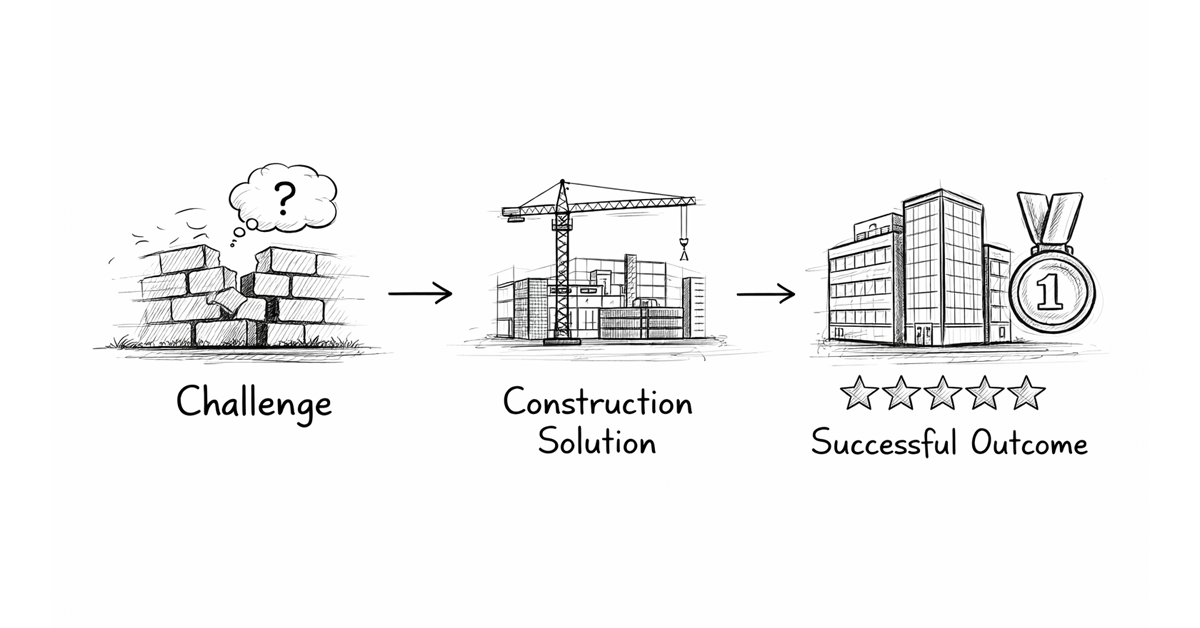
A compelling case study follows a simple but powerful flow:
This storytelling format turns a simple project into proof of your competence and reliability. It provides the social proof that prospects need before they feel confident enough to pick up the phone.
Long before your prospects start looking for a contractor, they are on Google asking questions. By creating content that gives them the answers, you position your company as a trusted authority and get on their radar early.
Think about the questions your sales team fields every day. Those questions are content gold.
Creating genuinely helpful content that addresses common client concerns is one of the most effective SEO strategies for a construction business. It builds topical authority, drives qualified organic traffic, and establishes you as the expert.
Here are a few examples of blog topics that attract the right kind of attention:
This approach does more than just boost your search rankings. It creates a library of valuable assets your team can share during the sales process to educate prospects and handle objections. It helps shorten the sales cycle and improve your win rate.
The UK's residential construction market is fiercely competitive, with revenues of £100.5 billion and over 57,000 firms all fighting for work. In a sector where buyers prioritise quality and proven results, content that showcases your successful projects is what makes you stand out. Detailed case studies and helpful blog posts provide the proof needed to win contracts. You can find out more about the UK residential building market on IBISWorld.
For most construction companies, projects are won and lost locally. While having a slick website is important, it is dominating your immediate service area and building a solid pipeline of B2B work that really moves the needle. This takes a two-pronged attack: a powerful digital footprint combined with proactive relationship building.
The goal is simple. You want to be the default choice in your region. When a homeowner searches for a local builder or an architect needs a reliable partner for a new development, your name needs to be the first one that comes to mind. This does not happen by chance; it is the result of a deliberate strategy to build visibility where it matters most.
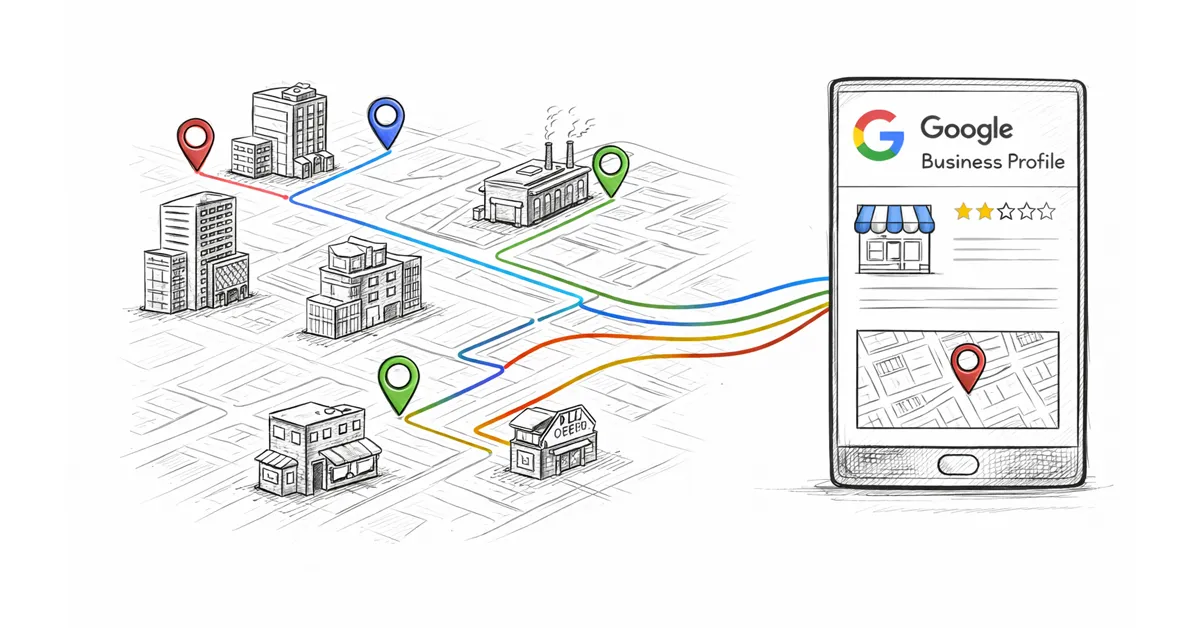
Your Google Business Profile (GBP) is the absolute cornerstone of your local marketing. It is often the first impression a potential client gets, showing up at the top of Google Maps and local search results. An incomplete profile is a massive red flag.
Optimising your GBP is a non-negotiable task that pays for itself almost immediately in phone calls and website clicks.
Think of your Google Business Profile not as a static listing, but as a dynamic, local micro-website. The more you feed it with fresh, high-quality information, the more visibility and leads it will generate.
While digital marketing brings in inbound leads, some of the most lucrative projects will come from professional referrals. Architects, designers, surveyors, and property developers can become a consistent source of high-value work, but these relationships need to be built.
LinkedIn is the perfect tool for this. It lets you pinpoint and connect with the exact decision-makers you need to get in front of.
The key is to build genuine connections, not spam people with sales pitches. Start by engaging with their content, offering useful insights, and positioning yourself as a helpful expert. The goal is to move the conversation offline for a coffee or a quick call, where you can properly discuss how you might support each other’s work.
For firms aiming for larger B2B contracts, especially in the public sector, it is vital to understand the formal tendering process. This practical guide on how to bid for government contracts can be an essential resource for accessing that valuable revenue stream.
By combining a strong local SEO presence and targeted, professional networking, you create a powerful system. You will capture immediate local demand while also building the long-term relationships that lead to larger, more profitable commercial contracts. This combined approach will truly cement your position in the market.
In construction, you would not build a foundation without a blueprint. Marketing is no different. Effective marketing is driven by data, not guesswork. If you do not have a clear view of what is working, you are simply wasting money.
Measuring performance is not about chasing vanity metrics like website traffic or social media likes. It is about connecting every pound you spend to a tangible commercial outcome: a new tender, a signed contract, a profitable project. This starts with identifying the key performance indicators (KPIs) that actually matter to your bottom line.
To get a true picture of performance, you need to track the entire journey, from the first click on an ad right through to the signed contract. This means combining data from your website analytics with what is happening in your sales pipeline.
Forget overwhelming reports. Focus on these essential KPIs:
Once you are tracking what matters, you can set a budget based on your growth targets, not arbitrary figures. There are two commercially-focused ways to approach this.
1. Percentage of Revenue Model
This is a straightforward, common-sense approach. You allocate a set percentage of your total annual revenue to marketing.
For established firms aiming for steady growth, this is often around 1-5%. If you are an ambitious business pushing for aggressive expansion, you might look closer to 5-10%.
2. Performance-Based Model
This is a much smarter method. Instead of picking a percentage, you work backwards from your revenue goals to build your budget.
Set your revenue target, calculate the number of projects needed to hit it, and then use your own conversion data to figure out how many leads you need to generate. This gives you a data-driven budget based on your target Cost Per Acquisition.
Let us run the numbers. Say you need 10 new projects, each worth £50,000. If your lead-to-project conversion rate is 10%, you know you will need 100 qualified leads. If your target CPQL is £250, your marketing budget is £25,000.
This approach changes the game. Your marketing budget stops being a fixed cost and becomes a dynamic investment directly tied to your growth ambitions.
Construction is far from the only industry where the right positioning changes everything. We've put together similar playbooks for digital healthcare marketing and financial services marketing, if either is relevant to your business.
Running a construction business means you are focused on projects, not pixels. When it comes to marketing, practical questions always come up. Here are some straightforward answers to the queries we hear most often.
You will hear benchmarks like 1-5% of annual revenue for maintaining your current position, or up to 10% for aggressive growth. But this is just a guess. A much smarter way to set a budget is to work backwards from your commercial targets.
First, decide on your revenue goal. Based on your average project value, how many new jobs do you need to land? Now, look at your historical lead-to-sale conversion rate. That tells you exactly how many qualified leads you need to generate.
This approach flips the script. Instead of treating marketing as a cost, you are building a performance-based budget around a target Cost Per Lead. It becomes a predictable, measurable investment in growth.
This is a classic question, but they are not competitors. Think of them as two essential tools in your toolbox, each with a different job.
A solid strategy uses paid ads to bring in leads today while building a powerful SEO foundation for sustainable, cost-effective growth tomorrow. One fuels the other.
You cannot manage what you do not measure. Proving your return on investment is all about tracking the journey from the first click online to the final invoice. Vague metrics like "impressions" or "clicks" are useless; you must connect your marketing spend directly to closed deals.
Here is how to do it properly.
First, implement call tracking on your website. This is non-negotiable. It lets you see which phone calls came from Google Ads, organic search, or your Google Business Profile.
Next, make sure every contact form on your site feeds directly into a CRM system. This gives you a clear line of sight, allowing you to follow a lead from their initial enquiry through the sales process to a signed contract. When it is all connected, calculating a precise, undeniable ROI for every channel becomes simple.
At Gilkes Media, I build and manage marketing strategies that deliver measurable commercial results for construction businesses. As a senior consultant, I am personally involved in every campaign to ensure performance and accountability. If you are ready to stop guessing and start building a predictable pipeline of high-value projects, book a no-obligation strategy call with me today. Find out more at gilkesmedia.co.uk
