
Nobody signs a marketing contract expecting to regret it. But eighteen months in, plenty of UK business owners find themselves checking invoices against results and not liking the maths.
The ads are still running. The retainer is still being paid. Nobody can quite explain why leads have flatlined.
This guide sets out the genuine signs it's time to switch marketing agencies, and the signs that look serious but usually aren't.
It covers what switching actually costs in time and performance, and how to do it without losing a quarter's worth of momentum.
It covers paid ads, SEO and website work together, since the same warning signs and the same switching process apply across all three, with a few channel-specific details flagged along the way.
Switching feels riskier than staying put, even when staying put is the worse option. Three things usually keep a business tied to an agency that isn't delivering, and a fourth one hides underneath them.
The first is sunk cost. If an agency spent three months building your account structure or your site, walking away can feel like throwing that work away.
It isn't. A properly run account or website is portable. A good new agency will use what's useful and fix what isn't.
The second is fear of disruption. Nobody wants campaigns to go dark or rankings to dip during a changeover.
That fear is reasonable, but it's manageable with the right handover process, covered later in this guide. It shouldn't be a reason to stay somewhere that isn't working.
The third is not having a clear benchmark. Without knowing what good performance looks like for your industry and budget, it's hard to tell whether your agency is underperforming or the market itself has got harder.
A 2024 UK survey of marketing managers, commissioned by reporting platform Ask Bosco and run by polling firm OnePoll, found that 73% had stopped or seriously considered stopping a collaboration over poor analysis and a lack of actionable insight.
62% cited insufficient transparency in reporting as a reason. 95% had seen an agency selectively highlight its best-looking metrics while quietly downplaying weaker ones, and 77% had caught outright errors in a report.
If any of that sounds familiar, you're not alone. It's worth reading the rest of this guide before you decide what to do about it.
The fourth, quieter reason is the fear that the next agency will turn out just as disappointing, so why bother. That's understandable given how common these frustrations clearly are.
It's also exactly why the later sections on vetting a new agency, and judging them fairly over 90 days rather than a gut feeling in week one, matter as much as the decision to leave.
Sunk cost, fear of disruption, no clear benchmark, and fear the next agency will be no better. None of these are good reasons to stay once you've read the signs below.
These are the patterns that, taken together or even on their own if severe enough, mean it's genuinely time to have the conversation about moving on.
One sign on its own is worth a direct conversation with your agency first, not an immediate exit. Two or more showing up at the same time is different.
If there's no real improvement after you've raised them, that's what tips this from a rough patch into a genuine decision point.
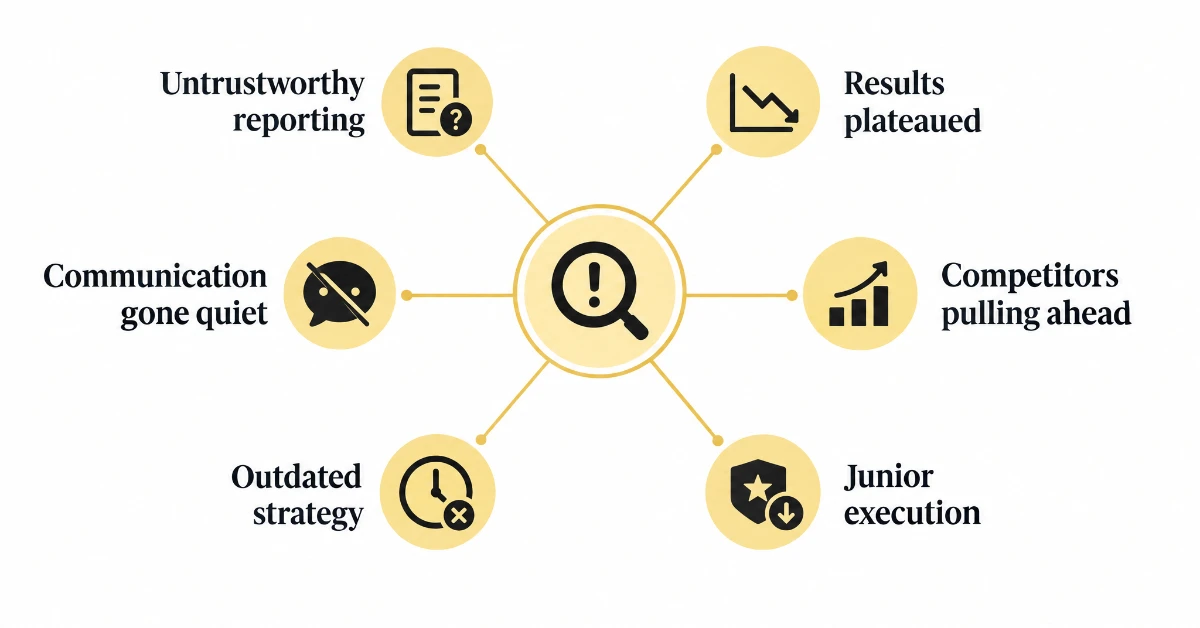
A report should let you answer one question in under two minutes: is this working, and why. If your monthly report is a wall of impressions and clicks with no link to leads or revenue, that's a problem.
If the numbers in the report don't match what you see in your own CRM or Google Analytics account, that's a bigger one.
Watch for metrics that quietly change definition between months, and for "engagement" being used to paper over a drop in actual enquiries.
Also watch for any reluctance to give you direct read access to the ad accounts and analytics properties you're paying for. That reluctance is itself a signal.
A simple test: ask your agency to walk you through last month's report live, on a call, rather than just emailing it over. How fluently they can explain their own numbers off the top of their head tells you a lot.
Every channel has quiet months. The problem isn't a dip, it's a dip with no diagnosis and no plan.
A good agency can tell you exactly why cost per lead rose last month: seasonal, competitive, a platform change, or a landing page issue. And what they're testing to fix it.
If the answer to "why has this dropped" is always a shrug, or always someone else's fault, that's a sign the account has stopped being actively managed.
Early on, most agencies are responsive. Calls get booked quickly, and questions get answered the same day.
If that has slipped to a monthly call you have to chase for, and emails that take a week for a one-line reply, the account has likely slipped down the priority list. Usually because a bigger client arrived.
This is one of the most common, and hardest to spot, complaints in UK agency relationships. The pitch involves a senior strategist or founder.
Three months in, that person has moved on to winning the next client. Your account is run day to day by someone with far less experience, often juggling several other accounts.
There's nothing wrong with junior staff doing execution under proper oversight. The problem is when that oversight quietly disappears and nobody tells you it happened.
Businesses change. You launch a new service line, move upmarket, or stop serving a segment that used to matter.
If your agency is still targeting the customer you had two years ago, or pushing a service you've quietly discontinued, the relationship has become administrative rather than strategic.
Ask when the account structure, keyword strategy, or the site's core content was last genuinely rebuilt rather than lightly tweaked.
If the honest answer is "not since we started working together," and that was years ago, you're paying current prices for a strategy built for a different market.
You can't see a competitor's internal numbers, but you can see their ad creative, their rankings, and how their website has evolved.
If a competitor with a similar or smaller budget is consistently outranking you or showing sharper ad creative, ask your own agency directly why. Don't just assume it's bad luck.
On their own, a quiet month or a slow email reply isn't a reason to leave. Untrustworthy reporting, unexplained plateaus, disappearing seniority and a strategy that hasn't moved in years, together, usually are.
It's worth being honest about the other side of this too. Switching agencies has real costs, covered in the next section, and switching for the wrong reason just moves the same problems to a new supplier.
A single bad month in paid ads is rarely meaningful on its own. Platform auction dynamics shift constantly, and a competitor's aggressive campaign can push your cost per click up for weeks.
That can happen with nothing your agency did wrong. Look at a rolling three-month trend before drawing conclusions, not a single month in isolation.
SEO that hasn't shown movement after six to eight weeks is also not yet a red flag. Technical SEO and content work routinely take three to six months to show in rankings.
That's simply how long search engines take to recrawl, reindex and re-rank a site, and it's longer again in competitive sectors.
A platform-wide algorithm update that hits every advertiser or every website in your sector at once isn't your agency's fault either.
A good agency should still explain what changed and what they're doing about it for your account specifically, rather than citing the update as a blanket excuse forever.
And a disagreement over strategy isn't automatically a sign the agency is bad at their job. If they're pushing back on an idea you like, ask them to explain their reasoning plainly.
A consultancy that only ever agrees with you isn't adding much value either.
Rising platform costs are another one worth separating out properly. Google and Meta auction prices have both climbed as more UK advertisers compete for the same inventory.
A higher cost per click doesn't automatically mean your agency has got worse at buying it. The market itself has simply got more expensive for everyone in it.
The fair test is whether your agency is adapting to that rising cost with better targeting, creative and landing pages, or simply letting your cost per lead drift upward unchallenged.
A bad month, a slow SEO start, an industry-wide algorithm update and honest pushback on your ideas are all normal parts of a working agency relationship, not reasons on their own to start looking elsewhere.
Switching isn't free. It's worth going in with realistic expectations rather than assuming performance improves the day the new agency starts.
Industry estimates, drawn from agency-side reporting on account handovers, put the typical disruption at the rough scale set out below.
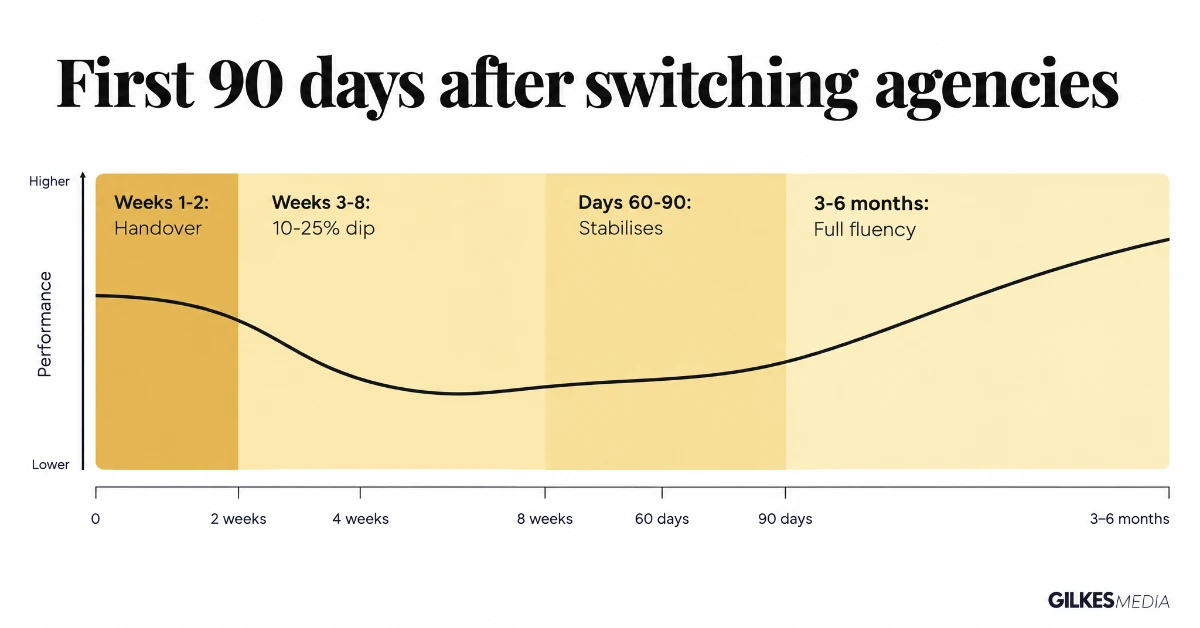
A new agency typically needs four to eight weeks just to properly understand your account, your products and your commercial context. Only then can they start making confident changes rather than cautious ones.
During that window, a short-term performance dip of roughly 10-25% is common, as new structures and creative get tested against what was running before.
Full commercial fluency, the point where the new agency understands your business nearly as well as the one you left, tends to take three to six months rather than weeks.
Your own team should expect to spend somewhere between 20 and 40 hours on the handover itself. Exporting data, briefing the new agency, reviewing proposals and sitting through onboarding calls all add up.
| Timeframe | What's typically happening | What to expect |
|---|---|---|
| Weeks 1-2 | Handover, data export, access transfer, initial audit | No major changes yet; this is discovery |
| Weeks 3-8 | New structure and creative tested against the old baseline | Possible 10-25% dip before it recovers |
| Days 30-60 | Early optimisation based on real account data | First genuine signs of direction, not final results |
| Days 60-90 | Account stabilises on the new strategy | Fair point to judge whether the switch was right |
| 3-6 months | Full commercial fluency with your business | Comparable or better performance to the old agency, if the switch was justified |
None of this is an argument for staying with an agency that isn't working. It's an argument for judging the new one over 90 days rather than 90 hours.
It's also an argument for choosing the right moment to switch, rather than doing it mid-way through your busiest quarter if you can avoid it.
Expect a four-to-eight-week settling-in period and a possible short dip in performance after switching. Judge the new agency at the 90-day mark, not in the first fortnight.
The signs and the switching process above hold across channels. But the timescales and the practical handover steps shift depending on whether you're moving paid ads, SEO, or a website build and CRO relationship.
SEO is the slowest channel to judge, and the slowest to recover from a bad switch. The stakes on getting the handover right are higher.
Before you give notice, insist on a full export of the keyword tracking history, the backlink profile and disavow file, and any technical audit documents.
Also insist on admin-level access to Google Search Console and your analytics property, not just viewer access. That distinction matters more than it sounds.
A genuinely competent incoming SEO agency will want four to six weeks of pure audit and research before touching anything live. Changing structure or links too quickly on an unfamiliar site can do real damage.
Be suspicious of any new agency promising a fast rankings turnaround inside that window. It's a sign they haven't understood how search engines work, not a sign they're better than your last one.
Website and CRO relationships carry a different risk: who actually owns the code, the CMS licence and the hosting account.
Before you switch, confirm in writing that the source code, any custom plugins built for you, and admin access to hosting and domain registration all belong to your business, not the agency.
It's a genuinely common and expensive problem in the UK web design market: a business discovers, only once it tries to leave, that its own website is effectively hostage to an agency's hosting infrastructure.
If you're mid-way through a redesign when the relationship sours, get a written audit of what's actually been delivered and paid for before switching developers.
An incoming team will otherwise have to spend real budget just working out what state the build is in before they can touch it.
Before you say anything to your current agency, read your contract properly. The advertising industry's traditional 90-day notice period has become far less common over the last two decades.
Many UK retainers now run on 30-day rolling terms with no fixed minimum, but assume nothing until you've checked your own contract.
Look specifically for the following before giving notice.
Check too for a data processing agreement covering any customer data the agency has handled on your behalf, such as leads synced into their own tools.
Under UK GDPR, you're the data controller and stay responsible for that data even after the relationship ends. Confirm in writing that the outgoing agency will delete or securely return it.
If any of this is ambiguous, it's worth a short, cheap conversation with a solicitor before you act, rather than guessing and finding out the hard way.
This is a legal question, not a marketing one, and Gilkes Media can't advise on contract law itself. If your situation looks complicated, get that checked properly first.
Notice period, asset ownership and any early termination fee are the three things to confirm in writing before you give notice, not after.
A clean switch is almost always possible with a bit of planning. This is the order that causes the least disruption, based on how these handovers typically run in practice.
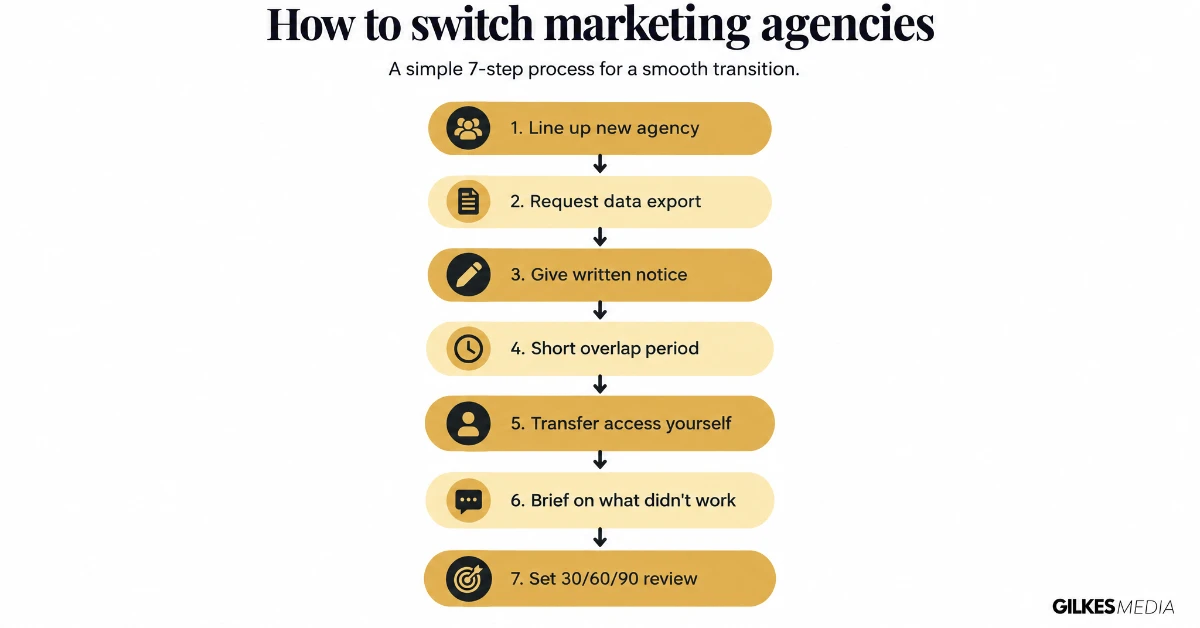
Timing matters too. Where you have any choice in the matter, avoid switching Google Ads or Meta accounts in the run-up to your busiest trading period.
That's exactly when the four-to-eight-week settling-in window covered earlier hurts the most.
Line up the new agency first, get everything in writing, transfer platform access yourself, and set a 90-day review from day one. That sequence is what keeps a switch from turning into a blackout period.
The whole point of switching is not ending up in exactly the same position again in eighteen months. A few questions during the pitch process tend to surface the issues covered earlier in this guide.
Ask who will actually run your account day to day, by name, and how many other accounts that person manages.
Ask to see an anonymised example of a monthly report before you sign, not just a sales deck, so you know what you'll actually be reading in month four.
Ask what their notice period and data handover terms are. How an agency talks about an exit before you've even started tells you a lot about how they'll behave if you ever need one.
Our own guide to choosing a digital marketing agency goes through this in more depth.
If paid search specifically is the channel you're moving, the PPC agency buyer's guide covers the platform-specific questions worth asking too.
It's also worth reading up on how marketing consultant fees are usually structured.
That way you can tell whether a quote is a genuine retainer for ongoing strategy, or a thinly-disguised flat fee for occasional check-ins.
If you're moving an SEO retainer, ask how they report on rankings and organic traffic separately from paid traffic. A surprising number of agencies blur the two together to make overall numbers look healthier.
If you're moving a website or CRO relationship, ask to see three live sites they've built that are still being actively maintained a year or more later, not just launch-day screenshots.
It's also worth asking for two or three existing clients you can speak to directly, not just written testimonials picked from their own website.
A genuinely confident agency will have no issue arranging a short call. How they react to the request tells you almost as much as the call itself.
To make the numbers in this guide concrete, here's how they play out for a typical UK business spending £3,000 a month on Google Ads.
That's roughly in the middle of the UK small business range covered in our marketing budget guide.
Say that account was generating 40 leads a month at a cost per lead of £75, a healthy benchmark for the sector. If performance has drifted to 25 leads at £120, that's an extra £45 per lead.
That's also 15 fewer leads reaching the sales team every month, with no change in spend, the exact kind of drift our guide to measuring marketing ROI talks through in more depth.
Switching agencies on that account, using the 10-25% dip and settling window from earlier, might mean a further two to six weeks at a similar or slightly worse cost per lead.
That's a real short-term cost: typically a few hundred pounds of inefficient spend during the transition on an account this size.
Set against that: staying at 25 leads for another year, instead of recovering to 40, costs roughly 180 missed leads over twelve months.
For most businesses in this spend bracket, a few weeks of transition cost is clearly the cheaper problem. It's worth running this same calculation on your own numbers before you decide.
The same logic applies to an SEO retainer, just on a longer clock. A business paying £1,200 a month for SEO with no ranking movement in over a year isn't just wasting that monthly fee.
It's also losing the compounding organic traffic growth a properly run campaign would have built, usually worth several times the retainer once it's established.
The transition cost there, several months of a new agency's audit and rebuild phase, is real. But it's a one-off delay against an open-ended ongoing loss.
Run the actual numbers on your own account. A short transition dip almost always costs far less than another twelve months of an underperforming agency.
A proper performance review every quarter, alongside a deeper annual review of strategy, fees and whether the relationship still fits where your business is heading. A quarterly review is frequent enough to catch a problem early without creating constant disruption.
Yes, and it's worth naming that feeling so it doesn't quietly drive the decision. An agency relationship is a commercial arrangement, not a friendship, and a well-run agency expects clients to review that arrangement on its merits from time to time.
Usually only by following your contract's notice and termination terms, unless the agency has materially breached the agreement, which is a legal question rather than a marketing one. Read your contract and, if performance is bad enough that breach seems possible, get a solicitor to confirm before acting.
The account's historical data stays with the ad account itself, not the agency, provided you own that account. This is exactly why confirming who legally owns your ad accounts, covered earlier in this guide, matters so much before you switch.
Ninety days is a fair minimum, in line with the settling-in period covered earlier in this guide. Judging a new agency inside the first month almost always means judging the handover period rather than their actual work.
Giving notice before the next agency is lined up. That gap, even a short one, is when accounts get neglected, budgets get wasted on autopilot campaigns, and momentum genuinely gets lost, rather than the switch itself.
None of this needs to be an emotional decision. Look honestly at the signs set out earlier, and check what your contract actually says.
Run the real numbers on what staying is costing you against what a few weeks of transition would cost. For an account that's genuinely underperforming, the maths usually settles the question on its own.
And if the honest answer is that your current agency is doing a reasonable job in a tough market, that's a useful outcome too.
It's far better to confirm that with a clear-eyed review than to switch out of frustration and end up no better off in another eighteen months.
Either way, put a date in the diary for the next proper review, whether that's with your current agency or a new one. A relationship this important to your revenue shouldn't just run quietly in the background until something forces the question again.
If you're weighing this up right now and want a second opinion before you commit either way, we offer a free, no-pressure discovery call.
We'll look through your current reporting and tell you honestly whether what you're seeing is a normal rough patch or something worth acting on, as part of our wider marketing consultancy work with UK businesses. You can get in touch here to book one in.
