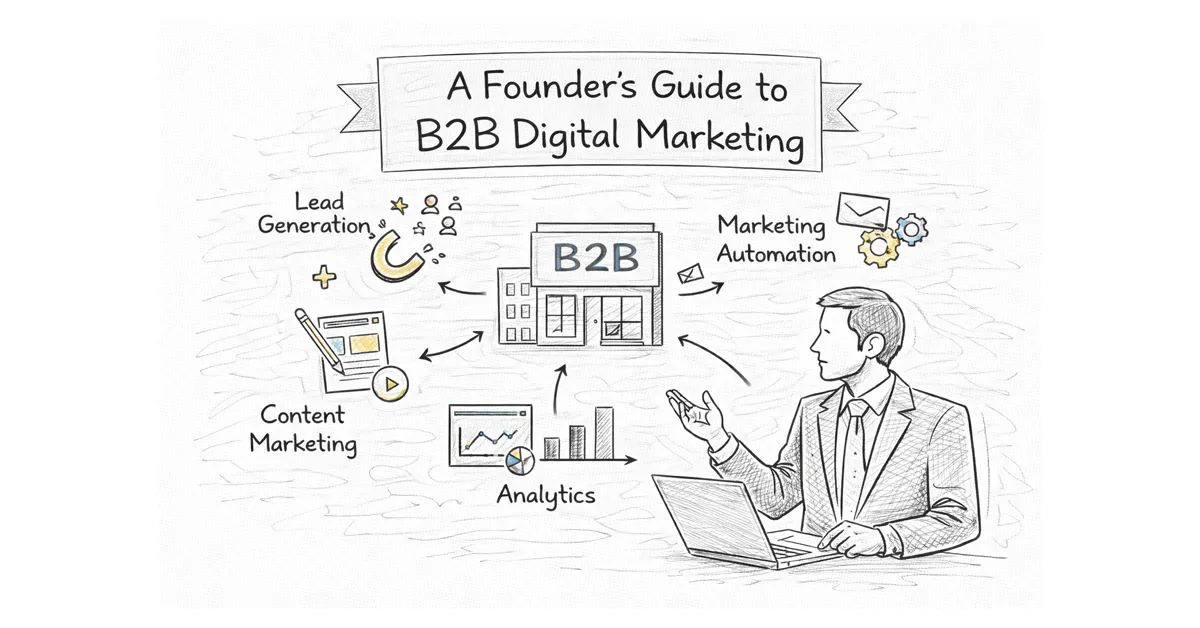
So, what exactly is B2B digital marketing?
In simple terms, it involves using online channels to sell products or services to other businesses. It is more than just running a few advertisements. It is a strategic process focused on building genuine relationships and proving your value to professional buyers, using a toolkit of paid ads, SEO, and smart content to generate qualified leads.
Not so long ago, B2B deals were sealed on the golf course or over a handshake at a trade show. Today, those relationships almost always start online. B2B digital marketing is no longer a side project for the field sales team; it is the core engine that builds a predictable, scalable pipeline of high-quality leads. Our guide to B2B service marketing looks at how this plays out specifically for firms selling services rather than products.
This is not about discarding traditional methods. It is about facing a fundamental shift in how business decisions are now made.
Modern B2B buyers, whether in technology, finance, or professional services, conduct their own research. They investigate relentlessly, read reviews, and compare every possible solution long before they consider taking a sales call. If you do not have a strong digital presence, you are invisible during this critical research phase. For a deeper dive, it is worth understanding what B2B marketing is in its wider context first.
The path from 'interested' to 'customer' has changed permanently. Decision-makers now complete a huge portion of their buying process on their own. Your digital marketing must meet them exactly where they are, with the right answers at the right time.
This means your strategy needs to be built around three key tasks:
The real goal here is to build a repeatable system that turns your online activity into measurable revenue. Think of it as a machine that consistently delivers qualified opportunities, freeing you from the unpredictability of referrals or cold outreach alone.
When executed correctly, B2B digital marketing ceases to be a cost centre and becomes your most measurable growth engine. Every pound you spend should be directly traceable to a commercial result, whether that is a qualified lead, a sales opportunity, or a new client.
This guide is designed to provide a clear, commercially-focused roadmap to help you achieve this. We are skipping the fluff and focusing on practical frameworks to turn your online presence into your most valuable asset for business development. You can learn more by exploring our detailed guide on the connection between digital marketing and lead generation.
So, what tools are actually in the B2B digital marketing toolbox? This is not about chasing every new trend. It is about selecting the right tools for the right job to hit your commercial targets, whether that is booking sales calls this quarter or building a brand that dominates your market for years to come. We cover this channel in more depth in our guide to social media for B2B marketing. For the paid side of that mix specifically, our founder's guide to hiring a B2B PPC agency covers what good execution should include.
For most UK businesses, a solid strategy stands on four pillars: Paid Advertising, Search Engine Optimisation (SEO), Content Marketing, and Email Marketing. Each has a specific role, but they work best together, creating a predictable engine for growth.
The timing could not be better. The UK's digital marketing sector is growing, reaching around £15.7 billion in 2024 and projected to soar to £37.7 billion by 2033. This growth is driven by the very channels we are about to break down, which demonstrates their importance for any company serious about scaling.
Paid ads, or pay-per-click (PPC), are your fast lane to getting in front of motivated buyers. When a finance director Googles "accounting software for SMEs" or a construction manager searches LinkedIn for "site management tools," paid ads place your solution right there at that exact moment of need.
As a paid ads specialist, I see this as the most direct lever for growth you can pull. You control the budget, the message, and the audience, and you see the return almost instantly.
Search Engine Optimisation (SEO) is the process of getting your website to rank higher in the organic (non-paid) search results. Unlike paid ads, which disappear the moment you stop paying, SEO builds a lasting digital asset that can generate traffic and leads for years.
The aim is to become the trusted authority your customers find when they are looking for answers. This means creating genuinely helpful content that solves their problems, ensuring your website is technically sound, and building credibility by earning links from other respected sites. It is a marathon, not a sprint, but the payoff is significant: a sustainable stream of highly qualified, low-cost leads.
Think of paid ads as renting an audience and SEO as owning one. One provides immediate access, while the other builds equity over time. A balanced B2B digital marketing strategy uses both to manage short-term cash flow needs and long-term growth ambitions.
This simple diagram shows how the journey from online research to actual revenue works.
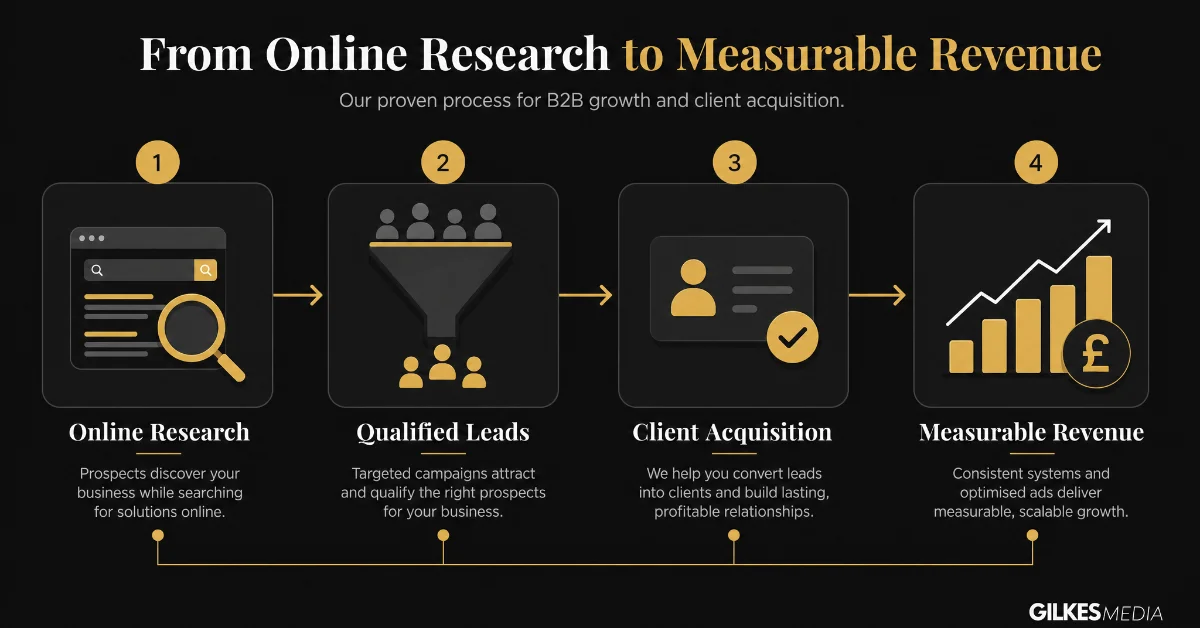
It is a great reminder that every digital touchpoint should guide prospects from discovery to becoming a qualified lead that generates real income for the business.
Content and email marketing are the glue that holds your strategy together. Ads and SEO bring people to your website, but these channels are what build the relationship that turns a curious visitor into a paying customer.
To help you decide where to focus your energy first, here is a quick comparison of these core channels.
This table breaks down the main channels, their primary purpose, time to impact, and the type of business they suit best.
| Channel | Primary Purpose | Time to Impact |
|---|---|---|
| Paid Ads (PPC) | Immediate Lead Generation | Days to Weeks |
| SEO | Long-Term Authority | 6-12+ Months |
| Content Marketing | Building Trust & Authority | 3-6 Months |
| Email Marketing | Lead Nurturing & Conversion | Immediate (with a list) |
As you can see, there is no single "best" channel. The right mix depends entirely on your business goals, your timeline, and the resources you have available.
 The right approach also depends on your sector: our guides to digital marketing for professional services and digital marketing for manufacturers both show what this looks like in practice for those industries.
A proper B2B digital marketing plan is not born from guesswork or random acts of marketing. It is a deliberate, commercially-focused framework built to achieve specific business goals.
Without that solid foundation, you are just throwing money at channels and hoping something sticks. The real aim is to draw a straight line from every marketing pound you spend to a tangible outcome, like a qualified lead or a new client. That process does not start with tactics; it starts with who you are trying to reach and what you need to achieve.
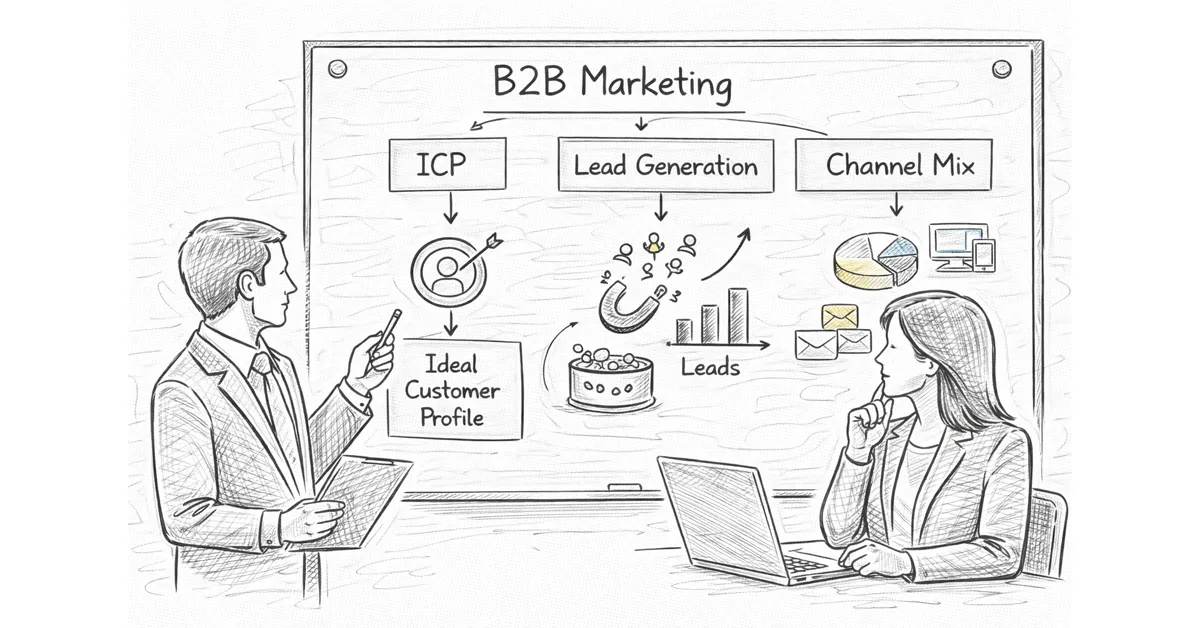
Before you even think about which channels to use, you must be crystal clear on who you are selling to. This is your Ideal Customer Profile (ICP). It is a detailed description of the perfect company you want as a customer, moving beyond vague demographics to focus on specific commercial traits.
To build your ICP, ask the tough questions about the businesses that get the most value from what you do:
A well-defined ICP is your strategic filter. It stops you from wasting budget on audiences that will never convert and ensures your message lands with real impact for those who will. This focus is the first step towards marketing efficiency.
Once you know who you are targeting, you need to define what success looks like in plain, measurable terms. Vague goals like “increase brand awareness” are not useful here. Your objectives need to be specific, measurable, achievable, relevant, and time-bound (SMART).
Think in terms of direct business impact. For instance:
These are not just marketing metrics; they are commercial targets that feed directly into revenue. They give you a clear benchmark to measure performance and justify every penny of your investment.
With your ICP and objectives established, you can now pick the right channels. The key is to start small and focused, rather than trying to be everywhere at once. Choose one or two channels that offer the most direct path to your ideal customer and align with your goals.
Here is a simple framework to help you decide:
This kind of strategic prioritisation is more critical than ever. In the UK, the share of B2B revenue from digital channels is projected to hit 28% by 2025, a significant jump from around 20% in 2021. This trend shows that businesses are increasingly relying on a well-executed online presence to drive sales. You can discover more about this shift in B2B revenue on statista.com.
By starting with a focused strategy, you can prove a channel’s value, generate a return, and then reinvest those profits to scale up or expand into new channels, all based on real performance data. This methodical approach is the hallmark of a B2B digital marketing strategy that actually works. To go deeper, check out our guide on how to create a marketing strategy that aligns with your business goals.
 Before you can measure success properly, you need a clear strategy in place - our guide to building a marketing strategy for real growth covers how to set that foundation.
Running a great B2B digital marketing campaign is only half the job. The other, arguably more important half, is proving it works in cold, hard commercial terms. Without solid measurement, you are just spending money and hoping for the best, a position no business leader can afford.
The key is to move past surface-level “vanity metrics” like website traffic or social media likes. Those numbers might look good in a report, but they do not pay the bills. True success is measured by tracking metrics that have a direct, undeniable impact on your bottom line.
To build a marketing function that drives real performance, you must focus on the key performance indicators (KPIs) that connect your activity to revenue. This means shifting your mindset from measuring activity to measuring outcomes.
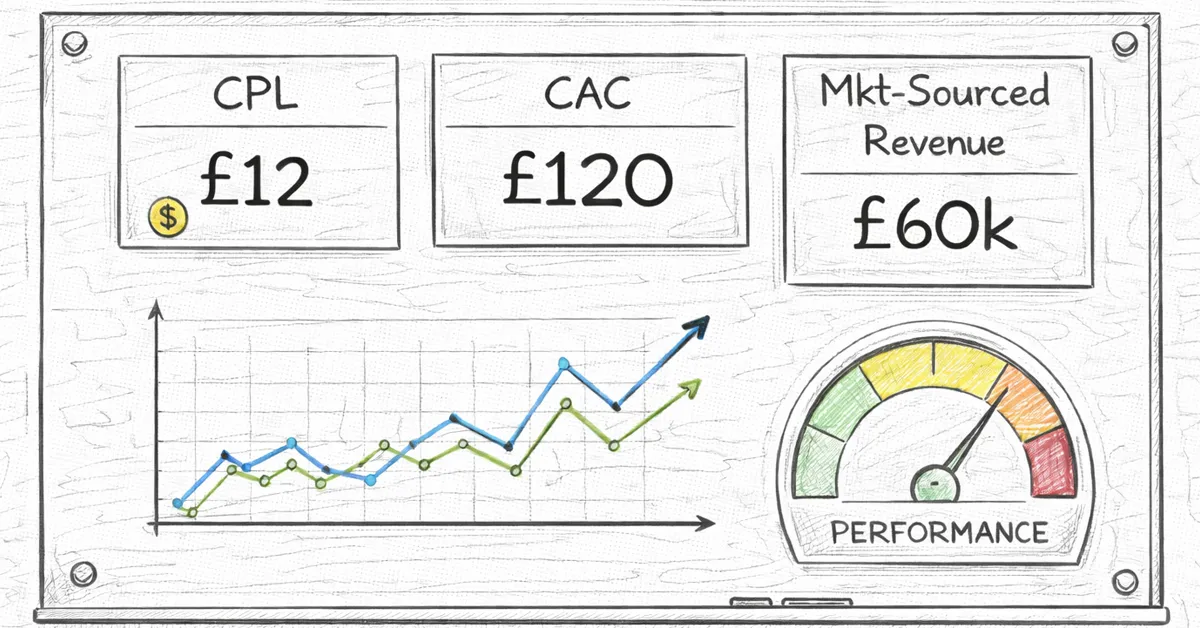
These are the core metrics that should form the foundation of any B2B marketing dashboard:
Tracking these KPIs provides the clarity needed to make smart, data-driven decisions about where to allocate your budget for the best possible return.
You do not need a complicated or expensive system to start tracking what matters. A simple spreadsheet or a tool like Google Looker Studio can be used to create a powerful dashboard that gives you a real-time view of your performance.
Your dashboard should answer critical business questions at a glance. It becomes your single source of truth for all marketing performance, allowing you to hold your activities accountable to commercial goals.
Think of your marketing dashboard as the control panel for your growth engine. It should tell you which levers are working, which need adjusting, and where you should allocate more budget to accelerate results.
The table below breaks down the essential parts of a practical B2B marketing dashboard, focusing on the numbers that drive decisions.
| Metric | What It Measures | Example Calculation |
|---|---|---|
| Cost Per Lead (CPL) | The cost to generate a single new lead. | £2,000 Ad Spend / 20 Leads = £100 CPL |
| Lead-to-Close Rate | The % of leads that become paying customers. | 5 New Clients / 100 Leads = 5% Close Rate |
| Customer Acquisition Cost (CAC) | The total cost to acquire one new customer. | £100 CPL / 5% Close Rate = £2,000 CAC |
| Marketing ROI | Revenue generated for every £1 spent. | (£30k Revenue - £5k Spend) / £5k Spend = 5:1 ROI |
Once you have this data, the real work begins. A performance-driven approach means actively using these insights to refine your strategy.
For example, imagine your LinkedIn Ads campaign has a CPL of £75, while your Google Ads campaign is at £150. You now have a clear signal. You can confidently reallocate budget from the underperforming Google Ads to the more efficient LinkedIn campaign, immediately maximising your return on investment.
This kind of data-led agility is what separates successful B2B marketing from the rest. For a more detailed breakdown, you can learn how to measure marketing ROI in our comprehensive guide.
One decision many businesses get wrong here is whether to build this capability in-house or bring in outside help - our guide on when and why to outsource marketing covers that call in more detail.
Knowing which channels to use is one thing. Executing them without falling into common, costly traps is another matter entirely.
Time and again, I have seen well-intentioned B2B marketing efforts fail. It is rarely because the core strategy is wrong, but because of avoidable mistakes in execution that burn through cash and deliver frustratingly poor results.
Drawing on years of hands-on experience, I have seen the same issues hold businesses back. Understanding these pitfalls is the first step toward building a resilient marketing function that delivers a return.
One of the most frequent mistakes is treating Search Engine Optimisation (SEO) as an afterthought or a one-off technical task. Businesses get focused on the instant feedback from paid ads and push SEO to the bottom of the list, failing to build a critical long-term asset.
This oversight is incredibly common. A recent survey of over 500 UK businesses found that a staggering 59% do not have a dedicated SEO strategy. This leaves a huge competitive gap for savvy SMEs and startups to exploit by simply doing the basics well. Learn more about these UK digital marketing statistics on localiq.co.uk.
How to avoid it:
Commit to SEO from day one. This does not mean you need a huge budget, but it does mean weaving basic best practices into your routine. Get your website's technical health in order, create content that answers your customers' genuine questions, and think of SEO as a continuous process, not a one-time project.
I see this one almost weekly. A company spends thousands of pounds on a highly targeted LinkedIn or Google Ads campaign, generates a list of promising leads, and then nothing happens. The leads sit in a spreadsheet, go cold, and the entire investment is wasted.
Running paid ads without a solid, immediate follow-up process is like paying for a premium delivery service that leaves your valuable packages on the doorstep in the rain.
The value of a lead decays incredibly quickly. Your chances of connecting with a new lead are highest within the first five minutes. After an hour, they drop dramatically. A slow or non-existent follow-up process kills your ROI before it even has a chance.
How to avoid it:
Before you spend a single pound on ads, establish your lead management process.
Many businesses invest heavily in creating high-quality content like white papers, case studies, or blog posts, only to publish them on their website and hope for the best. This "publish and pray" approach is a recipe for failure.
Content creation is only half the battle. If you do not have a clear plan to get that content in front of your Ideal Customer Profile, it is just taking up space.
How to avoid it:
For every piece of content you create, build a simple distribution plan. Think about how you will actively promote it. Will you share it via your email newsletter? Promote it with a small budget on LinkedIn? Use it as a resource in your sales outreach? Tying content directly to a distribution channel ensures it works as a commercial asset, not just a forgotten page on your website.
You now have a solid map of the B2B digital marketing landscape, from the core channels that drive real growth to the commercial metrics that prove your marketing is working. But theory is one thing; action is another. Not sure which service to prioritise first? Our guide on which digital marketing service suits your business helps narrow that down, and our piece on how marketing strategies have developed for UK SMEs gives useful context for the decision.
The goal is not to launch a dozen new campaigns overnight. It is about taking smart, deliberate steps to build a marketing function that delivers predictable returns. The path forward starts with an honest assessment of where you are right now. From there, you can set one clear, powerful objective to build momentum and justify future investment. This is how you turn a list of marketing activities into a cohesive growth engine.
Before you can plan for the future, you need to be brutally honest about the present. A quick, practical audit of your current digital marketing will highlight what is working, what is not, and where immediate opportunities exist. You do not need a complicated spreadsheet for this.
Just answer these three straightforward questions:
This simple exercise provides a no-nonsense baseline. It often reveals that a huge amount of effort is going into channels that produce little to no measurable return, and that is your obvious starting point for optimisation.
With a clear picture of your current state, resist the urge to fix everything at once. Instead, pick one high-impact commercial objective to achieve in the next 90 days. This creates focus, forces you to align your resources, and gives you a single, measurable goal to aim for.
Here are a few examples of strong quarterly objectives:
By focusing on one key objective, you create a clear finish line. This approach lets you properly test a channel, prove its ROI, and build a solid business case for more investment based on real performance data, not just assumptions.
Finally, a crucial part of any smart strategy is knowing when to bring in specialist support. If your internal audit reveals a lack of clarity, poor results, or simply a shortage of time and expertise, engaging a consultant can be the most direct path to growth.
As a hands-on paid ads specialist and consultant, my role is to provide that clarity and direction. I work directly with founders and leadership teams to turn business goals into a practical, performance-driven marketing plan that gets results.
If you are ready to move from ad-hoc tactics to a cohesive strategy that delivers measurable growth, let’s have a conversation. To continue learning and stay ahead of the curve, you can explore the blog for further insights. If you'd rather bring in outside expertise than run this in-house, our guide to hiring a digital marketing consultant covers how to vet one properly.
Let’s tackle some of the most common questions UK business leaders ask about B2B digital marketing. Here is some direct, practical advice.
There is no magic number, but a solid rule of thumb is to set aside 7-12% of your total annual revenue for marketing. If you are an early-stage or high-growth business trying to capture market share, you might push that closer to 15%. More established firms can often sit comfortably at the lower end.
However, a fixed percentage is just a starting point. The best approach is always ROI-driven. Start with a test budget, say, £2,000 to £5,000 per month, to prove a channel can deliver a positive return. Once you see it working, you can scale the budget with confidence, knowing your investment is fuelling real growth.
This is a key question, and it depends entirely on the channels you choose. It is absolutely critical to set the right expectations from day one.
Predictable growth is not about choosing one or the other. It is about balancing short-term tactics for immediate cash flow with long-term strategies that build a sustainable, low-cost lead engine for the future.
This really comes down to what you need more: immediate leads or a long-term asset.
If you need sales conversations and leads right now to fund growth, paid ads are the clear winner. You get instant visibility in front of buyers and can measure the results from day one.
If your priority is building a long-term, low-cost lead generation machine and you can afford to wait for the return, then investing in SEO is the smarter strategic move.
Ideally, you should do both. Use paid ads to generate revenue today, then reinvest a portion of those profits into your SEO to build your brand and organic presence for tomorrow. It is the most powerful combination for sustainable growth.
If you are ready to move from scattered tactics to a cohesive strategy that delivers measurable growth, Gilkes Media can help. Let's have a conversation to build a practical, performance-driven marketing plan that gets results.
