Marketing can feel busy without feeling effective. Campaigns go live, content gets published, someone checks the numbers, and yet growth still feels uneven. Leads arrive in bursts. Sales says the quality is mixed. You know money is being spent, but you can't say with confidence which part of the machine is working.
That's usually the point where a founder starts searching for a digital marketing consultant in the uk. Not because they want more marketing activity, but because they want a clearer commercial answer. What should we keep doing, what should we stop, and who should own it?
In the UK, that decision matters more than most businesses realise. You're not just choosing a supplier. You're choosing an operating model. In some cases, a consultant is the right move. In others, you need an agency with delivery capacity. Sometimes the best answer is an in-house hire, but only if the workload, leadership time and channel complexity justify it.
You've outgrown the stage where referrals and a few ad hoc campaigns were enough. Revenue has targets attached to it now. Sales wants better leads, finance wants clearer answers on spend, and the team is still making marketing decisions one channel at a time. If you're a startup founder wondering whether this is even the right stage to bring someone in, our guide on when to hire a marketing consultant for startups covers the timing question directly.
That's usually when a founder starts weighing three options at once. Bring in a consultant to sort the strategy. Hire an agency to add delivery capacity. Recruit in-house and build control internally. The problem is that many businesses start comparing suppliers before they've faced the harder question, which is what kind of operating model the business can support.
The symptoms are usually obvious:
At this point, growth stalls. Not because the business has stopped marketing, but because it has reached the point where weak ownership becomes expensive.
The UK market adds more noise to an already difficult decision. There are thousands of agency options competing for attention, and digital spend keeps rising, so founders are asked to choose between more suppliers, more specialisms and more delivery models than they can reasonably assess. That often leads to the wrong hire. A business with a leadership gap hires an agency for output. A business with an execution gap brings in a strategist. A company that needs flexibility takes on a full-time salary too early.
I see the same pattern in conversion work as well. Businesses often assume they need more traffic when the underlying issue sits further down the funnel. A proper review of how to improve conversion rates on existing traffic can save a business from hiring the wrong kind of help and adding cost before fixing the bottleneck.
Commercial reality: the decision is not simply who can do marketing. It is who should own direction, who should do the work, and what level of cost, speed and oversight your business can carry without creating more complexity.
That is the point of this comparison. The right answer depends on your stage, your budget, your internal capacity and whether the actual problem is strategy, execution or management.
Before you hire anyone, write down what's broken. If you're still not sure what a marketing consultancy actually covers day to day, our guide on what a marketing consultancy actually does is a good starting point, and our piece on driving growth with marketing consultancy services goes further into the value they add.
Not the symptoms. The actual problem.
If you skip that step, you'll buy the wrong kind of help. A strategist can't fix a team that never executes. A hands-on freelancer won't solve a board-level positioning problem. An agency won't automatically sort reporting if your conversion tracking is messy.
A good starting point is this. LocaliQ's 2026 UK survey found that 52% of businesses are satisfied with their digital strategy performance, while 34% are not satisfied and 14% say it is not applicable. That gap tells you something important. Lots of businesses are active in digital marketing, but a large share still don't feel the strategy is delivering.
Most situations fall into one of three buckets.
Strategy problem
You don't have a clear acquisition plan. Messaging is vague, channels are chosen by habit, and budget allocation is based more on opinion than evidence.
Execution problem
You know what should be done, but the work isn't happening consistently. Campaigns stall, landing pages take too long, SEO priorities drift, and reporting gets pushed to the end of the month.
Capability problem
Your team is capable in one area but weak in another. A business may have a decent content person but no paid media operator, or a sales team with strong demand handling but poor attribution and CRM discipline.
These are the questions I'd want answered before any hiring conversation:
Where do our best leads come from?
Not all leads. The best ones. The ones that close, retain and produce margin.
What is the one metric that would materially improve the business if it moved?
Sometimes it's enquiry volume. Sometimes it's conversion rate. Sometimes it's lead quality.
Where does the funnel currently leak?
Traffic generation, landing page conversion, follow-up speed, qualification, or sales close rate.
What decisions are we unable to make because the data is weak?
If you can't trust attribution, budget planning becomes guesswork.
Do we need someone to think, do, or build?
Think means strategy. Do means execution. Build means internal systems, process and capability.
A vague brief attracts vague proposals. A sharp problem statement attracts useful solutions.
A practical brief can be very short. Something like:
That's already more useful than saying “we need better marketing”.
If your funnel is getting traffic but not enough commercial return, this guide on how to improve conversion rates is worth reading before you brief anyone. It helps separate traffic problems from conversion problems, which are often confused.
A serious review should look at:
If that diagnosis isn't done first, the hiring process becomes theatre. Nice meetings, polished decks, and very little clarity.
Herein lies the difficulty for much advice. Plenty of articles explain what each option does. Very few explain when each one makes commercial sense. If your business is still small, our dedicated guide to choosing the right small business digital marketing consultant weighs up the same decision at that scale, and if you'd rather go it alone, our piece on what to look for when hiring a freelance digital marketing consultant covers that route too.
The right choice depends on two things. First, the type of problem you've identified. Second, the operating model your business can realistically support.
A useful market signal is the rise of flexible senior support. A UK marketing survey cited by Distribute Digital found that 68% of UK businesses have considered or are already using fractional marketing services. That tells you many businesses don't want the fixed commitment of a full-time senior hire before they've proved the need.
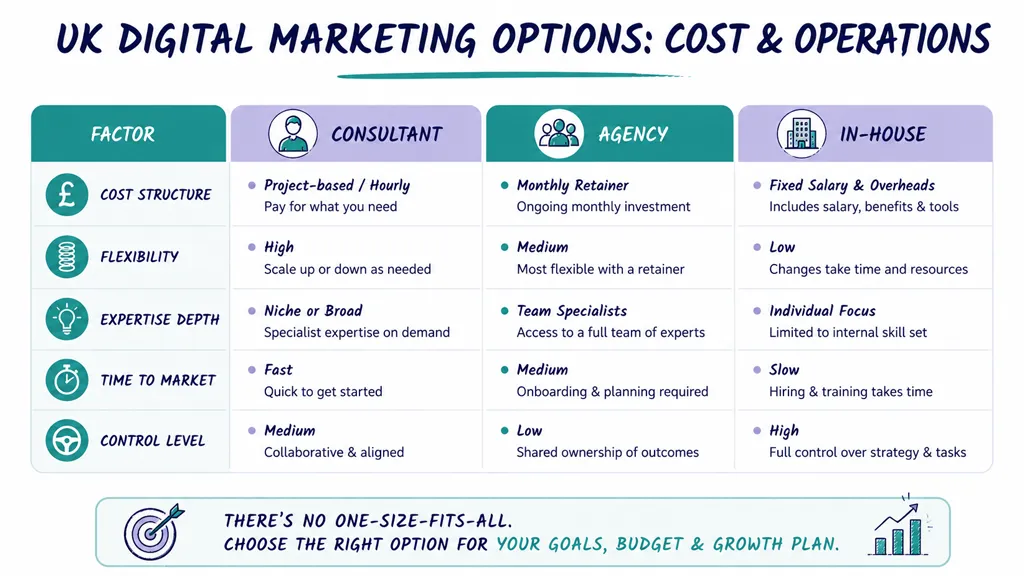
| Option | Best for | Main strength | Main weakness |
|---|---|---|---|
| Consultant | Diagnosis, strategy, accountability, senior guidance | Flexible access to experience | Limited delivery capacity unless paired with a team |
| Agency | Ongoing execution across channels | Delivery resource and specialist breadth | Can become process-heavy or detached from internal commercial priorities |
| In-house | Long-term ownership and embedded knowledge | Proximity to product, sales and leadership | Hiring risk, management load and narrower skill coverage |
A consultant is usually right when the business needs clarity before scale.
That includes situations like these:
This is also where the consultant model often beats the alternatives. You can bring in judgement, diagnostics and channel direction without committing to a larger retainer or a permanent headcount. For many SMEs, that's the most sensible first move.
Agencies are useful when the strategy is largely understood and the problem is throughput.
If you already know the channels you need, have budget allocated, and want campaigns built, tested and managed consistently, an agency can provide the delivery layer. That's particularly true when you need multiple capabilities at once such as Google Ads management, paid social creative, landing page testing and reporting.
A lot of founders also look for a data driven marketing agency approach because they're tired of channel-first reporting that doesn't connect to pipeline or revenue. That's a sensible filter. It forces the conversation towards measurement quality rather than activity volume.
In-house becomes stronger when marketing needs daily ownership and there is enough work to justify full-time focus.
That usually means:
The trade-off is obvious. You gain control and embedded context, but you also take on recruitment risk, onboarding time, holiday cover, management overhead and skill gaps.
If you don't yet know what the role should own, hiring in-house is often premature.
Use this lens.
Choose a consultant if you need diagnosis, strategic direction, leadership support or a growth plan.
Choose an agency if you need consistent execution across multiple channels and don't want to build an internal team yet.
Choose in-house if the need is permanent, the workload is steady, and someone internally can manage performance properly.
If you're weighing those trade-offs in more detail, this breakdown of in-house marketing vs agency is useful because it frames the decision around operational fit rather than vague preference.
A founder usually meets three types of consultant. For a step further into vetting once you've shortlisted someone, that same guide on choosing the right partner has a fuller checklist worth reading alongside this one.
The first sounds impressive and says yes to everything. The second talks almost entirely about channels. The third starts by asking awkward commercial questions about margin, sales capacity, lead qualification, tracking, and who will own the work internally. Shortlist the third.
A polished website proves very little. A long service list proves even less. If you are deciding between a consultant, an agency, or an in-house hire, the vetting standard should be simple. Can this person identify the commercial problem, recommend the right level of support, and explain the likely return without dressing guesswork up as strategy?

Good consultants make decisions in public. They explain why one channel fits and another does not, what has to be fixed first, and where the commercial risk sits. They are comfortable saying, “I would not spend there yet,” or, “You do not need an agency for this stage.”
That matters because the hiring decision is rarely just about marketing skill. It is about fit. A consultant should know when a business needs senior diagnosis for a few months, when it needs an execution team, and when the right answer is to hire internally and stop paying external fees.
Weak consultants usually show the same patterns:
Case studies should answer practical buying questions, not just showcase wins.
Start with the baseline. What was wrong before they came in? Low lead quality, poor tracking, weak conversion rates, rising acquisition costs, no strategy, an overstretched team. If the starting point is vague, the result is hard to trust.
Then check the intervention. Did they set the direction, fix measurement, improve landing pages, manage paid media, support the internal team, or do all of it? Often, founders are caught out by this distinction. A strong result delivered by a consultant who only advised is very different from a result delivered by an agency with a full execution team.
References should cover commercial relevance too. Ask whether the consultant helped the business make better decisions, not just whether they were pleasant to work with. Pleasant does not pay back the fee.
Strong candidates talk openly about what did not work, what had to change internally, and what they would do differently next time.
Some signs should end the conversation quickly:
One more point. Be careful with consultants who keep expanding the scope. If every answer leads to more channels, more retainers, or more outsourced work, check whether they are solving the problem or increasing account value.
Founders often overpay for range they will never use.
For a lead generation business, I would care far more about a consultant's grasp of conversion tracking, landing page structure, CRM flow, and sales feedback loops than whether they can also produce content calendars or manage every social platform. Breadth looks reassuring in a proposal. Relevance is what improves performance.
The best hires are usually clear about their limits. They know where they add value, where a specialist is needed, and when an agency or in-house hire is the better commercial decision. That honesty is not a weakness. It is often the strongest evidence that you are speaking to someone who knows what they are doing.
Most consultant interviews are too soft. If it's sales as well as marketing you're trying to fix, our guide to marketing and sales consulting covers that combined approach, and for a broader look at tactics beyond hiring a consultant, our piece on proven strategies for growth markets is worth a read too.
“Tell me about your experience.”
“What channels do you specialise in?”
“How do you approach SEO?”
Those questions invite rehearsed answers. Better questions force someone to think in real time, show how they prioritise, and reveal whether they understand the commercial side of growth.
A capable consultant should be comfortable with ambiguity. They should also be able to explain a complex issue without disappearing into jargon.
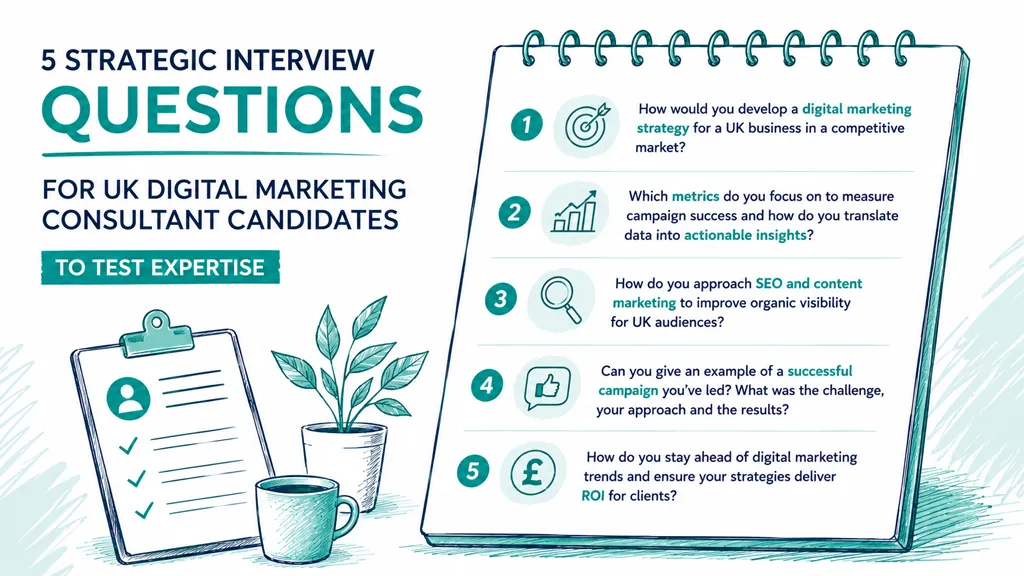
Ask one scenario question from each area below.
“Walk me through how you'd assess a business that gets traffic but not enough qualified leads.”
A strong answer should cover offer clarity, traffic source quality, page experience, CRM handling and sales feedback. A weak answer jumps straight to channel tactics.
“If we had a limited test budget, how would you decide whether to prioritise Google Ads, LinkedIn Ads or Meta Ads?”
This tells you whether they understand intent, audience behaviour and sales cycle length. It also shows whether they can tie platform choice to business model rather than platform preference.
“How do you decide whether SEO is worth investing in for a service business with a long sales cycle?”
You're listening for search intent, content depth, local demand, lead quality and timescale. If you want to benchmark their thinking against practical service delivery, look at examples of SEO consultancy and growth strategy that focus on pipeline, not just rankings.
“If paid traffic is landing on a page that gets clicks but few enquiries, what would you review first?”
A serious answer should mention message match, trust elements, form friction, page structure, analytics and audience alignment. That's often where a consultant's understanding of website design and development shows up most clearly. Useful context comes from seeing how website design and development is tied to conversion rather than aesthetics alone.
Ask for their first three checks, not a full lecture. The order they choose tells you how they think.
The environment has changed. EY's UK consulting position on digital strategy emphasises data-driven transformation in EY's digital strategy consulting overview, and that matters because the best consultants now think beyond channels. They think about measurement, consent, data flow and how AI changes execution speed.
Ask directly:
These questions are useful because they expose whether someone is current or just updated their website copy.
A consultant can be technically strong and still fail inside the business.
Ask:
If you need support that combines strategic direction with channel execution, examples of paid ads management can help frame what good collaboration looks like when strategy and delivery have to work together. If you decide an agency is a better fit than a solo consultant, our guide to choosing a digital marketing agency walks through that vetting process, and if you'd rather build the capability in-house, see our founder's guide to B2B digital marketing.
A founder hires a consultant, agrees a monthly fee, gets a glossy report six weeks later, and still cannot answer a basic question. Is marketing improving revenue, or just producing activity? That gap usually comes down to poor setup, not poor intent. If broader growth support, not just marketing, is what you're after, our guide to business growth consulting services covers what that looks like beyond a single consultant.
The expensive mistake is simple. Businesses buy advice or execution before they agree how success will be judged, who owns decisions, and what happens if performance stalls. If you are comparing a consultant with an agency or an in-house hire, this matters even more, because each model creates different reporting lines, different speed of execution, and different accountability.
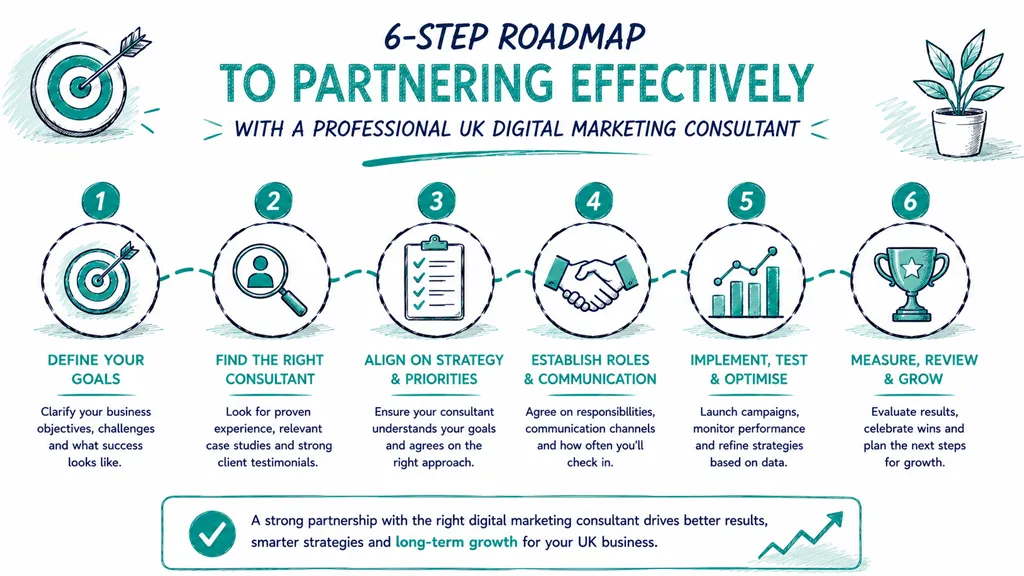
Good KPI setting starts with the commercial outcome and works backwards.
Use three layers:
Business outcomes
Enquiries, sales-qualified leads, revenue contribution, customer acquisition efficiency.
Marketing performance indicators
Conversion rate, cost efficiency, lead quality, landing page performance.
Channel signals
Search query quality, ad engagement, email response, organic visibility for commercial terms.
This structure stops two common problems. The first is vanity reporting, where a supplier hides behind impressions, clicks or rankings with no commercial context. The second is oversimplified reporting, where everything is judged on last-click conversions and you end up cutting activity that was helping demand form earlier in the buying process.
That problem shows up constantly in B2B, professional services, and other longer-consideration sales cycles.
If you want a practical benchmark for setting reporting expectations, this guide on calculating customer acquisition cost is a useful reference.
A decent contract protects budget, time and working relationships. It should be clear enough that a founder, finance lead and marketing manager would all read it the same way.
Make sure it covers:
Also define what is outside scope. That one line prevents the slow drift into extra requests that eat time and blur accountability.
A project works well for diagnosis, audits and short-term planning.
A retainer suits ongoing oversight where performance needs regular review, testing and course correction.
Fractional marketing director support makes sense when the business needs senior judgment across channels, sales coordination, reporting and supplier management, but does not have the workload or budget for a full-time senior hire.
This is often a key decision UK SMEs need to make. An agency may give you more delivery capacity. An in-house hire may give you more day-to-day control. A consultant or fractional lead can be the better financial choice when the main gap is direction, prioritisation and accountability rather than headcount. That model is especially relevant for SMEs that need someone to connect strategy, reporting, sales and external suppliers. It also allows one provider to combine consultancy with practical delivery. For example, Gilkes Media offers consultancy, paid ads management, SEO support and website development, which can be useful when a founder wants one partner to shape direction and coordinate implementation rather than splitting the work across multiple suppliers.
Reporting should help a leadership team make decisions. It should not force them to decode channel jargon.
Ask for a reporting format that answers five questions clearly. What changed? Why did it change? What commercial impact did it have? What is being tested next? What decisions are needed from the business? If a consultant cannot explain performance in those terms, confidence usually drops fast, especially once finance starts asking harder questions.
A strong engagement leaves the business with clearer priorities, tighter accountability and better decisions. If it does not, the issue is usually the structure of the engagement, not the slide design.
If you are close to hiring, slow down for one final check. Are you buying strategic judgment, delivery capacity, or management cover for a gap in the team? Get that answer right before you sign anything.
At Gilkes Media we offer a free consultation to run through your requirements before you make any long lasting decisions. Contact us today for a no obligation review of your digital marketing strategy.
