
Digital marketing for lead generation is the process of using online channels to generate interest in your business. The goal is simple: turn that interest into a pipeline of potential customers, or leads. The process involves attracting the right audience with valuable content and compelling offers, then guiding them methodically towards a sales conversation. The entire system depends on a deep understanding of who your customers are and what they need.
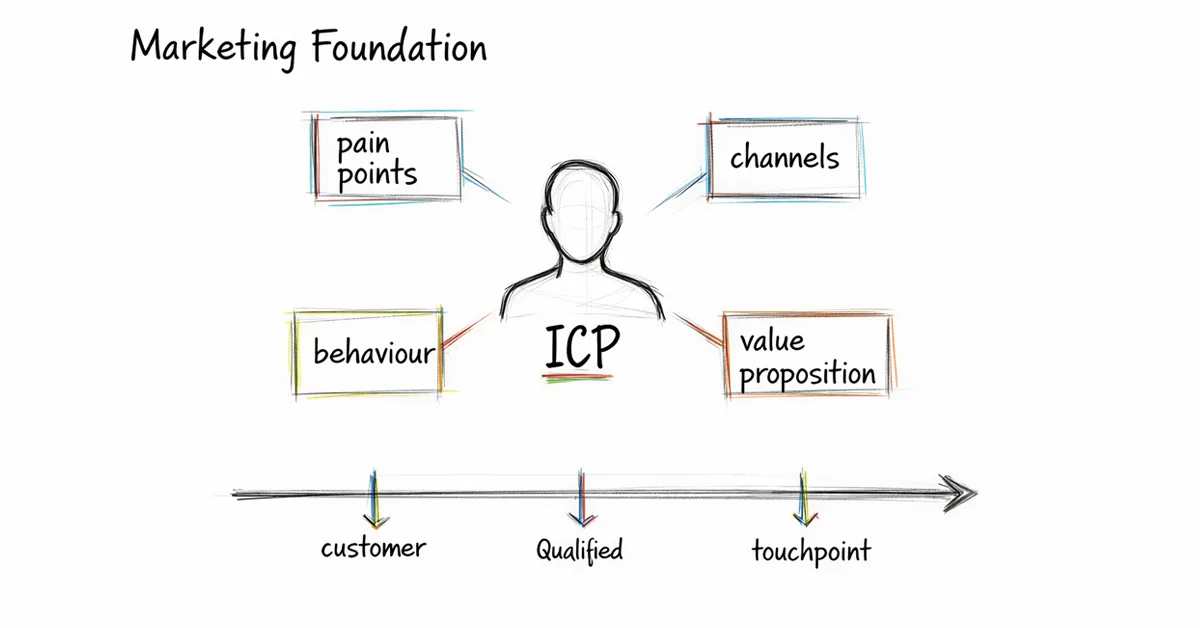
Before spending a single pound on ads, it is essential to establish the correct foundations. This strategic groundwork separates high-performing campaigns from expensive failures. Rushing this stage is a common mistake that always leads to wasted ad spend and poor-quality enquiries that frustrate the sales team. If you'd rather bring in specialist help to build that foundation, our guide to expert lead generation services for UK businesses covers what a good provider offers.
The starting point is always clarity. Without it, you are just guessing. Every decision, from the ad copy you write to the landing page you build, must be informed by a clear picture of the person you are trying to reach.
An Ideal Customer Profile (ICP) is more than basic demographics like age or location. It is a detailed portrait of the specific business or individual that gains the most value from your offer. This is your most profitable and loyal type of customer.
To build a solid ICP, you need to ask commercially-focused questions:
This level of detail makes your messaging connect. It ensures your solution feels not just relevant, but essential for solving their real-world problems.
A well-defined ICP acts as a filter for all your marketing activities. It ensures you attract prospects who are not just interested, but are also a perfect commercial fit for your business, dramatically improving lead quality and sales conversion rates.
Once you know who you are targeting, the next step is to understand how they buy. The customer journey maps the entire process a prospect goes through, from realising they have a problem to choosing a solution. For most B2B businesses, this breaks down into three core stages: awareness, consideration, and decision.
Your job is to identify the crucial touchpoints within this journey. For example, in the awareness stage, a prospect might be searching on Google for "how to improve warehouse efficiency." Later, in the consideration stage, they could be comparing software providers or downloading case studies. By understanding this path, you can place the right message in the right place at the right time.
Your value proposition is a clear, concise statement that explains the tangible results a customer gets from using your product or service. It must answer their most important question: "What is in it for me?"
A strong value proposition is:
This foundational work is the blueprint for every successful campaign. For a deeper look at the core concepts, you can explore our guide on what lead generation is in marketing. As you build this foundation, understanding a practical guide to AI for ads for user acquisition is becoming essential for automating creative production and personalisation at scale.
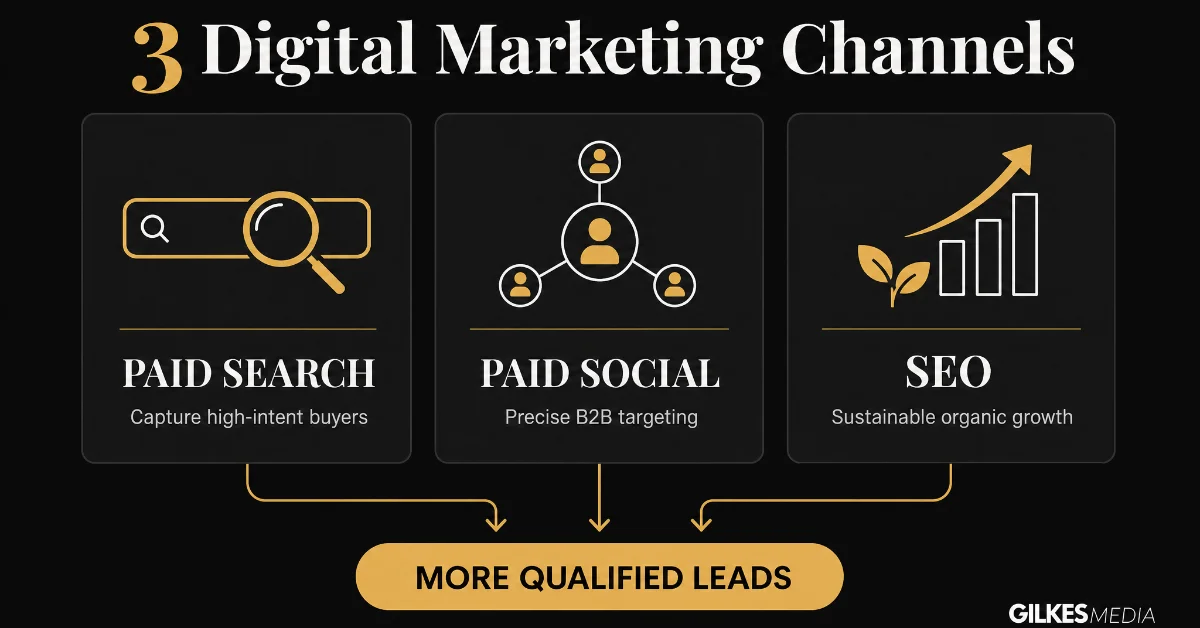
Once your strategy is defined, the next question is where to invest your budget. A common mistake is spreading the budget too thinly across multiple platforms, which often leads to mediocre results. Two channels worth a closer look on their own: our guides to lead magnets for B2B lead generation and lead generation for small business both dig into what actually works in practice.
The key is to be selective. Focus on the channels where your Ideal Customer Profile (ICP) is most active and commercially receptive. This ensures every pound invested has the best chance of turning into a genuine lead.
Different channels have different strengths, and their effectiveness depends on your goals, audience, and sales cycle. A smart digital marketing for lead generation strategy involves a calculated mix of channels that captures immediate demand while building a sustainable pipeline for the future.
Let's examine the main contenders from a commercial perspective.
Paid search, primarily through Google Ads, is the most direct way to generate high-intent leads. You are not creating demand; you are capturing it. This allows you to place your business in front of people at the exact moment they are searching for a solution you provide.
The main advantage of paid search is its speed and control. You can launch a campaign and start receiving traffic and enquiries within hours. It is ideal for businesses that need to generate leads quickly or want to test a new offer in the market without a long wait.
The downside is the cost. You pay for every click, and in competitive B2B sectors, the cost-per-click (CPC) can be high. Success requires diligent campaign management, a highly optimised landing page, and a clear understanding of your key metrics, especially your maximum cost per lead.
Platforms like LinkedIn and Meta (Facebook/Instagram) are excellent for proactive targeting. Instead of waiting for a search, you can push your message directly into the feeds of a specific audience.
For B2B lead generation, LinkedIn is particularly effective. If your ICP is "Finance Directors at UK-based manufacturing firms with 100-500 employees," you can build that exact audience and serve them tailored ads. This precision is its core commercial advantage.
The challenge is that you are interrupting someone's day. Your creative and offer must be compelling enough to stop them scrolling and persuade them to click. The intent is naturally lower than with paid search, so you should be prepared for a potentially longer sales cycle.
Search Engine Optimisation (SEO) is a long-term strategic investment. Unlike paid channels where traffic stops when you stop paying, SEO builds a lasting business asset. By creating valuable content and ensuring your website is technically sound, you earn visibility in organic search results.
This approach delivers a consistent stream of highly qualified, "free" traffic over time. Prospects who find you organically often have a higher level of trust because you have earned your position through authority, not ad spend. A strong SEO presence reduces your dependency on paid ads, significantly lowering your blended customer acquisition cost in the long run.
The trade-off is time. SEO does not deliver results overnight. It typically takes 6-12 months of consistent effort to see a real commercial impact. It demands patience and an investment in quality content and technical expertise. If you are looking to get started, our list of the best free SEO tools available is a great resource.
A balanced strategy often uses paid channels for immediate lead flow while simultaneously investing in SEO to build a sustainable, long-term pipeline. This dual approach provides short-term cash flow and long-term business resilience.
To help you decide, here is a breakdown of how the primary channels compare for UK businesses focused on lead generation. This table focuses on the key performance factors.
| Channel | Best For | Primary Strength | Consideration |
|---|---|---|---|
| Paid Search | Capturing immediate, high-intent demand. | Speed & Control: Generates leads within hours. | Cost: Can be expensive. Performance stops when payment stops. |
| Paid Social | Proactive B2B targeting of niche audiences. | Precision Targeting: Target by job title, industry, and company. | Lower Intent: You are interrupting users. Creative must be strong. |
| SEO | Building a long-term, sustainable pipeline. | Asset Building: Creates a durable source of "free" traffic. | Time: Results are not immediate, often taking 6-12 months. |
| Email Marketing | Nurturing existing leads and driving repeat business. | High ROI: Directly communicates with a warm audience. | List Dependent: Effectiveness relies on the quality of your list. |
Ultimately, choosing the right channel mix is not about picking one over another. It is about understanding how they can work together to achieve your business goals, creating a system where the whole is greater than the sum of its parts.
While organic channels like SEO and content marketing build long-term value, paid advertising is your accelerator. It delivers speed, control, and scalability, allowing you to generate a flow of high-intent leads almost overnight. For a full breakdown of one of the most effective channels here, our guide to Google Ads for lead generation covers it in detail.
Think of it as hiring a dedicated salesperson who can speak to thousands of your ideal customers simultaneously.
The real power of paid advertising lies in its precision. Instead of waiting for prospects to find you, you go directly to them, placing a compelling message in front of a hand-picked audience. This direct approach makes it a cornerstone of any serious digital marketing and lead generation strategy.
As specialists who have managed over £3,000,000 in ad spend, we have seen firsthand how a well-executed paid strategy can transform a business. It is not about boosting posts; it is about engineering a predictable system for acquiring customers profitably.
Not all paid platforms are created equal. Your choice should depend entirely on where your customers spend their time and their mindset while there. For most B2B and high-value B2C businesses, three platforms dominate the conversation.
The key is to match the platform's strength to your business goal. You do not just "do ads"; you select the right tool for the job.
Running paid ads effectively is a science. It revolves around a constant cycle of testing, measuring, and optimising. Success is not found in a single "perfect" campaign but in the relentless pursuit of small, incremental improvements.
Paid advertising is a game of data, not guesswork. Every click, conversion, and pound spent provides feedback. The goal is to listen to that feedback and act on it decisively to improve performance and drive down your acquisition costs.
To see how this works in practice, consider one of our technology clients. They needed to generate high-quality leads for their enterprise software. A generic Google Ads campaign would have wasted money, attracting low-quality traffic from the wrong audience.
Our approach was surgical:
The result? The campaign generated a pipeline of highly qualified leads who were already educated on the problem our client solved. The ad spend was directly tied to demos booked and, ultimately, new revenue.
This is what performance-driven advertising looks like. It is a strategic process, not a lottery. If you are interested in the numbers behind such campaigns, you might find it useful to learn more about what Cost Per Acquisition is and how to calculate it. This metric is fundamental to measuring the real financial success of your paid advertising efforts.
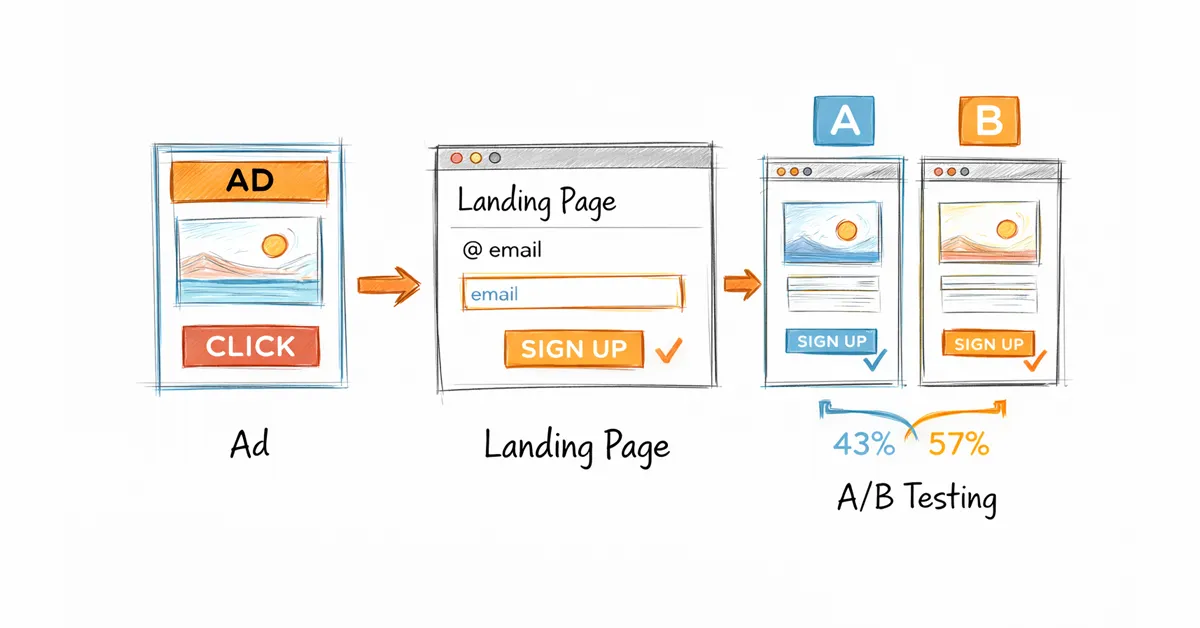
This is where your strategy becomes real-world assets designed to persuade and convert. The details are important, and small adjustments can have a significant commercial impact. For a sector-specific example of this in practice, our guide to lead generation for construction firms shows how these principles play out in a hands-on trade.
Execution is crucial. A brilliant strategy on paper will fail if your ad copy does not connect or your landing page is difficult to use. After managing over £3,000,000 in ad spend, I can confirm that consistent results come from a disciplined, methodical approach to campaign structure and creative.
Your ad is often the first interaction a prospect has with your brand. Its one job is to earn a click from the right person. Focus on being clear and resonant, not just clever.
Effective ad copy should always:
Your creative, such as images or videos, must support this message. It needs to grab attention in a busy feed and visually communicate the value you offer. Generic stock photos are ineffective; custom graphics, short video testimonials, or simple animations almost always perform better.
Once someone clicks your ad, the landing page takes over. This is arguably the most critical junction in the lead generation process. Its sole purpose is to convert that visitor into a lead.
A landing page is not your homepage. It should be a focused, distraction-free environment built for a single offer.
A high-performing landing page will always have these core elements:
Getting these elements right is fundamental. For a deeper dive, our guide explains in detail how to improve your website conversion rate.
Your landing page is your digital salesperson. It must be persuasive, trustworthy, and incredibly easy to navigate. Any friction or confusion will cause potential leads to abandon the process.
Launching a campaign is not the finish line. The most successful campaigns are built on continuous, data-driven improvement. This is where A/B testing, or split testing, becomes invaluable.
The concept is simple: create two versions of a single element (like an ad headline or a landing page button), show them to different segments of your audience, and see which one performs better. This systematic approach eliminates guesswork and allows for compounding improvements over time.
You should methodically test key variables to improve campaign performance.
| Element to Test | Why It Matters | Example A/B Test |
|---|---|---|
| Ad Headline | This has the biggest impact on click-through rates. | "Reduce Your Costs by 30%" vs. "The #1 Software for Finance Teams" |
| Landing Page CTA | The button's design directly influences conversions. | "Start Your Free Trial" (Green) vs. "Get Started Now" (Orange) |
| Form Fields | Form length is a major friction point for leads. | Name and Email vs. Name, Email, Phone, and Company Size |
| Ad Imagery | Visuals capture attention and convey your message. | Software screenshot vs. a photo of a happy customer. |
By isolating one variable at a time, you can accurately measure its impact on key metrics like cost per lead. This iterative cycle of testing, learning, and optimising turns an average campaign into a predictable and scalable lead generation machine.
Launching a campaign is just the start. The real work in digital marketing begins once the data starts coming in. Once leads are coming in, how you score and prioritise them matters just as much as how you generate them - our guide to lead scoring for UK businesses covers how to build a model that actually works.
Success comes from rigorous tracking and a constant drive to improve results. Many businesses invest in campaigns without truly understanding what is working. That is the fastest way to burn through a budget with nothing to show for it.
We need to focus only on the metrics that have a direct commercial impact. Vanity metrics like impressions or page views do not tell you if you are actually making money. The goal is to build a clear, data-driven feedback loop that connects marketing spend directly to revenue.
To move beyond guesswork, you must track a handful of critical numbers. These metrics reveal your campaign’s health and its contribution to the bottom line.
Your primary focus should be on:
Knowing these numbers is not optional. They provide the clarity needed to make smart decisions about budget allocation and campaign scaling.
The most powerful setup connects your marketing platforms (like Google Ads or LinkedIn) directly with your Customer Relationship Management (CRM) system. This creates a closed-loop reporting system.
It allows you to see exactly which keywords, ads, and audiences are generating leads that turn into actual revenue.
Imagine running two campaigns. Campaign A has a CPL of £40, while Campaign B has a CPL of £70. On the surface, Campaign A appears to be the winner.
However, after connecting your CRM data, you discover that leads from Campaign B are twice as likely to become high-value customers. Suddenly, the “more expensive” campaign is revealed to be more profitable. This insight turns your marketing from a cost centre into a predictable growth engine.
A closed-loop system provides the ultimate commercial clarity. It moves the conversation from "How many leads did we get?" to "How much revenue did our marketing generate?" which is the only question that truly matters.
Data is only useful if you act on it. Optimisation is a continuous cycle of analysing performance, forming a hypothesis for improvement, and testing changes to prove it. This data-driven approach is fundamental to scaling your marketing profitably.
A large part of this is implementing proven conversion optimization best practices. This involves methodically testing elements on your landing pages, such as headlines and calls-to-action, to increase the percentage of visitors who become leads.
Here is a simple decision-making framework based on your core metrics.
| Performance Scenario | Key Metric | Strategic Action |
|---|---|---|
| High CPL, Low Conversion Rate | Cost Per Lead | Review landing page for friction. Test new ad copy. |
| Good CPL, Low Lead Quality | Lead-to-Opportunity Rate | Refine audience targeting. Add negative keywords. |
| Acceptable CPL, Low Volume | Number of Leads | Cautiously increase budget. Expand audience targeting. |
| High CAC, Long Sales Cycle | Customer Acquisition Cost | Improve lead nurturing and sales follow-up. |
This continuous loop of measuring, analysing, and acting is the core of performance marketing. It allows you to systematically improve your return on investment and build a truly scalable lead generation machine.
If you'd rather hand this whole process to an agency, our guide to finding the right lead generation agency in London covers what to look for.
Prospects rarely convert after a single interaction. The idea of someone seeing one ad, clicking, and instantly becoming a customer is a myth.
The modern customer journey is fragmented across different devices and platforms. A smart digital marketing for lead generation strategy embraces this reality by building an integrated, multi-touchpoint system.
Treating channels like Google Ads, LinkedIn, and email as separate silos is a strategic mistake. Their real power is realised when they work together, creating a smooth path for potential customers. Each channel has a different role, but they should all work towards the same goal.
This integrated approach ensures your brand remains visible and relevant at every stage. For example, you could start with a highly targeted LinkedIn campaign to introduce your solution. This first touchpoint builds name recognition.
From there, you can run a remarketing campaign on the Google Display Network, showing display ads to those who engaged with your LinkedIn content. This keeps you top-of-mind. This simple two-step process connects an awareness tactic with a consideration-stage follow-up and is far more effective than either channel working alone.
Not every lead from a paid ad campaign is ready for a sales call. Most are not. This is where email marketing becomes essential, acting as the connective tissue for your strategy.
Once someone provides their email, you can continue the conversation directly. Automated email sequences can:
This nurturing process is vital for converting leads with longer buying cycles. UK businesses using multiple touchpoints often see much higher conversion rates. Combining email with LinkedIn, for example, can produce higher response rates. More details can be found in the lead generation statistics report from SendIq.
A multi-channel strategy is not about being everywhere at once. It is about being in the right places at the right times, with a message that fits where that person is in their journey.
The process flow below simplifies this continuous improvement loop into three core actions: measure, analyse, and optimise.
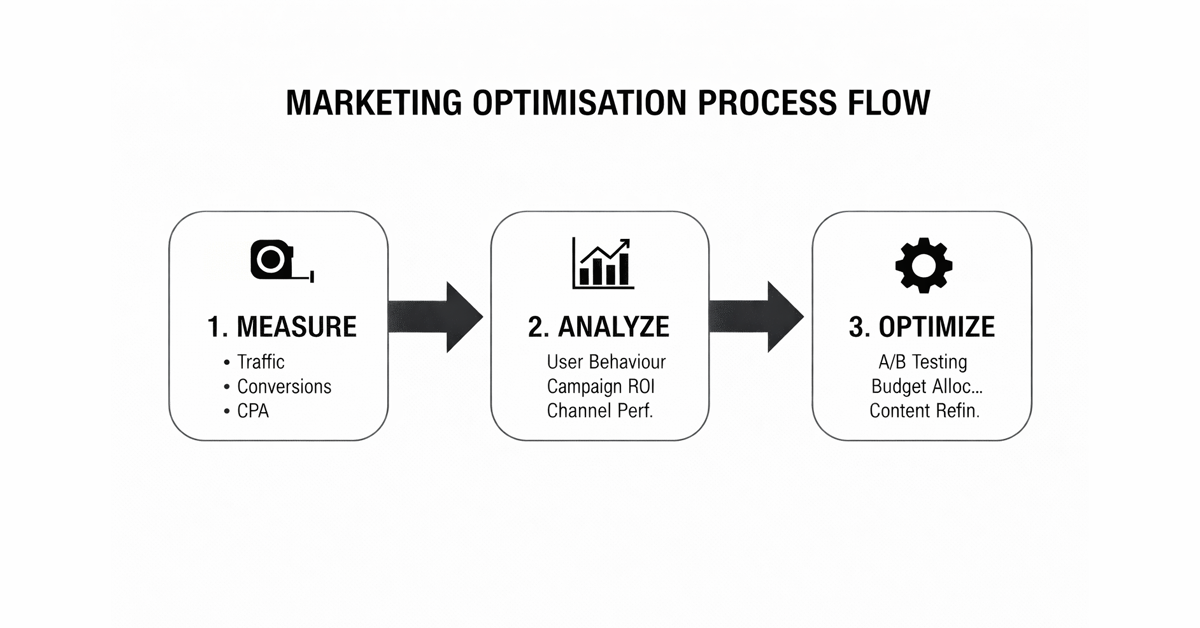
This cycle is the engine of any successful integrated strategy. It ensures that data from every touchpoint feeds back into the system, driving smarter decisions and better results. When you build a cohesive journey across channels, you create a solid lead generation system that consistently delivers higher-quality opportunities.
If content is going to carry a large share of your lead generation workload, it is worth planning it properly rather than bolting it on. Our guide to content marketing for lead generation goes deeper into producing content built to convert, not just attract traffic.
Even with a solid plan, business leaders often have practical questions. This section addresses the most common queries with direct, commercially-focused answers.
This depends entirely on your goals. Instead of choosing an arbitrary number, it is better to work backwards from your revenue targets.
Start by asking these three questions:
Think of your initial budget as an investment in learning. Once you have reliable CPL data, you can build a predictable model: spend X to generate Y leads, which turns into Z revenue. Then you can scale with confidence.
The timeline varies significantly depending on the channel.
A common mistake is judging SEO on a paid ads timeline. They serve different purposes. Paid ads provide immediate lead flow, while SEO builds a sustainable asset that reduces your reliance on ad spend over time.
While you will monitor many metrics, the one that truly matters for lead generation is Customer Acquisition Cost (CAC).
CAC tells you the total cost of winning a new customer.
It is the ultimate measure of your marketing's commercial viability. It combines all your marketing and sales costs and compares them against the revenue a customer generates. A low Cost Per Lead is meaningless if those leads do not convert.
Focusing on CAC ensures your digital marketing is not just an activity but a genuinely profitable driver of sustainable business growth.
Ready to build a lead generation system that delivers predictable, high-quality leads? Gilkes Media works directly with founders and leadership teams to design and execute marketing strategies that drive real commercial results. Book a free, no-obligation consultation to discuss your growth goals at https://gilkesmedia.co.uk.
If your leads are local, paid search has a format built specifically for that: Google Local Services Ads put you at the very top of results with pay-per-lead pricing rather than pay-per-click, which can work out far more cost-effective for local service businesses.
For more on this topic, browse our full lead generation guides.
